Posts Tagged ‘pencil drawing’
what is a ‘Meniscus Peripheral?’
On the cover of each of my new Urban Mystery novellas is the subtitle ‘A Meniscus Peripheral.’ What is this strange thing? Some new treatment for failing knees? A more accurate way to read your measuring cup?
~
~
No. A ‘Meniscus Peripheral’ connects each of my Urban Mysteries with another series I write, the Meniscus Science Fiction Series. The science fiction series tells the story of Humans who have been kidnapped and taken, against their will, to the planet Meniscus, somewhere out in the Galaxy.
~
The novellas in the Urban Mystery Series (Office Green, City Grotesque, Roundabout, and Hollow Hotel) are written in the same universe as the Meniscus Science Fiction Series.
~


~
In the Meniscus series, the aliens of planet Meniscus, the Dock-winders and Gel-heads, visit Earth seven times (in 1982, 1988, 1995, 2008, 2013, 2020, and 2023), harvesting Humans for transport to their planet and to a life of enslavement.
~
Some of these Humans escape to the wilds of Meniscus, sharing adventures and building new Human communities.
~
Look for titles in the Meniscus Science Series, starting with Meniscus: Crossing the Churn.
~

~
In A Meniscus Peripheral, the world of Meniscus and the associated alien abductions are always mentioned, but not explained. Each of the abducted Humans mentioned in the novella are living on Meniscus, alive and well.
~
For example, in Roundabout, the story begins with a car, deserted in the middle of a traffic circle. The owner of the car is identified as Mary Fitzgerald, a twenty-year-old student of the Community College, studying Information Technology. No one ever sees Mary Fitzgerald again. But…
~
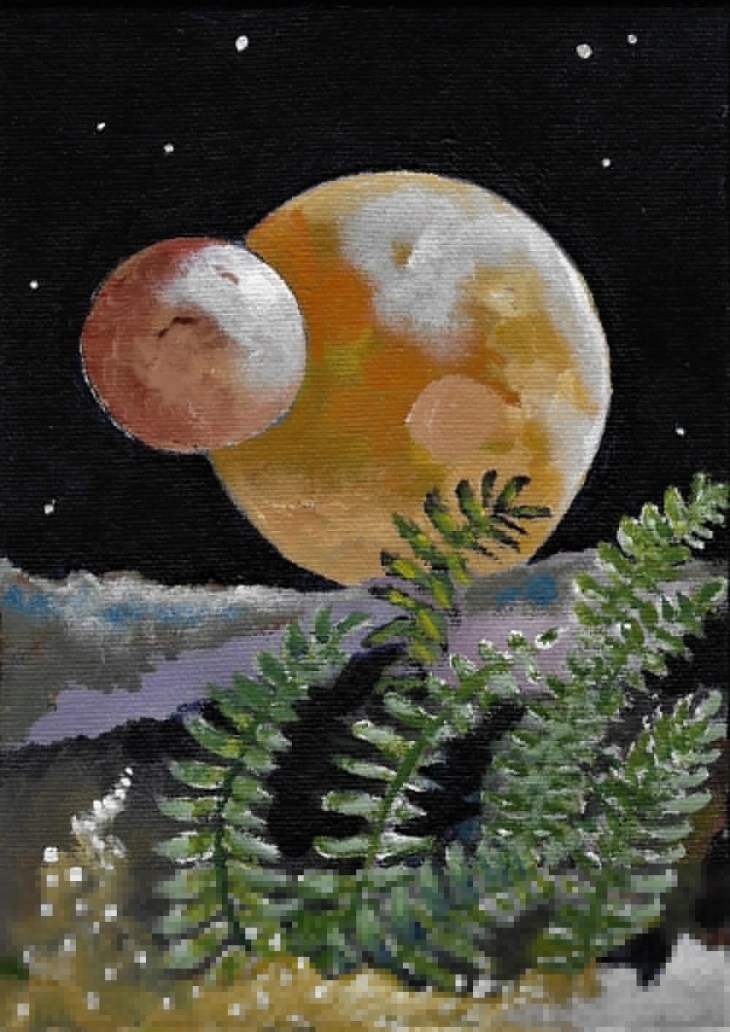
On Meniscus there is a character named Aagle, also known as ‘The Stone.’ She is a formidable member of the Blood-Let resistance movement. She was abducted from Earth in 2020 as she was driving around the Victoria Circle in Fredericton!
~
~
Reading the two series together will reveal more about the backgrounds of some of the characters on planet Meniscus.
~
Both series of my books are available at ‘Dog Eared Books‘ in Oromocto and, soon, at ‘2nd Story‘ in Harvey. Drop in sometime to enjoy browsing through these great local book stores! Reading is so much fun!!!!
~
All my best,
Jane (a.k.a. Alexandra)
Hollow Hotel – a new Urban Mystery
This week is the release of book 4 in my Urban Mystery Series: Hollow Hotel. There are three previous titles in the Series: Office Green, City Grotesque, and Roundabout. These are novellas, each a quick read and packed with adventure and mystery.
~
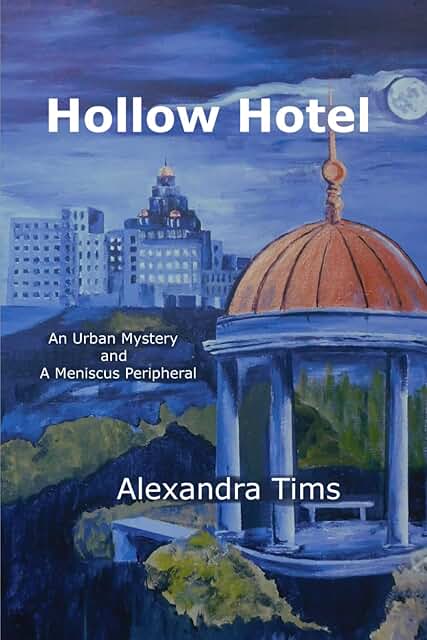
Set in Saint John, New Brunswick, Hollow Hotel features three young climbers who attempt to scale the exterior of the old Saint John Hospital (now demolished). They get into all sorts of trouble: with the climb itself, and with a group of thugs who have taken up residence in the abandoned building. After a brutal fall from the dome of the hospital, one of the climbers must team up with a homeless woman to save her friends.
~
~
The book is available through Amazon Canada, or Dog Eared Books in Oromocto.
~
All my best,
Alexandra Tims
(a.k.a. Jane)
City Grotesque: what is a ‘grotesque?’
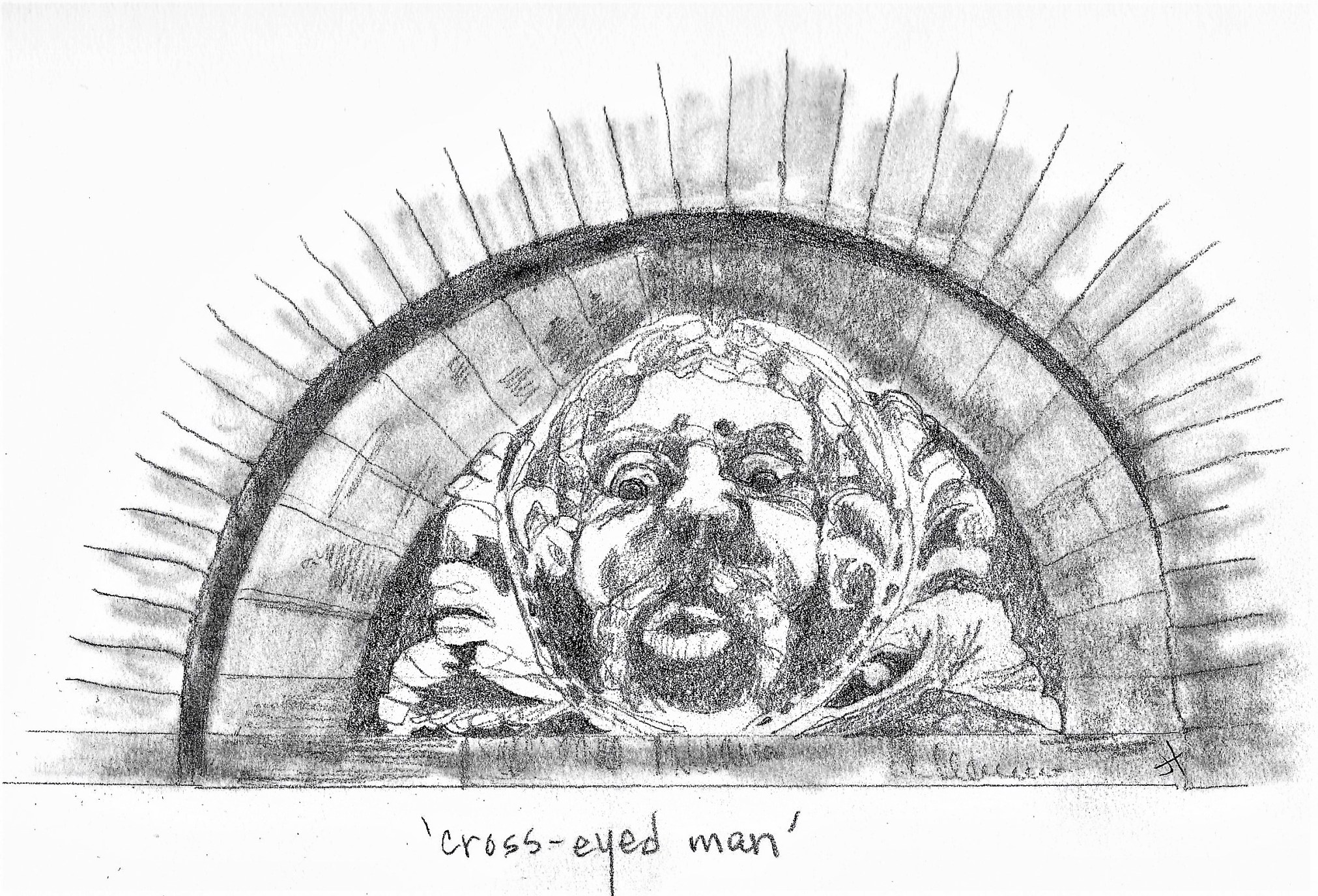
A grotesque is a type of architectural sculpture that represents a fantastical or mythical figure. A gargoyle is a type of grotesque directing and carrying water from a roof or other surface.
~
~
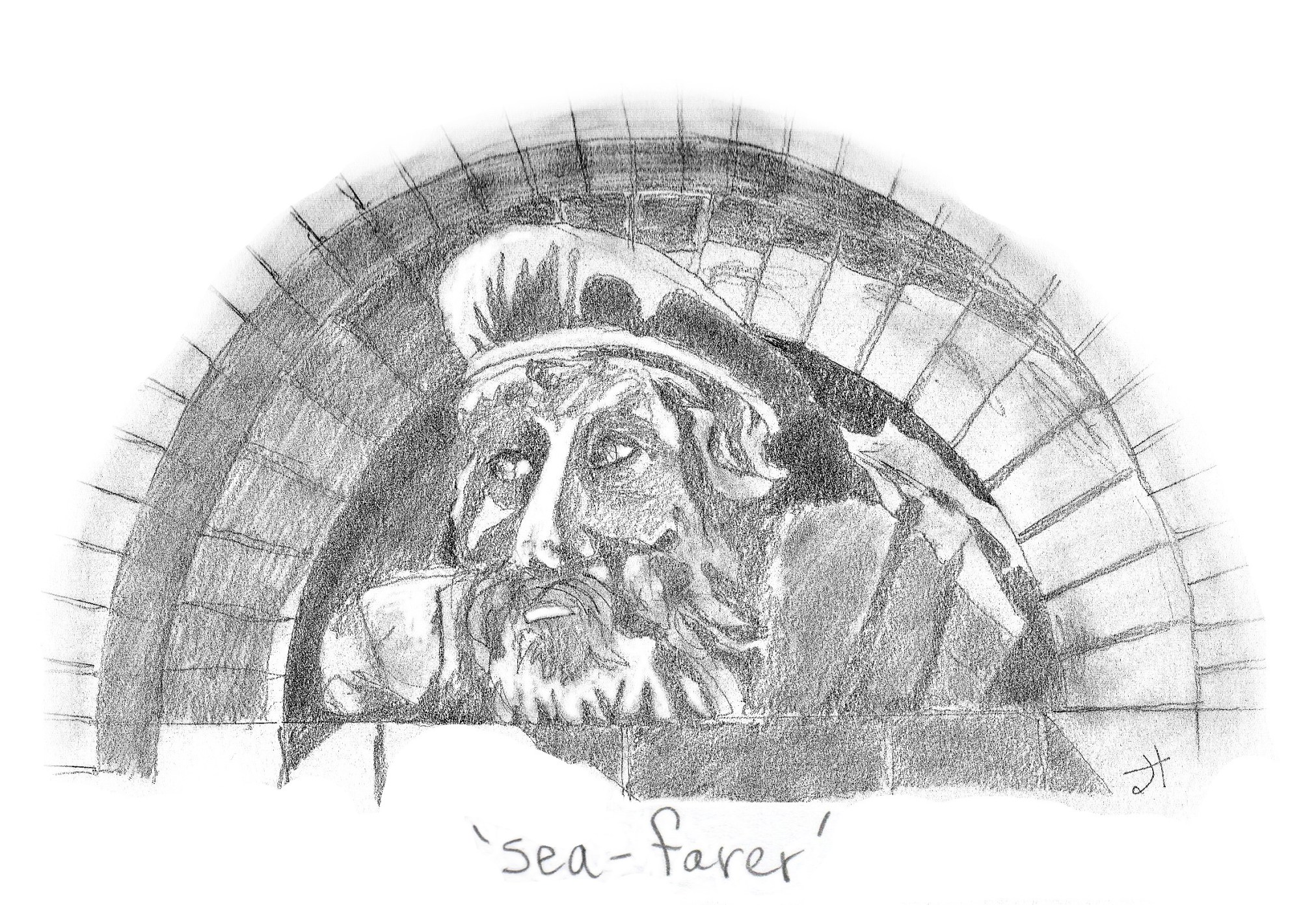
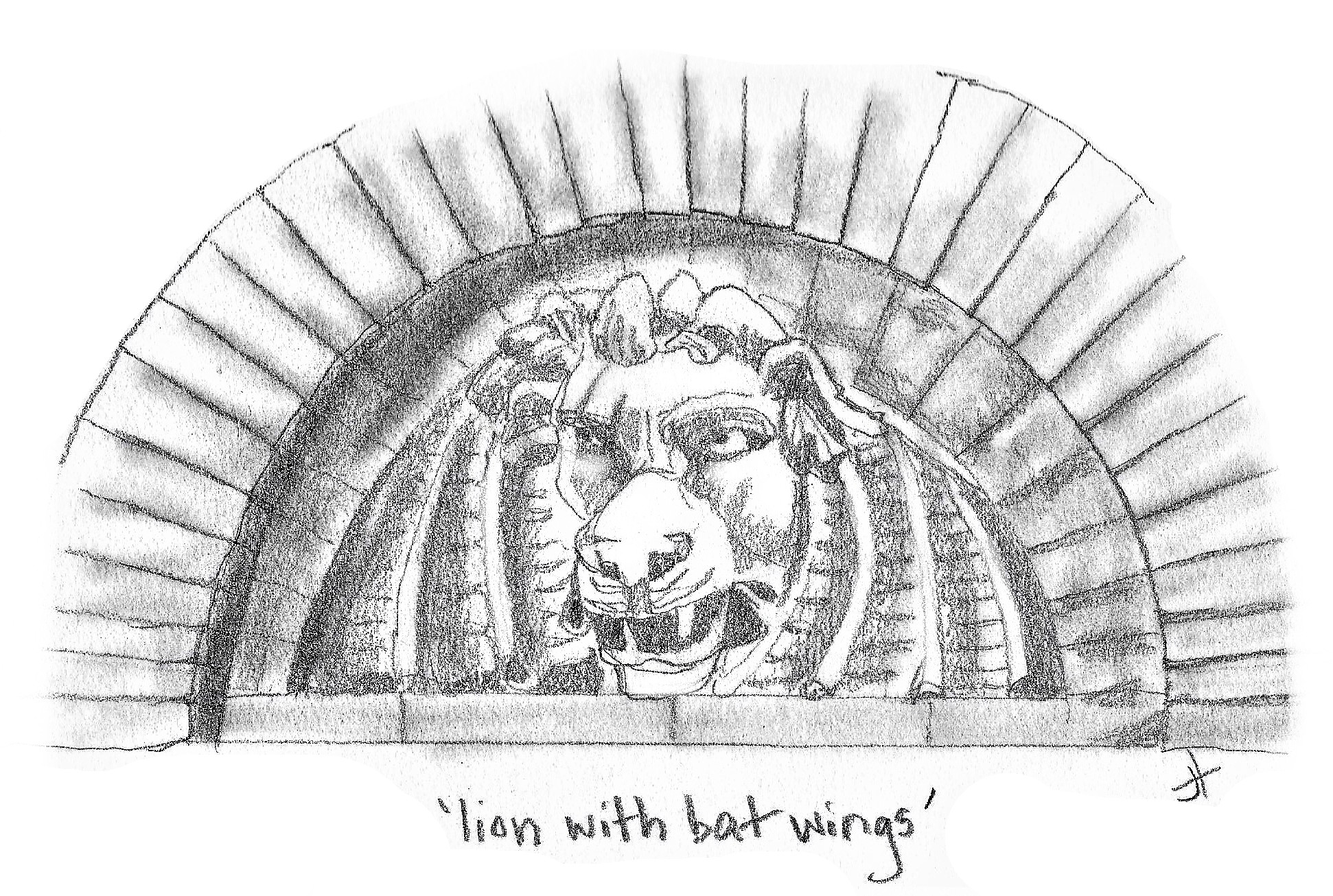
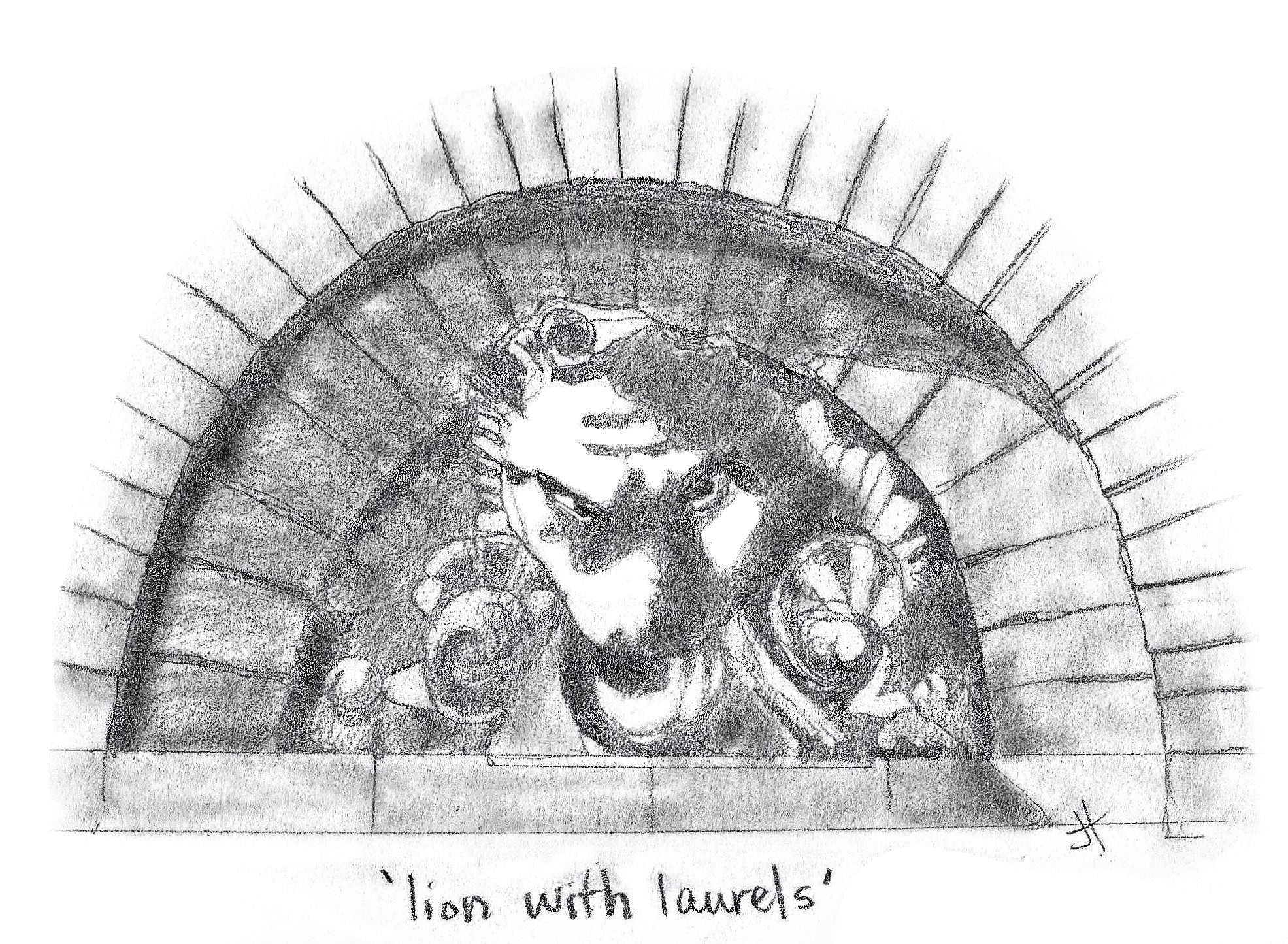
At the Chubb’s Corner Building in Saint John, New Brunswick, there are 16 sculptural grotesques above the third floor windows. Although a couple of them seem to represent actual people who lived in Saint John in 1878 (when the building was constructed), most are strange, unknown figures.
~


~
In my book, ‘City Grotesque,’ a contest is held to find modern look-alikes for the sixteen grotesques. The protagonist, a young artist working in the City, tries to find some of the grotesques with unfortunate consequences.
~
~
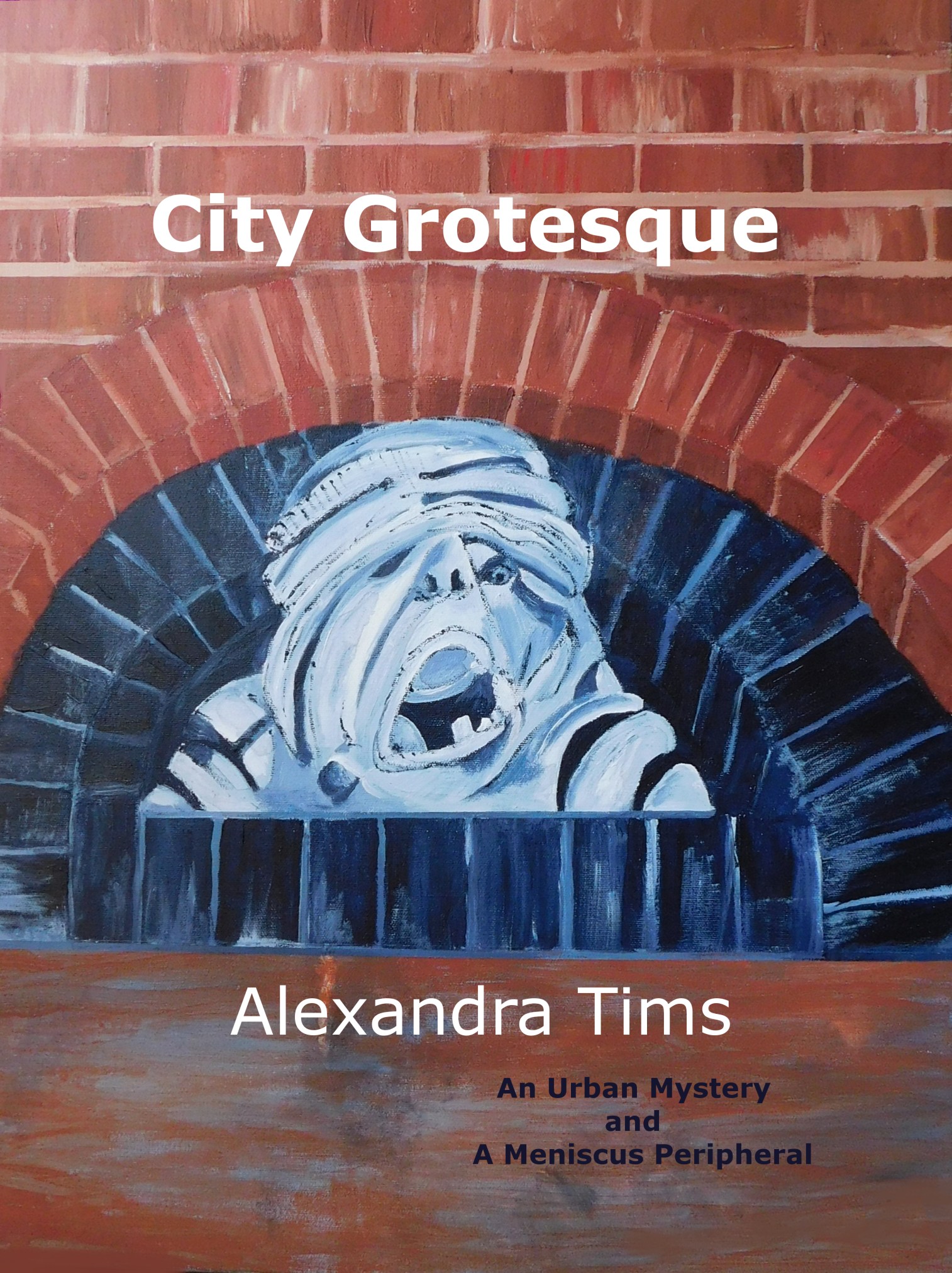
This story is one of three Urban Mysteries I have written. To get a copy of ‘City Grotesque,’ visit Dog Eared Books in Oromocto or order from Amazon.ca by clicking here.
~
~
I hope you enjoy learning more about some of the grotesques in the city of Saint John. For more information on the interesting uptown architecture, click here.
~

~
All my best,
Jane (a.k.a. Alexandra)
Office Green: a new urban mystery
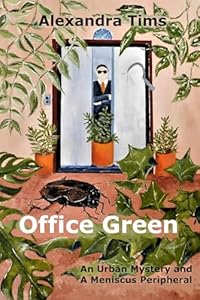
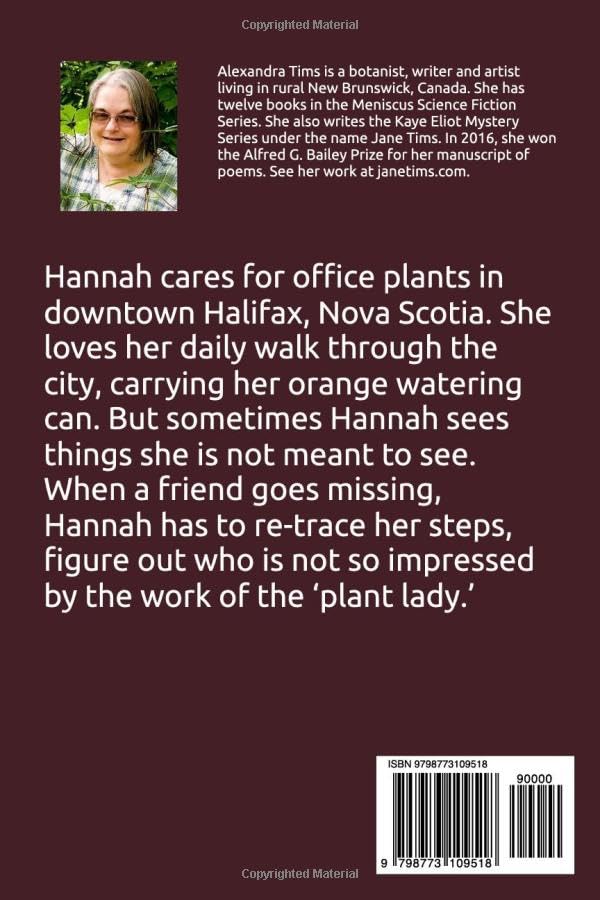
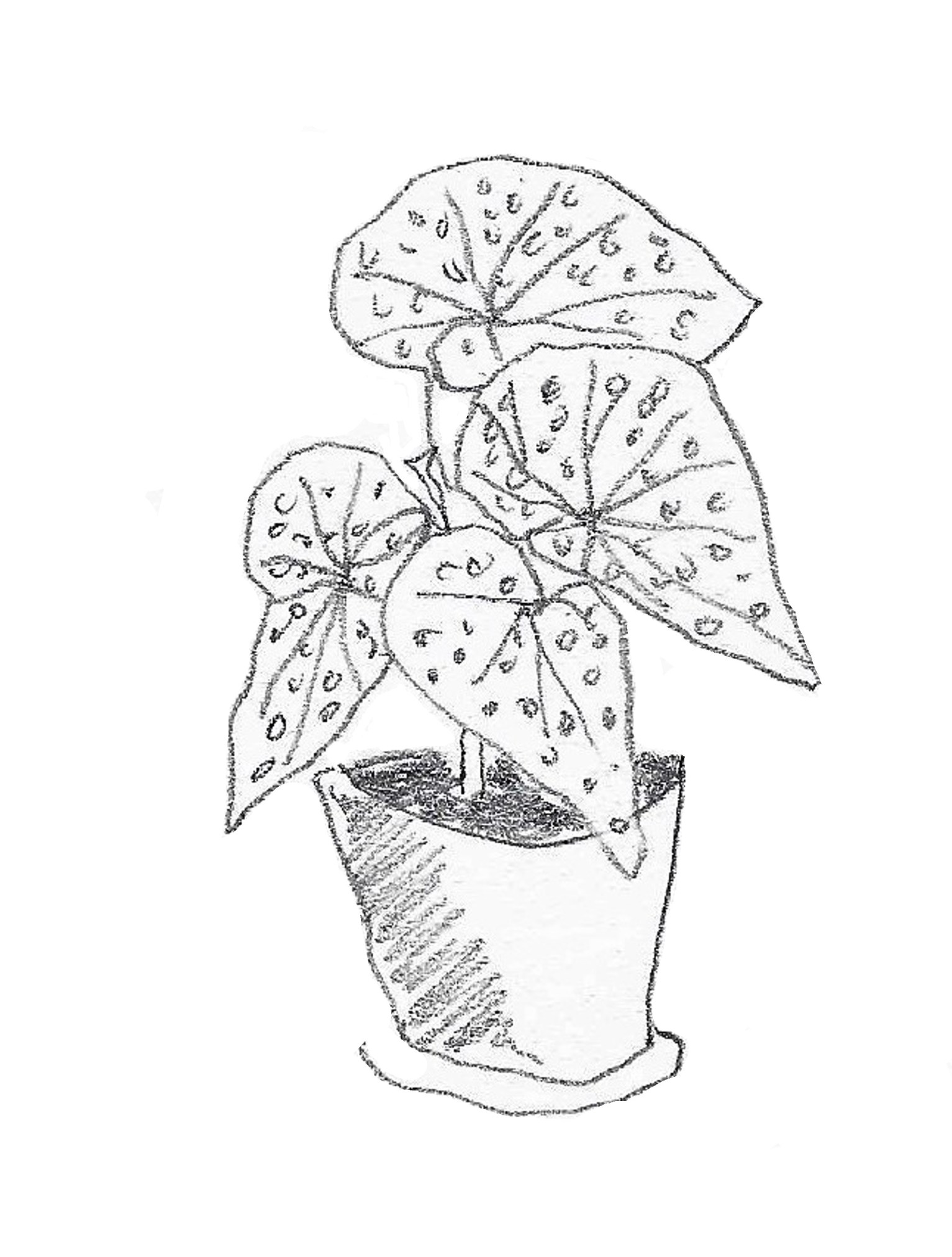
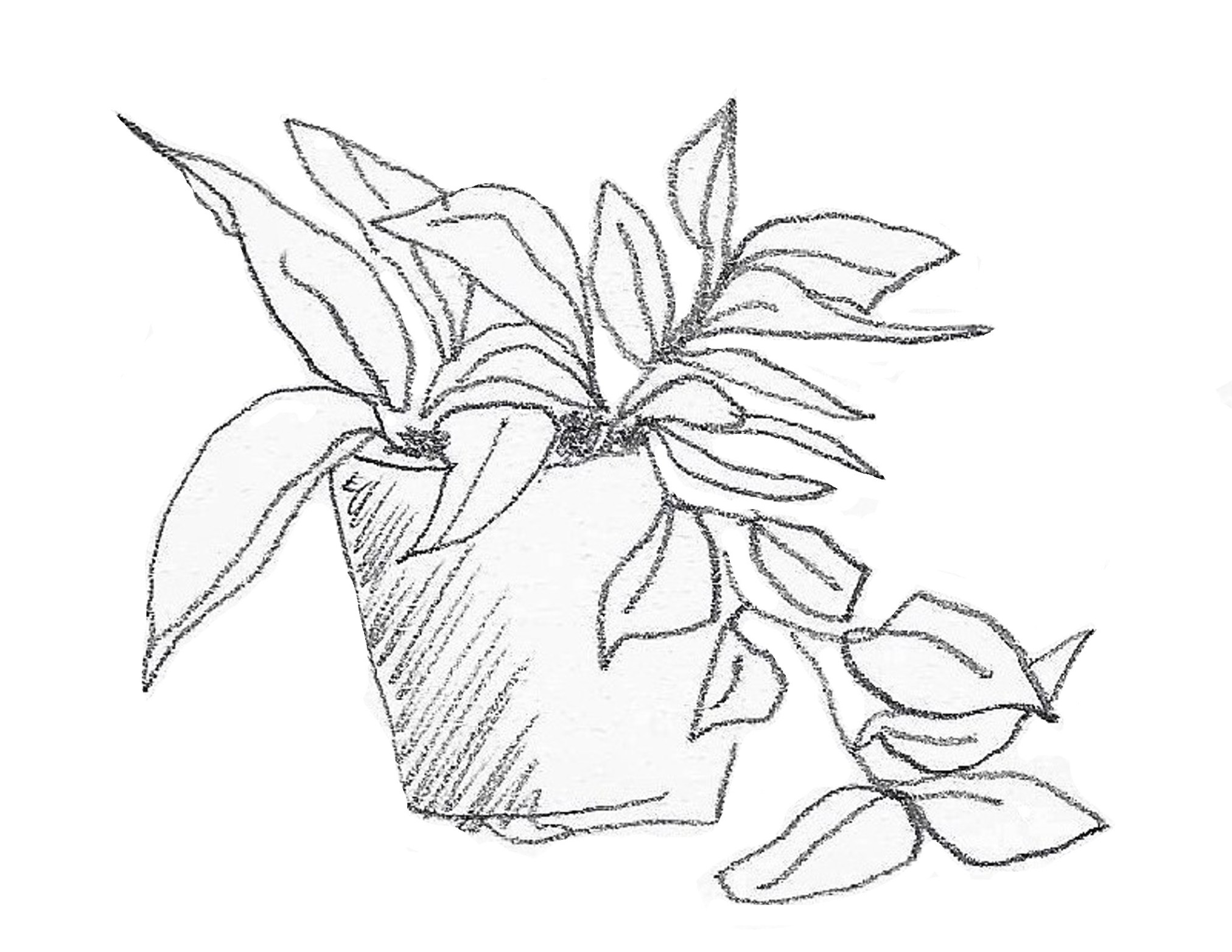
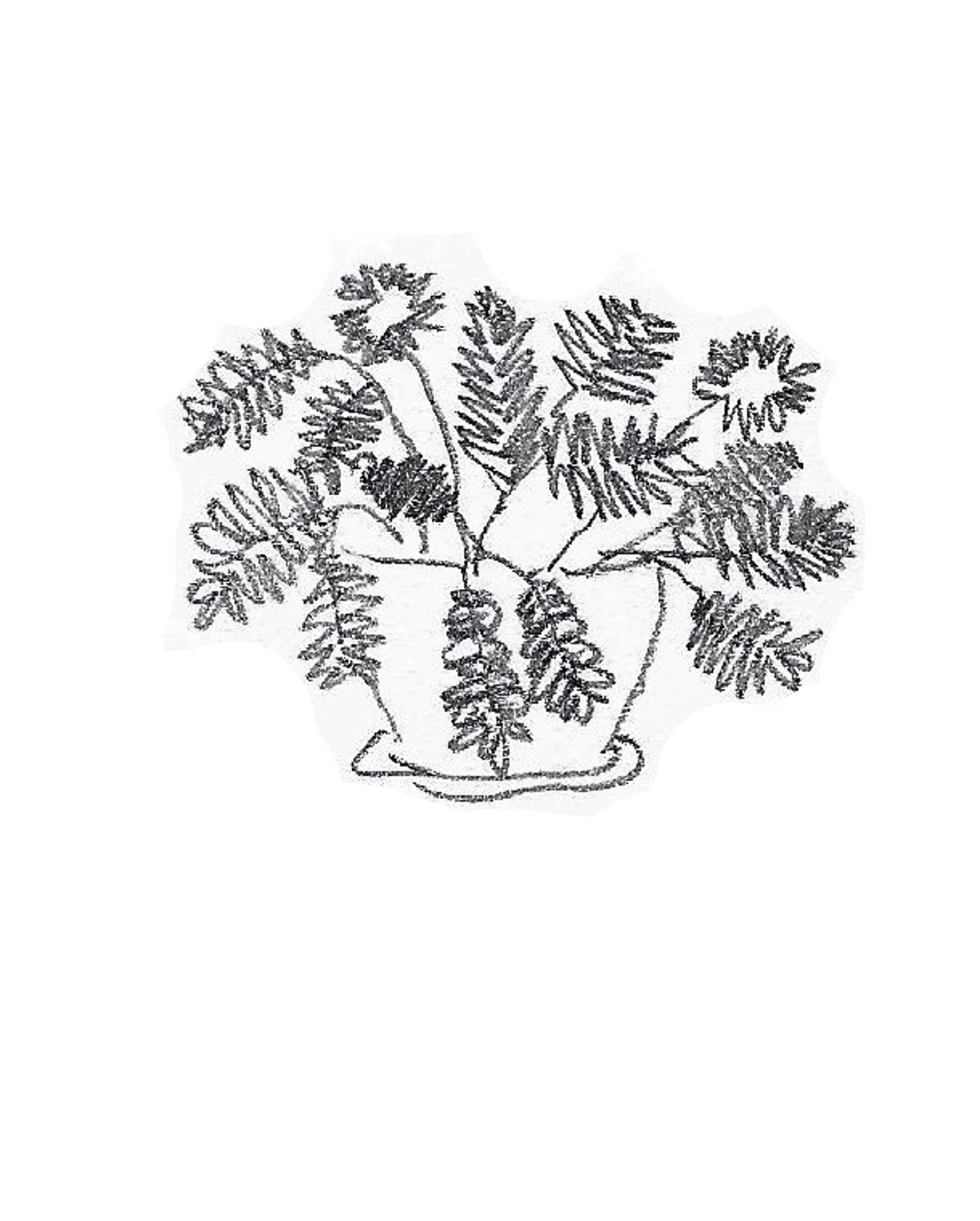
I am so happy to have published the first in my Urban Mystery Series: Office Green. The book tells the story of Hannah and her plant care business. She goes from office to office in the city of Halifax, watering office plants and battling plant diseases, white fly, and nutrition problems. She also sees things she is not meant to see and gets herself into all kinds of trouble.
~

~
So, what’s with the cockroach on the cover??? During her adventures, Hannah keeps a few handy ‘weapons’ within reach in case she gets in trouble. And what better scare-tactic than a huge African cockroach, rescued from the university biology labs. You’ll have to read the book to find out how that cockroach helps her escape from a few bad guys.
~



~
If you like tending to indoor plants, if you love a quick read, and if you like reading about resourceful amateur detectives, you will like Office Green. You can get a copy at Dog Eared Books in Oromocto (Unit #218, 281 Restigouche Road). You can also order a copy from Amazon, just click here.
~
All my best,
Alexandra Tims (a.k.a.Jane)
creating a cover: identifying a motif
As I prepare to release my new Urban Mysteries Series, I still have some work to do. Because I both write and illustrate my books, I also do my own covers. Selecting a motif or theme for a cover takes some thought.
~
~
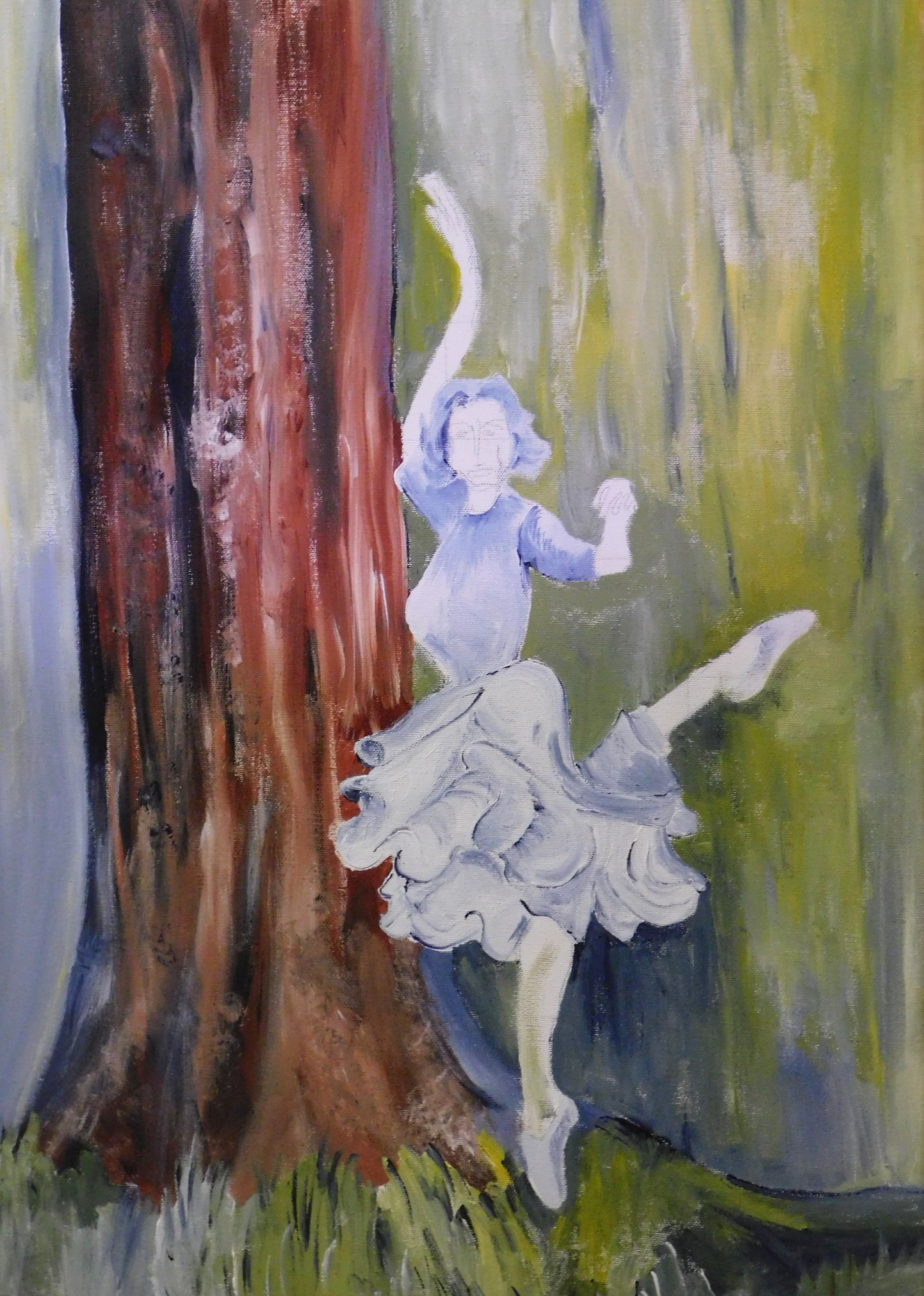
Most of my books focus on a central theme. The fifth book in the Urban Mystery Series (currently titled ‘Dancing with Trees‘) is set in Fredericton and tells the story of an artist who is making an drawn record of the trees in the community. As she draws, she encounters a mysterious woman who appears and dances with some of the trees. The woman is associated with an urban legend of a man and woman who hid a treasure in a local tree and vowed to only retrieve it together.
~
Creating a book cover is a little different from ordinary painting. A cover must:
- represent the themes and symbols in the book;
- entice a reader to know more about the story;
- present a strong focal point;
- leave room for the title, and sub-title and the author’s name;
- consider the style of other books in the series.
~
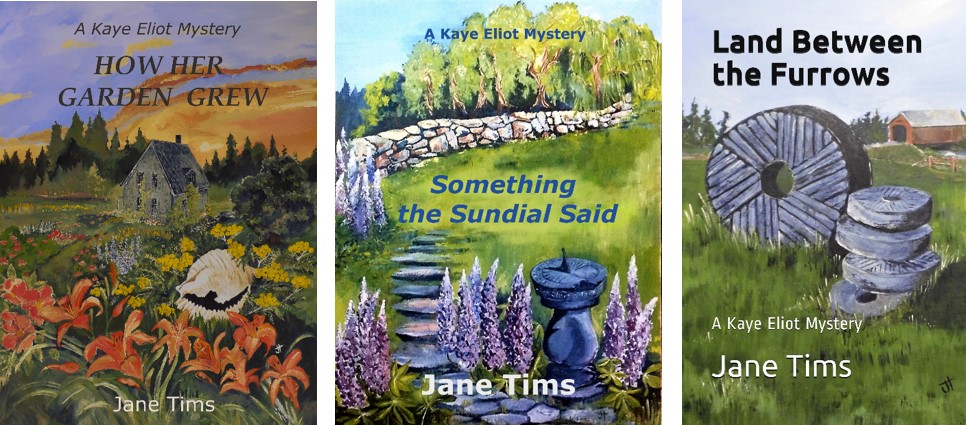
When I chose a theme for the cover of my book, I already have about twenty drawings to illustrate parts of the story. I choose one of the drawings and modify it to represent the story as a whole. The painting can be embellished by including various symbols from the story. In the case of my Kaye Eliot Mystery ‘How Her Garden Grew,’ I include a Grinning Tun, a sea shell that appears in the story, over and over.
~


~
In the Urban Mystery, ‘Dancing with Trees,’ trees and dancers are central motifs. So, for the cover, I chose to paint one of the drawings in the book.
~

~
I work with acrylics and seek to use only a set number of colours in the cover painting. This is partly to allow the font and colour of the lettering to show well on the cover. It also reduces the busy-ness of the image for the reader.
~
~
In a few days, I will be able to reveal the look of the final cover for ‘Dancing with Trees.’
~
All my best,
Jane (a.k.a. Alexandra)
Puzzling Over My Last Name
When I was growing up, I often puzzled over my last name: ‘Spavold.’ No one else in the community where we lived had that name. I made up stories to answer folks who asked me about my surname: we were Polish; we were the only family in the world to ever have that name; we were Italian and the real name was ‘Spavoldini.’
~
My dad was also interested in the orgins of the name, but he took a more studied approach. He found out the name of the first Spavold to arrive in Nova Scotia and wrote a book about the many Spavolds in Nova Scotia who were descendants of that first ‘Spavold’ in Canada: Spavold’s Wald, S.W. Spavold, unpublished, about 1990.
~
The first Spavold in Nova Scotia was a boy of only 8 years, born in England in 1808. He arrived in a shipwreck of the Trafalgar on Briar Island on July 30, 1817. He came to Briar Island with his mother (Eliza Greenfield), his step-father (John Adam Hill) and his half-brother (Thomas Hill, a boy of two). The family survived the shipwreck and stayed in the Digby area of Nova Scotia. For more about this story, see my earlier post at https://janetims.com/2011/12/03/briar-island-rock-2-the-shipwreck/ .
~

~
William’s father, my great, great, great grandfather, was William Spavold, born in Nottinghamshire in England in 1785. In 1807, when he was 22 years old, he married Eliza Greenfield. He was a carpenter and my Dad’s story was that when he died, Eliza sold his carpenter tools to get passage for Canada on the Trafalger with her second husband John Hill.
~
No other information was available to my dad, although he did track down ‘Spavolds’ elsewhere in Canada, in Australia and in England. I talked on the telephone with Helen Spavold who lives in Clowne, Yorkshire, and she said, with a proud lilt in her voice, “There are Spavolds in our graveyard.” My dad, and my brother (who lived in Australia for a time), corresponded with Joseph Spavould, who lived in Australia.
~
Now, with the help of Ancestry.com, I am determined to find out more about William Spavold of Nottinghamshire. The next few posts will talk about my discovery of the occurrence of Spavolds in England in the 15th, 16th, 17th, 18th and 19th centuries. And in the 20th and 21st centuries—I am not alone.
~
All my best,
Jane Tims (a. k. a. Spavold)
nuthatch: bold acrobat
Sometimes I hear a knocking at the door and answer, to find no-one there. Instead, a nuthatch is tapping, banging a sunflower seed against the shingles. Later, he will sound off in the grey woods, ‘yank, yank, yank.’ He is one of my favourite birds: the red-breasted nuthatch, Sitta canadensis.
~

~
This nuthatch is slightly smaller and has a shorter beak than its cousin, the white-crested nuthatch. We have both but the white-breasted species has a faster-repeating ‘song’ to announce its territory.
~

~
The red-breasted nuthatch has a reddish orange breast, a short tail, and sturdy feet and bill. It has a white eyebrow and a black line on either side of its eye. Perhaps its neatest trick is to walk upside down on branches, head downwards.
~

~
In my poetry book, mnemonic: soundscape and bird song, I pay tribute to the red-crested nuthatch in a couple of poems. Here is a stanza from ‘woodland mnemonic’ …
~
nuthatch, bored, pulls
endless rope, yank, yank, yank
hangs upside-down, beats
a seed against the shingles
~
In the book are 53 poems about bird song and other sounds in nature, and 15 illustrations of birds found in New Brunswick. Some poems are merely descriptive, others see bird calls and songs as metaphors for various life events. For a copy, contact Chapel Street Editions here, or Amazon.ca here.
~
“An orchestra of other surrounding sounds prompt the author’s poetic rendering, revealing a world chock-full of interesting information for those alert to its resonance. mnemonic offers a doorway in which to first stand, and then engage a journey from poem to poem into the author’s immersive experience of the great world’s soundscapes and birdsong.”
– publisher’s comments on the book
~
Enjoy your day and take a little time to watch our neighbours, the birds, and listen to their songs.
All my best
Jane
three robin’s nests
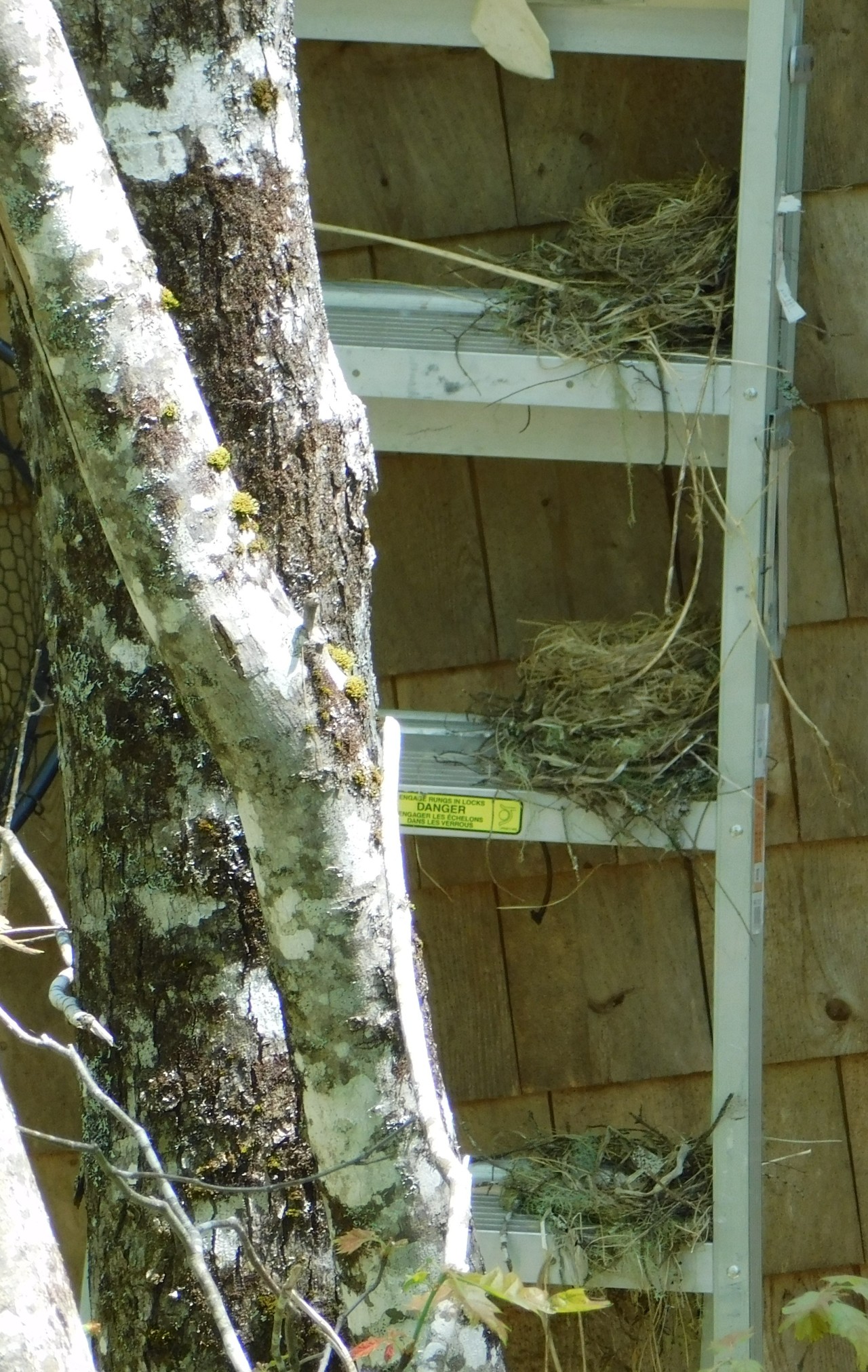
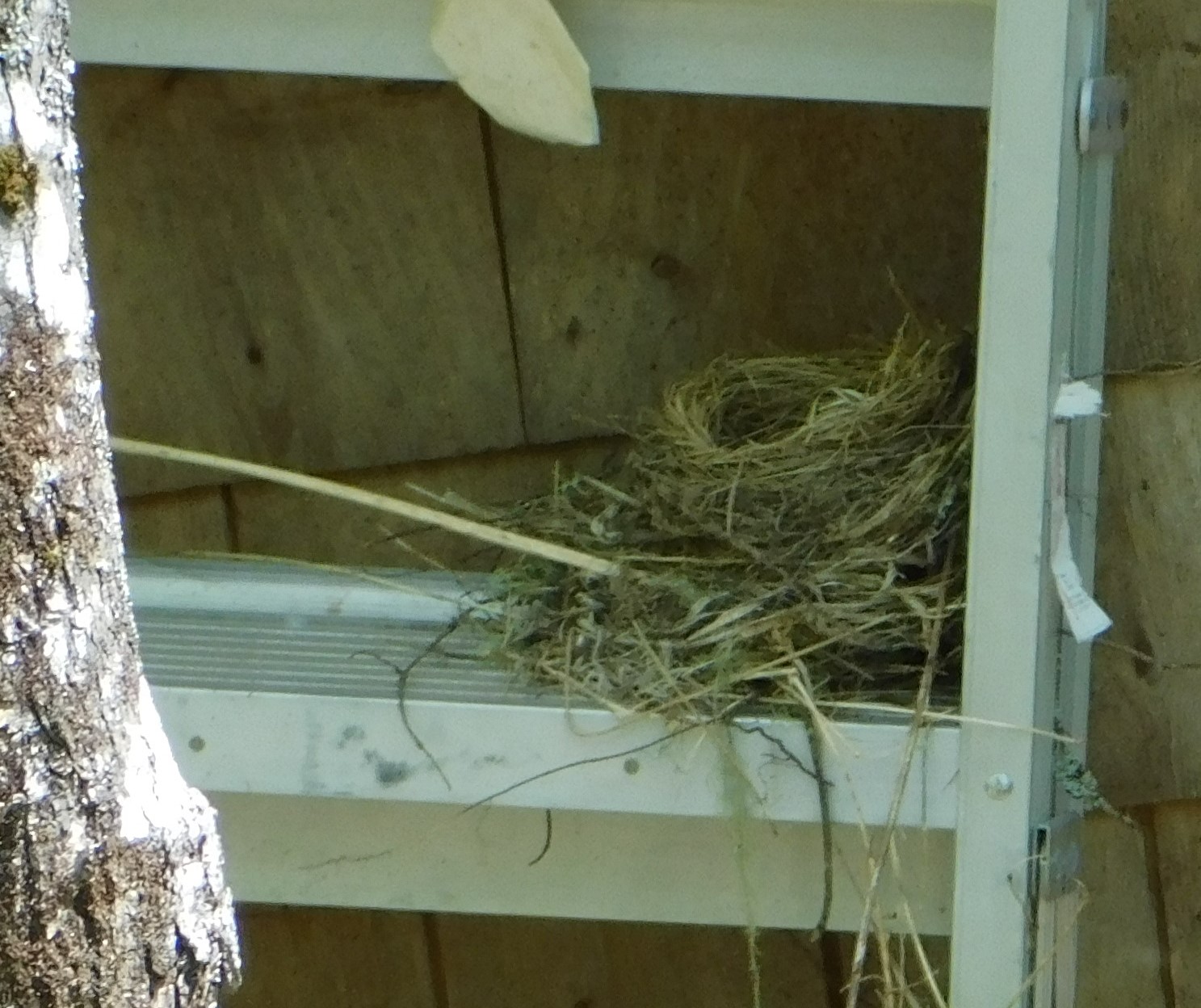
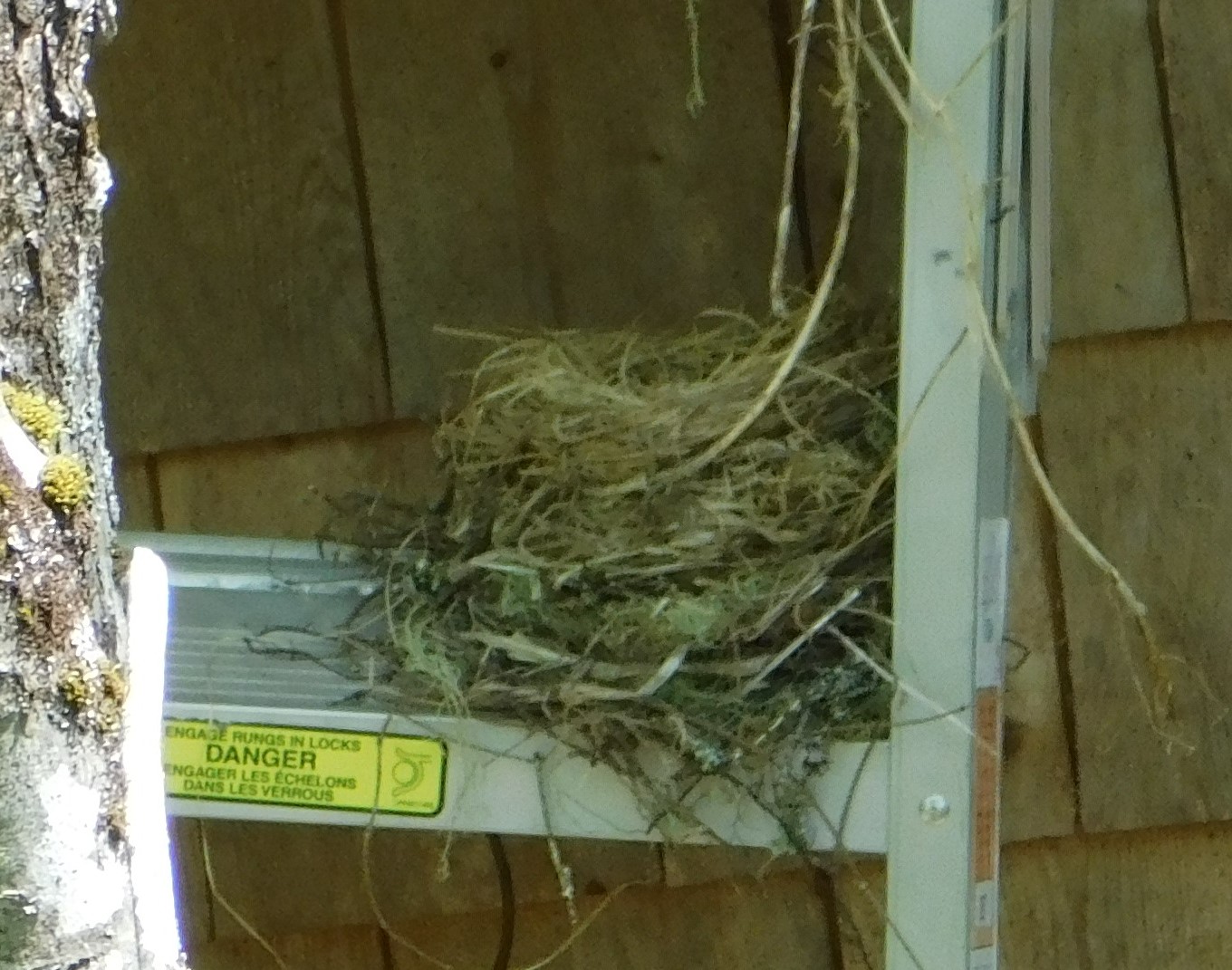
A robin has built three nests on the ladder leaning against our garage! The top two are well-formed and intact. The lower nest looks disarranged, as though construction was abandoned or a predator has pulled it apart.
~
~
Bird nests are built during a period of a few days using grasses and twigs, mud for a lining. They are used for incubation of eggs and brooding of young. Adult robins don’t use the nest as a bed, but roost on a tree branch. For a great description of how the nest is built, see allabout birds.org.
~
~
We have watched the nests on the ladder, but there is no sign of eggs or baby birds. Every day, we hear the robin singing nearby, ‘cheery, cheer-up, cheer-up, cheeree.’ I hear the robin singing as I type!
~
~
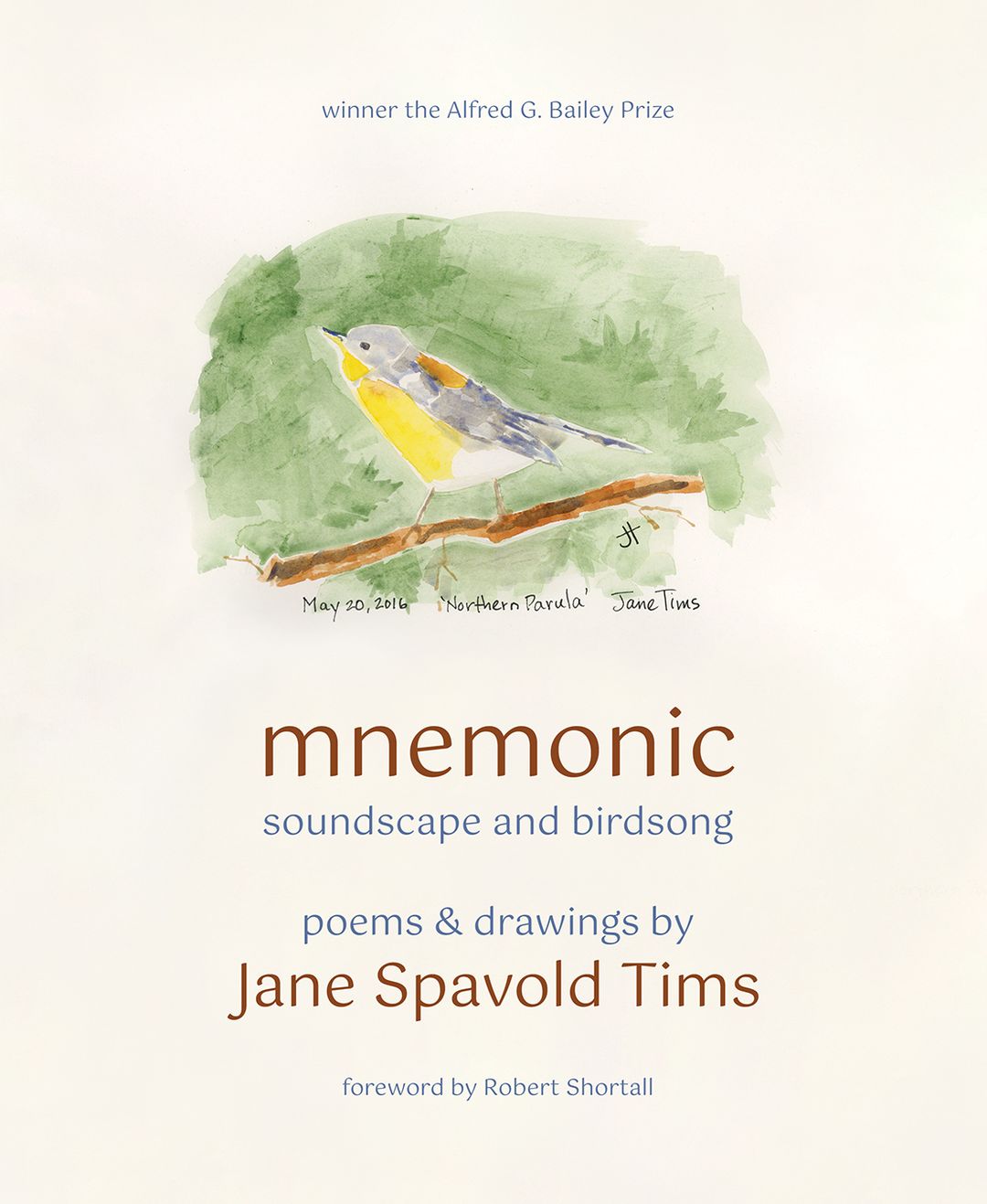
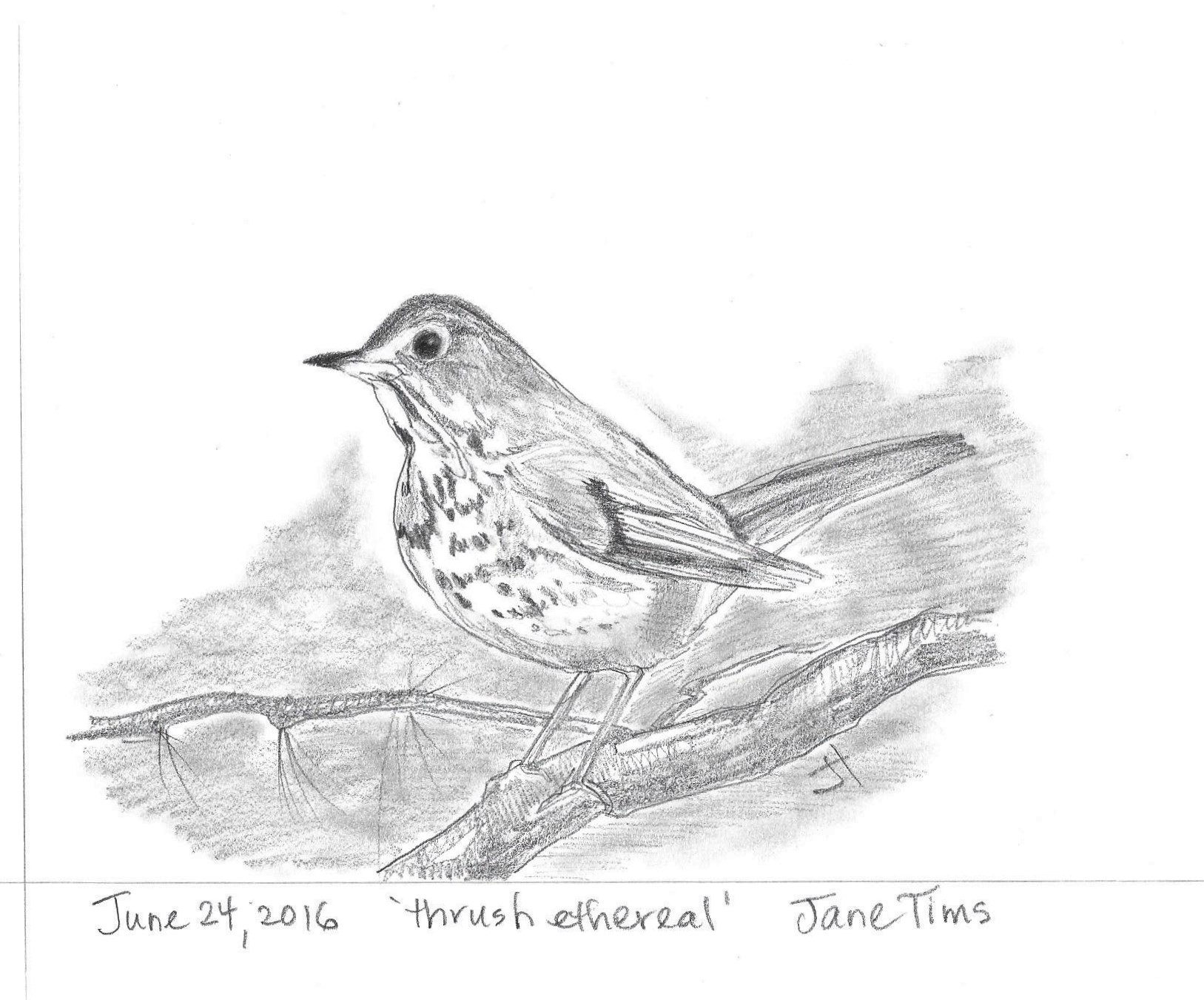
If you love birds and enjoy watching them through the seasons, you might like my new poetry book: ‘mnemonic: soundscape and birdsong.’ The book includes 53 poems about birdsong, bird behaviour, my experiences with birds, birdsong as a life metaphor, and celebration of other sounds in nature. I have also included 15 of my black and white drawings of birds. To get your copy of the book, click here to go to Chapel Street Edition’s (the publisher’s) website. If you would like to purchase the book on Amazon, click here. You can also find my book in several New Brunswick bookstores, including Westminster Bookmark in Fredericton and Dog Eared Books in Oromocto.
~
~
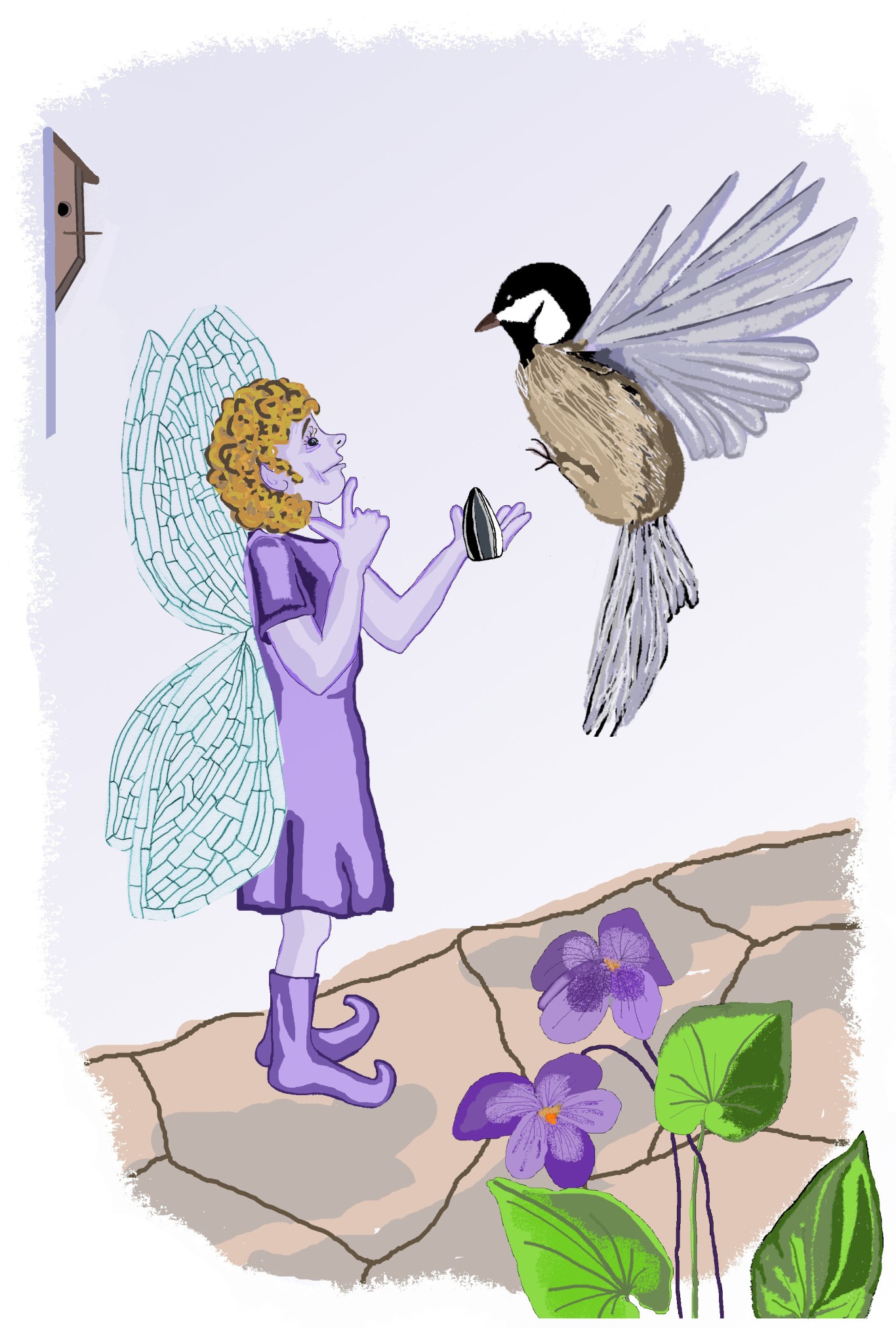
I want to write a story about the robin building nests in our ladder. I have decided to write a third book in my children’s books about ‘Wink.’ The first of these is ‘Wink in the Rain’ (available here), a story about a garden elf and his adventures in finding the perfect umbrella. The second book, ‘Wink and the Missing Sidewalk Chalk,’ a story of the hunt for a thief in the garden, will be published later this year. The story about ‘Wink and the Garden Ladder’ is written and I will soon be doing its illustrations.
~
~
Will our robin use the nests on the ladders to raise a family? I will keep you up to date.
~
All my best!
Jane
Cover Painting for ‘Meniscus: Reckoning’
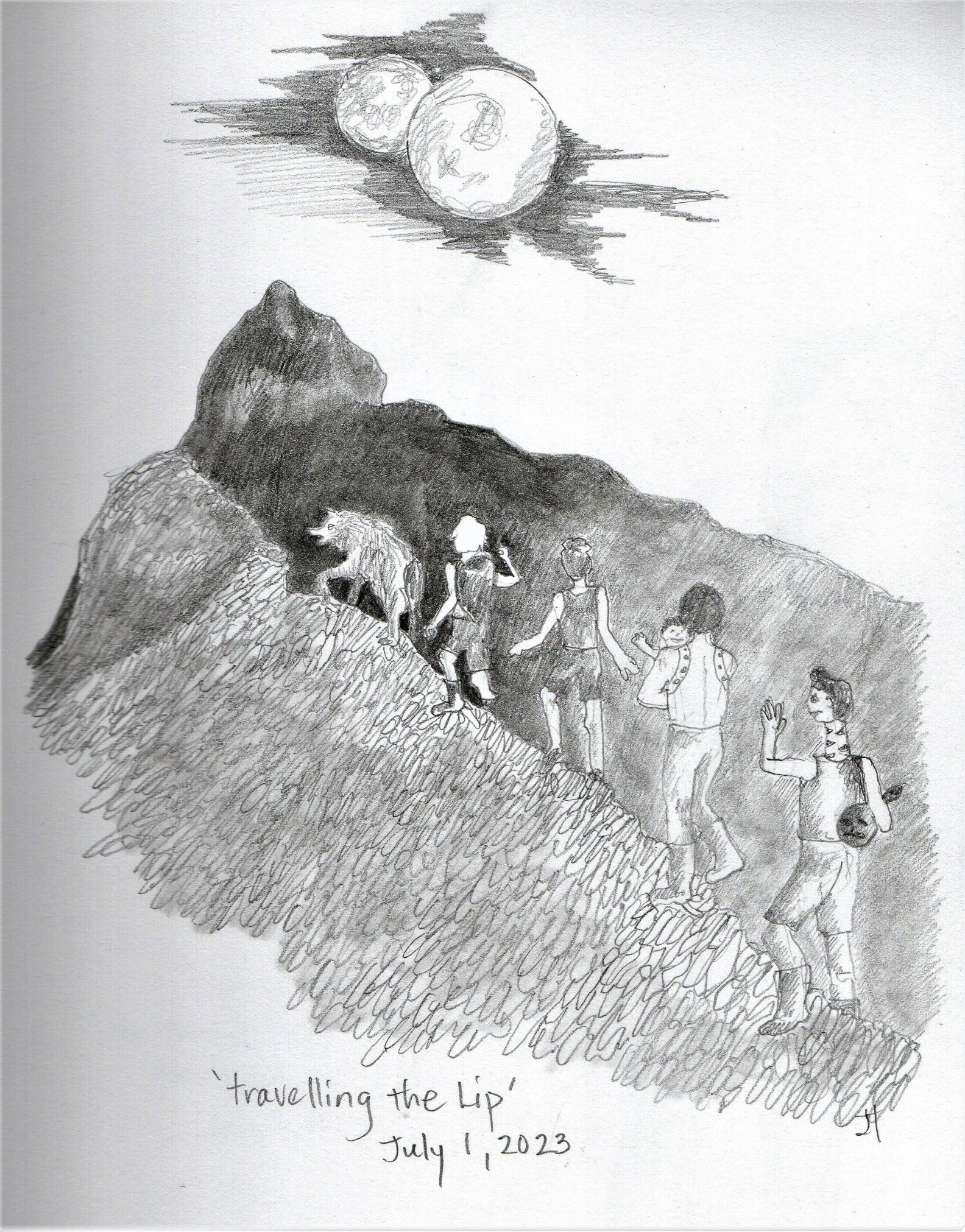
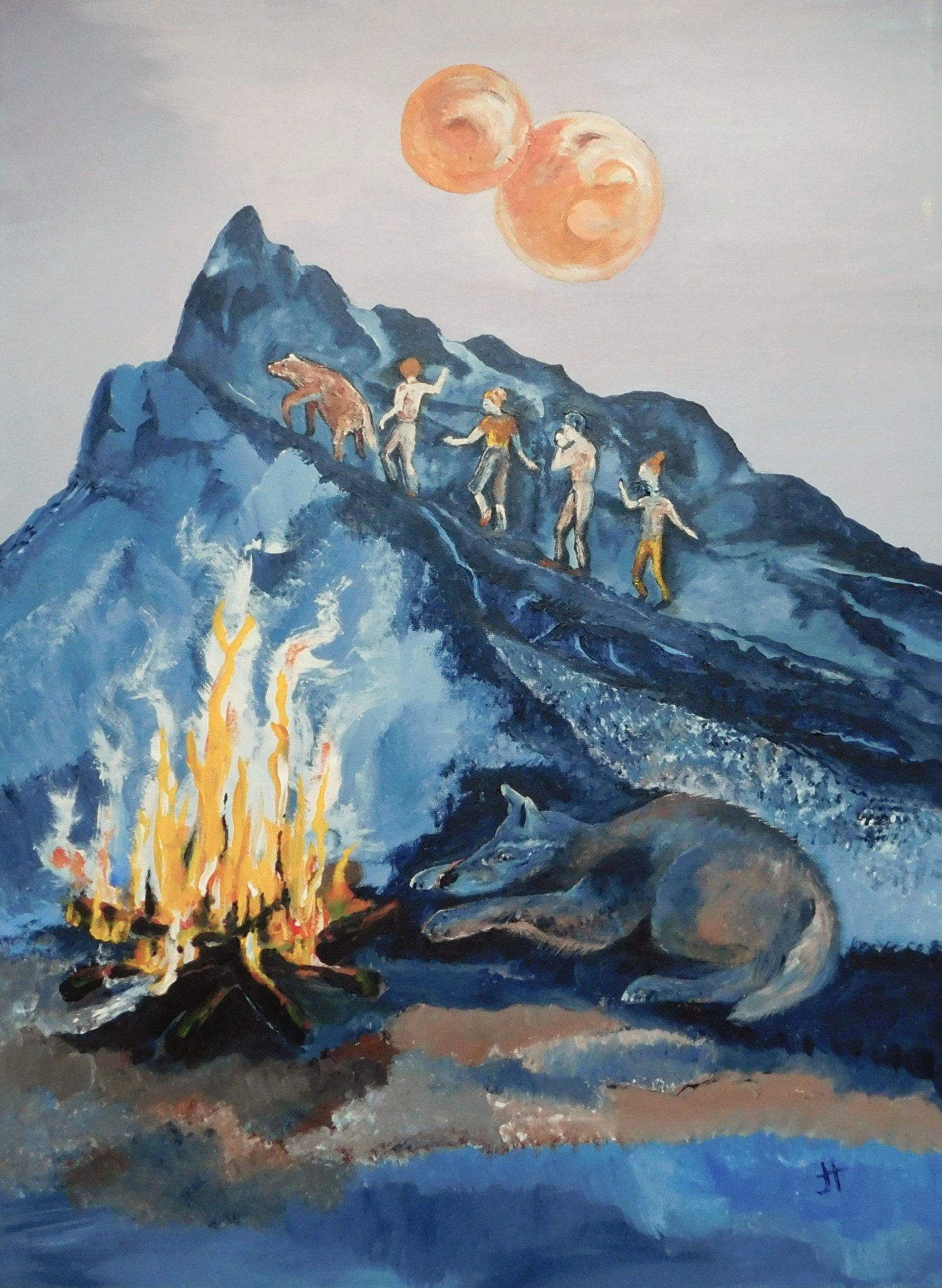
In preparation for the release of ‘Meniscus: Reckoning,’ the next book in the Meniscus Science Fiction Series, I have finished the painting for the cover.
~
The painting is based on the pencil drawing ‘Travelling the Lip.’ It shows six travellers as they cross the treacherous El’ban Elevations, on their way to rescue James, imprisoned in El’ban. The group, in order, are Kotildi (the wild alien ‘wolf’), Belnar (one of the Slain), Odymn (heroine of many of the stories), Daniel (also a Slain), carrying Danny (Odymn and Daniel’s baby), and Don’est (the Dock-winder child, with her long neck).
~
~
To be consistent with other covers, I need a distant view of the Meniscus moons (Cardoth roe and Cardoth grill’en), a mid-range view of the travellers, and a nearer scene from the book. Campfires are a common theme in the story and who better to sleep by the fire than wolf-like Kotildi?
~
~
I was pleased with the painting. For a couple of days, I showed the travellers as black silhouettes against the Elevations. In the end, I gave them some colour, to suggest clothing and hair. I love the browns, blues and yellows in the painting.
~
To make the painting fit the space on the book cover, I made some alterations in GIMP (GNU Image Manipulation Program). I brought the moons closer to the mountain silhouette and moved the fire and sleeping Kotildi closer to the travellers. In the end, the image fit well with the cover design. Here is a sneak peek at the final cover.
~

~
I am now re-reading Meniscus: Reckoning for the last time, making a few revisions as I go. I have also sent the proof to my beta-reader for her reactions.
~
I plan to release Meniscus: Reckoning in early May. I am looking forward to my reader response!
~
All my best!
Alexandra (a.k.a. Jane)
new book coming soon! Meniscus: Reckoning
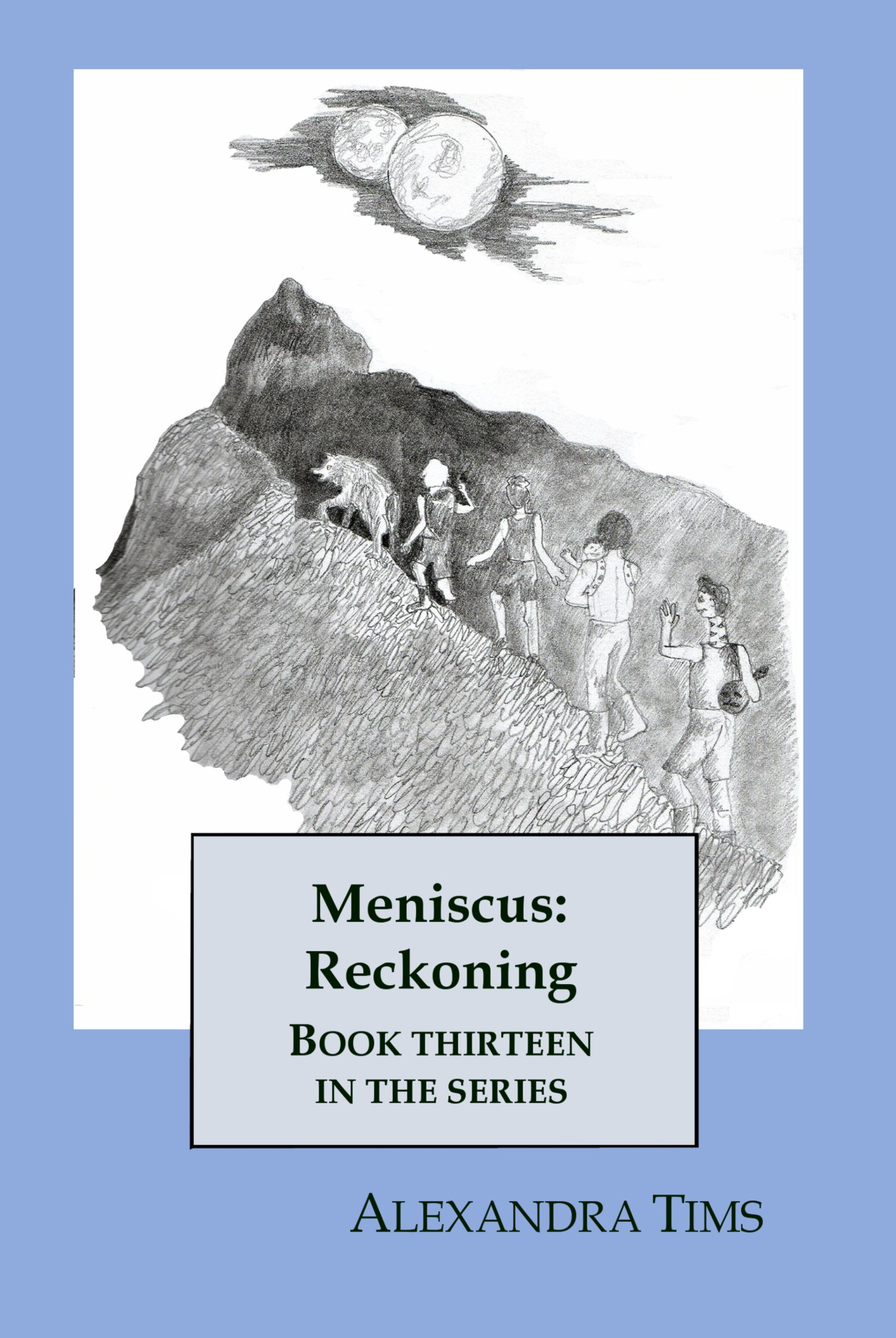
Today, after many hours of editing and formatting, I sent for a proof of my new book in the Meniscus Science Fiction Series. Meniscus: Reckoning will be out in early May. This will be the story of a perilous journey to a distant city, over difficult alien landscape, to rescue a member of the Human Resistance. The book is set in the El’ban District of Meniscus, a city mentioned but not visited in other books in the Meniscus Science Fiction Series.
~

To find out a little more about the steps from draft to proof, have a look at the whole story here. Below is a peek at the first draft of the cover for Meniscus: Reckoning (the final cover will be a painting of the scene).
~
~
All my best!
Alexandra (a.k.a. Jane)




 nichepoetryandprose