Posts Tagged ‘Nova Scotia’
A Book Review: Where’s Home by Jan Fancy Hull
I am originally from Alberta, but left for Nova Scotia as a teenager and remained there for twenty years until I took my first job. Although I have not lived there for years, Nova Scotia has a way of tugging at my heart-strings. I love the ocean, the rural landscape of the Annapolis Valley, the silver waters of the Bras d’Or Lakes. My Kaye Eliot Mysteries are set in the Rawdon Hills of Nova Scotia. For these reasons, I was so happy to hear about a writing project by my friend Jan Hull, a book exploring the ideas of people who consider Nova Scotia ‘home.’

Where’s Home? by Jan Fancy Hull (Granville Ferry, Nova Scotia: Moose House Publications, 2020)
An honest and charming mixture of memory, experience and connection.
This book explores the difficult idea of acceptance (how you accept your community/landscape/province and how it accepts you). Through anecdote and survey response, the book explores the idea of ‘home’—where you live, why you live there, who you are, when you arrived, and how you seek to be part of community.
A reader will begin the book expecting a series of anecdotes about down-east warmth and soothing ocean vistas. But, as the cover states, the answer to Where’s Home? can be complicated. Here you will find stories of people who love Nova Scotia, would never live anywhere else. You will find stories of those who love the ocean, the rural landscape, the home cooking and the welcoming people. You will also find stories of those who hate cold and snowy winters or have ambitions for urban success in other parts of the world.
The book does not avoid difficult subject matter but discusses problems of ‘home’ throughout Nova Scotia’s history—the loss of home by indigenous peoples who did not surrender title to their lands, the loss of home by Acadian people who were deported by the English, people who lost homes when a federal park was established, people whose idea of home has changed as a result of the Covid-19 pandemic. The anecdotes and survey answers in the book consider the complex idea of CFA (Come From Away). Some new arrivals have been welcomed with plates of scones. Others have not found acceptance and the author considers some of the barriers to feeling at home—local colloquialisms, lack of business opportunities, even racism.
My favorite idea in the book?—a way to make people feel welcomed: organized Campground Hosts at Kejimkujic Park, unofficial community greeters, local refugee organizations, local people all set to welcome newcomers to a home in Nova Scotia.
As you read Where’s Home? you will compare your experiences with those in the book, even if you are not from Nova Scotia—the experiences related are applicable to any place where we live or wish to return. These are stories of entrepreneurs, artists, immigrants, people of various cultures and backgrounds. They are told with consideration, empathy, humor and understanding.
Where’s Home? is available at Amazon here, at your local bookstore, or by contacting Jan directly at the website here.
Enjoy your reading during these uncertain spring days.
All my best!
Jane
Coming Soon: New Title in the Kaye Eliot Mystery Series
Every afternoon, I spend some time working on reviewing/revising the proof of my new mystery in the Kaye Eliot Series. I have a cozy spot to work, in my big reading chair in front of the fireplace. Not hard to take a fanciful flight to Nova Scotia where the mystery unfolds.
~
The new book focuses on stones of various types and the part they play in our history: gemstones, millstones, standing stones, building stones. It may take a while for readers to understand the title of the book: Land Between the Furrows.
~
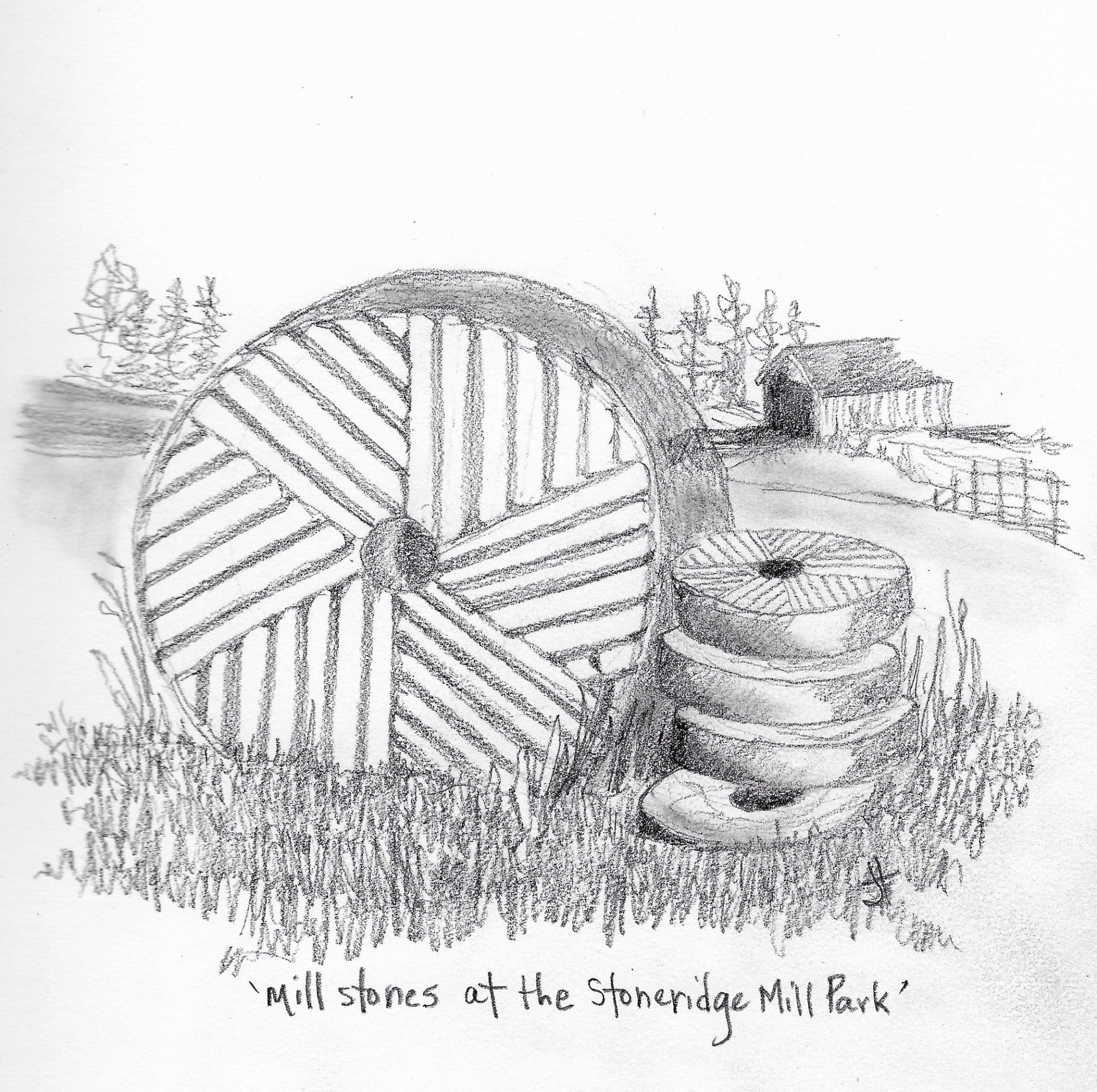
In each book, I include three illustrations. Here is one of the three: an old grist mill and its grind stones figure in the mystery. This drawing will be the basis for the painting featured on the book’s cover.
~
~
In this book, Kaye finds a stack of very old postcards that tell the story of a missing stone. Kaye welcomes the chance to solve a puzzle with her kids but some of the visitors to the community make their sleuthing a little dangerous. Then the family discovers the ruin of an old stone house on an unexplored part of their property and finding the missing stone may be only part of their venture into history.
~
Land Between the Furrows is planned for release on March 15, 2021. A perfect cozy mystery to enjoy during these long winter afternoons.
~
All my best!
Jane
time on the shore
On this Father’s Day, I remember times spent with my dad.
~
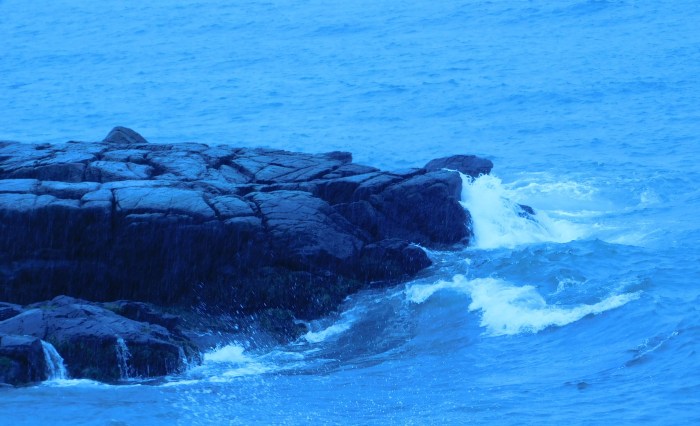
When I was a kid, he would take us to the shore near Port Maitland, Nova Scotia, to look for chunks of iron pyrite (fool’s gold) in the rocks.
~
~
time on the shore
~
1.
spit of sand
grains in an hourglass
poured through gaps
in a cobble sea
~
2.
waves advance
try to tangle me
wash me, turn me
like a sea-smooth stone
~
but I know about tides
I move myself inland
each hour
~
3.
he watched whales blow here
saw sea horses dance
filled his pockets with sea glass
pitied the sandpiper
sprinkling tracks the waves erase
~
I hear the hiss of air
the echoing wail
small stallions prance on my toes
~
I close my eyes
forget to move
~
4.
~
he takes us prospecting
we wedge into crevasses
keen for pyrite gold
cube within cube
embedded in stone
~
we always forget the hammer
we chip and scratch with fingernails
reach across rock
dare the waves
~
a sanderling cries
quit quit!
~
6.
~
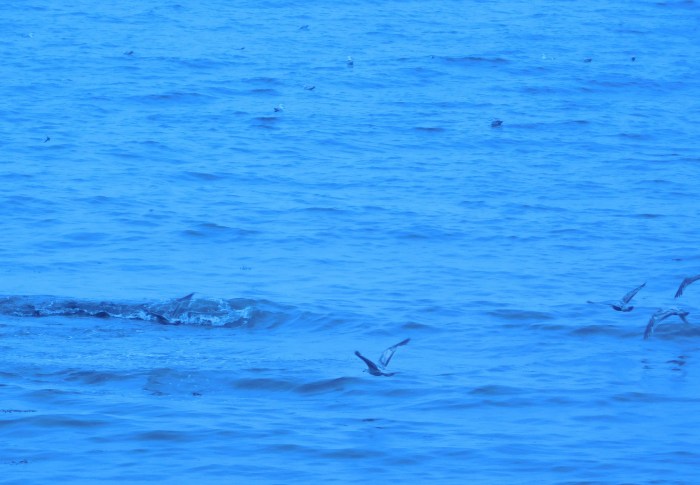
shorebirds
befriend me
~
a dowitcher sews a seam with her bill
bastes salt water to shore
~
the sanderling shoos back the tide
~
terns
plunge into the ocean
and complain they are wet
~
~
Published as: ‘Time on the Shore’, Canadian Stories 16 (89), February/March 2013
Part of manuscript ‘mnemonic‘ winner of the Alfred G. Bailey Prize, Writers’ Federation of New Brunswick 2016 Writing Competition
~
~
Copyright Jane Tims 2017
dancing around the daisy pole
Perhaps strange to talk about a Maypole in July but Maypoles have been used for summer celebrations throughout the years. In the old stereoscope photo below, published by a company in Meadville Pennsylvania and St. Louis Missouri, the Maypole is referred to as a Daisy Pole.
~

A rather blurry scan of a stereoscopic photo, blurry because it is curved for the viewer. The title of the photo is ‘A June Carnival – Dancing Round the Daisy Pole’ 1900
~
When my Aunt Jane was young, attending a small school in Nova Scotia, field days were held in June. In her book, she recalls participating in a field day:
… I was in grade 1 … we had a “field day”. My dress was made of blue and white crepe paper and, holding on to the end of a white paper streamer, I danced around a May pole. I remember my great embarrassment as a gust of wind took the streamer out of my hand and sent it high in the air to flutter in the breeze …
~
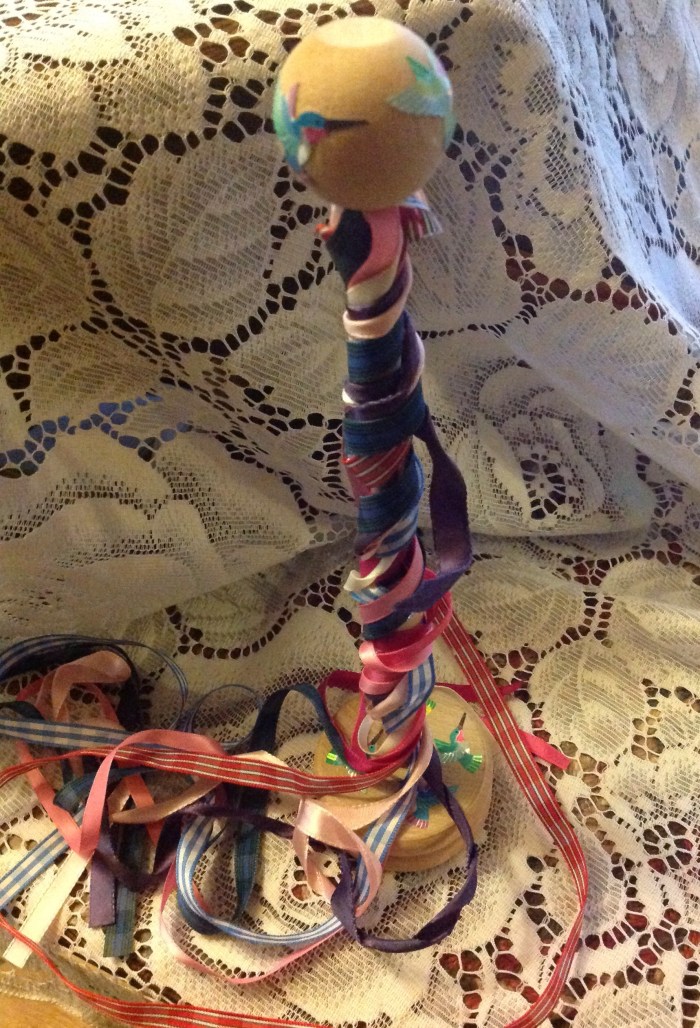
The decorative Maypole we made years ago to celebrate May 1 every year. Through the years, when I needed ribbon, I occasionally snipped a length from the pole, so there are a few short ribbons!
~
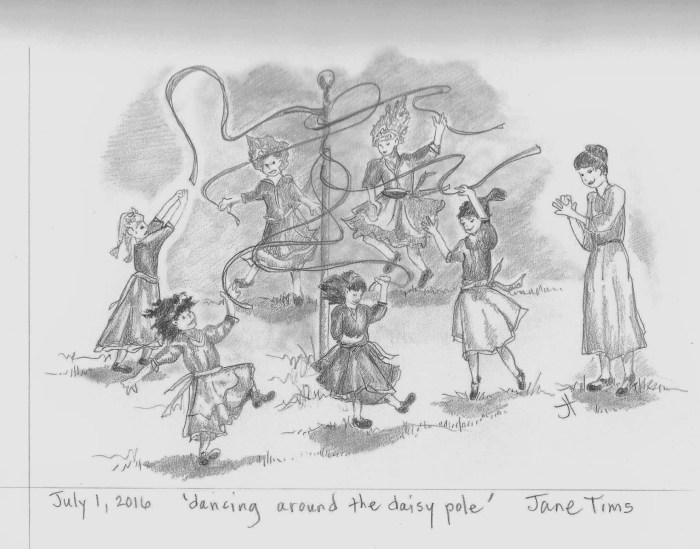
~
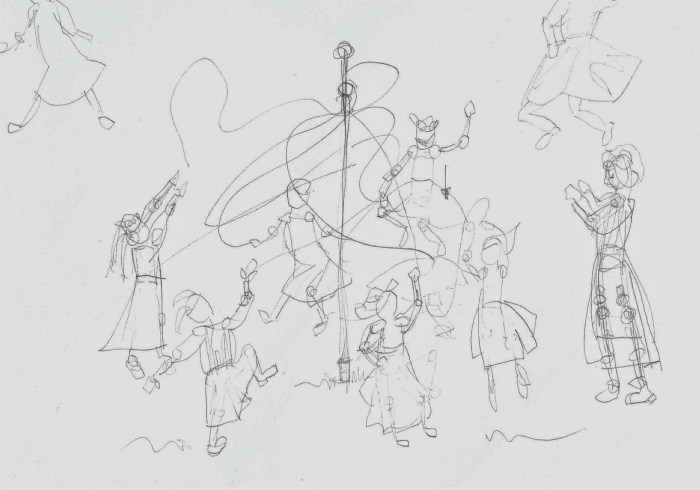
sketch for ‘dancing around the daisy pole’ … in some ways more lively than the final drawing
~
~
Copyright Jane Tims 2016
early schools – the exotic and the common
In my Aunt’s book about early schooling in Nova Scotia, she tells an amusing story about field days at school:
… I recall another field day when Dr. DeWolfe, Miss Harris, and Miss Baker came with shrubs to our school. The shrubs were ten cents each. My mother had always longed for a weigela and a snowball and we were delighted that at last she could have her wish, for both these varieties were among Dr. DeWolf’s collection. They were duly planted at my home on the bank of the French River. One turned out to be a high bush cranberry and the other a spiraea, but today we still refer to them as the “snowball” and “weigela” and, I may mention, they have many an offspring throughout our province.
~
I must have seen the high bush cranberry and spiraea many times at my mother’s old home, but I don’t remember them in particular. I do remember the gardens, lush with rose bushes, tiger lilies, and grape vines.
~

~
Copyright 2016 Jane Tims
coastal barren, coastal bog
On our vacation to Nova Scotia last month, we revisited the Peggy’s Cove area near Halifax. I spent a lot of time along this coast years ago, but I had forgotten the unique wildness and beauty of this landscape.

We explored two habitat types, the dry and rocky barrens, and the wet coastal bog. As we found each new plant, I felt like I was greeting old and well-loved friends.
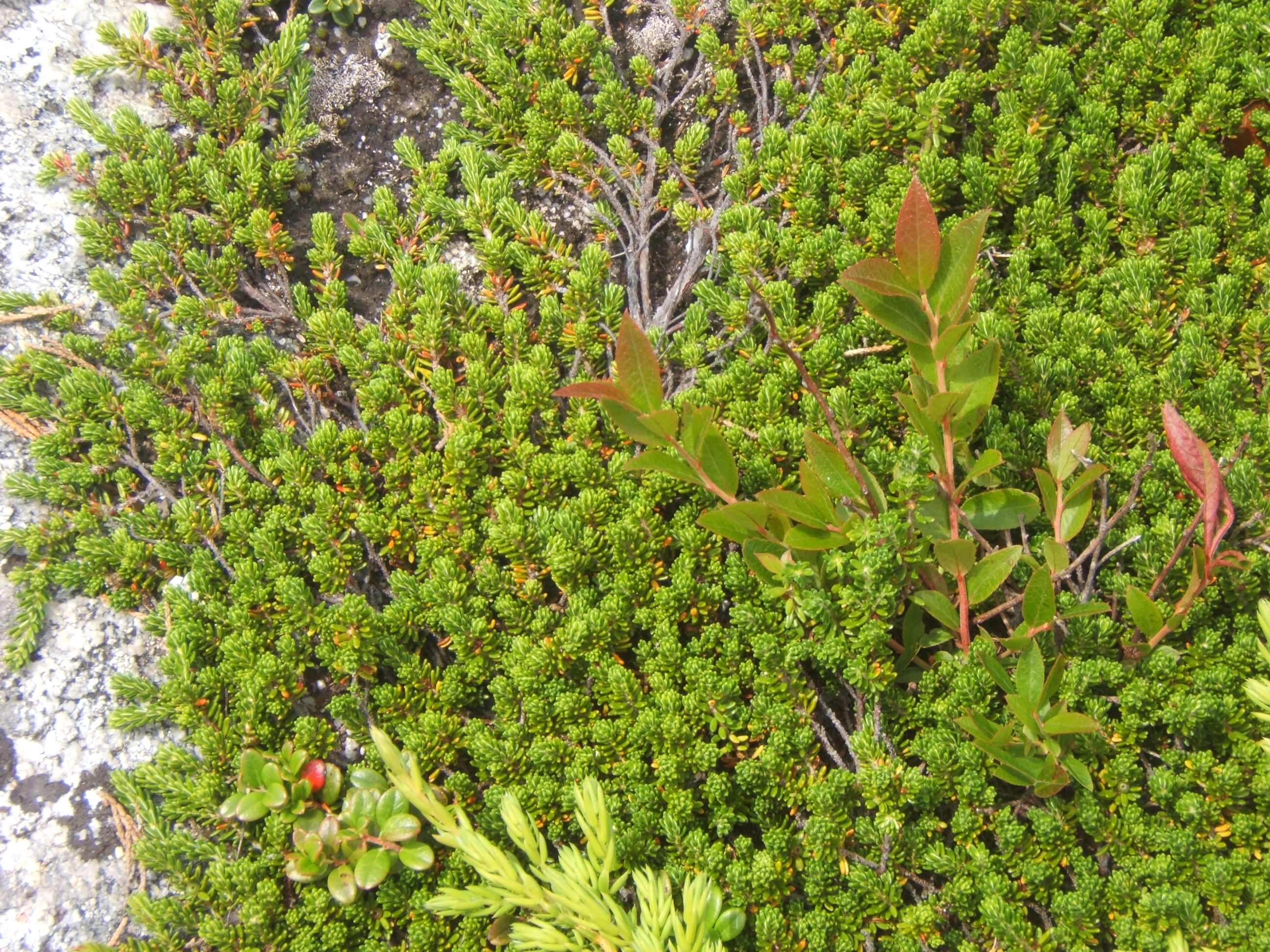
On the higher areas, growing in the thin soil on the bedrock were several species. One of these included Crowberry (Empetrum nigrum L.), a small moss-like plant with spiky leaves and small pink flowers. Later in the season, these will bear edible back berries.
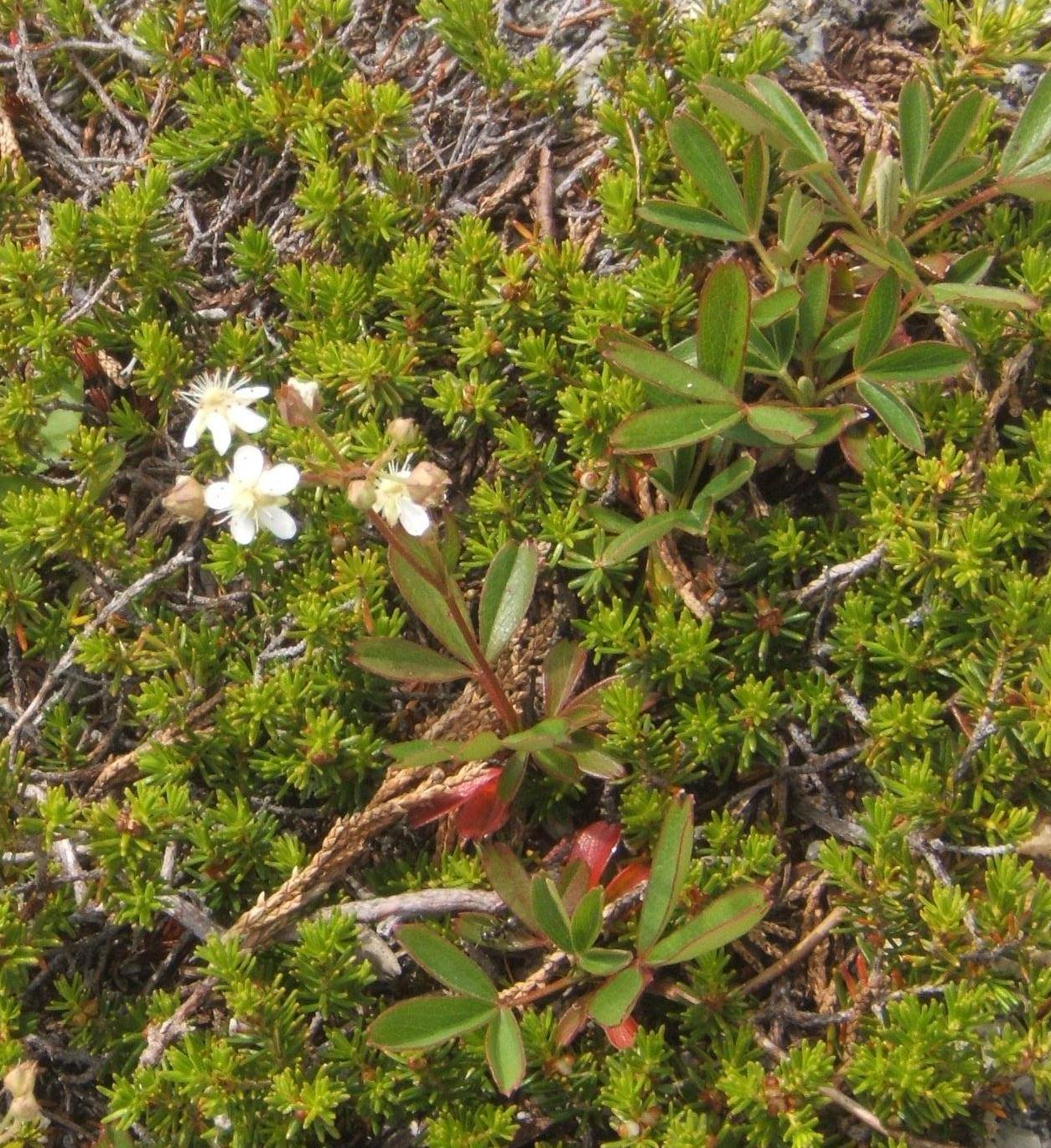
We also found Three-toothed Cinquefoil (Sibbaldia tridentata (Aiton) Paule & Soják) with its three leaflets and the characteristic three teeth at the tip of each leaf. The leaves are thick and outlined in red at this time of year. Later in the year the leaves turn bright red. The white flowers each have five petals, and are starry with stamens.
In the low-lying, boggy areas, we found a ‘merriment’ (my word) of Pitcher-plants (Sarracenia purpurea L.).

The leaves of these insectivorous plants are shaped like vessels. Insects climbing into the leaves encounter downward pointing hairs. They are trapped! Eventually they drown and are digested in the water at the base of the ‘pitcher’.
We also found another carnivorous plant, the Round-leaved Sundew (Drosera rotundifolia L.). The leaves of these plants are covered with tiny hairs… these exude a sticky liquid and trapped insects are slowly digested. For more information on the Sundew, please visit my post for October 31, 2011, ‘Round-leaved Sundew’. https://nichepoetryandprose.wordpress.com/2011/10/
All was not gruesome. We also found Arethusa (Arethusa bulbosa L.), a member of the orchid family. This beautiful pink orchid is also known as the Dragon’s Mouth.

Overall, our trip to Peggy’s Cove was a wonderful adventure. We plan to return in the early fall, when the Crowberry and the other edible plants we saw have set their berries.
Have you ever been to Peggy’s Cove and what did you think of the coastal landscape and the plants growing there?
~

© Jane Tims 2012
Warning: 1. never eat any plant if you are not absolutely certain of the identification; 2. never eat any plant if you have personal sensitivities, including allergies, to certain plants or their derivatives; 3. never eat any plant unless you have checked several sources to verify the edibility of the plant.between the tides – sea glass
Walking on the beach at low tide creates a two-way competition for the eyes.
First there is the pull of the sea – the vistas of distant shores, islands, boats and buoys to contemplate, and the crash and retreat of the ocean waves…

Second is the compulsion to watch the beach as you walk, searching for shells and patterned rocks…
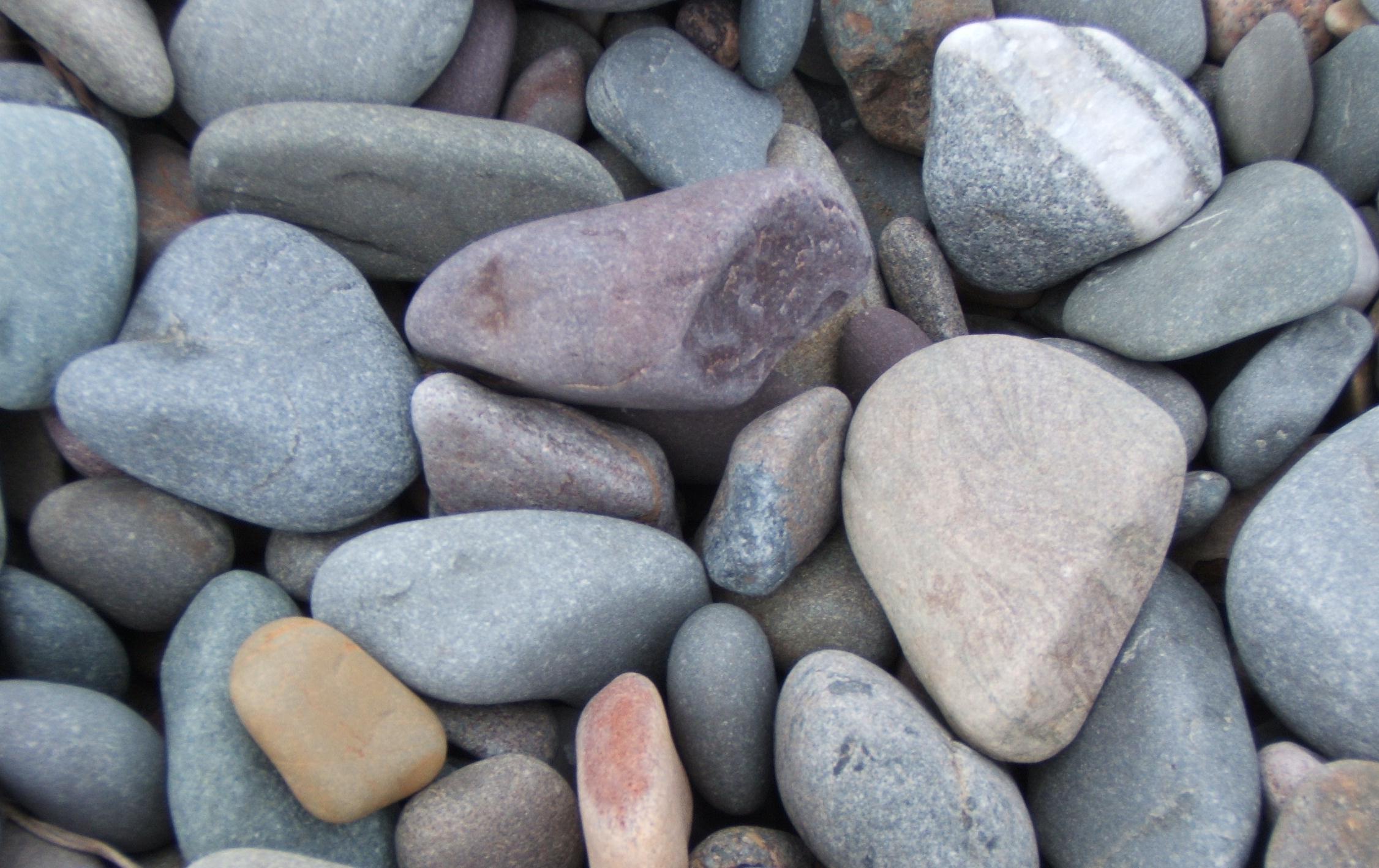
or the gem of beachcombers, sea glass…

When the tide comes in, we collectors come home from the sea, our pockets full of treasures we have found.

sea glass
~
tide turns
sea withdraws
we walk on the ocean floor
heads down
eyes conditioned to color
of sea glass translucence
of fog softened edges muffled
greens and bottle blues
rare ambers and reds
tide turns
ocean swells
glass and stone together
etched by sea
~
© Jane Tims 2011




 nichepoetryandprose