Posts Tagged ‘mnemonics’
mnemonic: listening to birdsong
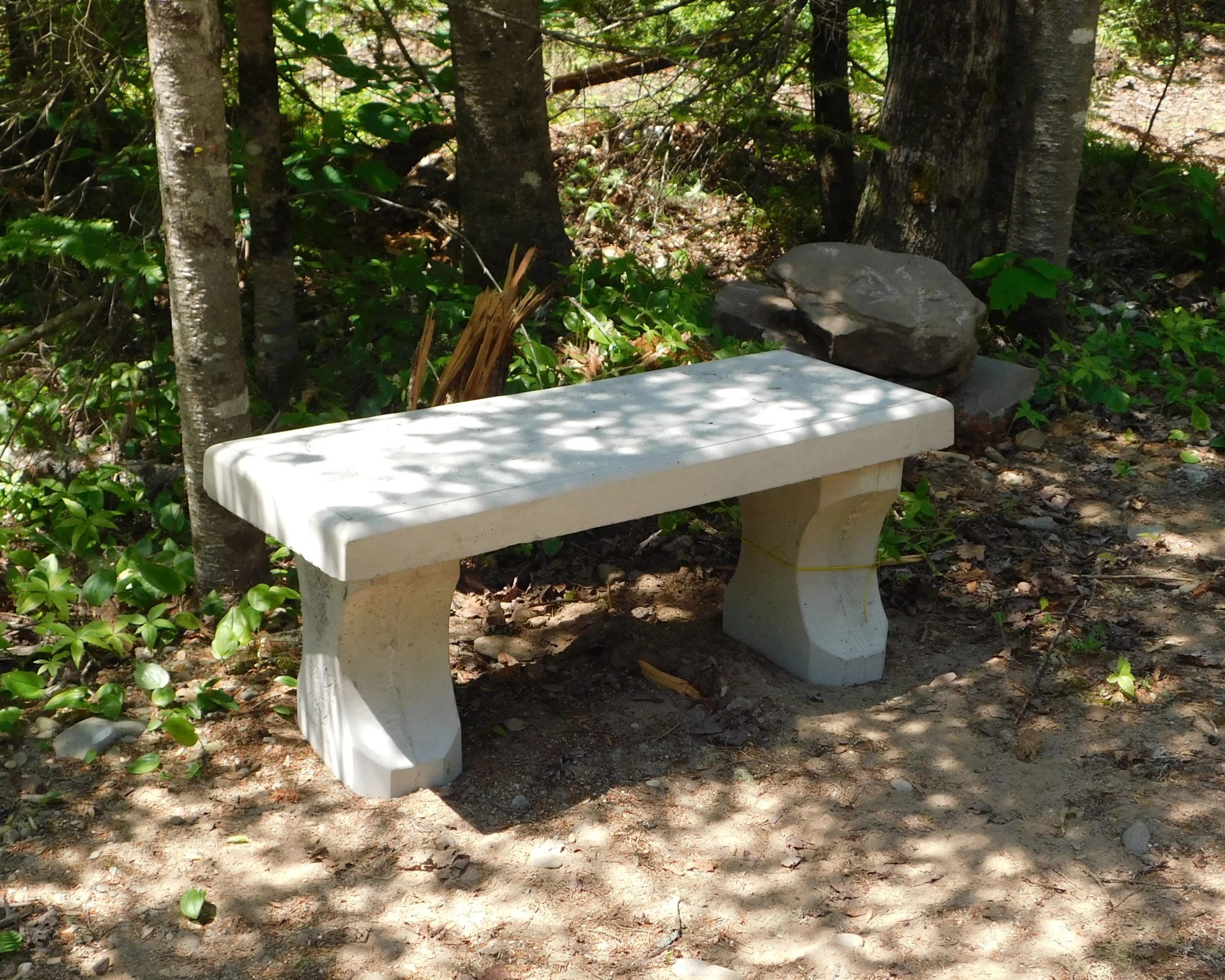
Each day, I walk the loop of our drive and stop for a moment at our concrete bench. I sit there and settle, listening to the sounds: a jet passing overhead, cars on the roadway, a neighbour using a saw. Then I start to hear the quiet mutter of the breeze, the rustling of leaves overhead, the occasional song of a bird.
~
~
This morning I heard the ‘caw’ of a crow, the ‘yank, yank’ of a nuthatch, the winnowing of a snipe. When we assign a pattern of words to mimic and remember the sound of a bird call, it is known as a ‘mnemonic.’ Various other sounds are remembered that way: the ‘chug, chug’ of a train, the ‘drip, drip’ of a tap. Bird mnemonics known to almost everyone are the ‘chick-a-dee-dee-dee’ of the chickadee, the ‘who cooks for you?’ of the barred owl, and the ‘conk-la-ree’ of the red-winged blackbird.
~
~
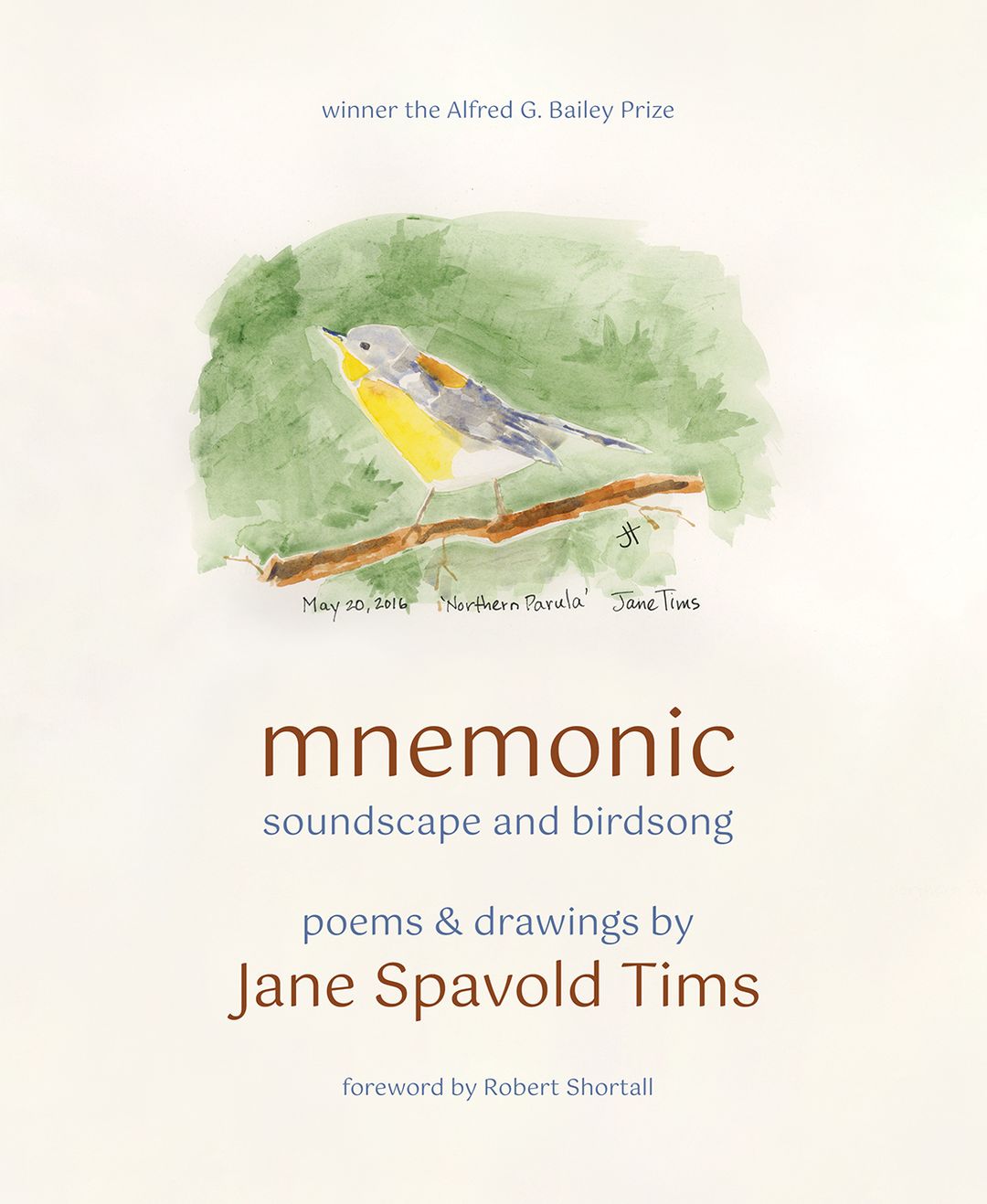
My new poetry book ‘mnemonic: soundscape and birdsong’ focusses on sounds in the woodland and along the shore. Most of the poems celebrate the way bird song can be a metaphor for the events in our lives. For example, the tapping of a pileated woodpecker on the wood of a backstop at the baseball diamond sounds like the connect of bat and ball during the game.
~
~
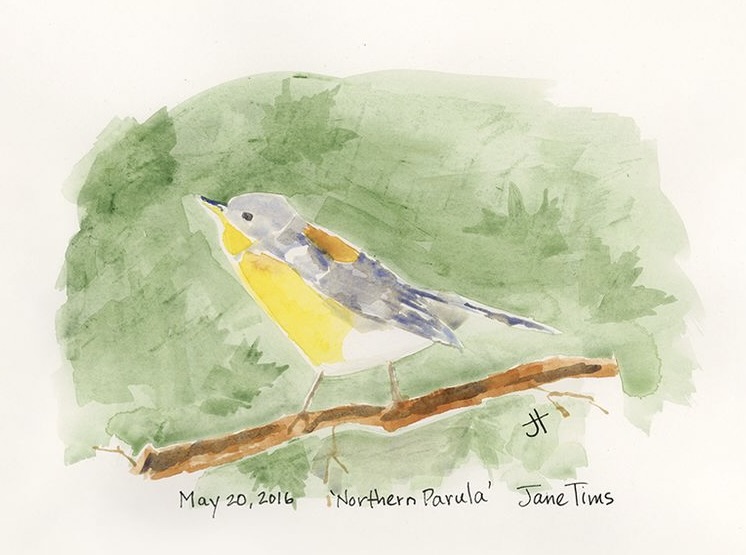
My book ‘mnemonic’ includes my poems and pencil drawings.
~
To obtain a copy of ‘mnemonic,’ take a visit to Dog Eared Books in Oromocto, or Westminster Bookmark in Fredericton. You can also order the book from Chapel Street Editions here, or from Amazon Canada here.
~
I hope you enjoy my poetry and my sketches. You can find a comprehensive list of bird mnemonics at South Bay Birders Unlimited ‘Mnemonic Bird Songs’ here.
~
All my best!
Jane Tims
including ‘sound’ in writing
I am so proud of my new poetry book ‘mnemonic – soundscape and birdsong’ (Chapel Street Editions, 2024) because it focuses on including sound in writing. Of the five senses (vision, hearing, touch, smell and taste), most creative writing focuses on vision. It is a bit of a challenge to include the other senses in order to give a more complete idea of the sensations contributed by your surroundings.
~

~
My book includes bird song as a main part of the soundscape. It also includes other sounds: the singing of a rock skipped across a frozen pond, the call of the spring peepers, the clinking of ice in glasses, the sound of a kettle boiling over a woodland fire.
~

~
For ways of including sounds in writing, you can look at some of my earlier posts here, and here.
~
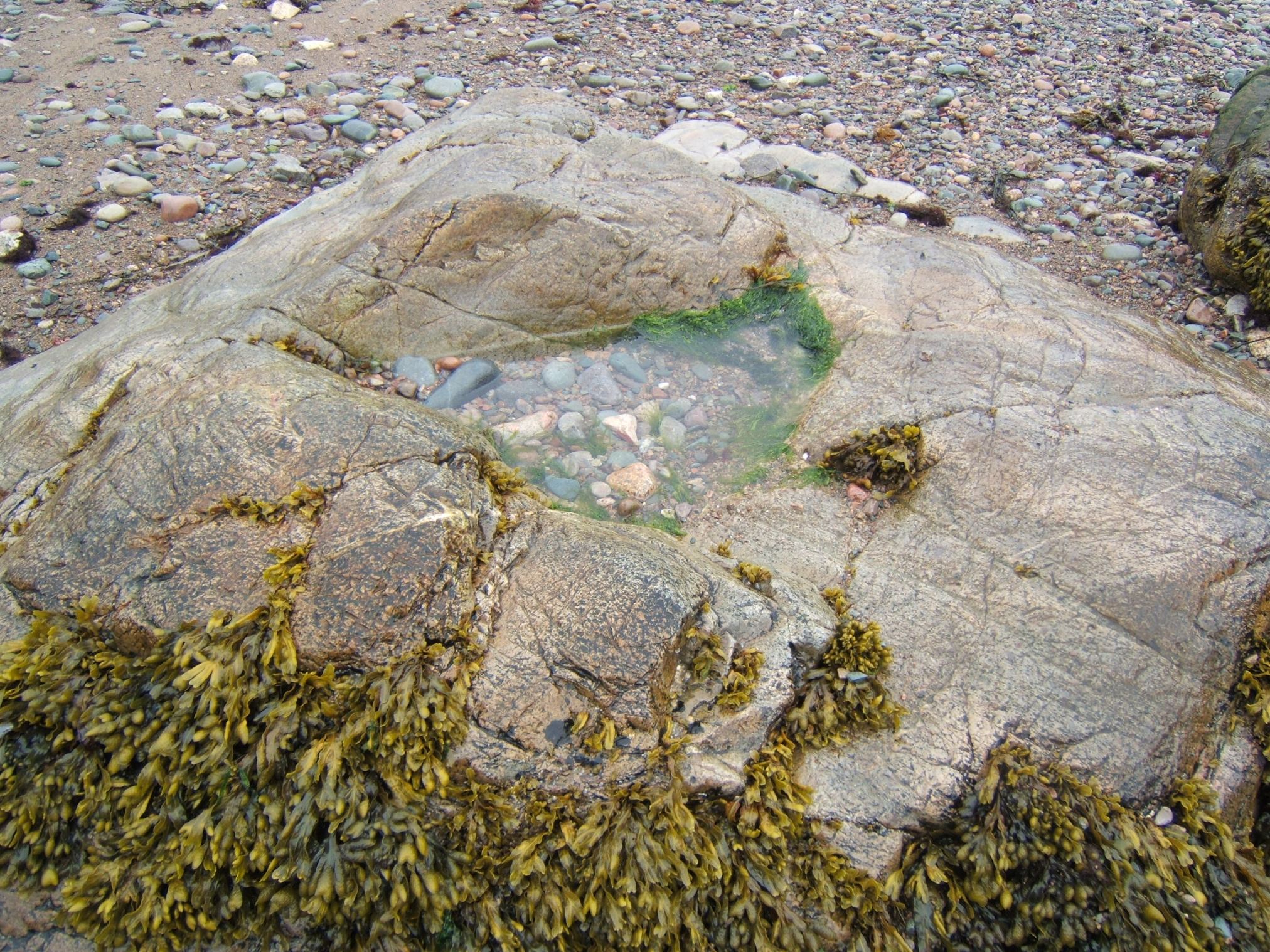
I think my favourite poem in the ‘mnemonic’ collection is about my Dad who took us along the Yarmouth shore to find iron pyrite (fool’s gold). The sounds in this poem focus on the shorebirds. Here is a short excerpt:
4.
he takes us prospecting
we wedge into crevasses
keen for pyrite gold
cube within cube
embedded in stone
we always forget the hammer
we chip and scratch with fingernails
reach across rock
dare the waves
5.
a sanderling cries
quit quit!
6.
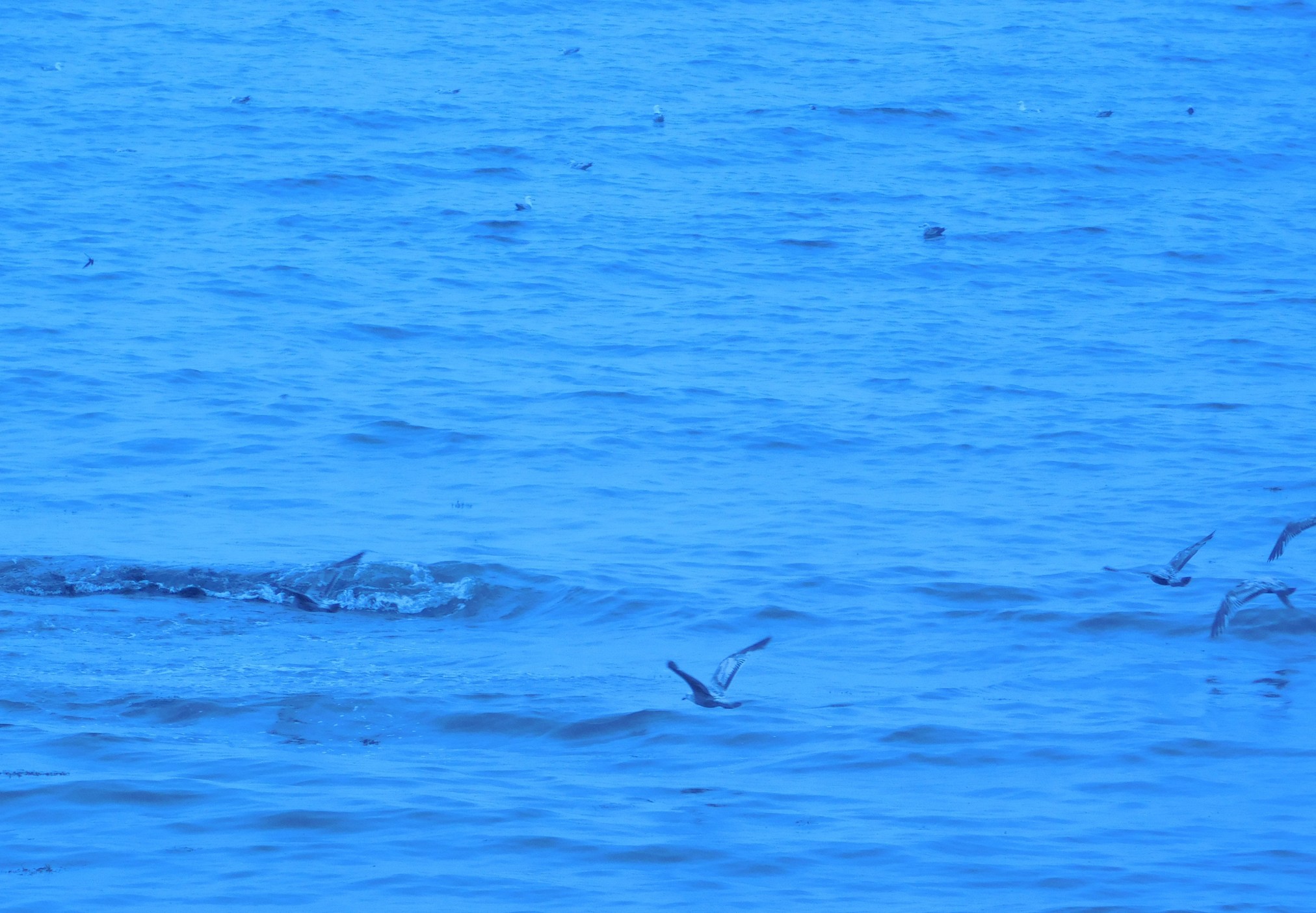
shorebirds
befriend me
a dowitcher sews a seam with her bill
bastes salt water to shore
the sanderling shoos back the tide
terns
plunge into the ocean
and complain they are wet
~



~
I hope you will have fun incorporating sound into your writing.
~
All my best,
Jane
mnemonics – soundscape and birdsong
~
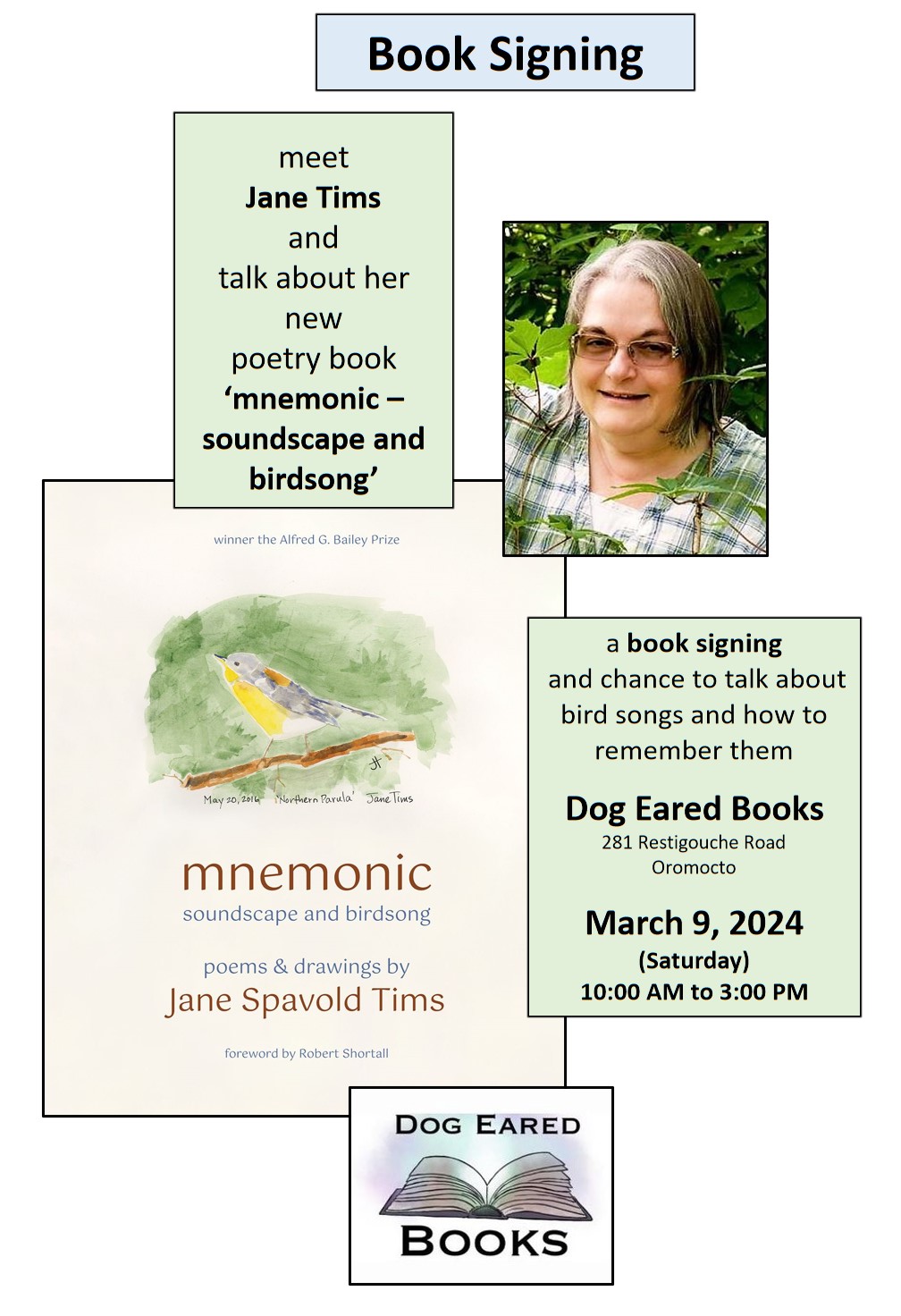
I am looking forward to another presentation, this Saturday, of my new poetry book, ‘mnemonic – soundscape and birdsong.’ I will be at Dog Eared Books in Oromocto for a few hours, to share my book and some favourite birdsongs. When you enter the store, listen for some of our well known birds and their songs. I will be using www.allaboutbirds.com to demonstrate how well established mnemonics mimic the sounds we hear in the woodland and seashore.
~

~
I enjoyed working on the poems in this book for four reasons:
. I feel strongly that we should include all of our senses in our writing; sounds are a significant component of our surroundings …
. my life has been enriched as I have come to know the birds in the morning bird chorus and to listen to the chorus with understanding …
. bird songs have accompanied me on many of my life journeys and are symbolic of various important milestones in my life …
. I love to draw birds, to try to show the softness of their feathers and their sturdy bodies in pencil …
~
~
I look forward to seeing you at the reading and hearing some of your favourite ‘mnemonics.’
~
Thank you so much to my publisher, Chapel Street Editions, for the lovely work they have done on this book!
~
All my best,
Jane
book reading and signing
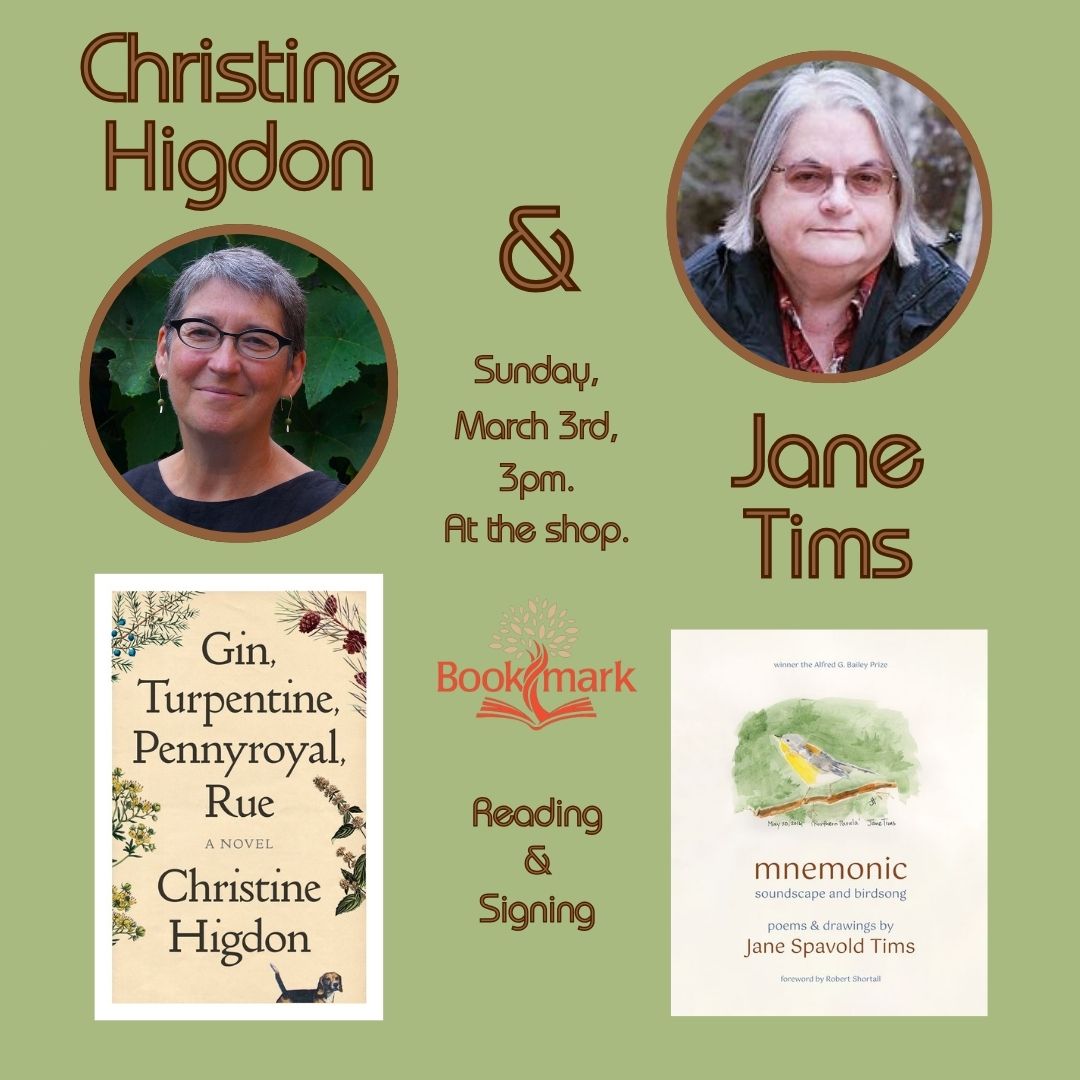
This week I am preparing for a launch of my new book ‘mnemonic – soundscape and birdsong’ at Westminster Bookmark in Fredericton. The poems are enjoyable to read and I look forward to talking about one of my favourite topics – birdsong!
~

~
Preparation means thinking about what I will say, choosing the poems to read within the time given and deciding what to wear. It also means letting you all know about the reading.
~
~
As you can see, I will be reading with another author whom I have never met: Christine Higdon. Her book title is fascinating and I am looking forward to reading her story of four Vancouver sisters in the 1920s. Reading with another author is great: it introduces you to someone you may not know and their books. It means the audience is treated to two readings instead of one. And it usually increases numbers of listeners.
~
My talk will focus on the idea of using mnemonics to remember bird songs and calls. Mnemonic means ‘a pattern of letters, ideas, or associations that assists in remembering something.’ Mnemonics are a well-know way of identifying bird calls.
~
This idea has been with me as long as I can remember. When my Mom heard a white throated sparrow, she would always answer with, ‘I love dear Canada, Canada, Canada.’ And I have always known the chick-a-dee by its name-sake call. In later years I have come to love some particular mnemonics and the birds they help identify: ‘who cooks for you?’ by the barred owl, ‘yank, yank, yank’ by the white-breasted nuthatch and ‘whirr-zip!’ by the northern parole warbler. A bird call I have never heard is the ‘cheer, cheer, cheer, purty, purty, purty’ of the northern cardinal – I have never seen a cardinal either! What are your favourite (or unique) bird call mnemonics?
~
Some of the best sources for mnemonics are Audubon Vermont https://vt.audubon.org/sites/default/files/bird_song_mnemonics.pdf and Stanford (South Bay Birders Unlimited) https://web.stanford.edu/~kendric/birds/birdsong.html a great place to listen to various bird songs is All About Birds https://www.allaboutbirds.org/news/browse/topic/sounds-songs/
~
I am looking forward to the opportunity to read and talk to the audience on Sunday! Hope to see you there. And hope to hear an afternoon chorus of bird song mnemonics from the audience!
~
All my best,
Jane
morning chorus
Each morning I have a short quiet time after rising. I spend this time in my guest bedroom. I do some stretching. I watch the sun rise among the trees. And I try to sort out the morning bird chorus.
~

~
The morning bird chorus is known to be a complex social interaction among birds of various species – a communication we humans can listen to with wonder, but little understanding.
~
We have lots of birds in our area and the woods are thick with birdsong. Although ours is a residential area, we have many hundred acres of woodland behind us and no houses between us and the river. Our back woods are mixed conifer and hardwood, mostly balsalm fir, spruce, red maple and white birch. We have nearby wetlands and, of course, the river.
~

~
I now regret not learning to identify the birds from their songs earlier in my life. Although I can name many birds by sight, I have a feeling I know many more by their sounds. This summer I have tuned up my ears and spent lots of hours trying to learn to recognise the birds by their songs. Perhaps because of their variety and complexity, learning the songs is more difficult than just listening and comparing. Once I have heard a few birds, my memory becomes jumbled trying to distinguish between them.
~
I use three main tools to help me identify and remember bird sounds.
- mnemonics – short phrases to describe and remember various bird songs. These phrases help narrow down the possibilities when I hear a bird sing. Many lists of bird song mnemonics exist, but I like the simple listing from the Fernbank Science Center in Georgia http://www.fernbank.edu/Birding/mnemonics.htm
- recorded songs – although there are many sites with bird song recordings, the one I like the best is Dendroica- NatureInstruct http://www.natureinstruct.org/dendroica/spec.php/Dendroica+Canada#sp_select . Once you select a bird, you can hear calls recorded by birders in various parts of the range.
- a list of the calls I know and new songs I hear, described in my own words and with a diagram of the way the song progresses, in a shorthand of my own. I use words like: trill, flute, scratch, liquid, repetitive, bored, delirious …
~
The Cornell Lab of Ornithology has some excellent tips for those who would like to learn the songs of local birds.
http://www.allaboutbirds.org/Page.aspx?pid=1189#_ga=1.202457239.768663648.1437046200
They suggest listening for rhythm, tone, pitch and repetition of a bird song. By listening for these qualities, one at a time, you can start to make sense of the variability and help your memory.
~
Here is a list of the participants in this morning’s bird chorus outside my window:
- odd high-pitched sound at the first grey light of morning, probably not a bird
- immediately, an American Robin – ‘chirrup, cheerup, cheery cheer-up’ – we have a nest of robins at the start of our woods road
- a Mourning Dove, intermittent – ‘oo-oo-hoooo’ – very sad sound – a pair perches on the wires along our main road
- a White-throated Sparrow – ‘I love dear Canada-Canada-Canada’
- a Hermit Thrush – an ethereal, flute-like phrase, repeated over and over, each time at a new pitch – close at first and then gradually moving further away
- an Eastern Phoebe – a nasal ‘fee-bee’, repeated – a nest in the eaves of our shed
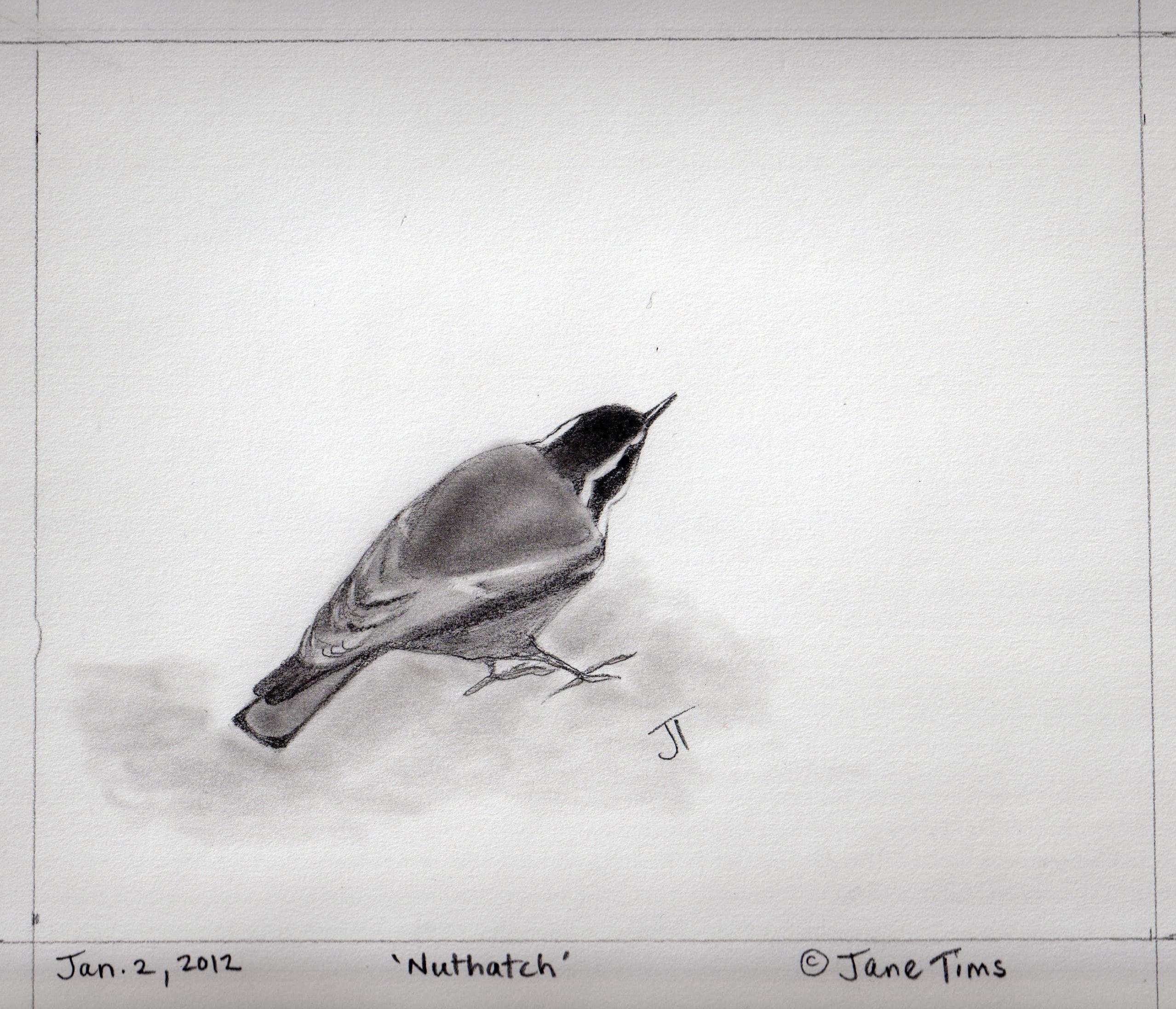
- a Red-breasted Nuthatch – a monotonous low-key ‘yank yank yank yank’, like a cross between a bored duck and a bullfrog
- the ‘caw caw caw’ of a Crow
~
I wonder if you ever listen to the morning bird chorus. What birds do you hear?
~
~
Copyright 2015 Jane Tims




 nichepoetryandprose