Posts Tagged ‘Mitchella repens’
Partridge-berry (Mitchella repens L.)
One of the evergreen plants in the spring woodland is a little vine called Partridge-berry. It trails, low to the ground, in shady, mossy woods, sometimes covering moist banks and hummocks with its shiny greenery.
Partridge-berry (Mitchella repens L.) is also known as Twinberry, Snakevine, Running Fox and Two-eyed Berry. The word repens is from the Latin for ‘creeping’.
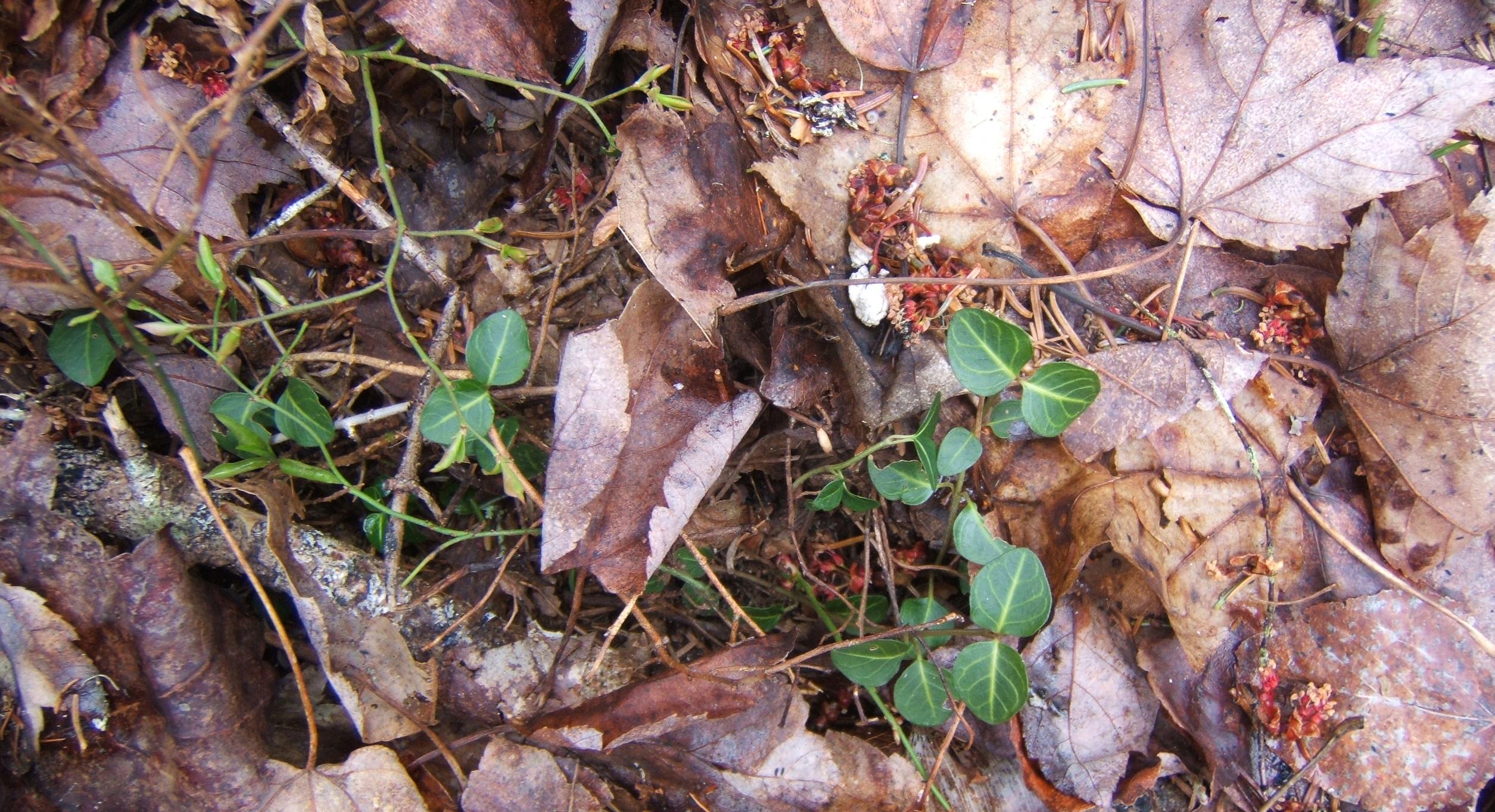
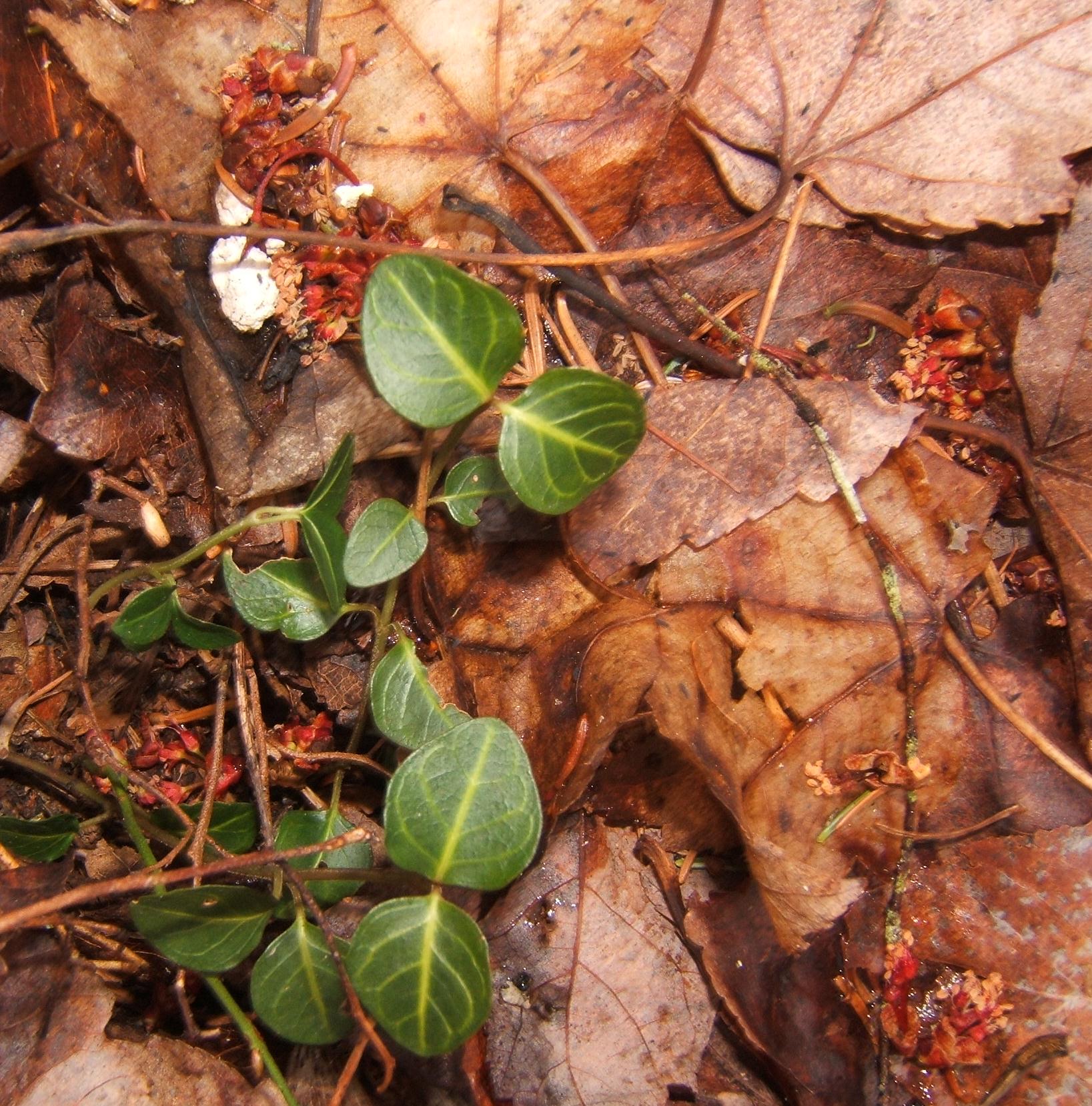
The leaves of Partridge-berry are small, ovoid and opposite on a vine-like stem. The leaves have a bright yellow midrib and veins, giving them a clear outline against the background of dry leaves.
The flowers are white or pinkish, and bell-shaped. They occur in pairs – the two flowers are closely united at the base, sharing a single calyx. As a result, the bright red berries are two-eyed, each showing two blossom scars.
This time of year, in July, Partridge-berry has flowered and set its berries. The berries are dry and seedy but edible, with a slightly aromatic flavour. They are a good nibble along the trail or can be used as emergency food. The berries are ordinarily eaten by birds, such as the Ruffed Grouse.
Warning: 1. never eat any plant if you are not absolutely certain of the identification; 2. never eat any plant if you have personal sensitivities, including allergies, to certain plants or their derivatives; 3. never eat any plant unless you have checked several sources to verify the edibility of the plant.~
~
common names
( Mitchella repens L.)
~
1.
Running Fox
~
a glimpse of red
between hairmoss and hummock
the fox slips into shrewd spaces
seeks the vacant way
~
2.
Snakevine
~
a twist and a Twin-berry
trail woven and worn
mottled and mid-ribbed
Mitchella meanders
over feathermoss, under fern
~
3.
Partridge-berry
~
Ruffed Grouse pokes and pecks
tucks a Two-eyed Berry in his crop
lurches on
~
~
© Jane Tims 2012

cascade across the rock
Earlier this summer, in July, we visited Little Sheephouse Falls, northwest of Miramichi. The Falls are part of the watershed of the South Branch of the Big Sevogle River.
To see Little Sheephouse Falls requires a short hike through mixed woods. The trail to the Falls is very well maintained by the forest company who manages the area and was an easy walk in spite of my arthritic knees.
The woods were green with ferns and other woodland plants. My favourite of these was a little vine of Mitchella repens L. cascading across a lichened rock. Commonly known as Partidge-berry, Mitchella is a small vine with roundish opposite leaves, often found growing in shady, mossy woods. It has pinkish flowers and small red berries. The Flora I consulted says it is found where it can be free from the competition of more vigorous plants.

Mitchella repens growing across a rock in the woods
We did not go to the base of the falls, but kept to the trails navigating the escarpment. The falls are about 20 meters high, with a large pool and a cave at the base. They were a white torrent on the day we visited, making a rumbling thunder in striking contrast to the quiet woods.

Little Sheephouse Falls
Directions to Little Sheephouse Falls, and other waterfalls in New Brunswick, are contained at Nicholas Guitard’s website http://www.waterfallsnewbrunswick.ca and in his 2009 book Waterfalls of New Brunswick (see ‘books about natural spaces’).
Waterfalls are spaces to soothe the soul and inspire love for natural areas. They engage the senses… the sounds of the gurgling stream and the roar of the waterfall, the feel of cool, clean water, and the sight of water bubbling and boiling, following the contours of the landscape.
the three fates, spinning
~
1.
wound on the rock
mended by waterfall thread
~
2.
at last I touch
the water
real, wet water
(not a report or diagram
but the flavor feel and smell
of water)
~
it pours through my fingers
delivers to me
the mosses
the lichens
(the moth on the pin where she has always
wanted to be)
~
3.
the doe must feel this
as she crosses
the road-to-nowhere
when the birch and aspen enfold her
~
or the ant
as she maps the labyrinth
on the rotting morel
when she touches the ground
(blessed ground)
~
or the needles of white pine
when they find the note
split the wind into song
~
4.
the three fates
spinning
~
the waterfall
diverted by the rock
~
Published as: “the three fates, spinning”, The Antigonish Review 165, Spring 2011.
(revised)
© Jane Tims

needles of white pine...split the wind into song




 nichepoetryandprose