Posts Tagged ‘fiddlehead’
fiddlehead season in New Brunswick
This time of year in New Brunswick, the fields and riversides are turning green. The leaves of the alders are the size of a mouse’s ear and that means fishing in the streams. The small leaves of the red maples are like green stars against a blue sky. And bouquets of fiddlehead ferns are unfolding in the wet meadows and along the shores.
~
Fiddleheads, the young coiled leaf fronds of the Ostrich fern (Matteuccia Struthiopteris (L.) Tod.), are a local delicacy in New Brunswick. Steamed, with a pat of butter, they are the perfect vegetable for a spring meal. Fiddleheads are one of the edible wild plants featured in my book ‘within easy reach’ (Chapel Street Editions). I will be launching my book at 7 pm on June 9, 2016 at Westminster Books in Fredericton. If you live in the Fredericton area, I would be so happy to see you there!
~
For more information on the fiddlehead, see https://janetims.com/2012/05/19/making-friends-with-the-ferns-2/

Fiddleheads along the Saint John River in the Grand Lake Meadows
making friends with the ferns #3
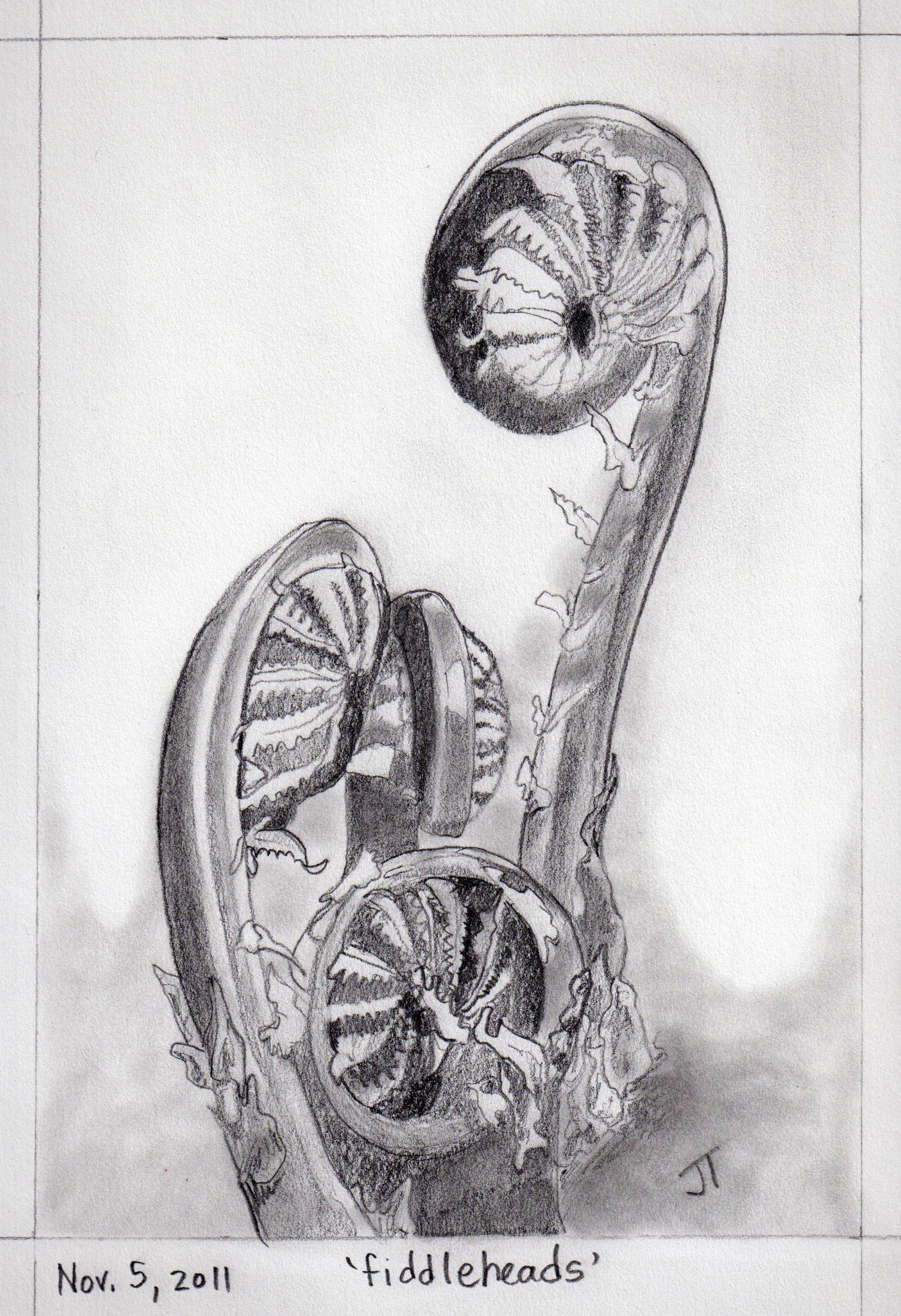
Although the fiddleheads of the Ostrich Fern are edible and a delicacy in New Brunswick, all fiddleheads are not edible. The fiddlehead is the tightly-rolled, earliest emergence of the immature fern leaf. This coil of the leaf resembles the head of a fiddle, hence the name. As time passes, the fiddleheads uncoil and become the mature leaves of the fern.
In the Grey Woods, we have two species of fern with very distinctive fiddleheads.
The fiddleheads of the Sensitive Fern (Onoclea sensibilis L.) are slim and red. They are not edible and are poisonous to horses.

red fiddleheads of the Sensitive Fern are hard to see against the dried leaf layer
The Sensitive Fern grows at the edges of the Grey Woods, along our house foundation and in a large patch on our ‘lawn’.
The common name ‘sensitive’ refers to the fern’s characteristic dying at the first frost. The Sensitive Fern is also called the Bead Fern, a reference to the hard brown spore cases on the fertile spikes. Once the green leaves have died, only the tall brown fertile spikes remain, and these persist until spring. The Sensitive Fern is a once-cut fern (the leaves are cut once into simple leaflets) with wavy margins and sometimes deep indentations in the leaflets. The upper leaflets are ‘winged’ or ‘webbed’ where they join the main axis of the plant.
The fiddleheads of the Cinnamon Fern occur in clumps and are densely covered with coarse white hairs. The fiddleheads can be eaten but are not used as commonly as those of the Ostrich fern.
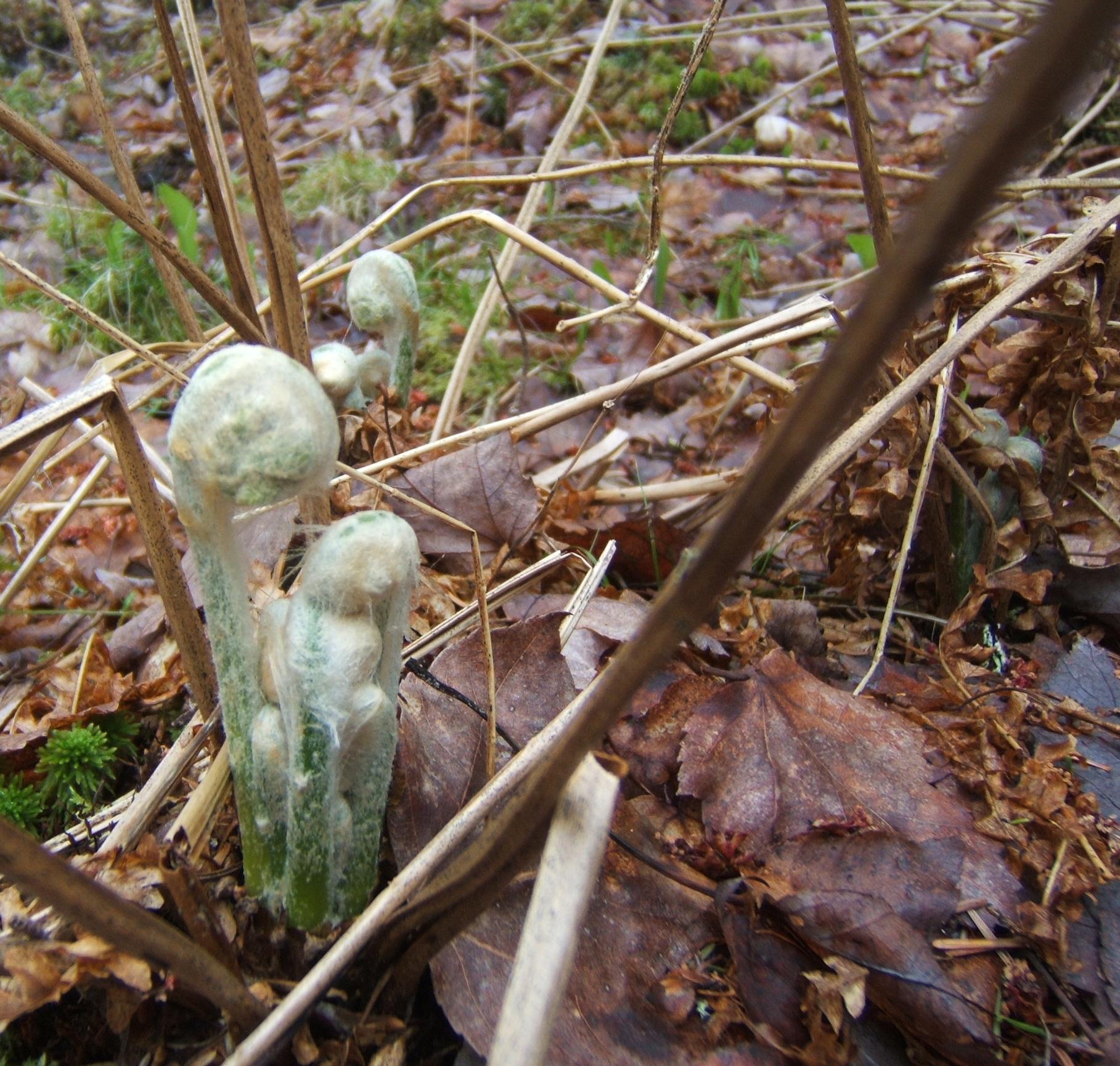
the wooly fiddleheads of the Cinnamon Fern are common in wet woods in New Brunswick
The Cinnamon Fern (Osmunda cinnamomea L.) grows in wet woods and other water-logged areas. In our Grey Woods, it grows in the fern gully (see the ‘map of the grey woods’ under ‘about‘).
Cinnamon Fern is a twice-cut fern (the leaves are cut into leaflets and these, in turn, are cut into sub-leaflets). As the sterile leaves expand, you can see fine cinnamon-colored wooly hair along the stalk, and tufts of cinnamon-colored hairs on the underside and at the base of each leaflet. The plant produces separate fertile spikes that turn cinnamon-brown in color.
~
~
fiddleheads
~
thin music in the May-woods,
trowie tunes from the peerie folk,
a bridge between spring
peepers and the wind,
fiddleheads carved in
Sensitive red and Ostrich green,
the bow strung by spiders,
the riff in the violin trembles
as potential uncoils,
music befuddled in a web
of Cinnamon wool
~
~
© Jane Tims 2012
Warning: 1. never eat any plant if you are not absolutely certain of the identification; 2. never eat any plant if you have personal sensitivities, including allergies, to certain plants or their derivatives; 3. never eat any plant unless you have checked several sources to verify the edibility of the plant.making friends with the ferns #1
November is an odd time to think about identifying ferns, I admit. But identification of the evergreen ferns is still possible, as they hang on to their identity in the frosty air and even beneath the snow. Also, ferns are so beautiful, it is fun just to look over the field guides and reminisce about the days of summer.

a pressed Long Beech Fern in my copy of Boughton Cobb’s ‘Field Guide to the Ferns’
Ferns belong to the group of vascular plants known as the Pteridophytes. They have stems, roots and leaves but no seeds. Instead, they reproduce by spores and have complicated life cycles.
Ferns grow in many habitats. In our area they are found in moist and shaded woodlands. They are also inhabitants of fields, cliffs, wetlands and cityscapes. I have even seen ferns growing deep within the Howe Caverns of New York State where they have taken advantage of the scant habitat provided by artificial lighting.
The uniform ‘greenness’ of ferns and their highly patterned leaves make them popular as a motif, especially for home decorating and at Christmastime.
In New Brunswick, fiddleheads, the tightly coiled new leaves of the Ostrich fern (Matteuccia Struthiopteris (L.) Todaro), are collected for food every spring along the banks of rivers and their tributaries.
~
waking from a dream
Ostrich Fern (Matteuccia Struthiopteris(L.) Todaro)
~
bottom-land thicket
naked in spring
a rumpled bed
the throws of hibernation
~
new growth cocooned
in dry leaves, bent skeletons
of last summer’s fern
~
sun surge
an insult
between curtains
~
green fiddlehead
uncoils
head down
fist thrust
between pillows and down
fingers stretched
filigreed shadow
new blocking of sun
~
brown coverlet
kicked
~
new green bedspread
new green canopy
green shade
~
© Jane Tims 2011




 nichepoetryandprose