Posts Tagged ‘ethics’
growing and gathering – ethics
Some of the poems in my collection will address the ethics of eating wild plants as food.
As a botanist, I know how many wild plants are edible. However, I also know there are ethical considerations to eating wild plants.
Plants differ greatly in their availability. Eating Dandelion greens puts no pressure on the survival of the Dandelion. Weedy species in general respond well to being harvested, by putting out copious seeds, by filling in the spaces with new rhizomes and shoots, and by growing in many habitats and conditions.
However some plants are very specific in their requirements. They need certain conditions of light, moisture and soil to thrive and reproduce. On our own property, I have watched the Painted Trillium (Trillium undulatum Willd.) struggle to maintain its presence. The Painted Trillium needs acidic, rich soils and lots of shade. Remove a single tree, cut a new trail, or let the Balsam Fir overtake the understory, and the place where a few Trilliums grew in previous years is suddenly vacant. The young leaves of the Painted Trillium can be used as a pot herb, but should I pick them to add to my knowledge about eating local foods?
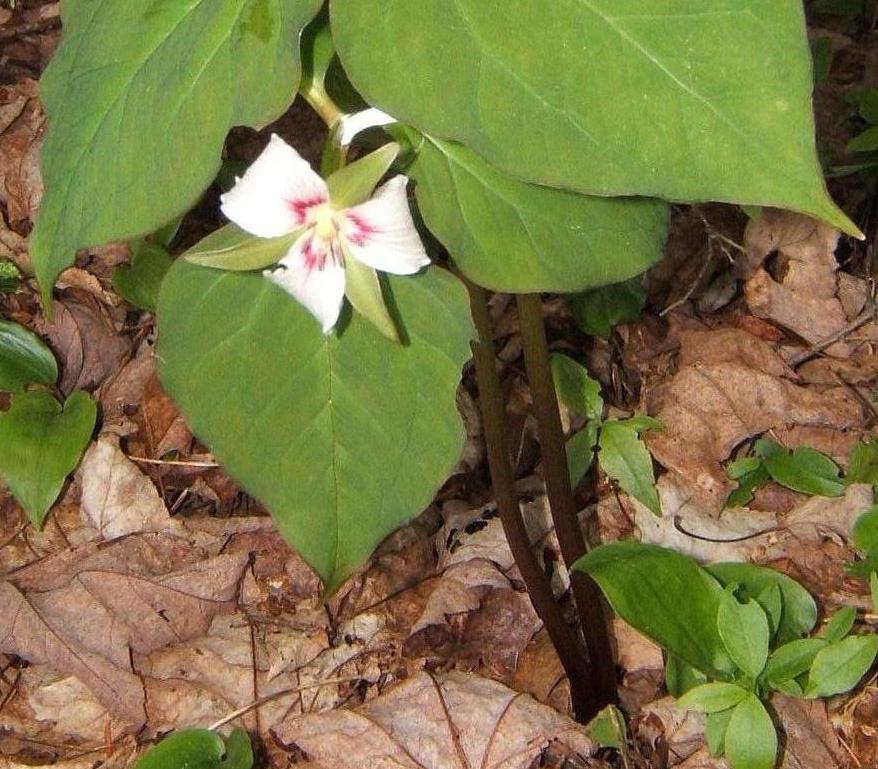
a Painted Trillium in our Grey Woods, near the end of its blooming
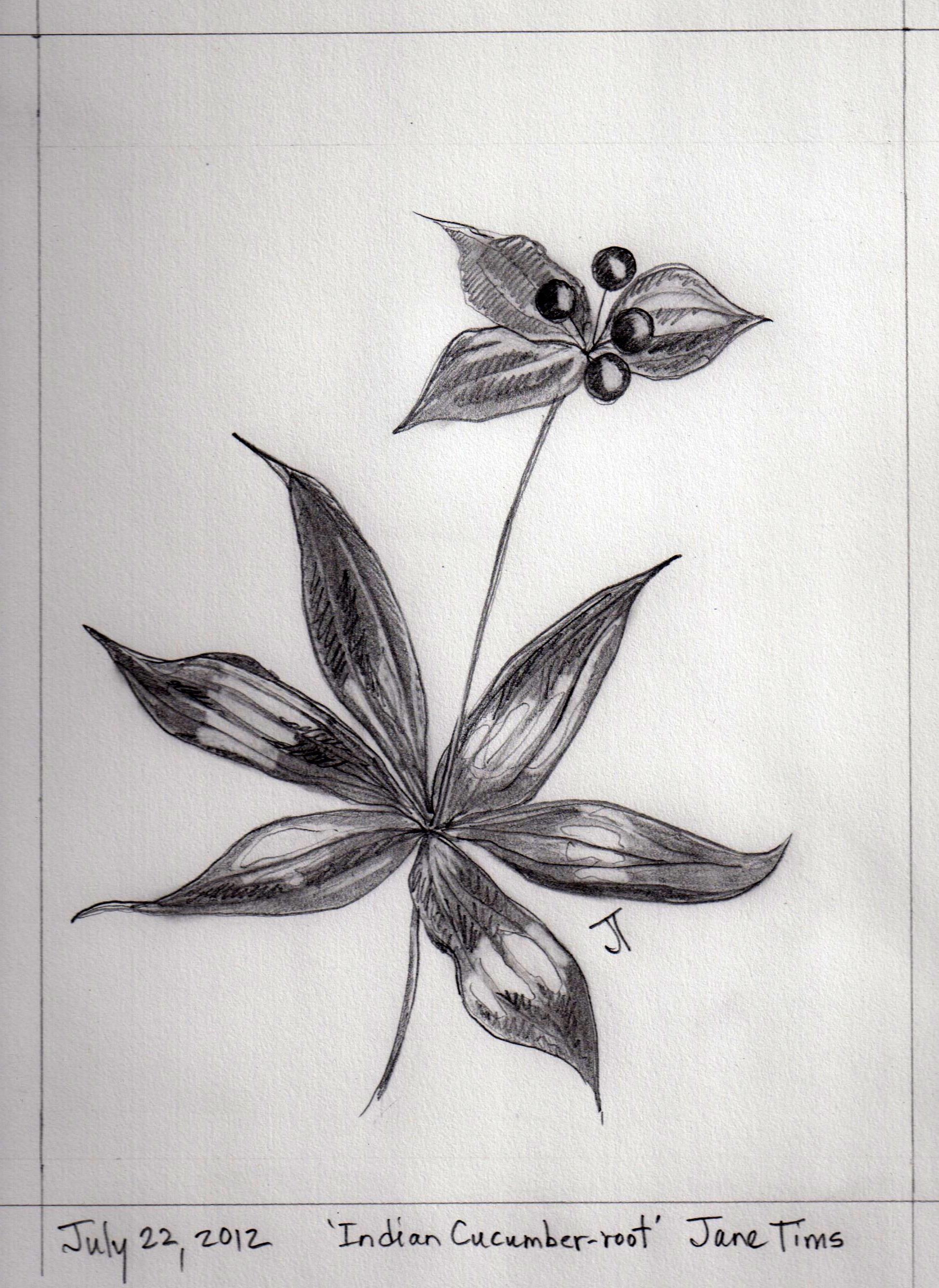
Many woodland plants deserve this special consideration. In his Flora of New Brunswick (2000), Hal Hinds wrote, of the Indian Cucumber-root (Medeola virginiana L.): “… Although this plant produces a deeply rooted, 2-3 cm edible white tuber with a bland cucumber taste and crisp watery texture, it is truly unfortunate to destroy the plant for such a tiny morsel…”
In some circumstances, harvesting and eating these rarer wildflowers would be acceptable. In the past, for example, people of the First Nations depended on wild plants for their existence. A lost hiker, needing sustenance or hope in an emergency situation, could be excused for eating any edible wild plant.
In other circumstances, rarity, the size of the population, and habitat health are probably the fundamental issues. Take the time to know a little about the plant you are thinking of picking. Is its habitat under stress or becoming hard to find? Is it rare, threatened or endangered? Local abundance may not be a deciding factor, since rare plants often grow abundantly where they are able to grow.
Eating local is an environmentally responsible life-style choice. It saves energy and supports local farmers. Eating local wild plants as food is a nutritious and thrifty way to supplement the larder. But these benefits must be weighed against the possible harm to plant populations.
Pick with some rules in mind. Understand the plant you harvest. Gather only what is sustainable. Sometimes this means gathering nothing at all.
~
~
Indian Cucumber-root
(Medeola virginiana L.)
~
step carefully
in your quest,
lured to the wood
by a sorceress
~
search carefully
among the shoots
for Indian
Cucumber-root
~
count carefully-
two layers of leaves
purple berries
stalk wool-sheathed
~
dig carefully-
below the stem
in dark, damp earth
awaits a gem
~
clean carefully
leave no trace
of the woodland soil
on the creamy face
~
taste carefully-
best to savour-
slightly celery
in flavour
~
think carefully
now you possess
one dead plant
and emptiness
~
~
© Jane Tims 2012




 nichepoetryandprose