Posts Tagged ‘Bunchberry’
Bunchberry (Cornus canadensis L.)
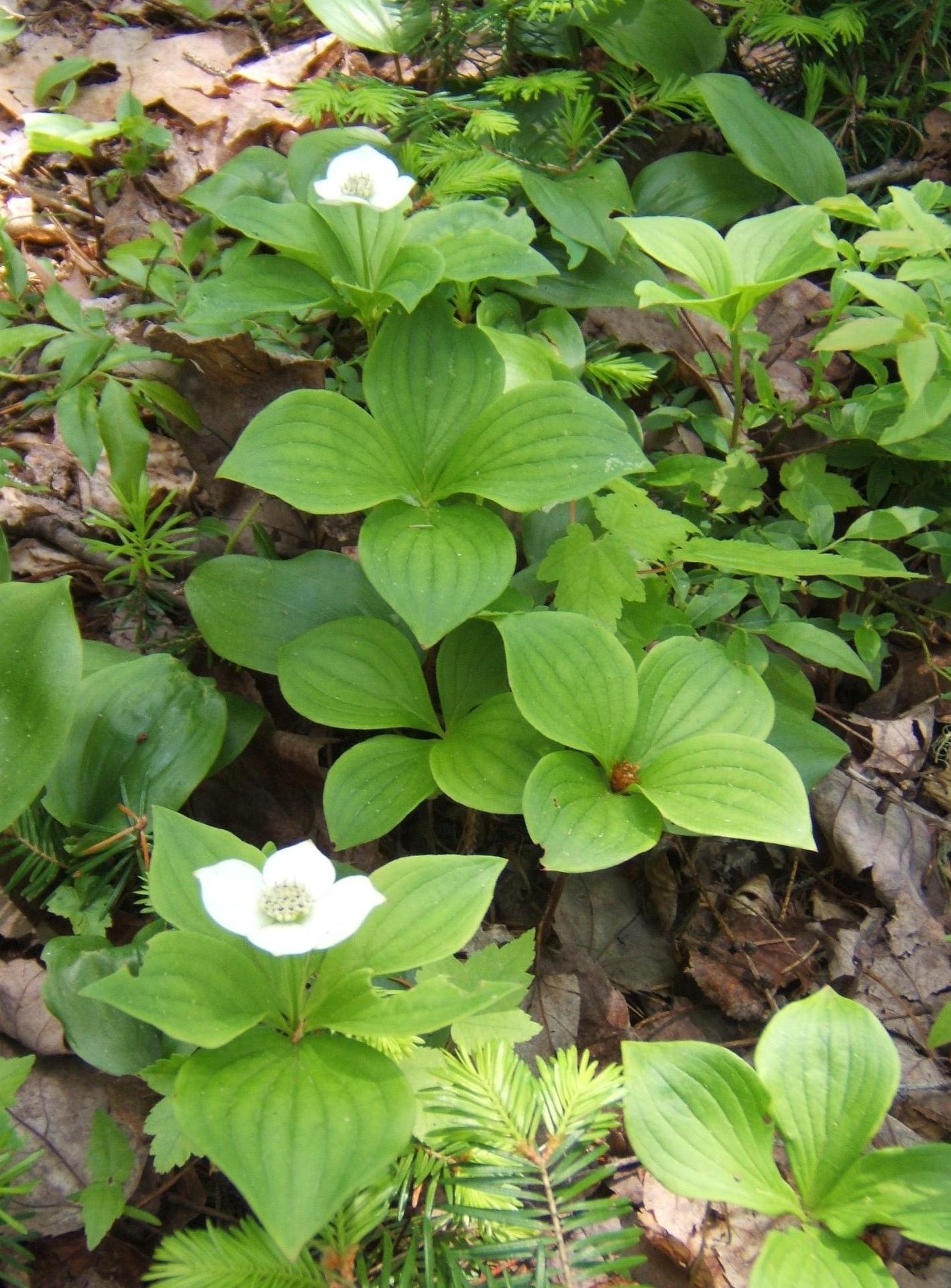
Bunchberry is so common in our Grey Woods, I think of it as a friend. When I walk our paths in the spring, its white ‘flowers’ glow around me. In late summer and autumn, it offers its scarlet bunches of berries freely. It was one of the first plants I learned to identify.

Bunchberry (Cornus canadensis L.) is also called Crackerberry, Dwarf Cornel, and Pudding-berry. In French, it is called quatre-temps. It belongs to the Dogwood family of plants. Although some Dogwoods are low-growing herbaceous plants like Bunchberry and some are large shrubs, such as Red Osier Dogwood (Cornus stolonifera Michx.), all have similar leaves – ovoid with pointed tips and a distinctive venation pattern, the parallel veins all arising from the midrib of the leaf. The generic name Cornus comes from the Latin cornu meaning a ‘horn’, descriptive of the hardness of the wood. The name ‘Dagwood’ is derived from the word dagge meaning a dagger or sharp object, a reference to the use of the wood of the European Cornus sanguinea L. as skewers for meat.
Bunchberry grows in cool woods, on roadsides and slopes, and in barrens. It is low-growing, and creeps via underground rhizomes or root-like stems.
The form of the Bunchberry is distinctive. It consists of a short woody stem with a false whorl of six leaves. Just below the whorl is a smaller pair of leaves. The whorls of leaves are all at the same level in the forest, creating a single ‘surface’ of green.
The flower of Cornus canadensis blooms from May to July and is at first greenish, changing to a dazzling white. The blossom is composed of four petal-like bracts enclosing a central cluster of tiny purplish flowers.
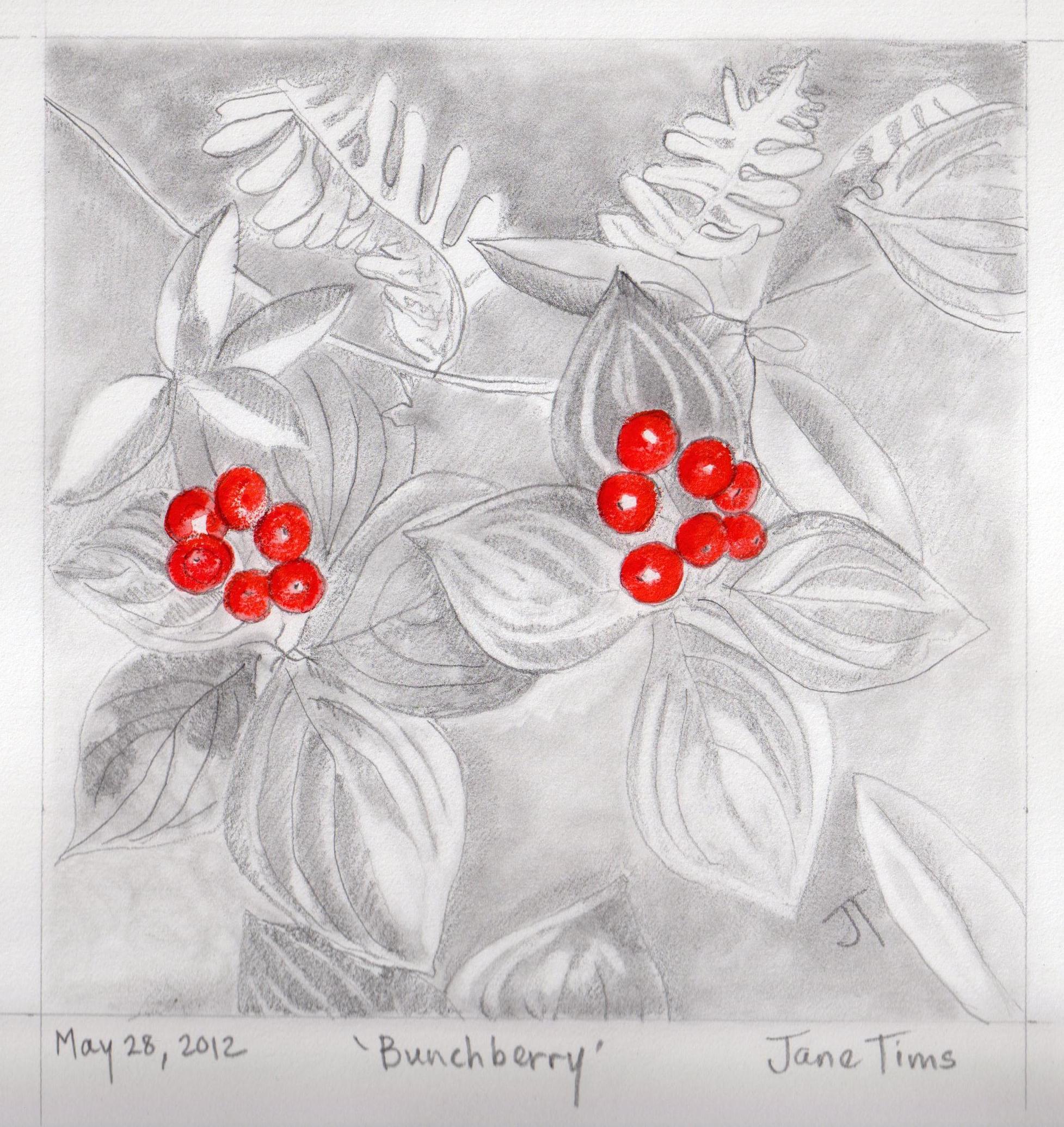
The berries of Bunchberry ripen in late summer and are bright scarlet, held in a tight cluster. The berries are sweet and great as a trailside nibble. They can also be made into jam or a berry pudding. Most guides describe them as ‘insipid-tasting’ but I find them quite pleasant. Unfortunately, each berry has a large seed, so enjoying a mouthful of berries is a challenge!
There is evidence Cornus canadensis and other Cornus species were included as part of the diet of prehistoric peoples in New Brunswick. Dr. David Black, an archaeologist at the University of New Brunswick, found a charred seed of what may have been Cornus canadensis in his excavation of a shell midden on Partridge Island in the southwest area of the province. Charred seeds of the dogwood species Cornus rugosa Lam. have been found by another archaeologist, Dr. Kevin Leonard, in excavations at Skull Island along the east coast of New Brunswick.
~
~
Bunchberry
Cornus canadensis L.
~
step lightly –
leaf-whorls of Bunchberry
are cobblestones, the green-between
~
Partridge-berry, ground-creeper
and landing platforms of Bracken
and Wild Sarsaparilla
~
elevated ways for fairy-folk
white flowers, four-weather beacons,
guideposts through the forest
~
bunches of berries, red-heaped into aprons
are pudding for dinner
~
or winter-fare, gleaned by a gatherer,
flavored by fire
~
a nibble to cheer a hiker
lost in the forest
~
~
© Jane Tims 2012
~
~
Sources:
David W. Black, 1983, What Images Return: A Study of the Stratigraphy and Seasonality of a Small Shell Midden in the West Isles of New Brunswick, M.A. Thesis, Department of Anthropology, McMaster University.
Kevin James Malachy Leonard, 1996, Mi’kmaq Culture During the Late Woodland and Early Historic Periods, Ph.D. Thesis, University of Toronto. http://independent.academia.edu/KevinLeonard/Papers/623902/Mikmaq_culture_during_the_Late_Woodland_and_Early_Historic_periods Accessed May 27, 2012.
Warning: 1. never eat any plant if you are not absolutely certain of the identification; 2. never eat any plant if you have personal sensitivities, including allergies, to certain plants or their derivatives; 3. never eat any plant unless you have checked several sources to verify the edibility of the plant.




 nichepoetryandprose