nichepoetryandprose

poetry and prose about place

on my bookshelf – Covered Bridges of Central and Eastern Canada by Lyn and Richard Harrington

with 5 comments

Thanks to a friend, I have added a gem to my small collection of covered bridge books! Covered Bridges of Central and Eastern Canada, published in 1976, gives a glimpse of days when there were over a hundred covered bridges still standing in New Brunswick.

~

Scan0027

~

Harrington, Lyn and Richard Harrington. Covered Bridges of Central and Eastern Canada. Toronto: McGraw-Hill Ryerson Limited, 1976.

~

Covered Bridges of Central and Eastern Canada includes black and white photos (and two in colour) of many of the covered bridges of the time, including one of the Southwest Otnabog Covered Bridge on Base Gagetown.

~

These photos provide a glimpse into history: the types of signage used, the vintage cars, and the land uses in the vicinity of the bridge. Photos show the stacking of wooden lobster traps and log drives on the river. From the days when the bridges were used for private notices, there are photos of a circus poster and a painted eye glass advertisement.

~

The book also includes written information on the history of covered bridges, bridge construction, enemies of the covered bridge and hopes for the future. The text covers topics such as traditions and superstitions, sources of bridge names, and anecdotes. I like the detailed story of the creation of the picnic park beside the Patrick Owens Bridge in Rusagonis.

~

The Chapter ‘Hope for the Future’ is informative and somewhat sad. In the 1970s The League for Rural Renewal was seen by the author as the cornerstone for covered bridge protection and appreciation.

~

Since the book was published, we have lost over forty covered bridges. On the positive side, appreciation for rural landscape is still alive in New Brunswick, evidenced by the many efforts of the Department of Transportation and Infrastructure. On our visits to covered bridges we have seen new roofs, mended walls and upgrades to abutments. Some of the photos in the book show deteriorated bridges now renovated and mended.

~

The book provides a list of covered bridges in New Brunswick and Quebec in 1970. Although the list includes the names of 101 covered bridges in New Brunswick, the authors say 113 bridges existed in 1974/75 when they made their visits. The book also says there were 307 covered bridges in New Brunswick in 1950. Many of the names in the list are no longer familiar in today’s covered bridge lexicon: two bridges over the Shikatehawk River in Carleton County; Windgap Brook #1 in Kings County; Southwest Long Creek in Queens County; and Chemical Creek #1 in Albert County. As a point of interest, in the 1960s, there were still three covered bridges in Nova Scotia.

~

The Foreword to the book is by Milton Gregg, born in Kings County, New Brunswick – cabinet minister, recipient of the Victoria Cross for bravery in World War II and Officer of the Order of Canada. He was also the founder and head of the League for Rural Renewal mentioned above.

~

I was very fortunate to receive my copy of this book from a friend and I thank him again for the gift. Amazon lists the book as available through one of their associated sellers.

~

Copyright 2016 Jane Tims

on my bookshelf –  A Photo Tour of the Covered Bridges of New Brunswick by Ray Boucher

with 2 comments

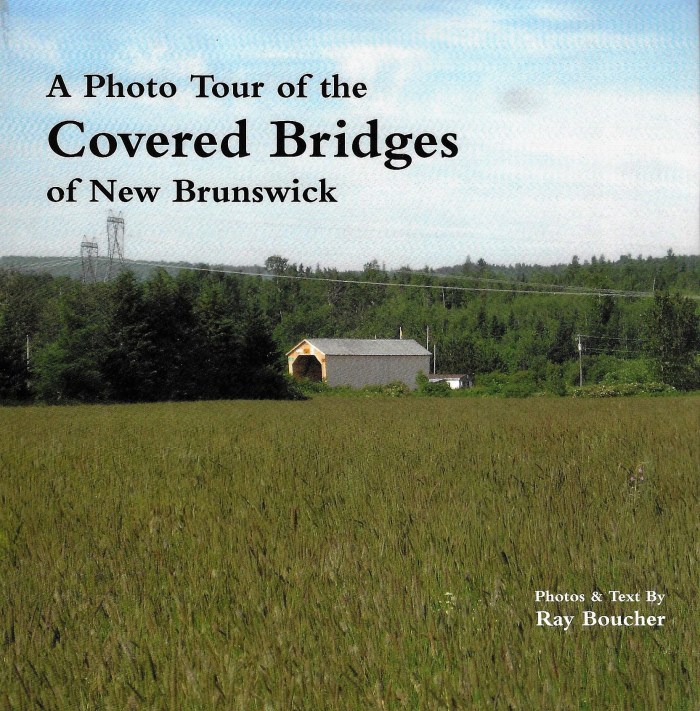
As I make revisions to my poetry manuscript ‘in the shelter of the covered bridge’, my collection of books about covered bridges in New Brunswick provides needed reference material. Ray Boucher’s book A Photo Tour of the Covered Bridges of New Brunswick looks at the 64 covered bridges present in the province in 2008. Today only 60 of these remain.

~

Scan0026

~

Ray Boucher. A Photo Tour of the Covered Bridges of New Brunswick. Kissing Bridge Publications, 2009.

A Photo Tour takes the reader county-by-county to discover New Brunswick’s covered bridges. Many of the bridges are shown in more than one photo and photos were taken in every season. I particularly like the photos showing a bridge from up or downstream.

~

Now gone from this record of 64 are the Adair Bridge (North Becaguimec River #1) (lost to fire in 2009), the Aaron Clark Bridge (Canaan River #1) (lost to flooding in 2014), the Stone Ridge Bridge (Keswick River #6) (lost to fire in 2008), and the Mangrum Bridge (Becaguimec River #3) (lost to fire in 2011). My version of the book has notes added in red to indicate the 2014 and 2008 losses. The historical value of this book is the photographic record of these four bridges as well as those still standing.

~

Each photo is accompanied by facts on bridge length and date of construction, and interesting notes and anecdotes on the bridge and the photographer’s visit. Since my husband accompanied me on my visits to the covered bridges I am writing about, I liked reading that this book was also a husband and wife effort!

~

I was able to buy a copy of this book on Amazon.ca … my collection of books about covered bridges is growing!

~

Copyright 2016 Jane Tims

morning bird chorus – ephemera

with 7 comments

When I was a child, one of the things I prized was my collection of ‘bird cards’. These were an advertising give-away from ‘Cow Brand Baking Soda’ (Church and Dwight Limited, Montreal, Canada).

~

Scan0025

~

I would spend hours looking at these, putting them in order of the ones I liked best, thinking about the birds depicted. The Meadowlark was a local bird I had seen many times and his call was as familiar to me as breathing – he always made it to the top of the pile! Today the winner would be the Cedar Waxwing who sits in the tops of the pines at our cabin, or the Goldfinch who spends all winter at our feeders!

~

Scan0021

~

Today I still have two packs of these cards. They are in sets of 16 in a paper envelope. The card sets are called ‘Useful Birds of America’ and the front of each card shows an image of a bird by artist Louis Agassiz Fuertes (1874-1927), an American ornithologist and artist. On the back, there is a tip on how to use ‘Cow Brand Baking Soda’, the bird’s common name, its scientific name and a charming paragraph about its appearance and habits. The card concludes with a short message still relevant today:

For the good of all, do not destroy the birds 

~

Scan0022

~

Copyright 2016 Jane Tims

Written by jane tims

August 3, 2016 at 8:22 am

remembering spring – wild strawberries

with 2 comments

I have completed one of the paintings I am preparing for my fall sale of books and paintings. This painting is of the wild strawberries growing at our cabin property.

~

Scan0020

July 31, 2016 ‘wild strawberries’ (acrylic, gallery edges, 10″ X 8″) Jane Tims

~

I hope when you see these paintings, they will remind you of the berry-picking seasons to come!

~

Copyright 2016 Jane Tims 

Written by jane tims

August 1, 2016 at 7:00 am

plants along the roadside – wild hops

with 7 comments

When we go for drives to find covered bridges or one room school houses, I always watch the roadside for plants familiar and unfamiliar. This habit comes from years of work as a botanist. As we drive, I name the plants I know. Sometimes there is a huge surprise!

~

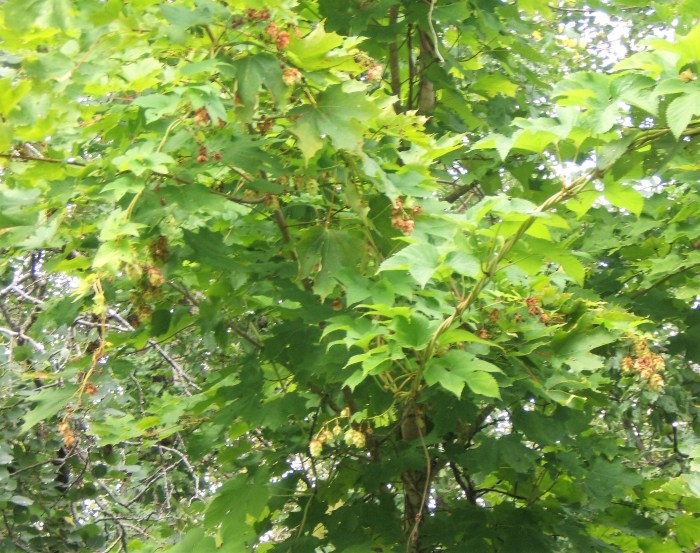
While driving in Victoria County last year, looking for a covered bridge, we travelled a short way on a side road. The road became quite rough and narrow and soon we were searching for a good place to turn. There, away from any habitation, among the vegetation on the side of the road, was something different: large 3 to 5-lobed leaves, climbing tendrils and golden cone-like flowers. A vigorous ‘wild’ hop vine. I was thrilled!

~
2015 019


~

Hops (Humulus sp.)  is well known as a stabilizing and flavouring agent in beer. The hops contain various flavonoids, acids and oils which impart smell and taste to beer.

~

2015 020


~

When I got home, I went hunting on the Internet and discovered a CBC article describing an Agriculture Canada study about native hops. http://www.cbc.ca/news/canada/prince-edward-island/hops-research-could-aid-beer-industry-1.3136764

The researchers, Jason McCallum and Aaron Mills, were (and still are) asking for the public’s help in locating wild hops in the Maritimes. Needless to say, I contacted them.

A couple of weeks ago, I learned they were coming to New Brunswick to find my hops plant. To make sure we could give them good directions, my husband and I drove to Victoria County to see if the plant was still there. It was growing more vigorously than ever, climbing among the top branches of a downed tree.

~
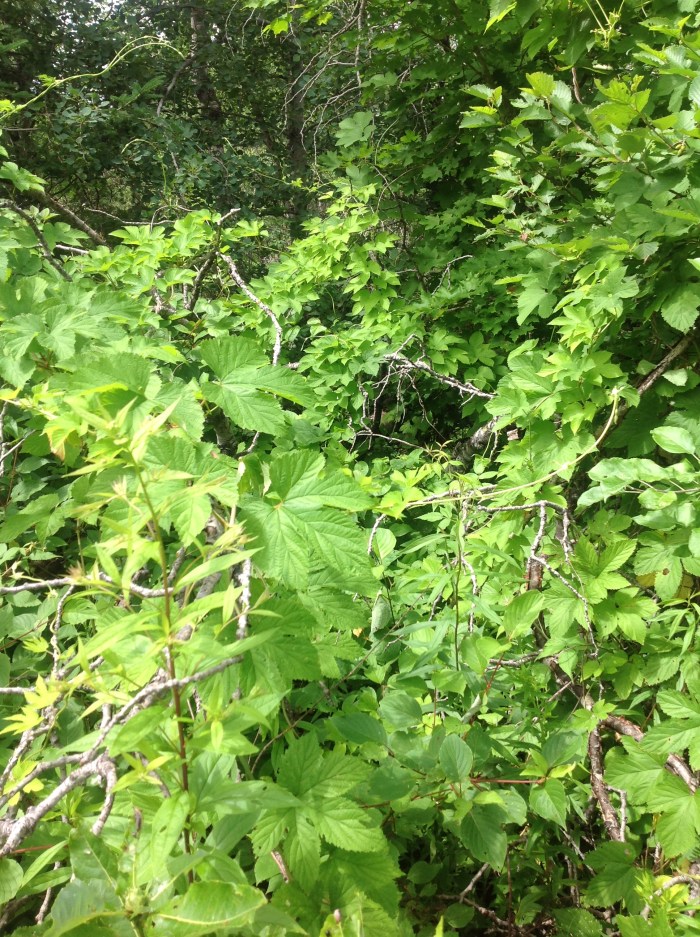
IMG_4614


~

With our improved directions in hand, the Agriculture Canada team found the hops plant, a couple of hours after a road crew went through with bush saws to widen the road!!! However, the team was able to take the samples they needed and assured me that the plant was so vigorous, it would be able to recover and continue to thrive!

~

IMG_4608


~

The researchers at Agriculture Canada will do genetic analyses to determine if the plant is native to North America (var. lupuloides), an escaped European hops (Humulus lupulus) or a hybrid between the two. The purpose of their study is to examine hops native to New Brunswick to see if they have resistance to disease and pests. Discovery of a native hops variety, perhaps with unique properties, flavours and aromas, would be valuable to a local brewing industry.

~

Hops are cultivated around the world.  The Agriculture Canada researchers think ‘my’ hops plant may have been grown on a now-abandoned homestead. These folks may have grown the hops as a way of making starter cultures of yeast for bread-making. The elements in hops are toxic to bacteria but tolerated by yeast. Starter cultures resulted when yeasts colonized standing mixtures of hops and a sugar like molasses.

~

This experience has reinforced my passion for ‘ditch-combing’ … I am so lucky to have my husband as driver so I can spend my time scanning the road side. If you live in the Maritimes, keep your eyes open and if you see a wild hops plant, let the researchers at Agriculture Canada know!

~

Copyright Jane Tims 2016

Written by jane tims

July 29, 2016 at 7:00 am

getting ready for fall

with 5 comments

It may seem early, but I have my sights set on November. I plan to sell my book and some of my paintings at a local Christmas market. To have enough paintings ready for the event, I have to start now! Just a bit at a time since I also have to finish two larger canvases already begun!

~

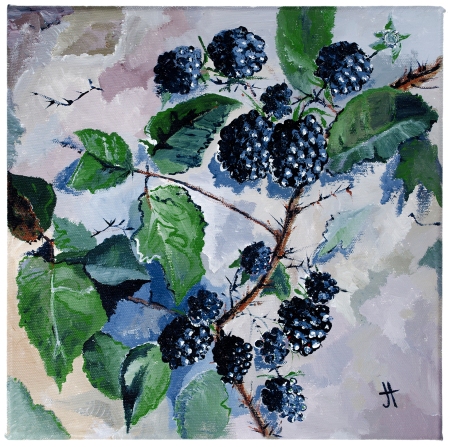
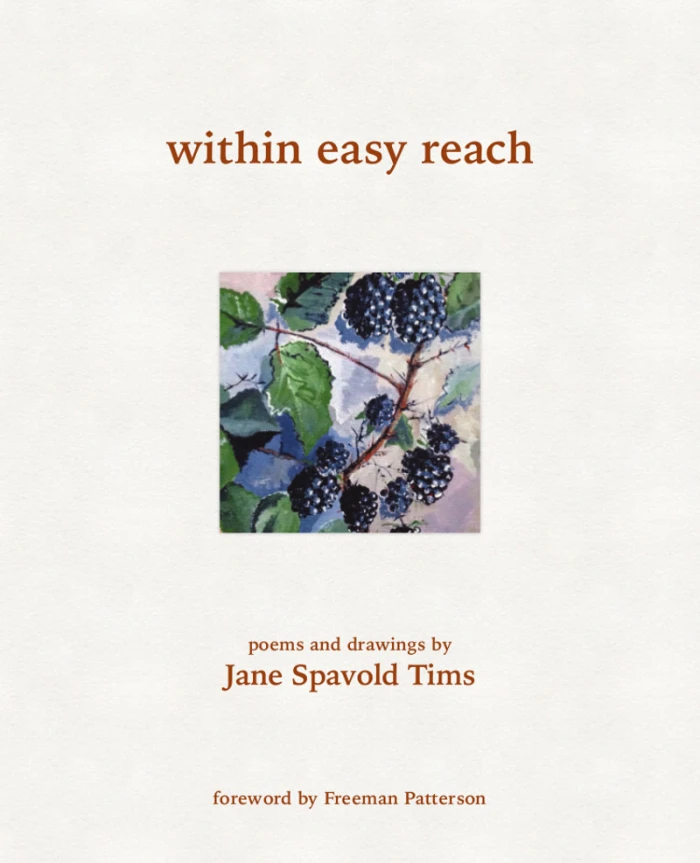
This will be a chance to see if I can sell copies of my book ‘within easy reach’ in a market setting. To keep in the theme of gathering wild edibles, the paintings for sale will be of some of the wild fruit we have in New Brunswick:

  • blackberries, in the style of the painting on the cover of my book
  • wild strawberries
  • raspberries
  • low bush blueberries
  • apples

~

IMG_4776

canvases, edges prepared and ready for paint!

~

Since I dread just sitting behind my table, waiting for someone to have a closer look, I will take a couple of canvases and paint as I wait!

~

!cid_A570666B-7C46-4223-8857-0A35F2DC2B1E

~

Copyright 2016 Jane Tims

Written by jane tims

July 27, 2016 at 4:17 pm

two old schools in Carleton County, New Brunswick

with 2 comments

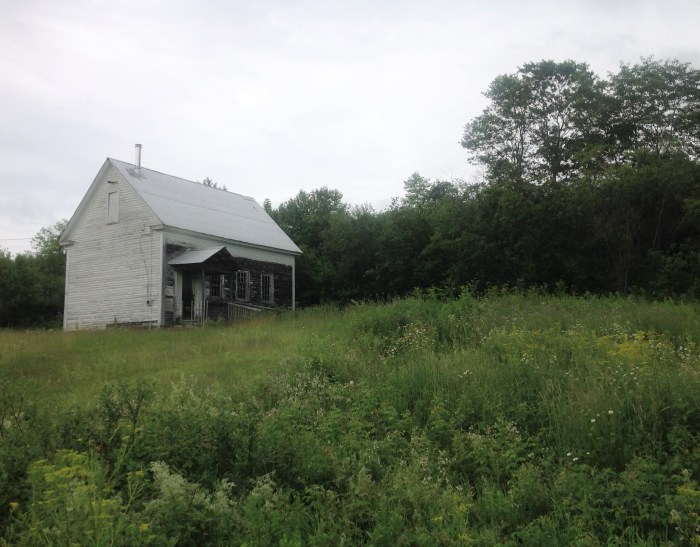
On our way home from Victoria County last weekend, we took the rural road from Hartland through Millville. We found two old one room schools along the way.

~

carlisle area schools

The location of two old schools in Carleton County. (Map Source: New Brunswick Atlas, Second Edition, 1998)

~

IMG_4686

The first of these was in Lower Windsor, Carleton County (once called Windsor Settlement).

in 1898 Lower Windsor was a settlement with a post office and a population of 100

to the north was Windsor, settled about 1840: PO 1864-1945: in 1866 Windsor was a farming settlement with approximately 50 resident families: in 1871 it had a population of 200: in 1904 Windsor had 1 post office, 1 store, 1 church and a population of 200.

Source: Provincial Archives of New Brunswick

~

When I got out of the truck to take some photos, I was overwhelmed by the smell of licorice. The source was Wild Fennel (Foeniculum vulgare Mill.), probably planted at the site (now used as a cottage).

~

IMG_4706

Carlisle School, Carleton County 2016

~

The next school was in Carlisle, Carleton County.

first called Northville Settlement: renamed Carlisle with creation of the post office: PO 1877-1924: in 1898 Carlisle was a settlement with 1 sawmill, 1 grist mill, 1 church and a population of 300.

Source: Provincial Archives of New Brunswick

~

The door of this old school was open to the elements.

~

Although I intend to focus my ‘old schools’ writing project in Kings, Queens, Sunbury and York Counties, I am delighted to have found these old schools in Carleton County!

~

The distance between these two old schools was 4.5 kilometres. Not far unless you are a young child on a snowy day!

~

Copyright Jane Tims 2016

Written by jane tims

July 25, 2016 at 7:00 am

uphill and down

with 8 comments

While doing a search for a particular plant we know grows in the area, my husband and I took a side road through rural Victoria County in New Brunswick. We drove from Route 109 (near the top of the map), south through Upper Kintore and Lower Kintore, to Muniac, a distance of about 23 kilometres.

~

IMG_4672

(Map Source: New Brunswick Atlas, First Edition)

~

Kintore was settled in 1873 and named for the town of Kintore near Aberdeen, Scotland. In 1898, Kintore was a railway station and had a post office and a population of 75. (Source: New Brunswick Archives)

~

IMG_4637

church and school house in Upper Kintore 2016

~

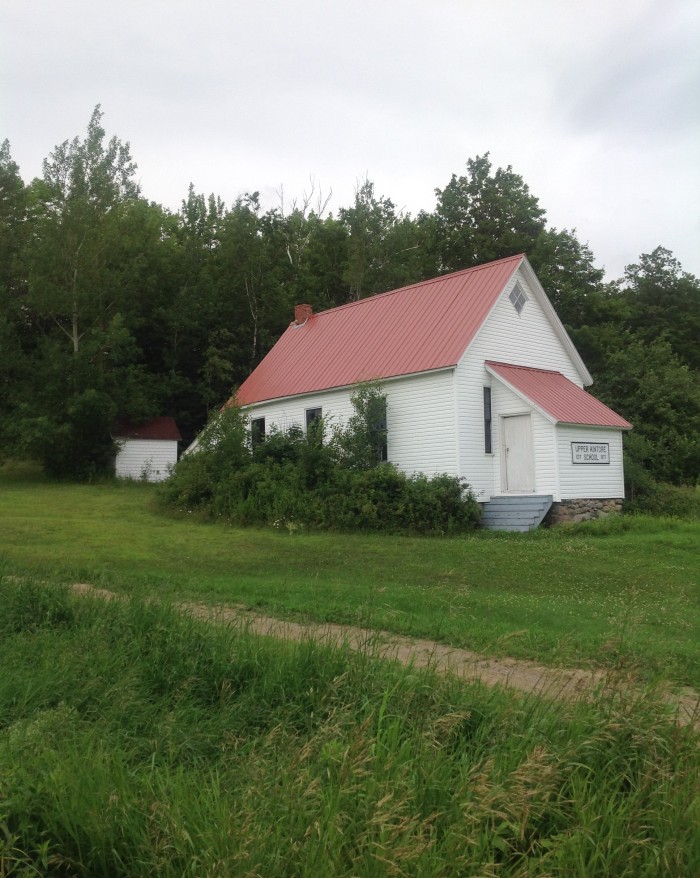
Interesting to me was the very well-cared-for one room Upper Kintore School, built in 1877.

~

IMG_4652

Upper Kintore School built 1877

~

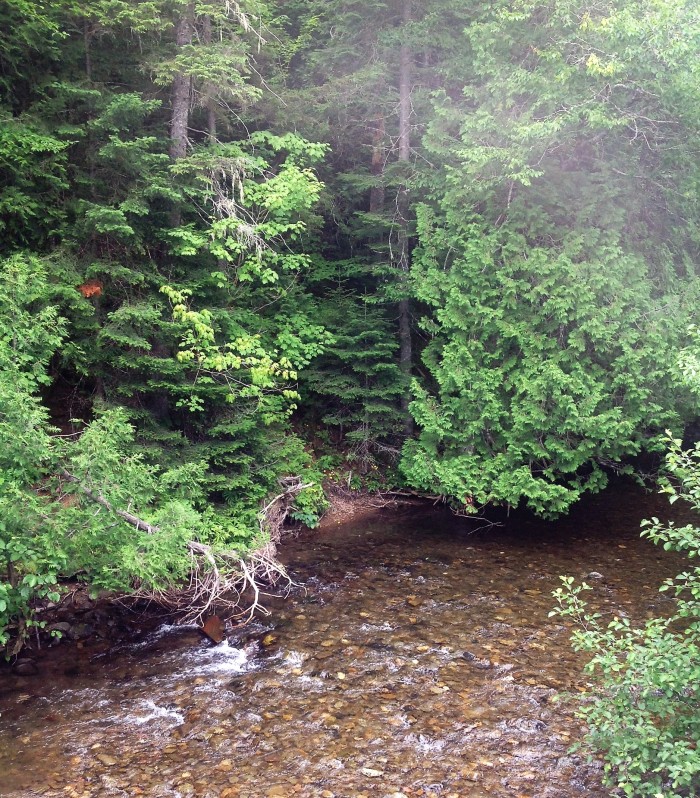
Our drive took us uphill through Upper Kintore, along Big Flat Brook (a tributary of the Tobique River). The road peaked at Lawson Hill and then ran down, through Lower Kintore. Again, the road followed a watercourse, the Muniac Steam (a tributary of the Saint John River). As we drove we talked about the road — the earliest roads took the easy way, along the brooks. The southern part of the road was banked by steep rocky roadcuts.

~

IMG_4662

the Muniac Stream near Lower Kintore

~

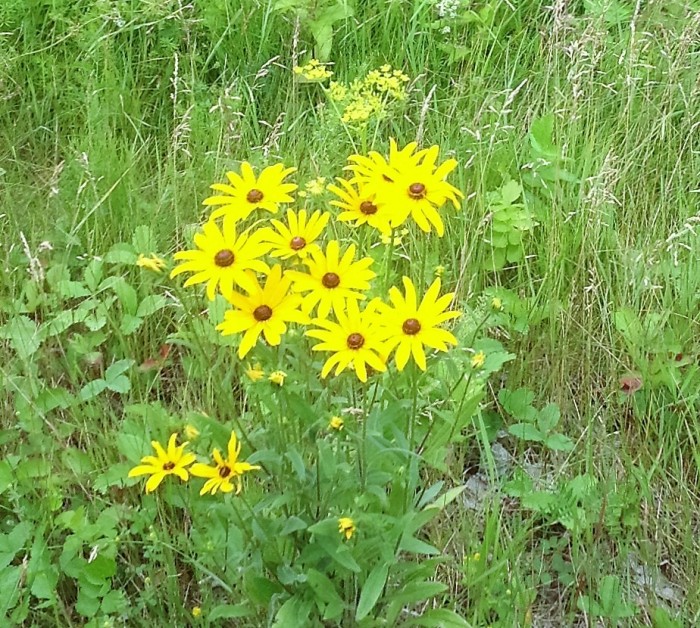
Since I am interested in the plants children might encounter on their way to school, I was happy that this is the time in New Brunswick when most of our roadside wild flowers are in bloom. We saw Black-eyed Susan (Rudbeckia serotina Nutt.), Red Clover (Trifolium pratense L.), Bedstraw (Galium sp.), Daisy (Chrysanthemum Leucanthemum L.), Bladder-Campion (Silene Cucubalus Wibel) and Meadow Rue (Thalictrum polygamum Muhl.). Quite a bouquet! I have to remain aware that some of these plants have become very weedy and invasive since the early 1900s and may have been hard to find in the 1800s. For example, in the photo below, just above the Black-eyed Susan, you will notice a plant of Wild Parsnip (Pastinaca sativa L.). In New Brunswick, Wild Parsnip is a invasive species, probably introduced by Europeans in the 18th century as a food source.

~

IMG_4671

Black-eyed Susan along the road

~

Do you have any favorite rural drives through communities with interesting histories?

~

Copyright Jane Tims 2016

within easy reach – winner of ‘berries and brambles’ painting

with 2 comments

I am so pleased to announce the winner of my painting ‘berries and brambles’.  The winning raffle entry was drawn at a dinner I attended this week in Fredericton.

~

The winner is Margo Sheppard, Fredericton!

~

Congratulations Margo!!! The painting ‘berries and brambles’ is yours. Thanks to all those who entered!

~

berries and brambles

April 24, 2016 ‘berries and brambles’ Jane Tims

~

Holding the raffles for my paintings has been a very enjoyable part of the process of marketing my book! I’ll be offering another painting to win at my reading at Tidewater Books in Sackville in the fall!

~

Copyright 2016 Jane Tims

Written by jane tims

July 21, 2016 at 7:39 am

early schools – old maps, photos and diaries

with 6 comments

Last week, my husband and I visited the New Brunswick Museum Archives and had a look at three sources of information on old one room schools in New Brunswick:

  • the Walling Map – shows the location of roads, family homes, businesses, churches and schools in 1862 in Kings and St. John Counties
  • the photo collection by Marion Johnston Dunphy who photographed 150 schools from 1974 to 1984 – The One Room Schools of New Brunswick and What Became of Them
  • the diary of C. Gordon Lawrence, teacher at the Tracy school (Sunbury County, New Brunswick) in 1903. His diaries chronicle his experiences as a school teacher from 1903 to 1962!

~

Thanks to the Walling Map, from now on, when we go for a drive to find old schools in Kings County, we will know exactly where to look. Also, I will know something about the landscape setting for each school – the key component of the poetry I intend to write!

~

With the photos, I was able to check the identity of some of the schools we have already found. A good example is the school building at Mill Road, near Gagetown, Queens County, New Brunswick (below). From the photos in the Marion Johnston Dunphy collection, I was able to verify this as the Lawfield School, Gagetown #1. I signed an agreement not to share the Dunphy photos on the Internet, but I will be able to use them to prompt ideas for my poems.
~

Mill Road School, Gagetown 2~

We also looked at C. Gordon Lawrence’s diary from 1903. This contains his day to day experiences as a 17 year old teacher at the Tracy School. He did not detail his observations of the natural world, but there are gems in the diaries for a poet! For example, after a long bout with chicken pox, he was feeling very ill and wrote: ‘… a dose of Pain killer failed to work but a dose of blackberry cordial gave me relief …’.

~

Gordon Lawrence’s diary includes a map of the location of the school. It is faint but shows where the school was located, not far from the North Branch of the Oromocto River. The roads have changed significantly since 1903 – back roads to Harvey and St. Stephen were the main roads in 1903!

~

The three items we looked at are only a sampling of the information available at the Archives. With these preliminary investigations, I can now begin to write my proposal for ‘a manuscript of poems about one room schools in the landscape’.  I will be sure to let you know if my proposal is successful!

~

~

Copyright Jane Tims 2016
 

Written by jane tims

July 20, 2016 at 7:35 am