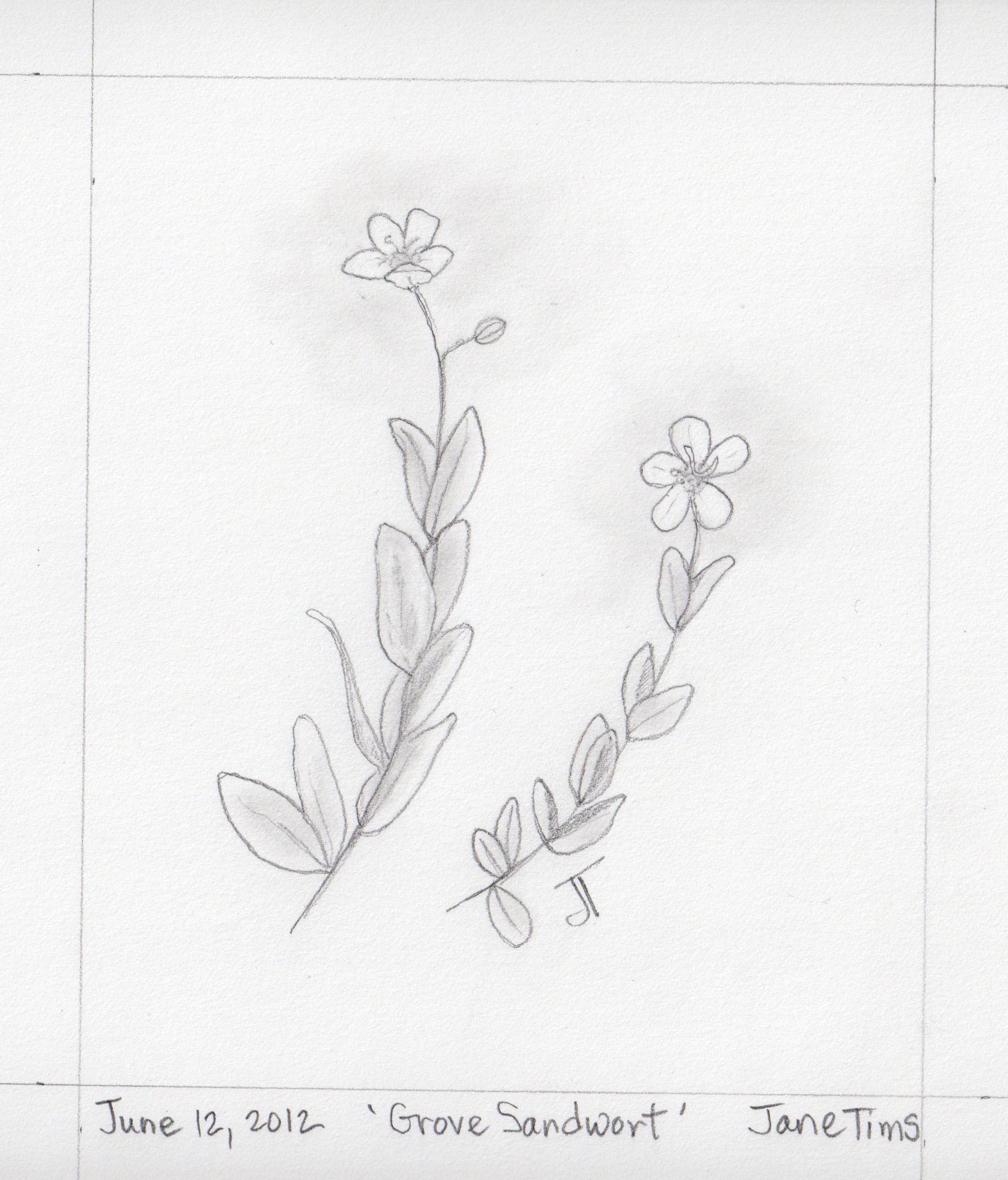
Grove-sandwort (Arenaria lateriflora L.)
Our summer property is a constant source of learning for me. Every year I seem to find at least one new plant. This year the plant is Grove-sandwort (Arenaria lateriflora L.).
Grove-sandwort is a common plant, found in meadows, along shorelines and at the borders of woods. It is a low-growing herb, first noticeable in June. The starry, white flowers each have five petals and grow near the top and along the sides of a simple stem. The leaves are elongated, elliptical, and in pairs.

Arenaria comes from the Latin arena meaning ‘sand’, where many of the members of the genus grow. The specific name lateriflora means ‘flowering on the side’.
Have you learned to identify any new plants this summer?
~
~
new neighbor
Grove-sandwort (Arenaria lateriflora L.)
~
met her in the meadow
by the split-rail fence
strewing the grove
with flowers
~
her leaves paired,
clapping hands,
delighted only ‘to be’
a bystander in the arena
~
~
© Jane Tims 2012
growing and gathering – ethics
Some of the poems in my collection will address the ethics of eating wild plants as food.
As a botanist, I know how many wild plants are edible. However, I also know there are ethical considerations to eating wild plants.
Plants differ greatly in their availability. Eating Dandelion greens puts no pressure on the survival of the Dandelion. Weedy species in general respond well to being harvested, by putting out copious seeds, by filling in the spaces with new rhizomes and shoots, and by growing in many habitats and conditions.
However some plants are very specific in their requirements. They need certain conditions of light, moisture and soil to thrive and reproduce. On our own property, I have watched the Painted Trillium (Trillium undulatum Willd.) struggle to maintain its presence. The Painted Trillium needs acidic, rich soils and lots of shade. Remove a single tree, cut a new trail, or let the Balsam Fir overtake the understory, and the place where a few Trilliums grew in previous years is suddenly vacant. The young leaves of the Painted Trillium can be used as a pot herb, but should I pick them to add to my knowledge about eating local foods?
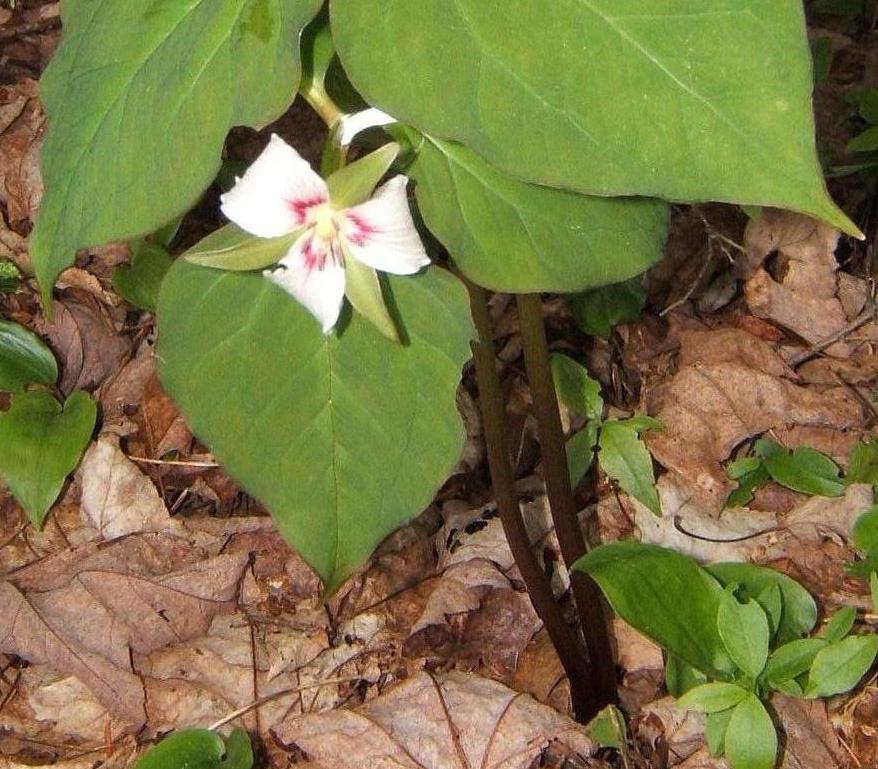
a Painted Trillium in our Grey Woods, near the end of its blooming
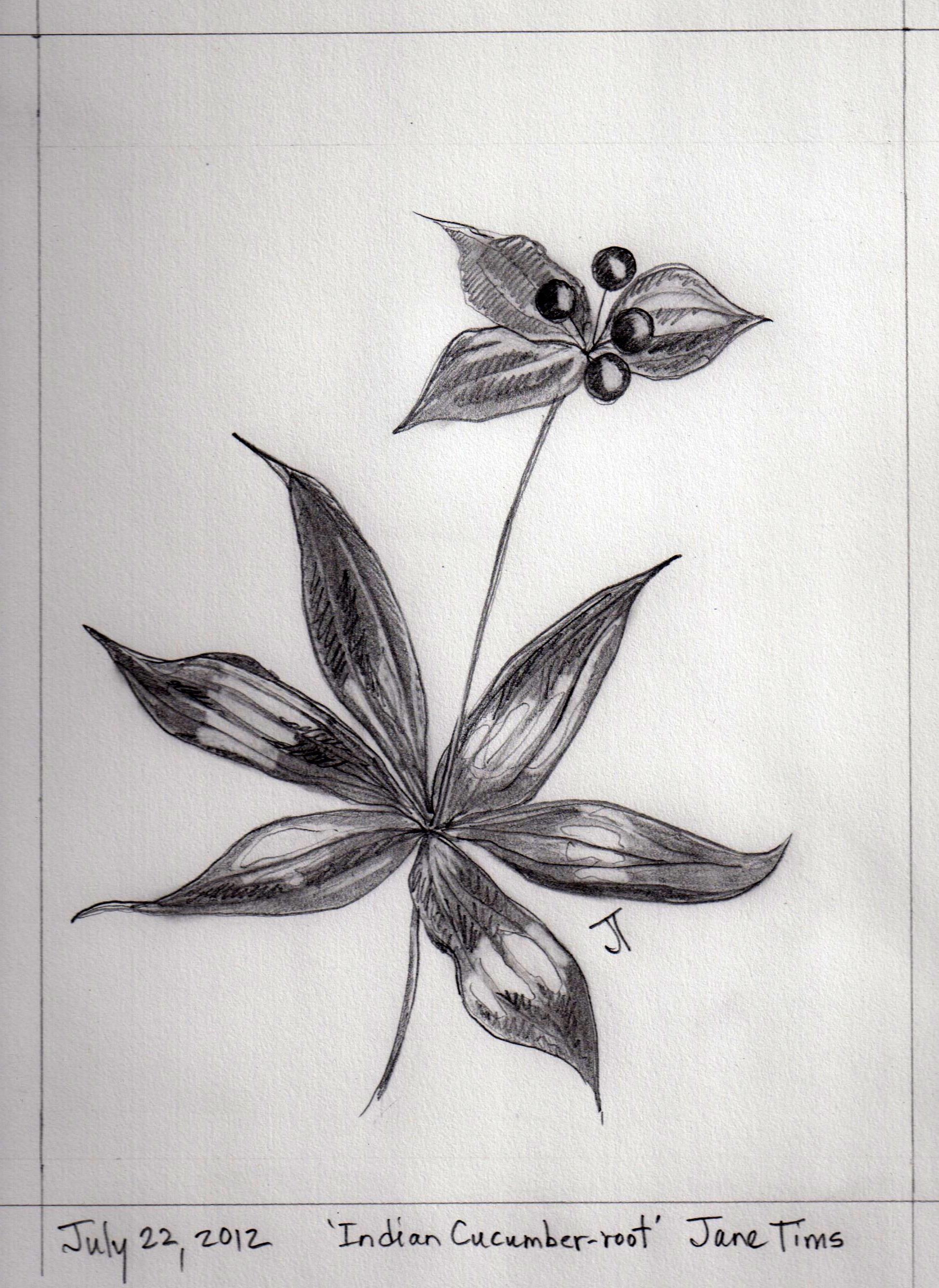
Many woodland plants deserve this special consideration. In his Flora of New Brunswick (2000), Hal Hinds wrote, of the Indian Cucumber-root (Medeola virginiana L.): “… Although this plant produces a deeply rooted, 2-3 cm edible white tuber with a bland cucumber taste and crisp watery texture, it is truly unfortunate to destroy the plant for such a tiny morsel…”
In some circumstances, harvesting and eating these rarer wildflowers would be acceptable. In the past, for example, people of the First Nations depended on wild plants for their existence. A lost hiker, needing sustenance or hope in an emergency situation, could be excused for eating any edible wild plant.
In other circumstances, rarity, the size of the population, and habitat health are probably the fundamental issues. Take the time to know a little about the plant you are thinking of picking. Is its habitat under stress or becoming hard to find? Is it rare, threatened or endangered? Local abundance may not be a deciding factor, since rare plants often grow abundantly where they are able to grow.
Eating local is an environmentally responsible life-style choice. It saves energy and supports local farmers. Eating local wild plants as food is a nutritious and thrifty way to supplement the larder. But these benefits must be weighed against the possible harm to plant populations.
Pick with some rules in mind. Understand the plant you harvest. Gather only what is sustainable. Sometimes this means gathering nothing at all.
~
~
Indian Cucumber-root
(Medeola virginiana L.)
~
step carefully
in your quest,
lured to the wood
by a sorceress
~
search carefully
among the shoots
for Indian
Cucumber-root
~
count carefully-
two layers of leaves
purple berries
stalk wool-sheathed
~
dig carefully-
below the stem
in dark, damp earth
awaits a gem
~
clean carefully
leave no trace
of the woodland soil
on the creamy face
~
taste carefully-
best to savour-
slightly celery
in flavour
~
think carefully
now you possess
one dead plant
and emptiness
~
~
© Jane Tims 2012
a moment of beautiful – new friends
the space- a shelf in an antique store
the beautiful- creating a collection of two
~
I took a break from writing this week, to take a drive to the Woodstock area, for lunch with my husband and to check out any antique stores we saw. We visited one store and I saw what I wanted the minute I walked in.

It was a little china salt and pepper shaker, a little Dutch boy, I think, from the bit of research I did on eBay.
He looked familiar, so I paid a dollar (a dollar!) and he came home with me. At home, I was so happy to find that he ‘matches’ another little Dutch figurine I have had for a long time. My figurine is not a salt and pepper shaker, but he is the same size and gloss. My son would say they belong to the same ‘universe’.
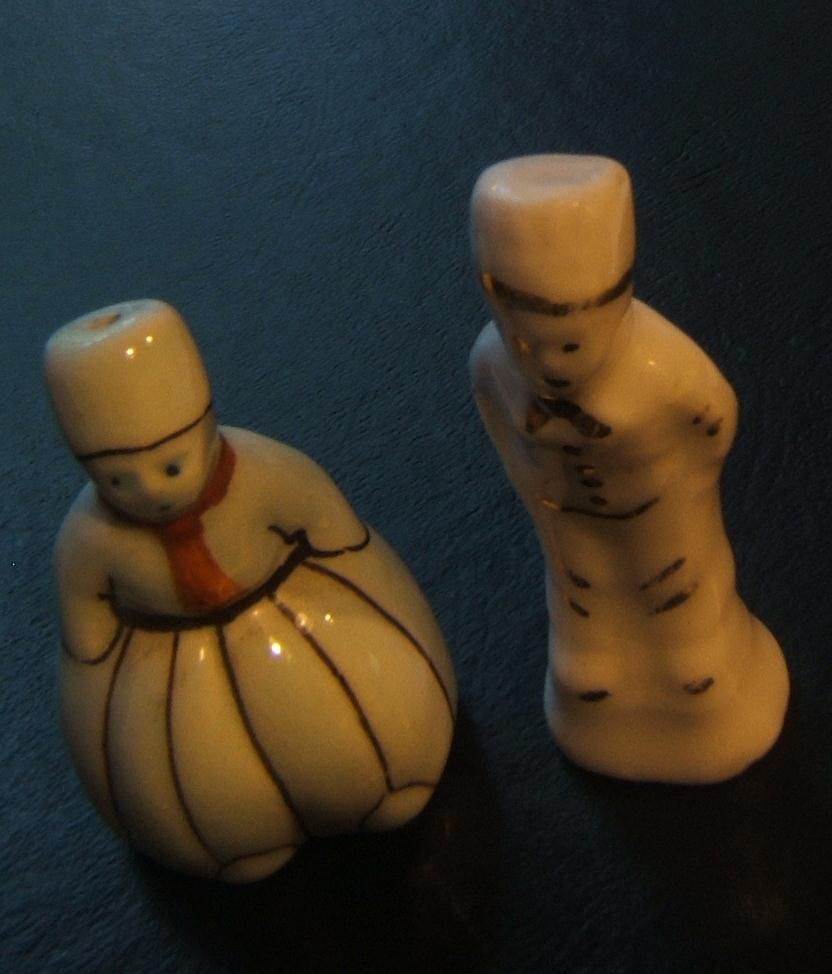
It is so much fun to meet new friends.
~
© Jane Tims 2012
Chicory – (Cichorium intybus L.)
Along the Trans-Canada near Jemseg, one colony of Chicory has taken hold. Its bright sky-blue flowers catch the eye as the usual roadside vegetation rolls by.
~

~
Also known as Blue Sailors and, in French, chicoreé, Chicory (Cichorium intybus L.) is a tall plant, found along roadsides and in other waste places.
Chicory has basal leaves resembling those of the Dandelion. When broken, the stem exudes a white milky fluid.
The bright blue flowers of Chicory occur along the length of the almost leafless and somewhat zig-zag stem. Each flower is formed of a central involucre of tiny blue flowers and a disc of larger ray flowers. The rays are square-cut and fringed. The flowers follow the sun, closing by noon, or on overcast days.
~

~
Chicory is a useful plant. Its young leaves are edible as salad greens or as a pot-herb. The roots can be dried and ground to make a coffee substitute or supplement. The root of Chicory has soothing properties to balance the edginess caused by caffeine. The roots of Chicory are large and very deep. I tried to pull them by hand, but a shovel will be needed to harvest the roots in the compact soil of the roadside.
~ When I see these flowers, I am reminded of my grandfather, my mother’s father. I never knew him, but I have a couple of photographs of him as a young man. I have made a small study of his mother, my great-grandmother, so I know quite a lot about him. ~
~
The flowers of Chicory remind me of his eyes, since they were the same startling blue. He was also a tall man, another feature of the plant.
The other name for Chicory, Blue Sailors, also reminds me of my grandfather. He was a sailor, entering the navy when he was only fifteen. I know from various records that he served on at least two naval vessels, the USS Nebraska and the USS Pensacola. As so often happens when I see photographs of ancestors, there is a familiarity about his features.
~

~
Blue Sailors
Chicory (Cichorium intybus L.)
~
at the roadside
weeds surge as waves
~
on the sameness of ocean,
a buoy lifted,
a sudden swell of Chicory
~
tall, like my grandfather,
the blue ice of his eyes
its blunt petals, the square-cut of his jaw
~
joined the navy at fifteen
dressed as a sailor, headed for sea
USS Pensacola, USS Nebraska
~
his tie, a sapphire ribbon
toothed or frayed
~
~
© Jane Tims 2012
Warning: 1. never eat any plant if you are not absolutely certain of the identification; 2. never eat any plant if you have personal sensitivities, including allergies, to certain plants or their derivatives; 3. never eat any plant unless you have checked several sources to verify the edibility of the plant.Partridge-berry (Mitchella repens L.)
One of the evergreen plants in the spring woodland is a little vine called Partridge-berry. It trails, low to the ground, in shady, mossy woods, sometimes covering moist banks and hummocks with its shiny greenery.
Partridge-berry (Mitchella repens L.) is also known as Twinberry, Snakevine, Running Fox and Two-eyed Berry. The word repens is from the Latin for ‘creeping’.
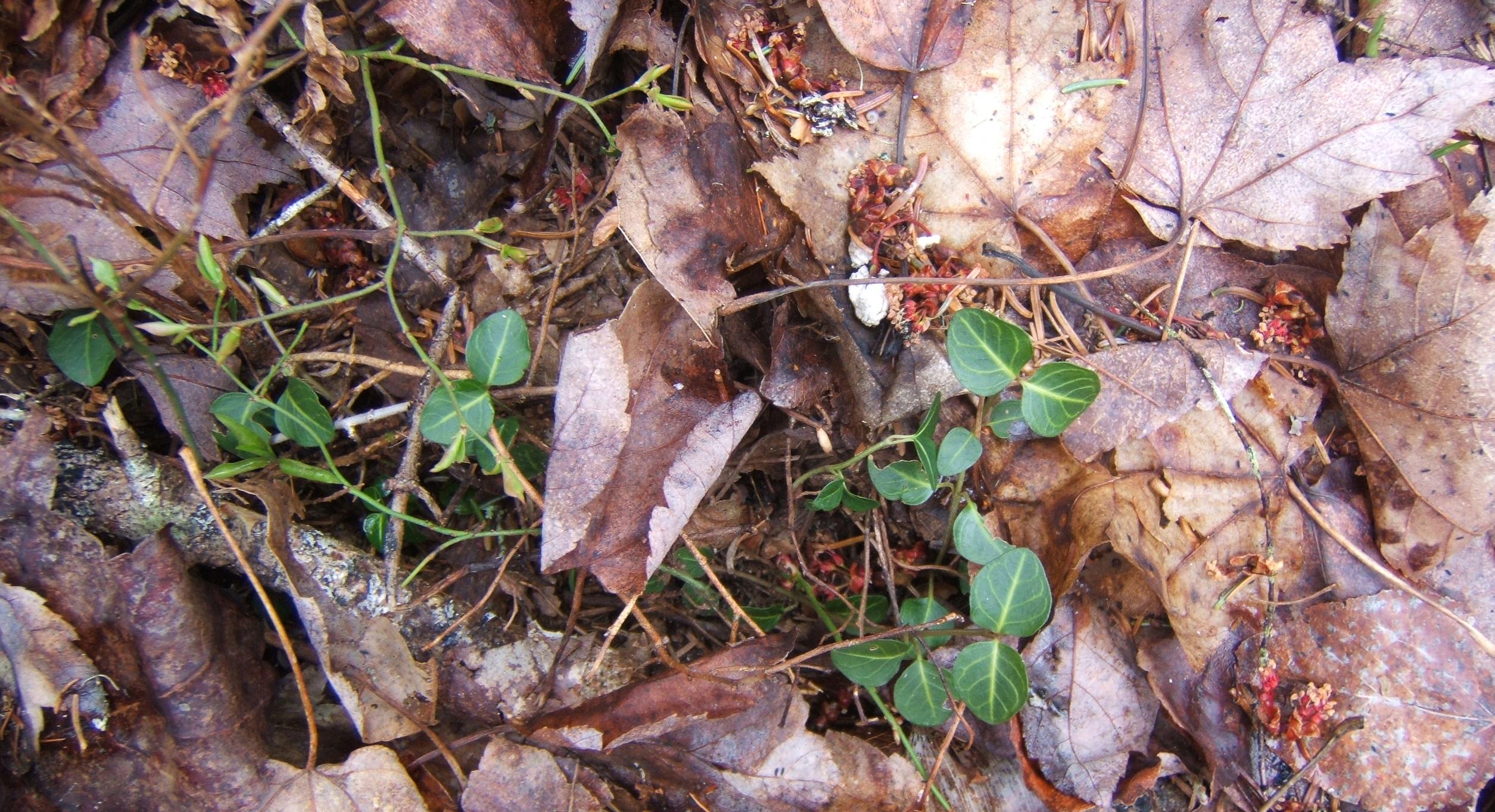
The leaves of Partridge-berry are small, ovoid and opposite on a vine-like stem. The leaves have a bright yellow midrib and veins, giving them a clear outline against the background of dry leaves.
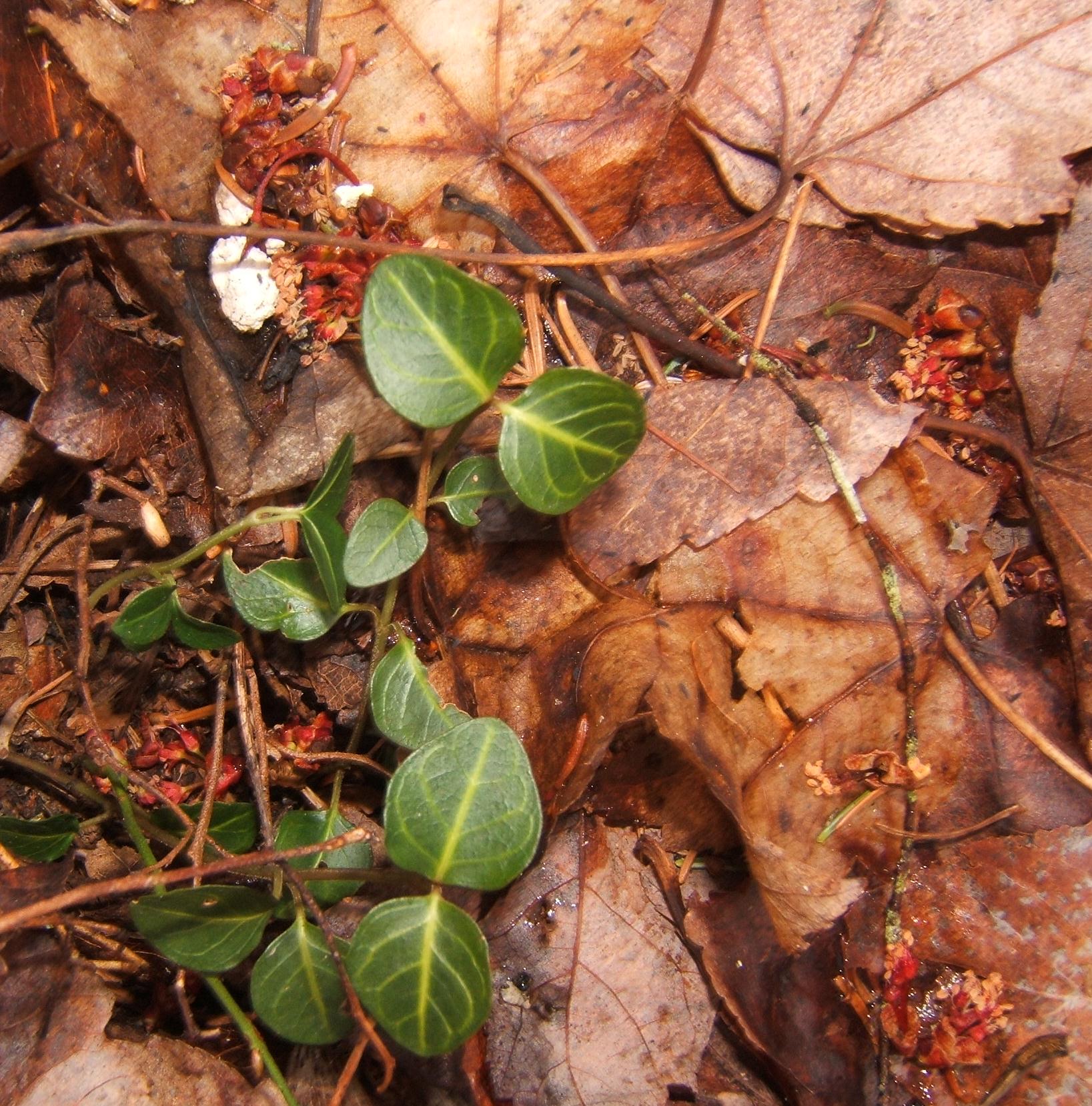
The flowers are white or pinkish, and bell-shaped. They occur in pairs – the two flowers are closely united at the base, sharing a single calyx. As a result, the bright red berries are two-eyed, each showing two blossom scars.
This time of year, in July, Partridge-berry has flowered and set its berries. The berries are dry and seedy but edible, with a slightly aromatic flavour. They are a good nibble along the trail or can be used as emergency food. The berries are ordinarily eaten by birds, such as the Ruffed Grouse.
Warning: 1. never eat any plant if you are not absolutely certain of the identification; 2. never eat any plant if you have personal sensitivities, including allergies, to certain plants or their derivatives; 3. never eat any plant unless you have checked several sources to verify the edibility of the plant.~
~
common names
( Mitchella repens L.)
~
1.
Running Fox
~
a glimpse of red
between hairmoss and hummock
the fox slips into shrewd spaces
seeks the vacant way
~
2.
Snakevine
~
a twist and a Twin-berry
trail woven and worn
mottled and mid-ribbed
Mitchella meanders
over feathermoss, under fern
~
3.
Partridge-berry
~
Ruffed Grouse pokes and pecks
tucks a Two-eyed Berry in his crop
lurches on
~
~
© Jane Tims 2012

growing and gathering – barriers to eating wild foods
One of the themes in the poems I have written for my manuscript on ‘growing and gathering’ local foods concerns the ‘barriers’ to eating local foods, especially wild local foods. Edible wild plants are everywhere around us… why don’t people make more use of them?
The barriers to gathering and eating wild foods are:
1. knowledge – although most people can recognise and even name a few plants, only a few can identify and name every plant they see with certainty. It you eat a plant, you need to know you won’t be the victim of mistaken identity. Sometimes very closely related plants are quite different when it comes to their edibility. A simple example is the Tomato: the species we eat is Solanum lycopersicum Lam.; a plant from the same genus is the poisonous Common Nightshade (Solanum ptychanthum L.). The fear of mis-identification and poisoning oneself is a barrier to eating local wild plants. Also, people can vary greatly in their sensitivity. One person can eat a plant without effect while another cannot because arthritis is aggravated.

berries of Common Nightshade are poisonous… later in the season, they are red and quite beautiful… children should be warned that all red berries are NOT good to eat
2. access – in order to eat wild plants, you have to know where they grow, you have to be able to go there, and you must have access. Many people live in urban or sub-urban areas where some species of wild plants just aren’t found. Even if you have transportation or live in a rural area, access may be a problem. There may be a lush field of raspberries just up the road, but if there is a locked gate, better get permission!

3. peril – sometimes picking wild plants for food has an unpleasant or dangerous side. Some plants are poisonous. Picking berries may mean avoiding sharp thorns! Sometimes berry picking takes you on a heads-down journey far from the point where you began… you may get lost! You can look up and not recognise where you are or how to return to your point of origin!

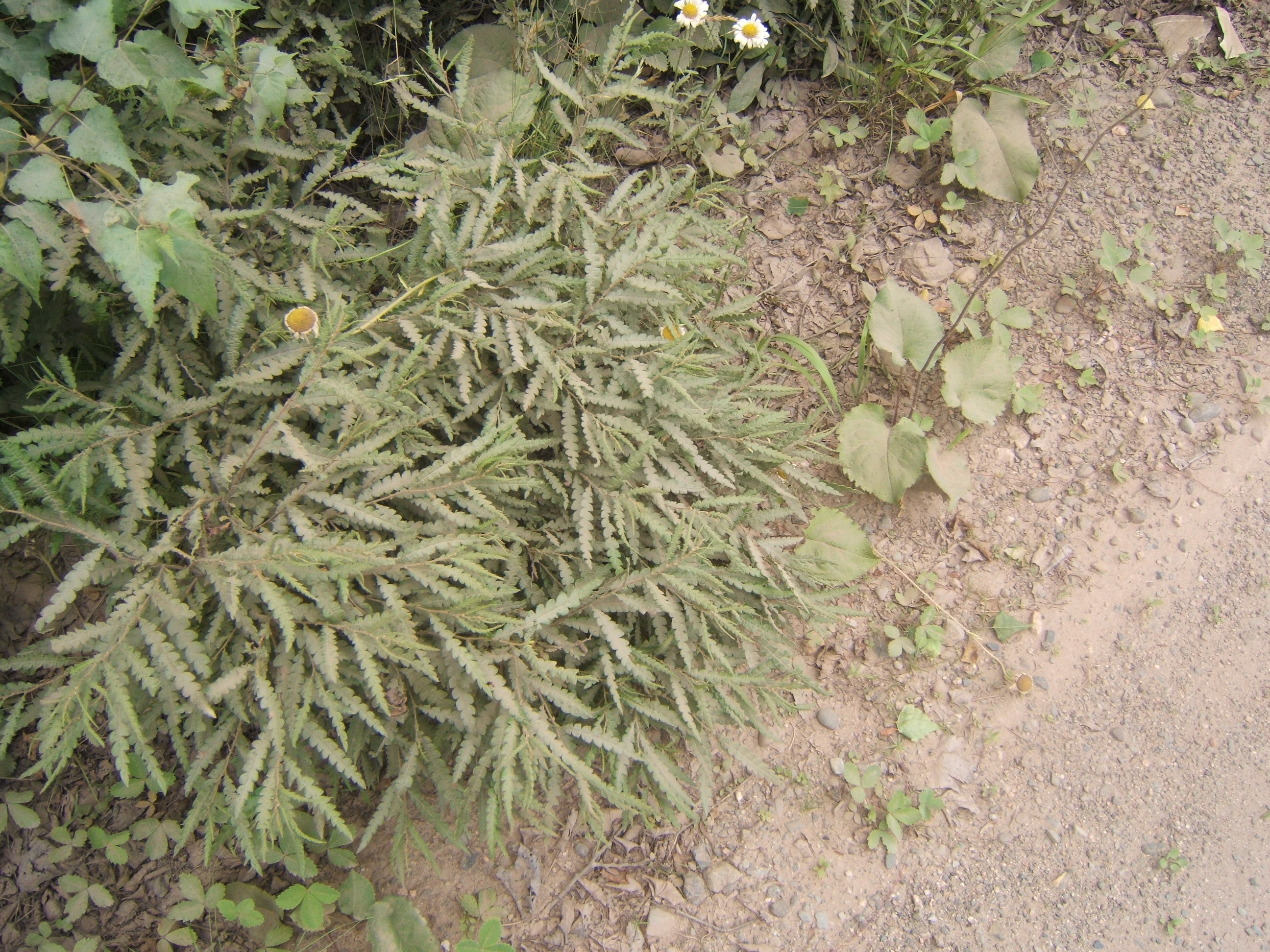
4. contaminants – some locations may not be suitable for collecting and eating wild plants. For example, plants along busy highways may have high levels of some contaminants. Berries or other plants growing along the roadside may carry a burden of dust, making them unpalatable. I wouldn’t make a cup of Sweet Fern tea from the dusty leaves in this photo!
5. convenience – Sometimes gathering or producing wild foods is too demanding of time and energy. I love collecting maple sap and boiling maple syrup each spring, but it is hard work and takes days to accomplish. Sometimes you know there is a patch of berries just down the road, but other demands on time take precedence.
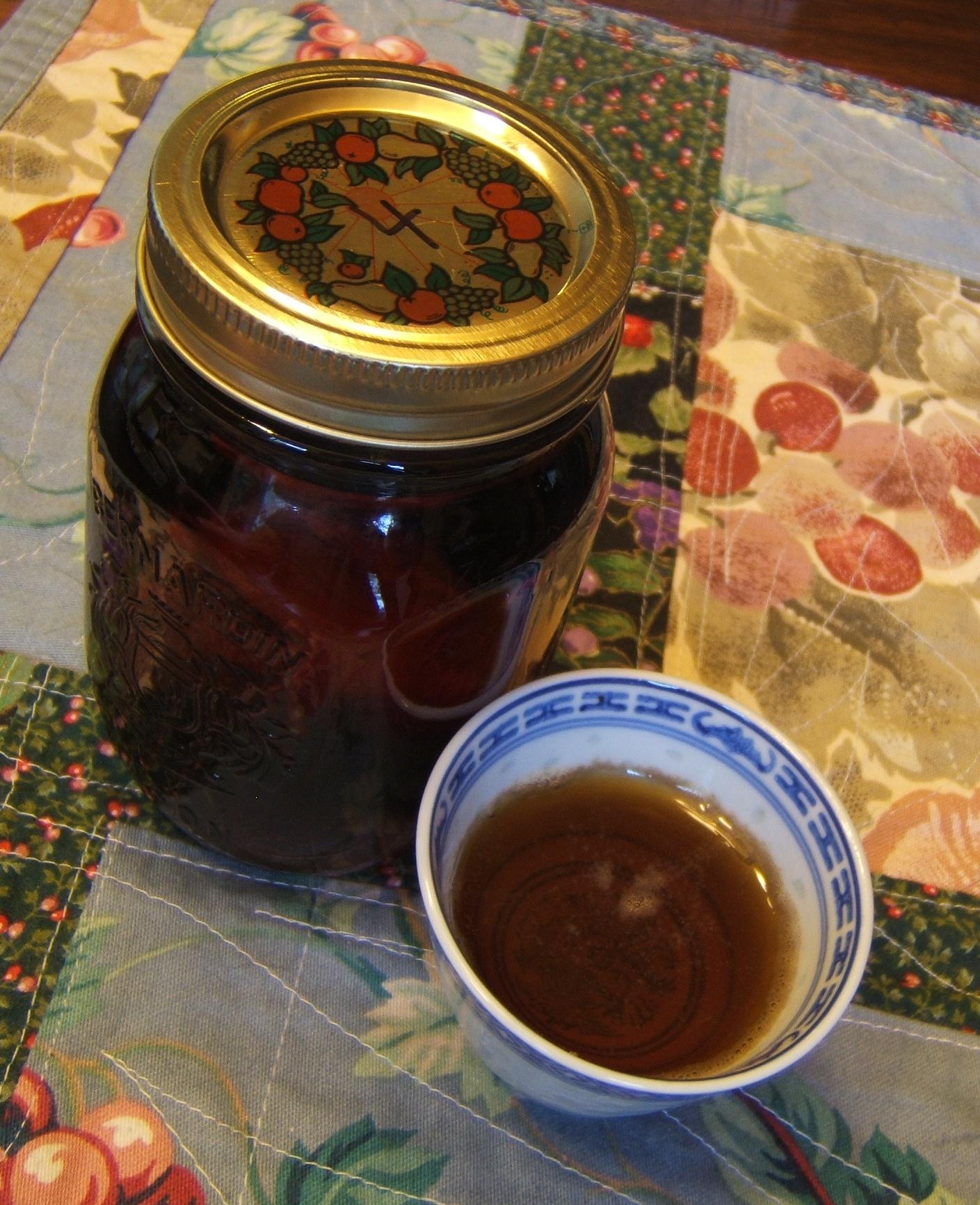
6. competition – Wild animals also like edible wild plants. You may run into a bear while picking berries, or face a moral dilemma when you realise you are keeping the squirrels from a food source! My garden is always under attack and the battle often seems to outweigh the benefits of having a garden. This year the enemies are slugs, bunny rabbits and shadows (too much shade).

7. complacency – Sometimes I think, most of the barriers I’ve listed above could be overcome. But a barrier not so easy to negotiate is one of separation from nature and the associated complacency. It has become normal not to seek our food in the natural spaces around us. We go to the grocery store, pick up what we need, and take the easiest route in our exhausted lives. Even gardens are not as common as they once were. In my mother’s generation, gardens were the norm. This partly came from long traditions of growing food, but also from the concept of the ‘Victory Garden’, begun during World War II in order to conserve resources and boost morale.

World War II poster promoting the Victory Garden (Source: Wikimedia Commons, original art by Morley)
~
The only way I know to return to a simpler life is to take small steps and take them often, so they become habit. Here are some suggestions:
- visit the Farmers Market in your community, to obtain fresh produce and to know the history of your food;
- stop at those market stands along the road and buy produce in season. In our area, vendors sell lobster, smelt, fiddleheads, strawberries and apples this way;
- if you have an apple tree in your yard, or wild raspberries in a field nearby, pick them and enjoy;
- if your apple tree needs pruning and some TLC, talk to a knowledgable person and find out how to return it to production;
- dig the fishing tackle from the garage and take the kids fishing;
- grow a pot of fresh herbs on your back deck;
- learn about one wild plant, find a place where it grows, be certain of the identification, and use it! Then find another!
keeping watch for dragons #7 – Bog Dragon
Some dragons like to live in bogs.
When we were in Nova Scotia, near Peggy’s Cove, imagine my delight when I found, among the Pitcher-plants, a species of the orchid family, Arethusa (Arethusa bulbosa L.), also known as the Dragon’s Mouth Orchid.
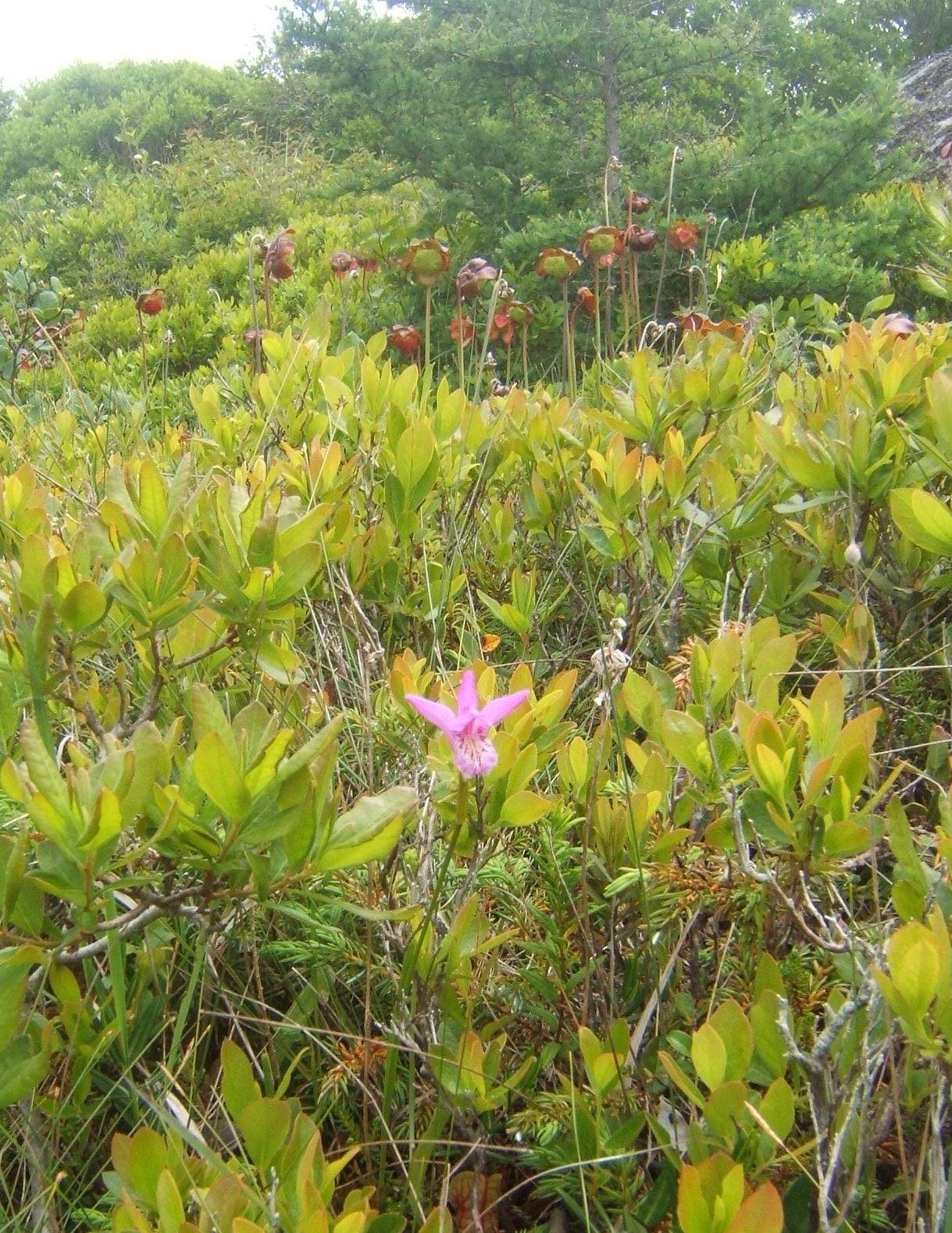
Arethusa loves wet, boggy conditions. Among the greens and reds of the low-lying bog, it surprises a visitor with its splash of pink. Even the Pitcher-plants in the photo above look a little over-come with the beauty of the Dragon’s Mouth!
This orchid has a complex flower, with three thin flaring upper petals, two in-turned petals guarding its ‘mouth’ and a lower lip with yellow and white fringed crests.

Arethusa is named after a Naiad in Greek mythology. The Naiads were nymphs associated with fresh water features such as springs, wells, fountains and brooks. Nymphs, like plants, were dependant on their habitat… if the water where they lived dried up, they perished.
Perhaps a Bog Dragon is also absolutely dependant on the water held within the bog!!!
~
~
Bog Dragon
Arethusa bulbosa L.
~
naiad
masquerades as dragon,
claps her hands across her mouth,
sorry to have spoken –
her voice, her pink, her petals
lure them,
their large feet and tugging hands
too near
~
~
© Jane Tims 2012
coastal barren, coastal bog
On our vacation to Nova Scotia last month, we revisited the Peggy’s Cove area near Halifax. I spent a lot of time along this coast years ago, but I had forgotten the unique wildness and beauty of this landscape.

We explored two habitat types, the dry and rocky barrens, and the wet coastal bog. As we found each new plant, I felt like I was greeting old and well-loved friends.
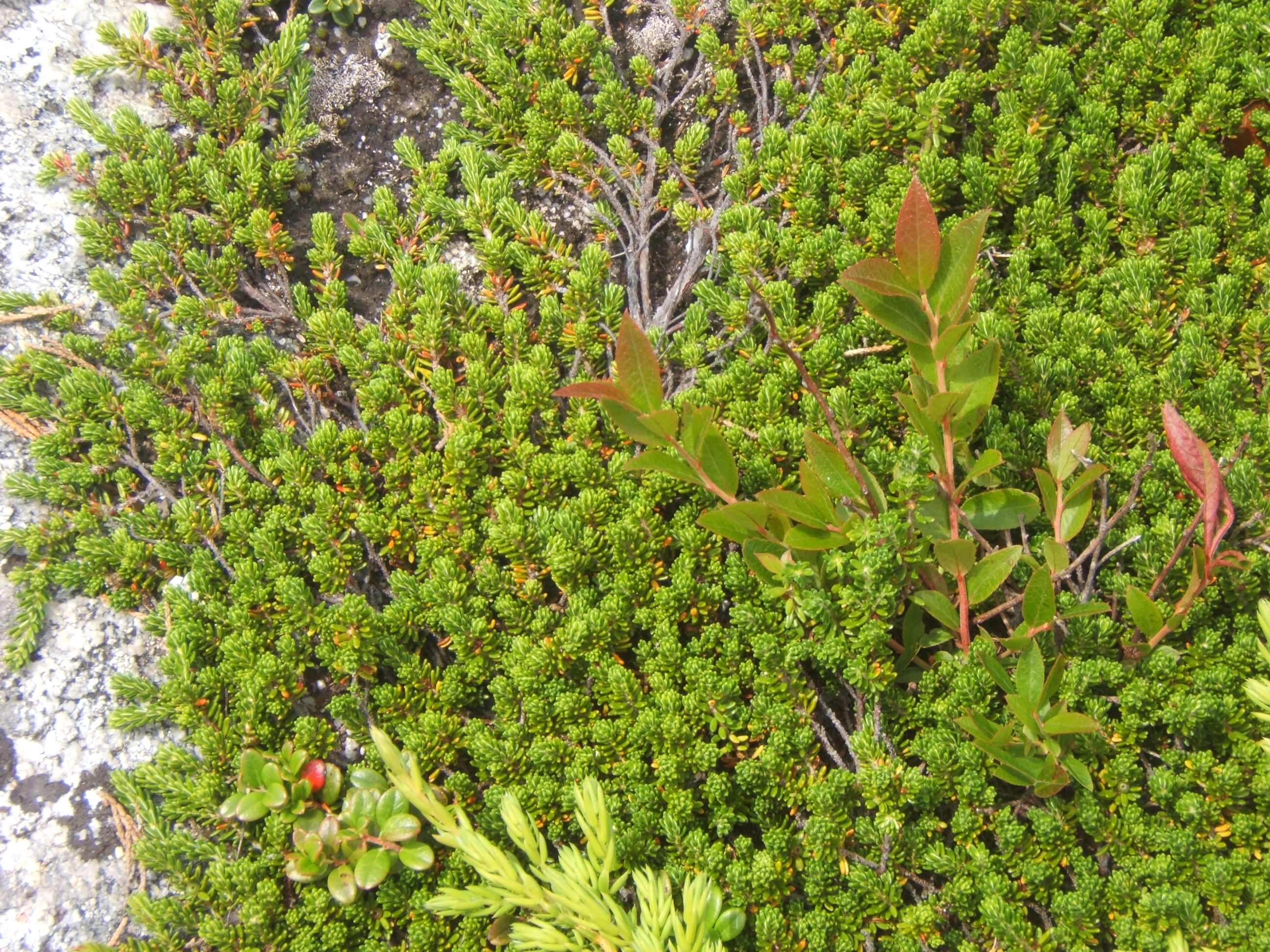
On the higher areas, growing in the thin soil on the bedrock were several species. One of these included Crowberry (Empetrum nigrum L.), a small moss-like plant with spiky leaves and small pink flowers. Later in the season, these will bear edible back berries.
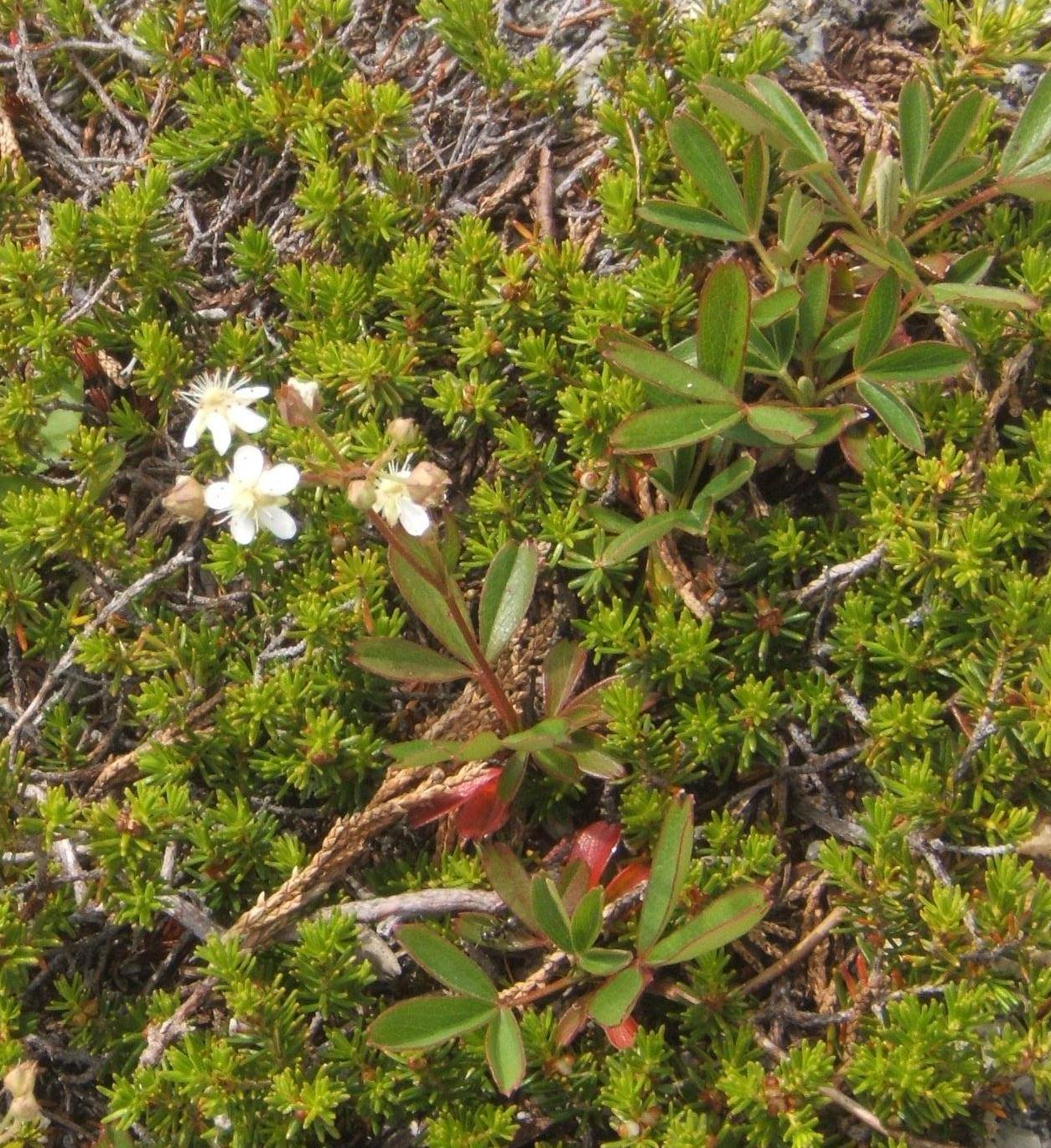
We also found Three-toothed Cinquefoil (Sibbaldia tridentata (Aiton) Paule & Soják) with its three leaflets and the characteristic three teeth at the tip of each leaf. The leaves are thick and outlined in red at this time of year. Later in the year the leaves turn bright red. The white flowers each have five petals, and are starry with stamens.
In the low-lying, boggy areas, we found a ‘merriment’ (my word) of Pitcher-plants (Sarracenia purpurea L.).

The leaves of these insectivorous plants are shaped like vessels. Insects climbing into the leaves encounter downward pointing hairs. They are trapped! Eventually they drown and are digested in the water at the base of the ‘pitcher’.
We also found another carnivorous plant, the Round-leaved Sundew (Drosera rotundifolia L.). The leaves of these plants are covered with tiny hairs… these exude a sticky liquid and trapped insects are slowly digested. For more information on the Sundew, please visit my post for October 31, 2011, ‘Round-leaved Sundew’. https://nichepoetryandprose.wordpress.com/2011/10/
All was not gruesome. We also found Arethusa (Arethusa bulbosa L.), a member of the orchid family. This beautiful pink orchid is also known as the Dragon’s Mouth.

Overall, our trip to Peggy’s Cove was a wonderful adventure. We plan to return in the early fall, when the Crowberry and the other edible plants we saw have set their berries.
Have you ever been to Peggy’s Cove and what did you think of the coastal landscape and the plants growing there?
~

© Jane Tims 2012
Warning: 1. never eat any plant if you are not absolutely certain of the identification; 2. never eat any plant if you have personal sensitivities, including allergies, to certain plants or their derivatives; 3. never eat any plant unless you have checked several sources to verify the edibility of the plant.the growing part of ‘growing and gathering’
So far in my posts, I have talked mostly about harvesting wild edibles. I am starting to get a little produce from my garden, so I thought I’d do a post for the ‘growing’ side of ‘growing and gathering’.
I have only a small garden, laughable by many standards. We have too much shade and since I won’t allow the nearby trees to be cut, I must be content with spindly carrots, sorrowful pea vines and a plethora of slugs. However, I also have lots of perennials and a small herb garden, enough to keep us in regular small harvests of additions for our dinners.
On Monday, I decided to prepare my favourite lunch, couscous, with a gathering from my garden. I used:
~ a handful of black and red currants (just ripening this week!)
~ a sprig of thyme
~ a few leaves of oregano
~ a small spray of parsley
~ a handful of chives
~ one clove of garlic from the shadowy garden.
To this I added a small purple onion from the grocery store…

I chopped the onion and the herbs quite fine…

I sautéed everything in olive oil, very briefly (to keep it all crisp and keep the currents from going mushy)…
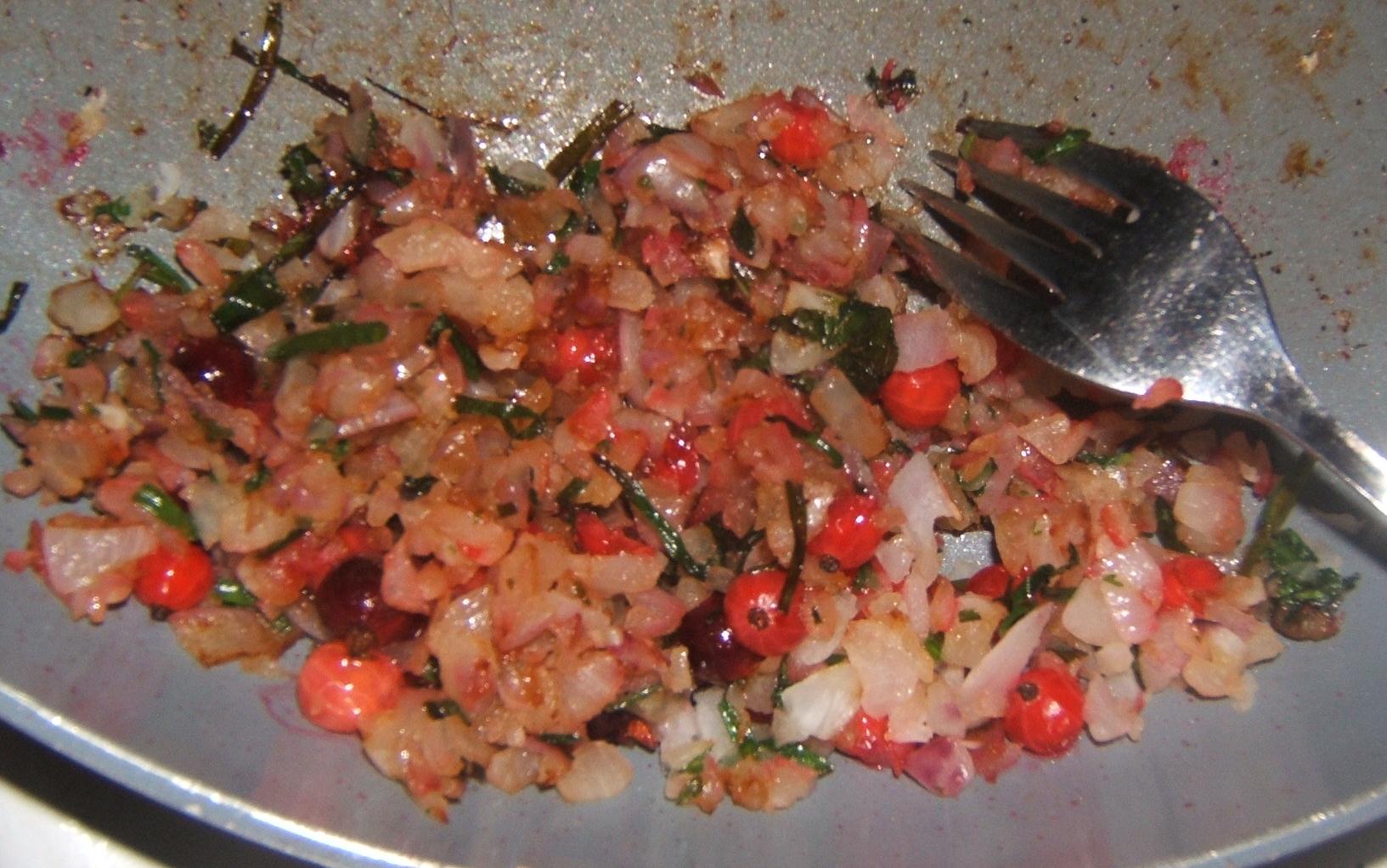
and added the mixture to my couscous, prepared with boiling water and a quarter teaspoon of powdered chicken bullion.
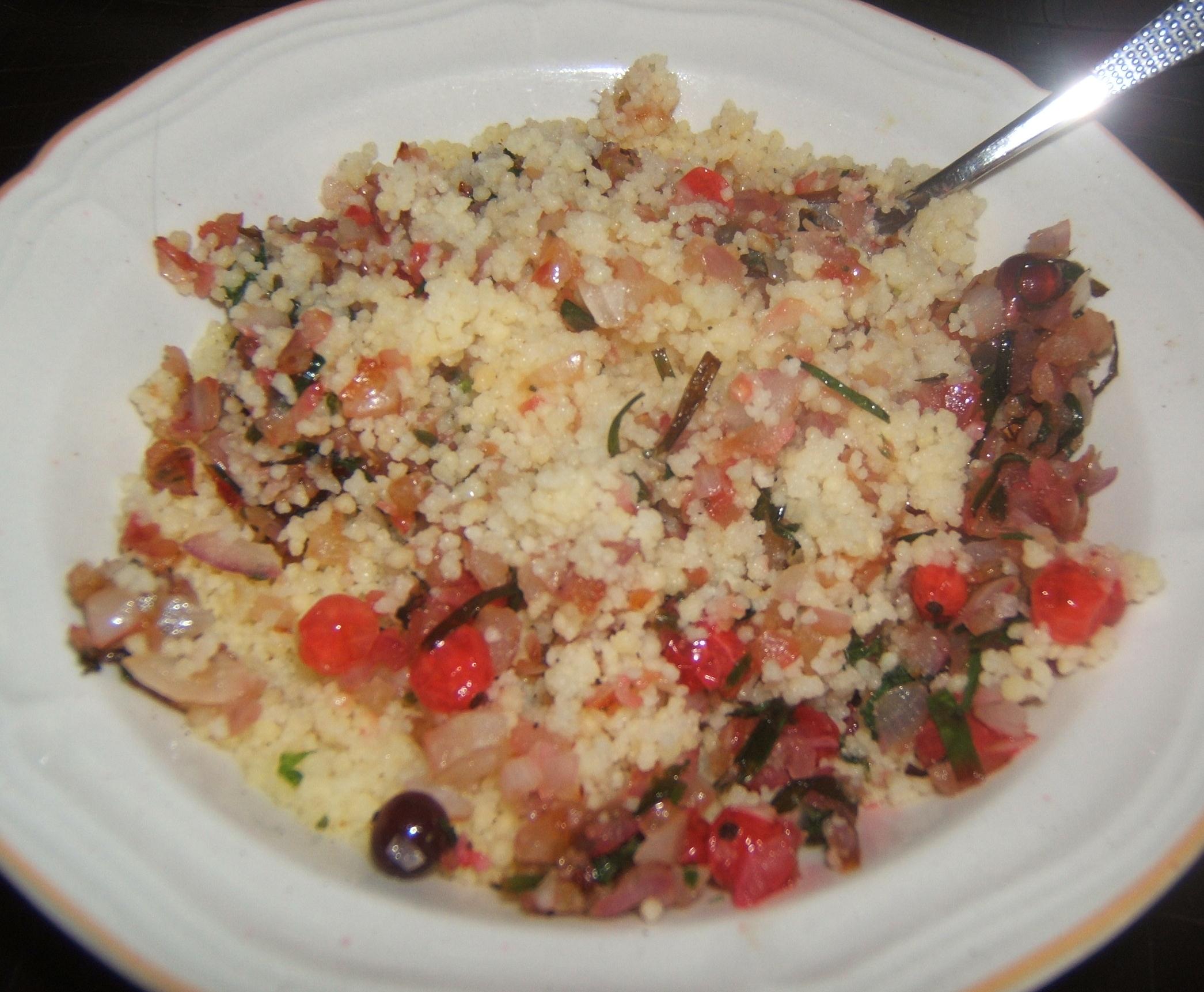
A delicious dinner, a little tart, but perfect for my taste buds!!!!
© Jane Tims 2012
a moment of beautiful – mustard fields in bloom
the space: a field along the St. John River
the beautiful: mustard in bloom
In some of the cultivated fields along the St. John River, acres of mustard are in bloom. Mustard is common here, in both coastal and inland areas, along roads and in fields. In the last weeks, I have found two species, Black Mustard (Brassica nigra (L.) Koch) and Field Mustard (Brassica rapa L.) also known as Rape, or Bird’s Rape.
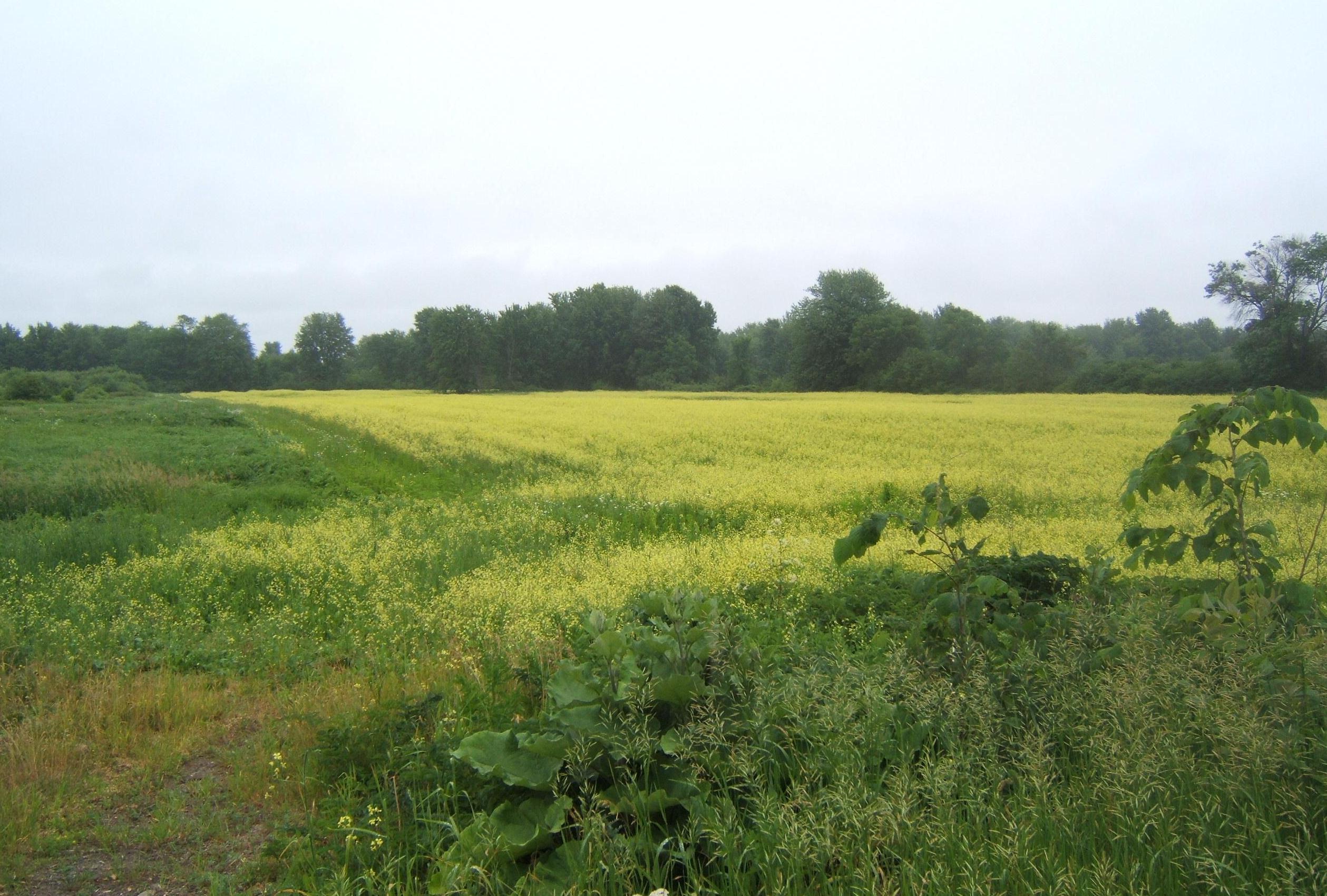
Mustard is an herb of medium size, with pale yellow, four-petalled flowers in terminal clusters, and large lobed leaves. The seeds are contained in pods; each pod ends in an elongated beak.

Mustard is well-known for its uses. The young, basal leaves may be cooked as greens or used in salads. Clusters of unopened flower buds can be cooked like brocolli. The tender seed pods are pickled, or used in salads.
Mustard’s best-known use is as a spice – the seeds are collected, dried and ground to make hot yellow mustard. I have a spot staked out to collect the seeds as they ripen in August, since I want to dry and grind some seeds for my own mustard.
~
~
sandwich
~
green leaves
between brown earth
and summer sky,
finished with
a generous smear
of mustard
~
~
© Jane Tims 2012
Warning: 1. never eat any plant if you are not absolutely certain of the identification; 2. never eat any plant if you have personal sensitivities, including allergies, to certain plants or their derivatives; 3. never eat any plant unless you have checked several sources to verify the edibility of the plant.