Archive for the ‘wild life’ Category
edge of lake
Water is essential to my health, not only because I need it to drink. I also need to see water. Whether it’s the water of a stream, river, lake or ocean, being near water comforts and enlivens me.
I like the transitions too, the places where land and water meet – the seashore, the margins of a brook, or the shoreline of a lake. Birds and other animals love ‘edge’ – places where the food is plentiful and cover is available. We go to the lake shore to watch loons diving for fish, deer wading in the marsh grass and ducks ‘dabbling’ along the shore.
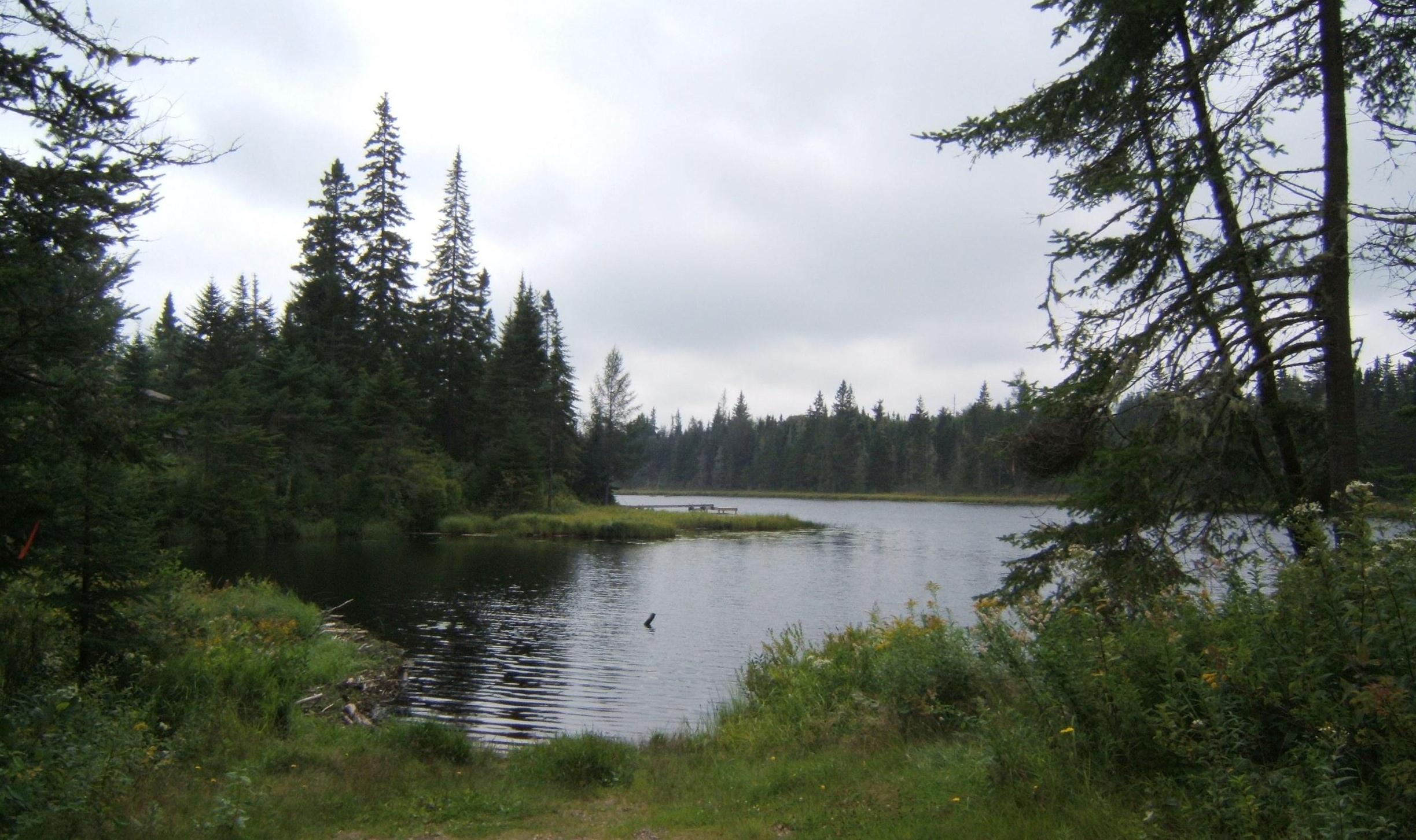
edge of lake
evening edge
~
of lake
a corner torn
from the loaf of hills
red with setting
~
faint click
sun gone
dusk and bread crumbs scattered
~
nasal chuckle
from the farther shore
arrows etched on glass
~
blue-winged teal
under wings a glimpse
of summer night
~
greedy for crust and crumbs
~
© Jane Tims 1998

evening edge of lake
trampled grass on a flat-topped hill
I change the spaces I enter, even when I enter only for a moment. I am an intruder. I am certain feet have scurried into hiding just as I arrive. Sounds have ceased. Scents and tastes have been altered.
Once in a while, my difference can be disguised. I can enter before the space can know I am there. If I am quiet, if I walk softly, some agent will help me pass through the veil and remain unnoticed, just long enough to see and hear and taste the true essence of the place. Often, the generous agent is the wind.
It was a favorite hike, an old cart track winding up the side of a dome-shaped hill in the Elkwater Lake area of the Cypress Hills in southern Alberta. The hill had a flat top and a thick bristle of conifers along the sides. On the flat top was a fescue grass meadow, a bit of prairie perched a layer above the mixed grasslands.
a hill at Elkwater Lake ... coniferous woods and grassland on the same hill
The track was not much more than two ruts, worn into the grass. It curved up the side of the hill, so the approach was gentle, gradual. Then, abruptly, the hilltop. If the wind was right, I could surprise the deer. They yarded there, grazing the grasses, etching paths into the meadow.
If the wind stayed in my favor, the deer would linger, chewing their cuds, watching me, but not registering my difference. As long as the wind blew I could watch, but if it settled, my scent would reach the deer. They would lift their heads and tails and be off in a few zigzag bounds.
deer yard
on a flat-topped hill
~
1.
below the hill is the distant prairie
speargrass and grama grass
and the sweetgrass hills of Montana
~
the grass at my feet is different
fescues of the Cypress Hills
flat-topped remnants of the Great Plateau
untouched by glacier scour
~
2.
bless the wind
it sorts the grasses
lifts each hair
ruffles the limp and fine
~
wind nudges the stubble
the artist’s bristle
the tail hairs of the doe
the chop of fresh grass
~
her gentle cud
her watchful eyes
wind in the spokes
of the mule deer wheel
~
the trampled paths
a game of fox and geese
or the part teased by wind
into sun-blond hair
~
3.
if the wind takes a breath
if the grass or the hair
settles on the shoulder
of the hill
she runs!
~
seeks the safety
of the downslope
downwind
trees
~
4.
fescue
curious on this flat-topped hill
its rightful place
the ancient prairie
~
Published as: “deer yard on a flat-topped hill”, 2010, Canadian Stories 13 (76)
(revised)
© Jane Tims

deer on the grasslands of Nebraska (2002)
a place to wait, out of the rain
My husband and I love to go for drives in the countryside, and we often turn these trips into ‘expeditions for collection’. For example, in 1992, we began a project to see all the covered bridges in the province; of the more than 60 covered bridges in New Brunswick, we have ‘collected’ about three-quarters. Recently, we began a quest to see as many waterfalls as possible (the state of my arthritic knees puts the emphasis on the ‘as possible’).
This spring, we set out with a very reasonable goal, to see the three lychgates at Anglican churches in the Diocese of Fredericton (all of the Parishes in New Brunswick are located in the one Diocese). This idea came from a short article in the New Brunswick Anglican in 1997 by Frank Morehouse (‘Only three lych gates remain in the diocese’). The three lychgates are at St. Anne’s Chapel in Fredericton, St. James Church in Ludlow, and St. Paul’s Church in Hampton.
Lychgates are an architectural remnant of past practice, dating back to the 13th century. They were used as a part of the funeral service, a place for the priest to meet the body of the deceased on its way to burial, and a shelter for the pall bearers to stand out of the rain. The word lychgate comes from the Anglo-Saxon word lych meaning corpse.
A typical lychgate is made of wood, and consists of a roof supported by a framework of two or more posts, and a gate hung from the framework. Lychgates usually stand at the entrance to the church property or the graveyard. They can be architecturally ornate.
Today the lychgate is a picturesque feature of the churchyard, but they also create habitat for wild life. Spiders tuck their webs in the rafters of the structure where they are safe from wind and rain. The shingled roof of a lychgate is often a place where lichens and mosses can grow without competition from other plants.
Our collection of lychgates at Anglican churches in New Brunswick is complete. We found the lychgate in Fredericton on a rainy day in April…
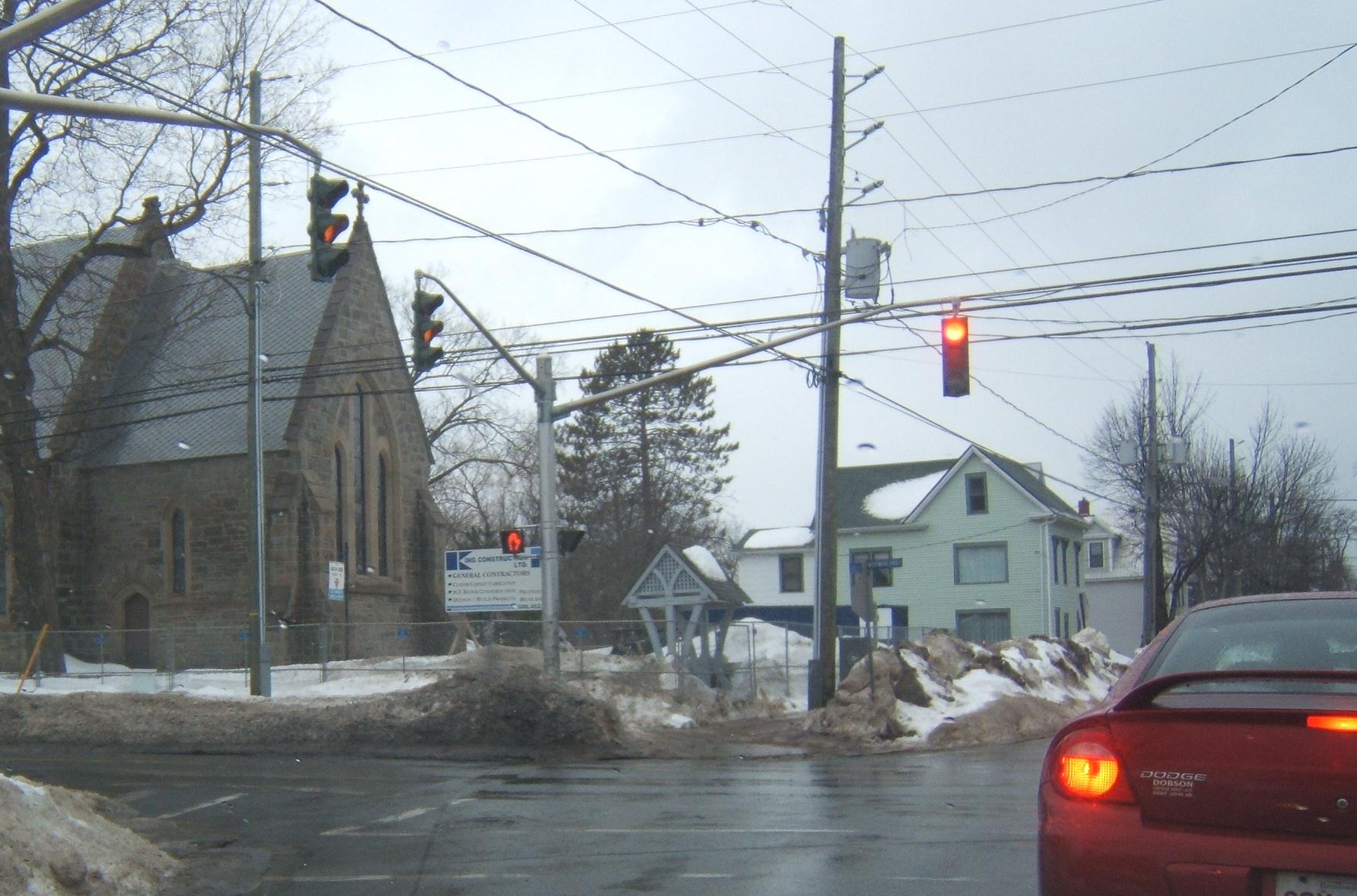
lychgate at St. Anne's Chapel in Fredericton, on a rainy day
… the Ludlow lychgate on a hillside in early July…

- lychgate at St. James Church, Ludlow

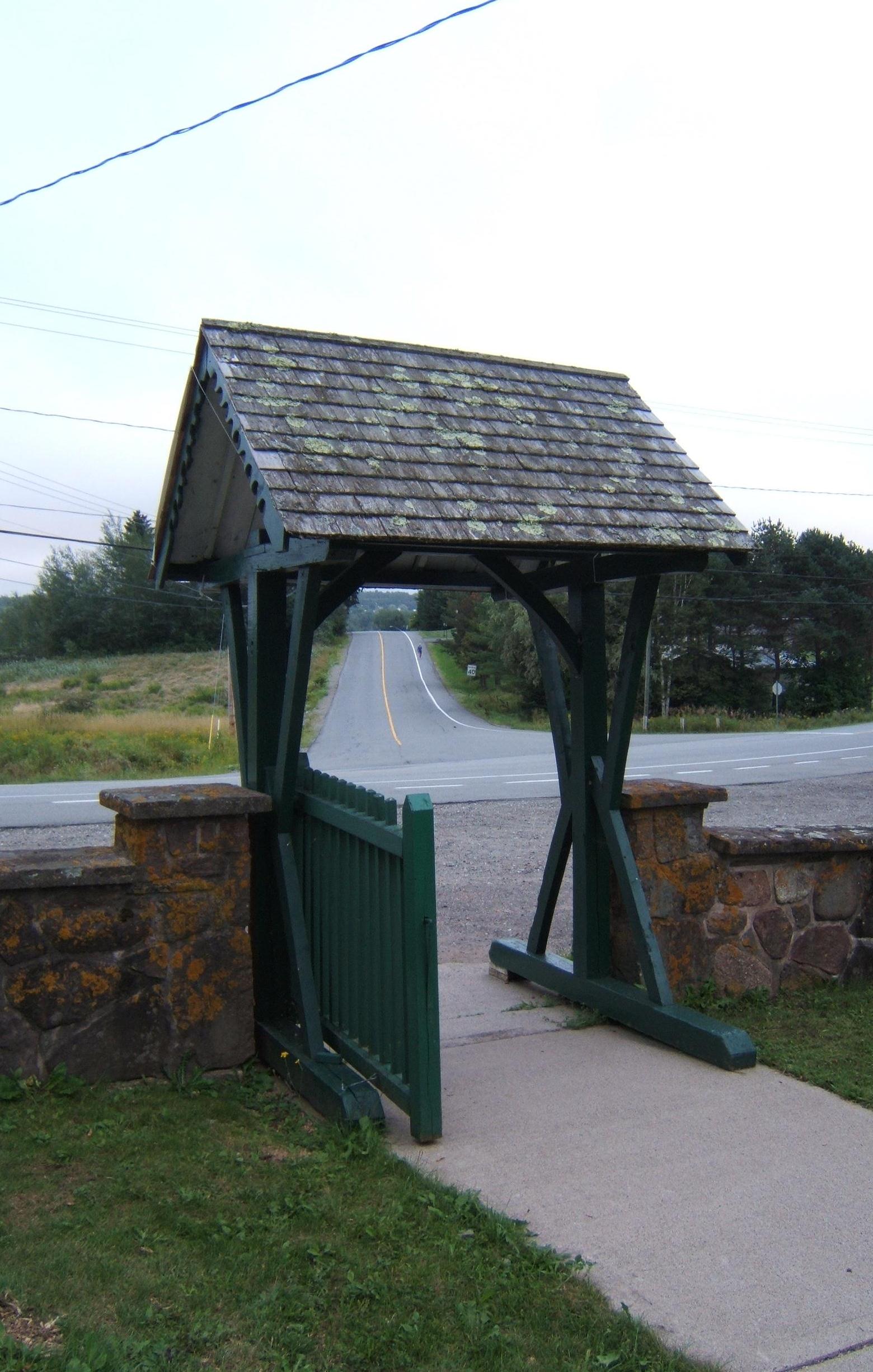
lychgate at St. Paul's Church, Hampton... green lichen on the lychgate roof and orange lichen on the stone wall
a place to wait, out of the rain
~
as if the rain matters
all of us drenched in tears
best for this to be
a grey day
heaven opened
for two way passage
~
the Sentences encourage me
to lift my eyes
and in the rafters of the lychgate a spider
spinning its web
~
as if it were a tale that is told
about a roof that protected me
the sun shall not burn thee by day,
neither the moon by night
neither the rain
~
(quotations in the poem are from The Book of Common Prayer, ‘The Order for the Burial of the Dead’, Canada, 1962)
© Jane Tims 2011
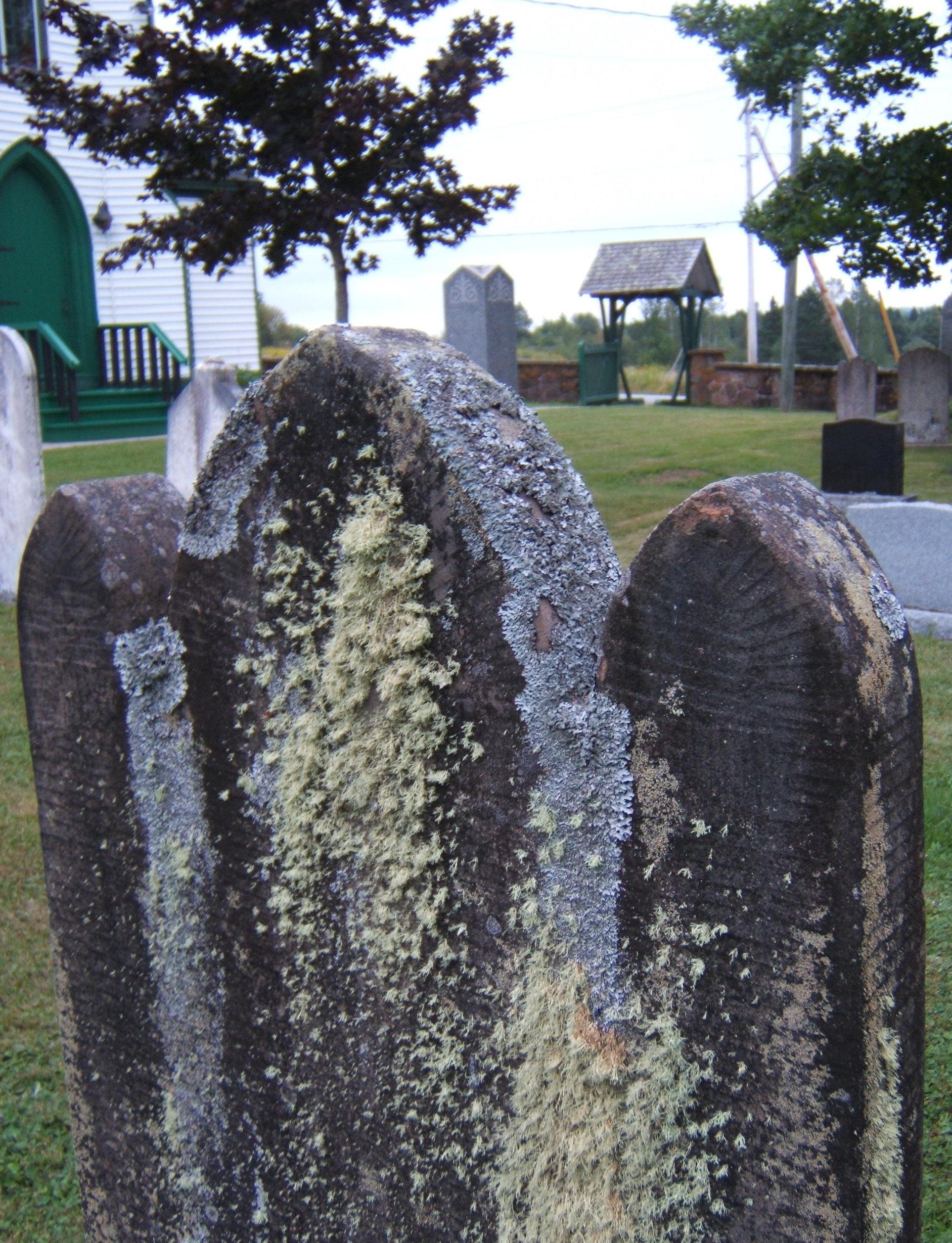
the location of our picnic table
Back in our grey woods is a place we don’t visit regularly any more. Our picnic table is there, in a mossy area among mature spruce and fir, at the top of a slope. It overlooks a wet spot in the woods. In the spring the wet area becomes an ephemeral stream, and a series of vernal pools among the mosses and ferns.
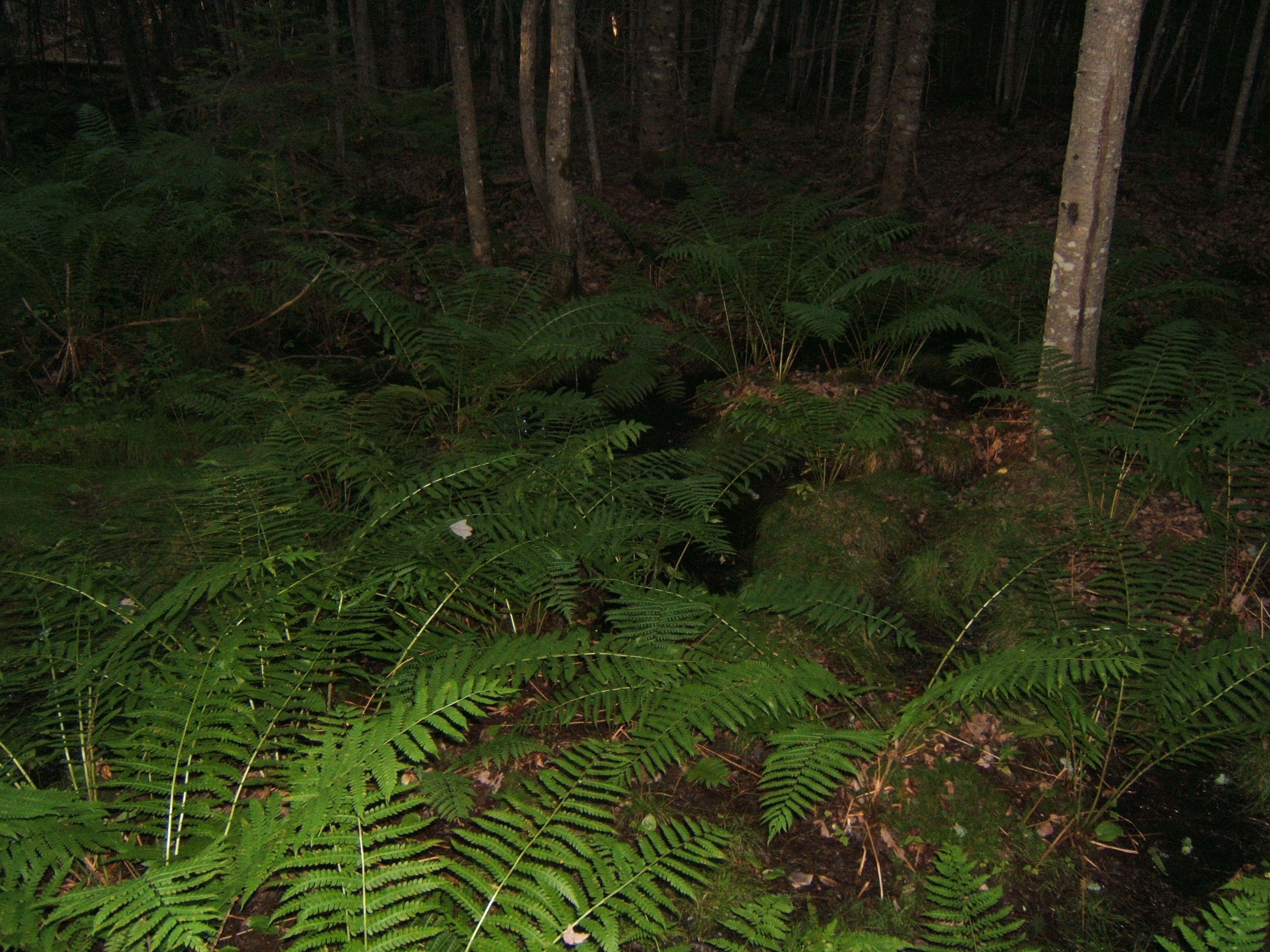
down-slope of the picnic table is a ferny area with an ephemeral stream... the dark areas in the photo are pools of water
Once, almost 28 years ago, the space was perfect for our new picnic table. The table was given to my newborn son by his Great-Aunt Jane and we took considerable care in choosing its location.

our picnic table in the woods
In years past, we took a picnic lunch there regularly. Sometimes I went there to write.
Today I pass the table when I follow the path through the woods, but I haven’t stopped to eat a picnic there in years. Another family has taken over, probably of Groundhogs (Marmota monax). They have built a labyrinth of burrows among the tree roots in the soft soil of the slope. Where each burrow exits is a mound, the remains of deep-earth excavation. One of the six burrow openings is larger than the others. My reading tells me this complex of burrows and exits provides quick escape from predators, a place to store food, and a place to hibernate.

the main entrance to the burrows, under the roots of a fir
Once this place was the ideal location for our new picnic table and our family picnics. Now the same site is perfect habitat for the Groundhog family.
concerning the location
of our new picnic table
~
share a meal with the unknown
to make it your friend
~
we find a clearing
near the path
where the sun will shine at noon
where we will not have to cut the trees
where the neighbours’ voices
and the passing cars
are quiet
~
we load the picnic table
into the cart
haul it through the woods
behind the Yamaha
~
we eat peanut butter sandwiches
and applesauce
drink cola
and sunshine
~
we laugh
make friends with the woods
and with each other
~
© Jane Tims 1983
hidden in the hollow heart of an oak
Hollow trees create mysterious spaces in the woods.
When I was young, a hollow in a tree was a secret hiding place for treasures, and one of my favourite books was a Nancy Drew mystery – “The Message in the Hollow Oak”. In the story, a hollow tree is used as a secret mailbox between long lost lovers.
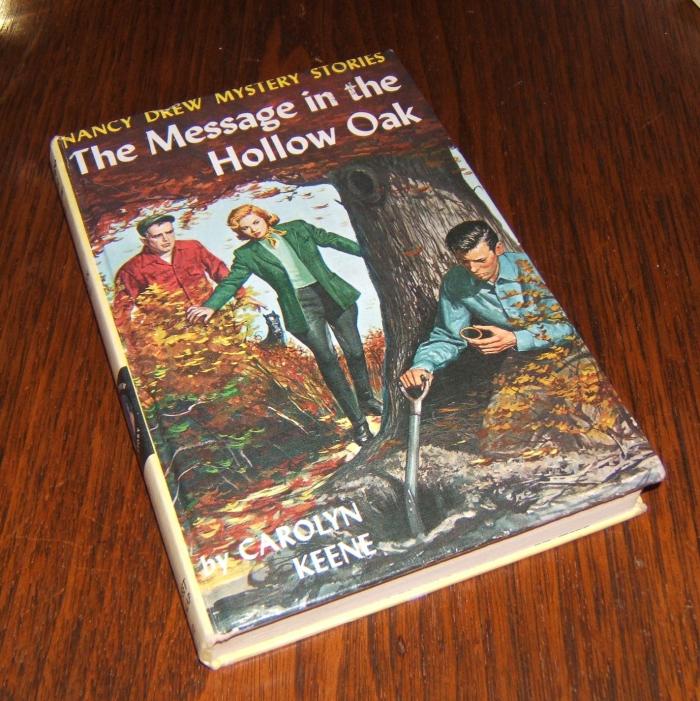
- Carolyn Keene 1935 The Message in the Hollow Oak (a later edition, probably around 1965)

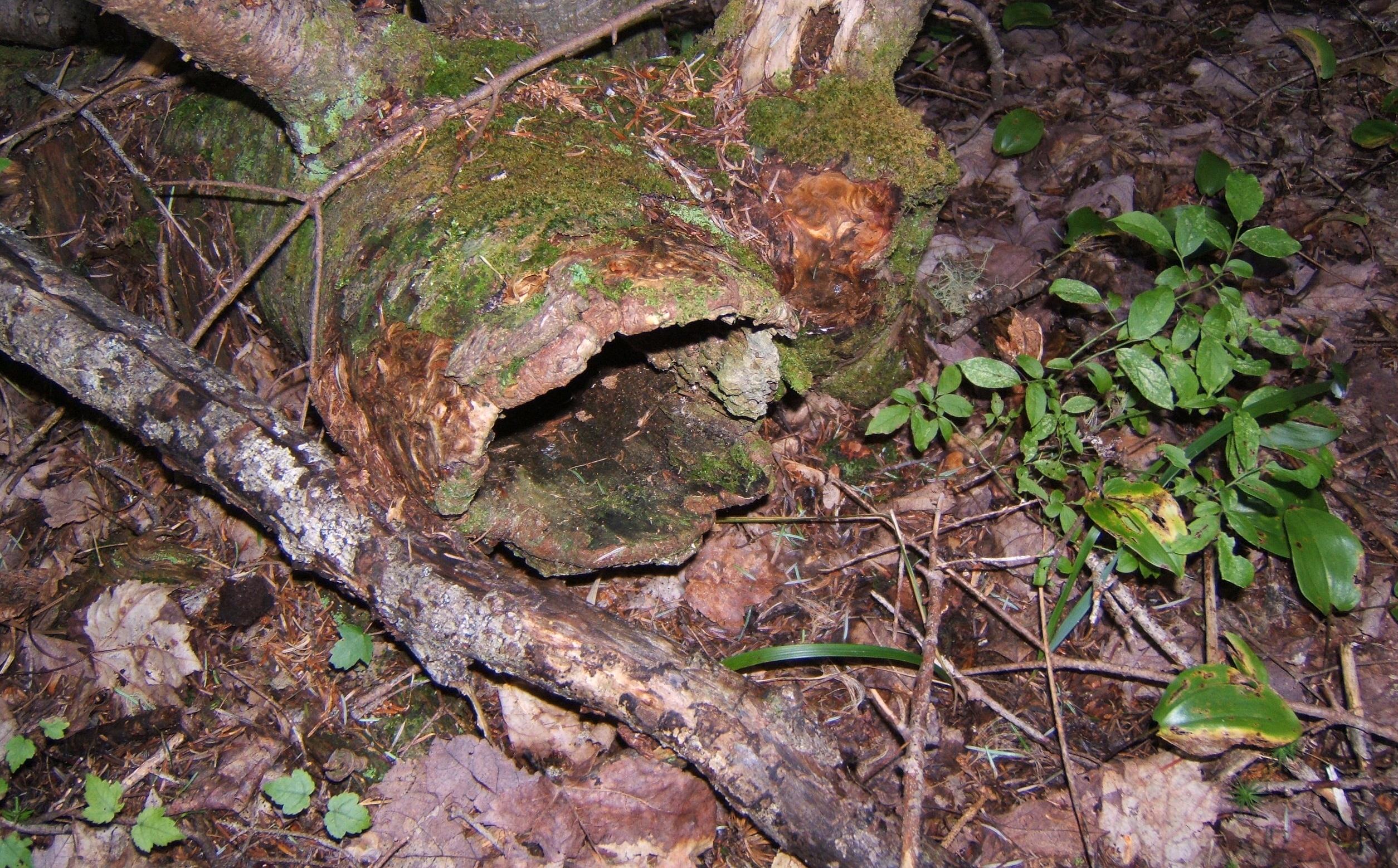
a hollow log in the woods
Cavities are usually found in mature trees. Their importance as habitat is a good reason for protecting older, mature trees in the woodlot. When my son was young, we made wooden signs saying “DEN TREE” for the older hollow trees in our woods, so we would remember not to cut them down.
Do you know a hollow tree and would you reach into the cavity to retrieve a letter???
requesting the favour of a reply
~
these leafless trees
brush against
a linen sky
ink strokes
on rice paper
letters
penned at midnight
~
hidden in the hollow
heart of an oak
afraid to reach in
to feel only
curls of bark
desiccated leaves
~
these trees
all seem the same
empty envelopes
parchment ghosts
~
branches tangled
messages
lost
~
black spruce scribbled on sky
~
Published as: ‘an answer in silence’, Spring 1995, The Cormorant XI (2)
(revised)
© Jane Tims
competing with the squirrels #2
We watched our hazelnuts carefully every day until August 11, certain the squirrels would not get them ahead of us.

our hazelnuts, almost ready to pick
Then, as humans do, we went on a small vacation, and returned on August 14, only three days later.
As soon as I was out of the car, I went to have a look at my hazelnuts.
And not one remained.

no hazelnuts
The squirrels got the hazelnuts.
No poem can express my dismay.
Next year…
Warning: 1. never eat any plant if you are not absolutely certain of the identification; 2. never eat any plant if you have personal sensitivities, including allergies, to certain plants or their derivatives; 3. never eat any plant unless you have checked several sources to verify the edibility of the plant. © Jane Tims 2012competing with the squirrels #1
The squirrels and I have issues. I say squirrels, because we have at least two species of squirrel (Sciurus sp.) on our property, reds and greys.
The red squirrels were here before we arrived, about 31 years ago. The red squirrels I see here today must be the great-great-great… grandchildren of the little fellow who used to shimmy down a copper wire to get to our feeder. The grey squirrel arrived only a couple of years ago and is as big as a small cat. Both reds and greys compete with the birds for the sunflower seeds and other food we put in the feeder. The two species of squirrels compete with one another for roughly the same ‘niche’ and my reading tells me that the grey squirrels will eventually displace the red.

grey squirrel cleans out feeder
I overlap with the squirrels’ ‘niche’ in one repect: we all love hazelnuts. I have two large shrubs of Beaked Hazelnut (Corylus cornuta Marsh.) in our woods. Beaked Hazelnut is a wiry shrub with large serrated leaves. Its fruit is contained in bristly beaked husks and the nut is edible, to both me and the squirrels.

Beaked Hazelnut shrub with hazelnuts in beaked husks
The question is, when do I pick my hazelnuts? It has to be the day before the squirrels pick their hazelnuts. I ask my husband every day and he says he doesn’t know…..
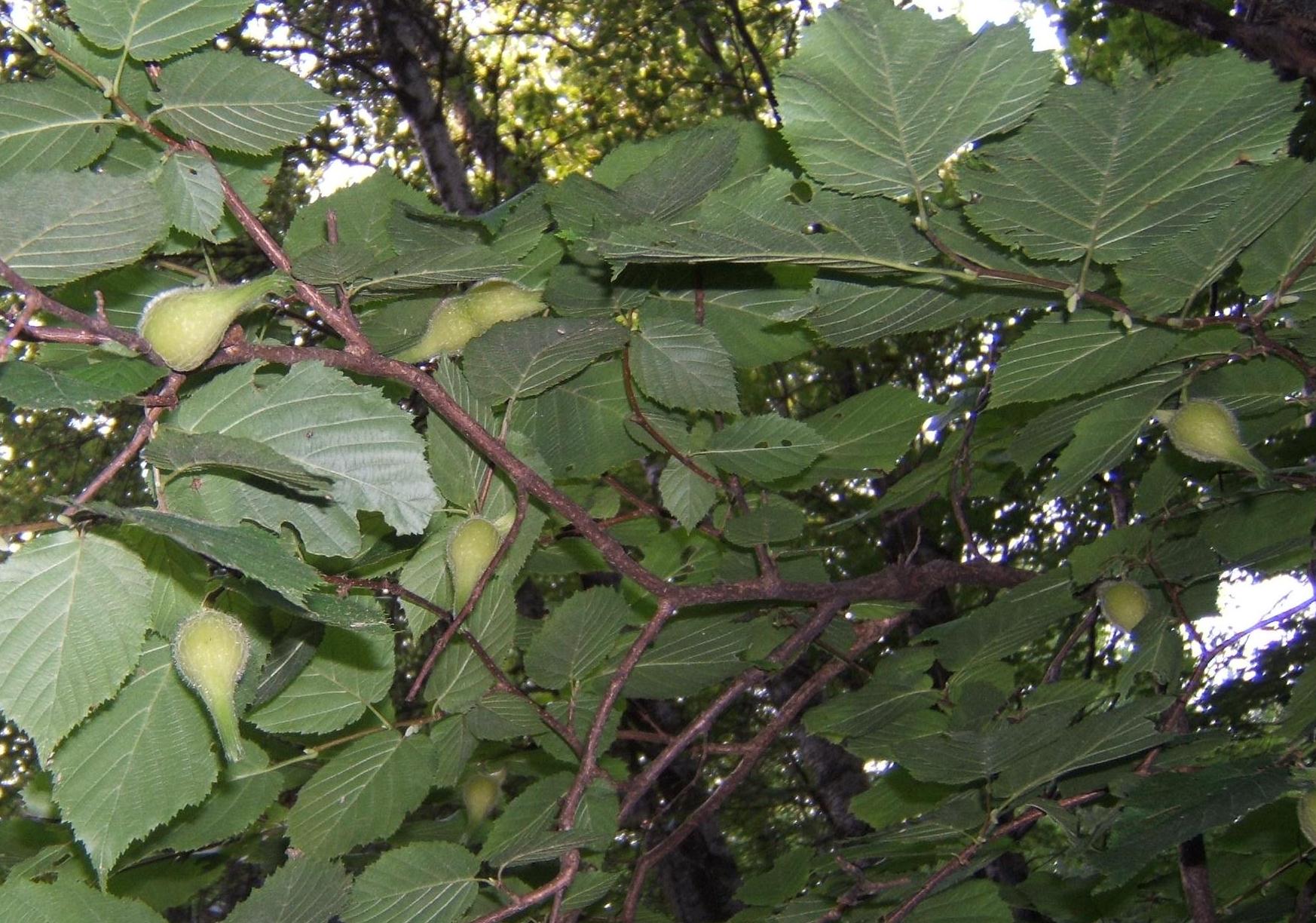
hazelnuts viewed from the underside of the shrub canopy
© Jane Tims




 nichepoetryandprose