Archive for the ‘where plants grow wild’ Category
along the country road #4
My Mom was a great gardener. She could grow vegetables on the smallest corner of land and coax flowers where I was certain none would grow. When I was a little girl, and we lived in Alberta, she kept vibrant flower gardens. I remember the hollyhocks towered above my head, nasturtiums made pools of fire beside our door, and alyssum spilled over the edge of the cement walkway. One year, Mom planted sweet peas and I helped her put up a little string, unbelieving when the shoots pushed up through the soil and the papery leaves used curly tendrils to climb the string.
Another flower I remember fondly is the snapdragon, with its inflated lower lip. Its mouth yawned and looked like it could spurt dragon-fire if you pressed the petals between your thumb and forefinger.
I was never able to grow snapdragons, although I’ve tried. But one of the plants growing wild along our road has the charm of the garden snapdragon and is in the same family of plants. This little plant is called Toadflax. Its other common name is Butter-and-eggs.
Butter-and-eggs (Linaria vulgaris Hill.) is a weed of roadsides and waste places, blooming in large patches, late in summer. The flowers are spurred and bright yellow, with a lower orange lip. The inflated lower lip acts as a landing platform for insects and is hinged, to allow the right pollinators access to the nectar and pollen.
Butter-and-eggs is not a very big dragon, but it does have a mouth that yawns if you press the petals between your thumb and forefinger. Perhaps this is the reason Butter-and-eggs is known in French as guele de lion. Its other French name is linaire. This name, and the scientific name Linaria, are derived from the Latin linum meaning ‘flax’.

Butter-and-eggs (Linaria vulgaris Hill.)
along the country road #3
A few years ago, I became interested in pressing flowers as a craft. I discovered a secret – one of the best flowers to press is Queen Anne’s Lace. Laid out on the page, it has the look of intricate crochet.
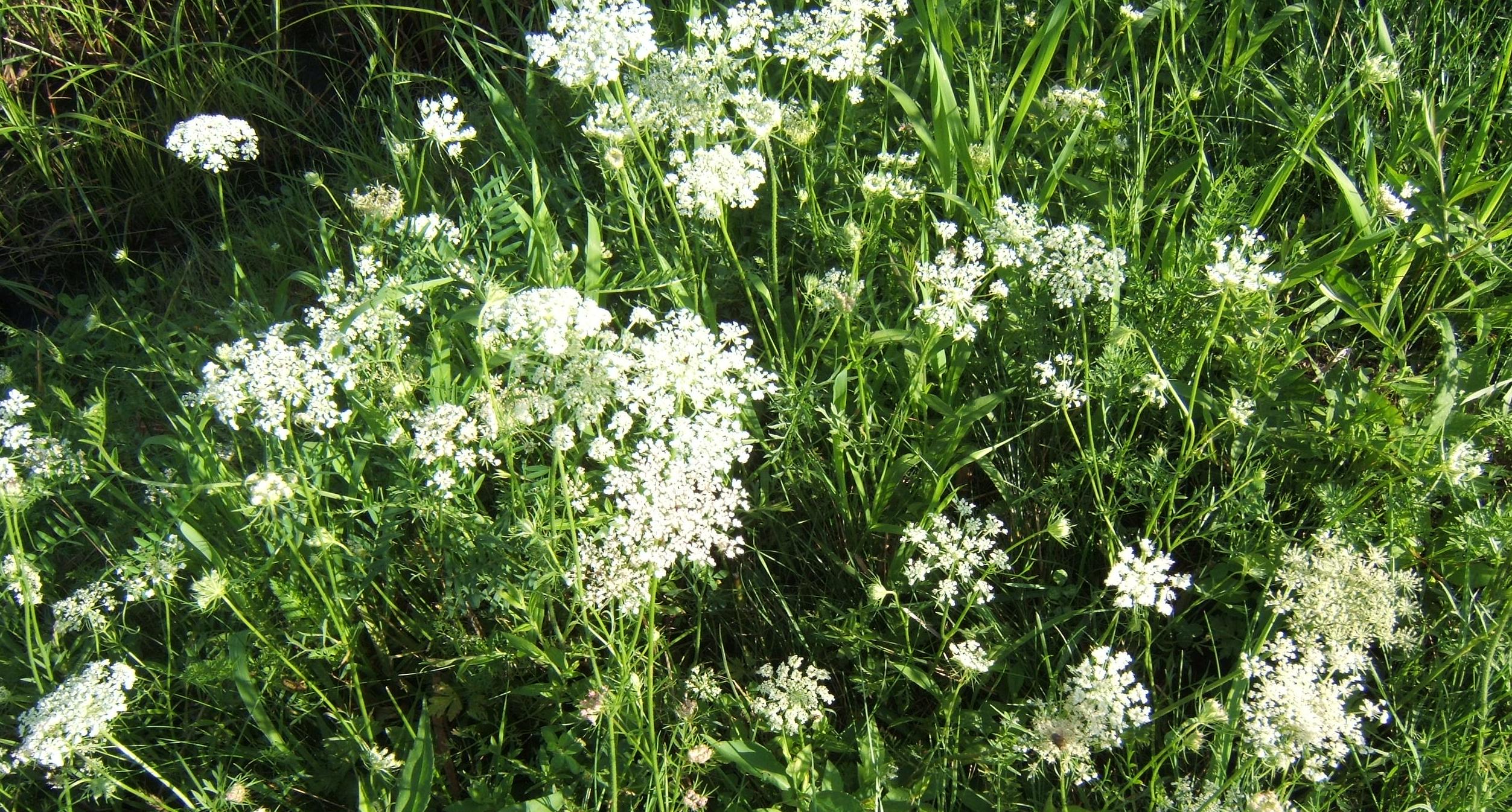
Queen Anne’s Lace, also called wild carrot, devil’s-plague, and carotte sauvage, is a tall weed with an umbrella-like cluster of lacy white flowers. The flowers are an umbel, meaning that the individual flowers all radiate from the same point on the stem to form a head. The flower is commonly seen in hayfields and waste places, and along roadsides.

Queen Anne's Lace (Daucus carota L.)
Daucus is the ancient Greek name for carrot; carota is the old generic name for carrot.
Don’t let the name ‘carrot’ fool you, as the roots are said to be somewhat poisonous. Also, beware of look-alikes. There are many flowers that can be described as a ‘white umbel’, some of them poisonous to the touch. Use an identification guide before you investigate too closely!
like snowflakes in summer
Queen Anne’s Lace
Daucus carota L.
wild carrot
inedible
no colour
unsuitable
as a vegetable
(poison probable)
white lace
three dimensional
tatted for Anne
‘Not Suitable’
for a Queen
(too usual)
umbrella
non-functional
(leaky)
unsuitable
for the rain
(or even drizzle)
in moonlight
unforgettable
common words
unsuitable
devil’s-plague?
ethereal!
Published as: ‘Queen Anne’s Lace’, Winter 1993, The Antigonish Review 92:80-81.
(revised)
© Jane Tims
along the country road #2
Here in New Brunswick, although it is only August, the flowers along the roadside are changing. The daisies and buttercups of summer are giving way to the flowers we associate with autumn – the goldenrods, the asters, and Pearly Everlasting.
Pearly everlasting (Anaphalis margaritacea (L.) C.B. Clarke), called immortelle in French, is a weed of roadsides, fields, open woods, and clearings. Its flowers are borne in clusters on an upright, leafy stem. They are easy to dry in bouquets since most of the so-called flower consists of a small yellow floral head surrounded by pearly-white dry bracts.
The generic name is an anagram of Gnaphalium, the name of another genus of everlasting flowers. This, in turn, is an ancient Greek name for a downy plant, derived from the word gnaphallon, lock of wool. Margaritacea means pearly.
What flowers mark the change of seasons in your area?
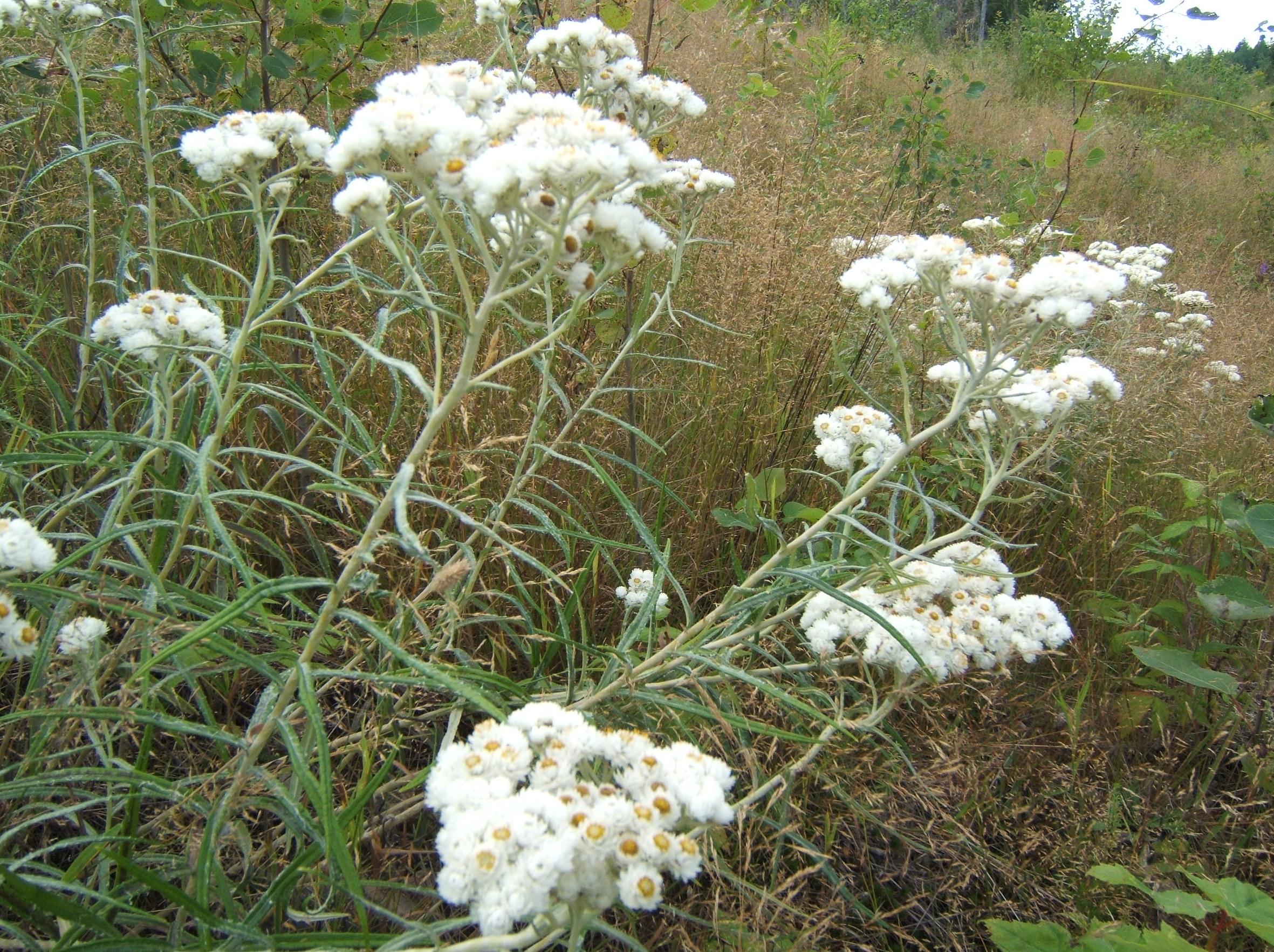
Pearly Everlasting (Anaphalis margaritacea (L.) C.B. Clarke)
Pearly Everlasting
Anaphalis margaritacea L.
Pearly Everlasting
sign of summer’s passing
yet- immortelle
picked by the road
by the armload
hung from rafters
children’s laughter
runs beneath
downy leaf, woolly stem
white diadem
perfectly matched flowers
thatched in gold
dry and old
Linnaeus-named
for Marguarite
memory sweet
paper petals keep
pale perfume
summer
grace
in a winter room
Published as: ‘Pearly Everlasting’, Winter 1993, The Antigonish Review 92.
(revised)
© Jane Tims
competing with the squirrels #1
The squirrels and I have issues. I say squirrels, because we have at least two species of squirrel (Sciurus sp.) on our property, reds and greys.
The red squirrels were here before we arrived, about 31 years ago. The red squirrels I see here today must be the great-great-great… grandchildren of the little fellow who used to shimmy down a copper wire to get to our feeder. The grey squirrel arrived only a couple of years ago and is as big as a small cat. Both reds and greys compete with the birds for the sunflower seeds and other food we put in the feeder. The two species of squirrels compete with one another for roughly the same ‘niche’ and my reading tells me that the grey squirrels will eventually displace the red.

grey squirrel cleans out feeder
I overlap with the squirrels’ ‘niche’ in one repect: we all love hazelnuts. I have two large shrubs of Beaked Hazelnut (Corylus cornuta Marsh.) in our woods. Beaked Hazelnut is a wiry shrub with large serrated leaves. Its fruit is contained in bristly beaked husks and the nut is edible, to both me and the squirrels.

Beaked Hazelnut shrub with hazelnuts in beaked husks
The question is, when do I pick my hazelnuts? It has to be the day before the squirrels pick their hazelnuts. I ask my husband every day and he says he doesn’t know…..
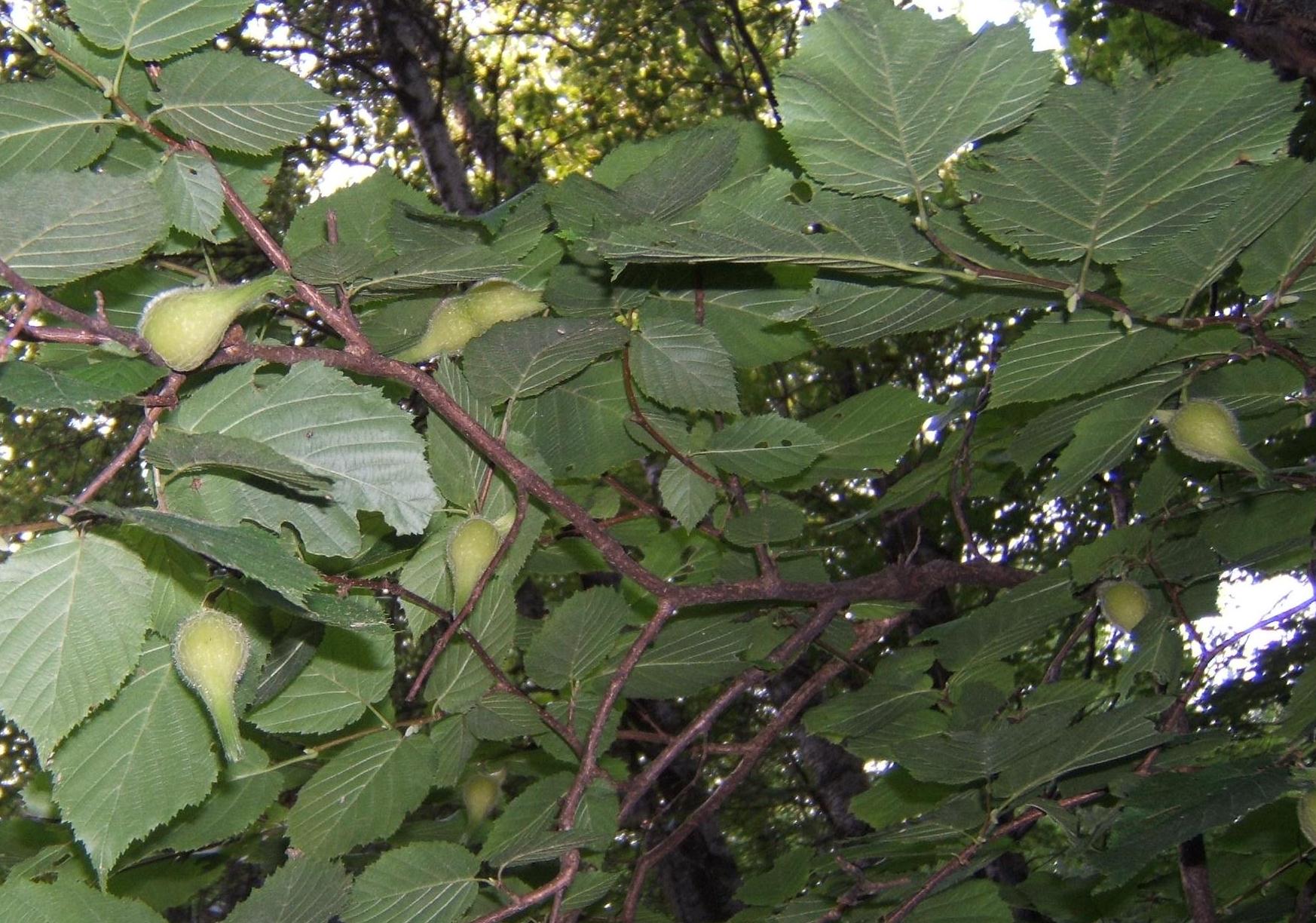
hazelnuts viewed from the underside of the shrub canopy
© Jane Tims
thriving on the roof
Our wood shed is almost thirty years old and its roof has never been re-shingled. This summer, perhaps it is trying to communicate with us.
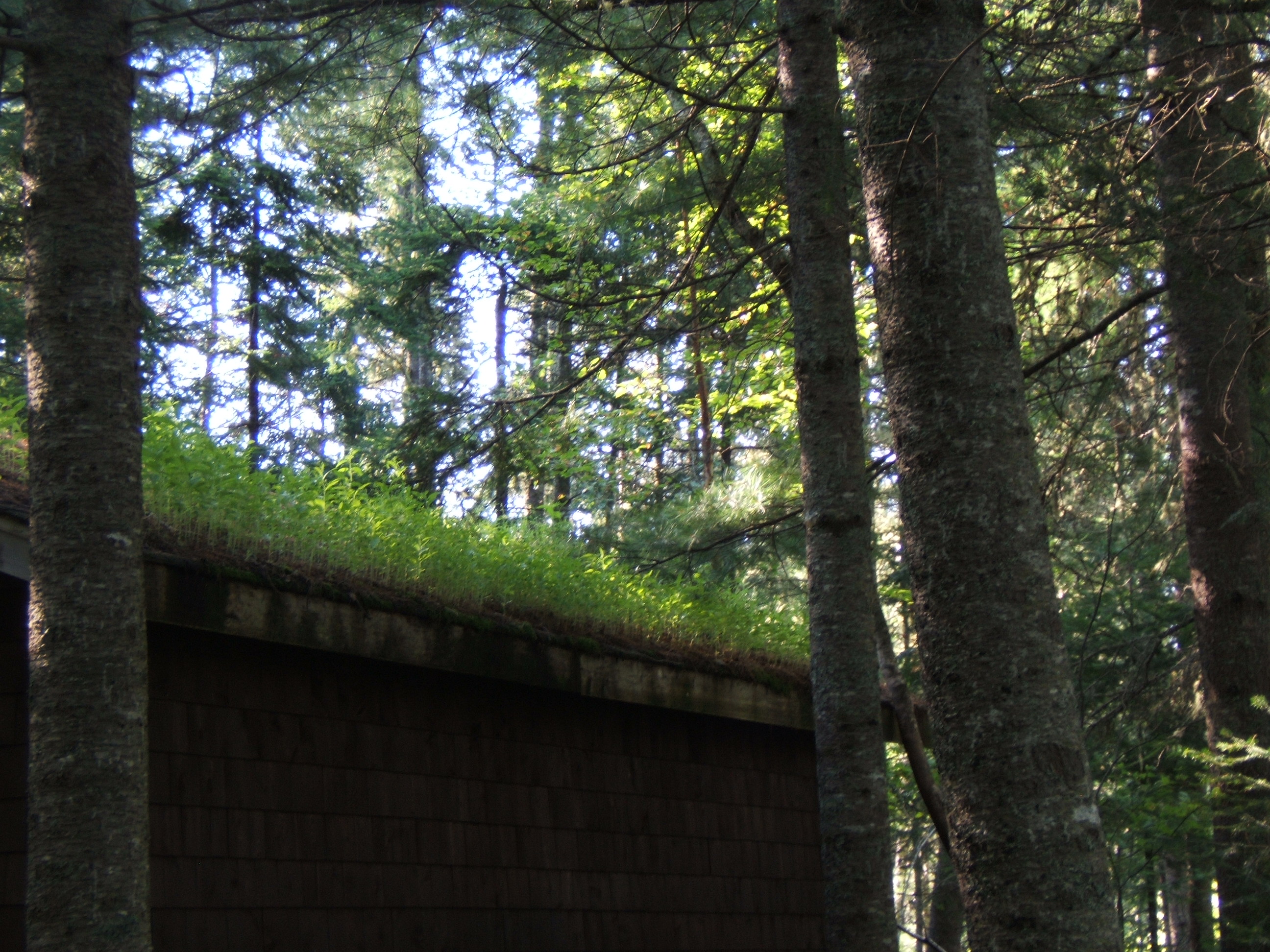
the right amount of soil, the right amount of sun
Just above the wood shed is a white pine. Each year it sheds some of its needles and these land on the roof. Over the years, they have gradually built up, forming a kind of compost. This year, a dusting of seeds found hold, sprouted and are thriving! The roof is still keeping the contents of the wood shed dry, although we expect a vigorous root to break through any time.
Sometimes, we find a space to grow and thrive where it is least expected.

thriving on the wood shed roof
‘niche’ on a rock
In July, we went to the Saint Martins area for the day and spent some time exploring the caves and beach-combing. We also took the short drive to the lighthouse at Quaco Head. The lighthouse is perched on the cliff overlooking Quaco Bay.

the Quaco Head Lighthouse ....... “The present Quaco Head Lighthouse was constructed in 1966 and consists of a square tower rising from one corner of a concrete fog signal building. The light in its lantern room produces a white flash every ten seconds, while the fog signal emits a three-second blast every thirty seconds, when needed.” from http://www.lighthousefriends.com/
If you look out over the Bay, you can see some exposed rocks where sea birds make their home, and, to the north-east, Martin Head, about 30 kilometers away.

the view to the north-east ...... Martin Head is on the horizon, to the left
Wildflowers were everywhere, but what caught my eye was a lichen on a flat rock at the base of the lighthouse. It was bright orange, like a splash of paint.
There are two orange lichens that live on rocks in the coastal area of New Brunswick, Xanthoria and Caloplaca. The orange lichen I found at Quaco Head is likely one of two species: Xanthoria sorediata (Vain.) Poelt or Xanthoria elegans (Link) Th. Fr.
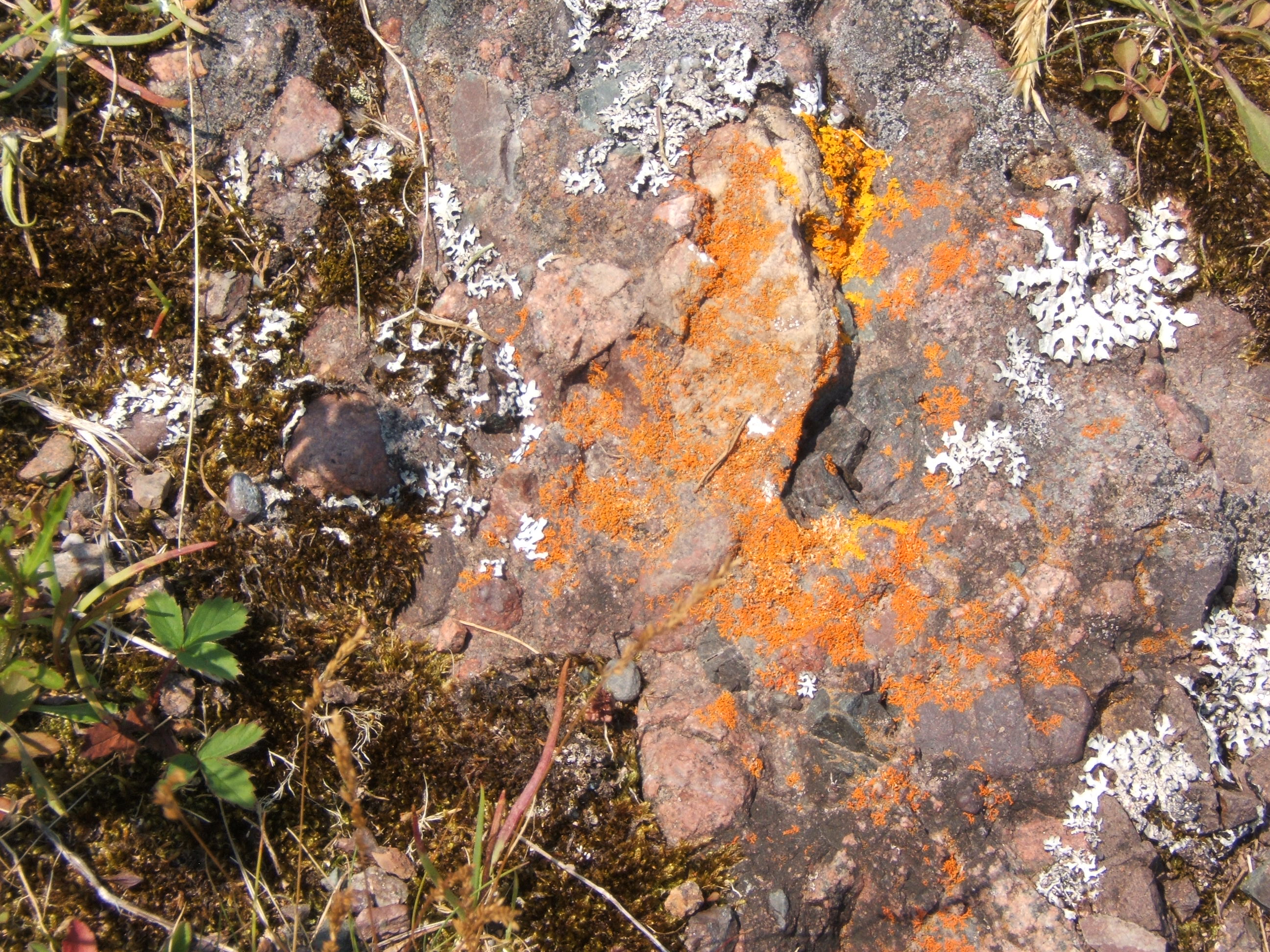
bright orange Xanthoria lichen on a rock .... there are also two or more other species of lichen present
A lichen is not a plant, but a composite organism, consisting of an algae and a fungus, living together in a symbiotic, mutually beneficial, relationship.
Ringing
Swallow Tail Lighthouse, Grand Manan
air saltfresh and balsam
walls lapped by a juniper sea
pale mimic of the salt sea
battering its foundations
its endurance
a mystery
until I found
an iron ring
anchored deep
in rock
almost lost
in lichen
Xanthoria orange
lifted and dropped
run round
its axis
clashing on stone
creak and clank of the metal door
echoes climbing the welded stair
ground glass grit of the light
fog washed clang of the channel bell
rock lashed to the lighthouse
salt breakers turned to stone
Published as: ‘Ringing’, Spring 1995, The Cormorant XI (2)
(revised)
© Jane Tims
along the country road #1
When I was taking botany in university, a requirement of my taxonomy course was to make a ‘collection’ of plants, so I could learn how to identify them. Since I lived at home, and spent lots of time on the road, the easiest collection for me to make was of plants living along the roadside.
I made the collection, identified, pressed and dried each plant, glued them to the herbarium sheets, prepared their labels, and got a good mark in the course. The real legacy of the collection was that I developed the habit of botanizing along the road, at the edges and in the ditches. Gradually, I learned the names of the plants of the roadside better than any other group.
One of my favorite roadside plants is Common Yellow Rattle (Rhinanthus minor). In early summer, it’s a small herbaceous plant, with wiry stems and opposite leaves. In the axil of each leaf is a yellow, two-lipped flower with an inflated green calyx.
The charm of Yellow Rattle is also the reason for its common name. After flowering, when the calyx dries and turns brown, it becomes a natural rattle. If you pick the dry plant and give it a shake, you can hear the seeds clattering inside the pod.
Rhinanthus minor L. is also known as Rhinanthus Crista-galli L. The old generic name crista-galli means cock’s-comb, from the deeply toothed flower parts. The present generic name is from rhis meaning snout, referring to the shape of the flowers. In French, the plant is called claquette (tap dance), or sonnette (door chime).
Do you have a favorite roadside plant? Next time you take a walk along the road, what plants do you see and do you know their names?
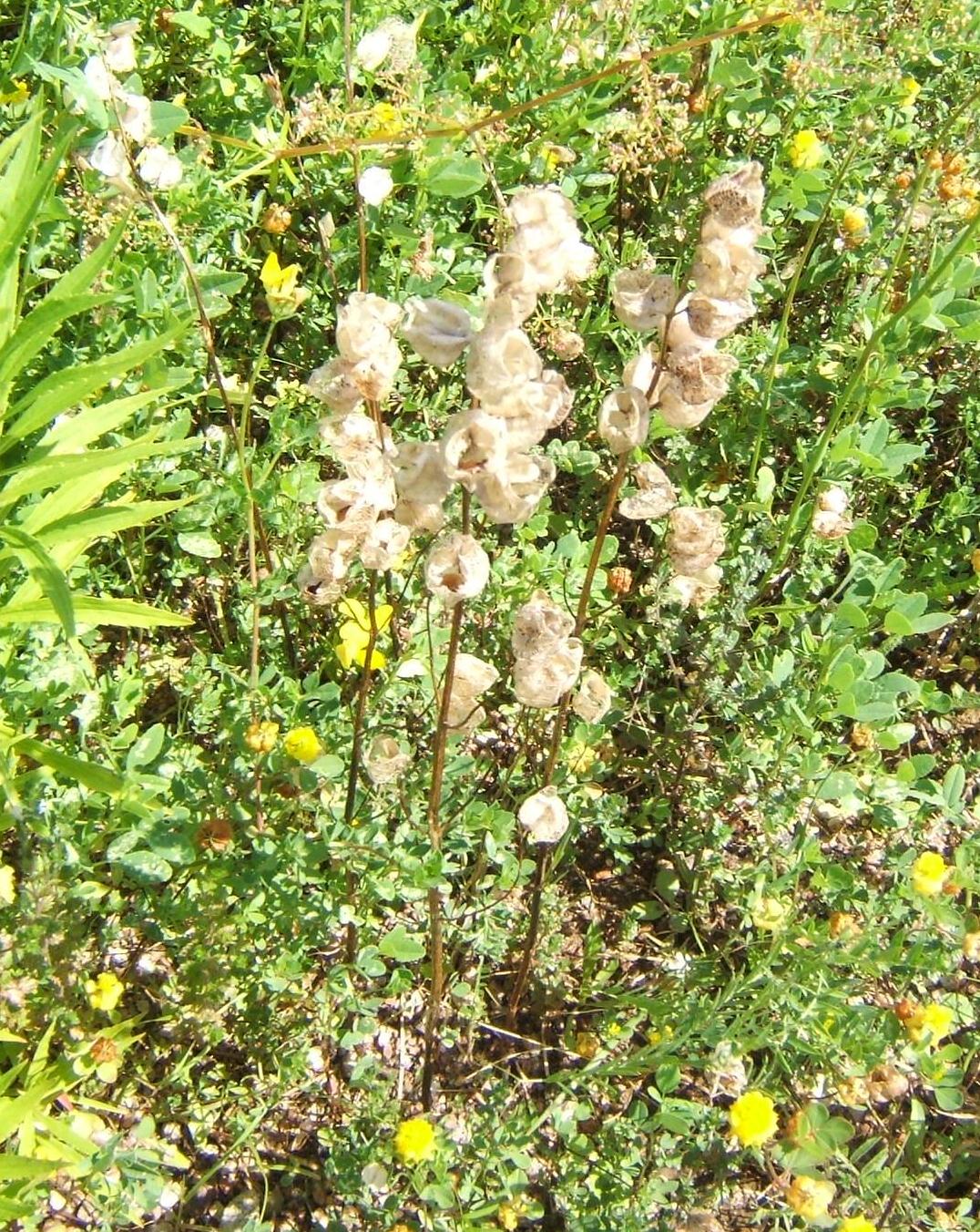
The dry brown plants are the rattling seed-pods of Yellow Rattle. Photo was taken in early August, so no flowers are present. The yellow flowers you see in the photo are two other plant species.
Yellow Rattle
Rhinanthus minor L.
weeds at the roadside
tickle my ankles
parchment whispers
like Alberta prairie
rattler whirr
I freeze
as I do when mouse feet rustle
in a house I thought empty
shake
loose seeds
in paper packets
yellow rattle snouts
test the air
crista-galli flowers
toothed as a cock’s comb
chatter at the north wind
claquette
tap dance on the chilly breeze
sonnette
quick scratching at summer’s door
Published as: ‘Yellow Rattle’, Summer 1994, the Fiddlehead 180
© Jane Tims




 nichepoetryandprose