Archive for the ‘collections’ Category
eight days – antler
During my trip to Ontario, we spent lots of time, on cold days, enjoying the wood stove.
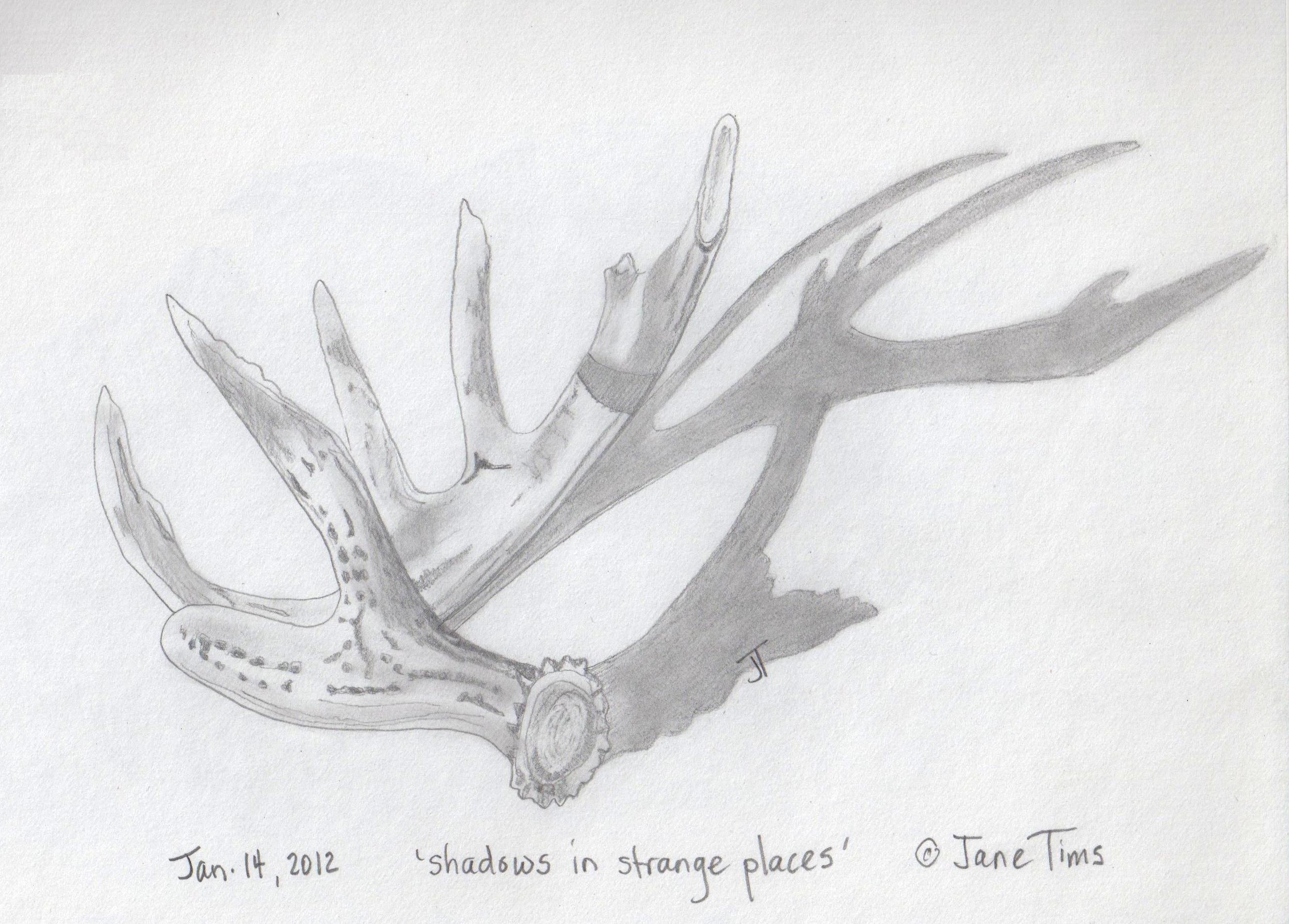
On the hearth was a deer antler, found on a walk in the woods. Usually they are hard to find since the mice chew them to nothing very quickly.
I was drawn to the antler because of its resemblance to a bony hand.

~
~
antler
~
ivory hand, posed
for incantation, shadows in unexpected places
relic of a woodland walk, artefact
enchanted, deer rub
cedar bark to summon
mist, acknowledge the passage
of days, manifest between
separation
and the gnawing of mice
~
~
© Jane Tims 2012
eight days – witch ball
When I was visiting my family in Ontario, my eye was constantly drawn to a window where plants were growing. Suspended above them in the window’s light was a ‘witch ball’. The ‘witch ball’ is a hand-blown glass ball with glass threads in the internal space.
The ‘witch ball’ was used in 18th century England to ward off evil spirits. In its modern form, these balls are used for decoration. When the light traverses the glass and enclosed area of the ball, it creates patterns of light and shadow, beautiful and mysterious.
~
~
witch ball
~
topsy-thwarted, turn
and tangle, strands
of glass and atmosphere
in innerscape of melted
ash and sand dendritic
paths a maze and morph
~
light and shadow
confused
congealed
~
~
© Jane Tims 2012

eight days – glass floats
In days before plastic and styrofoam, fishermen used glass and wood to make floats to keep their nets buoyant.
These floats are colorful symbols of the people who make their livelihood from the sea. In fishing communities in the Maritimes, we often see fences and walls festooned with painted wooden floats and buoys.
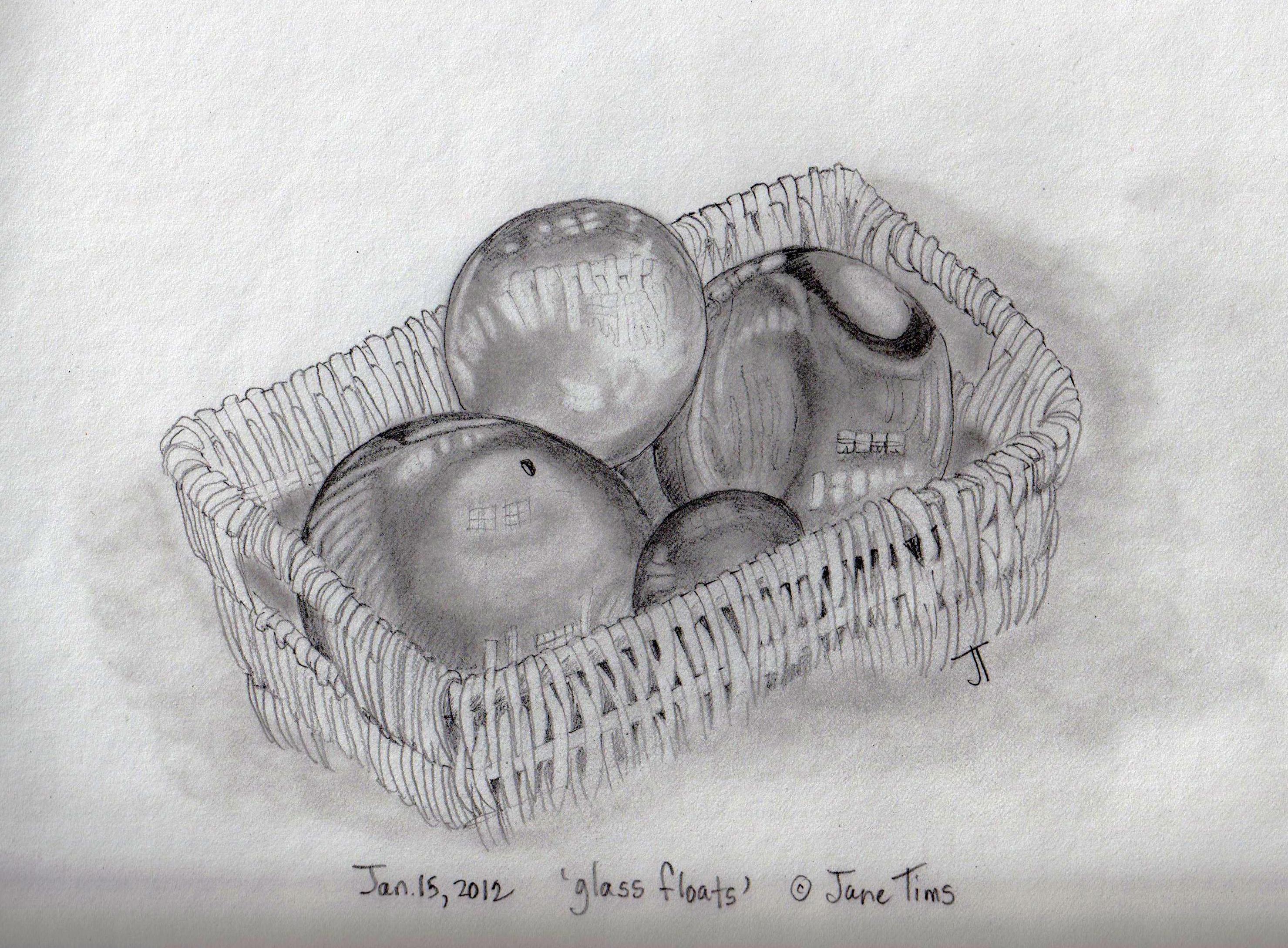
Glass floats are rarer because they are so breakable. At home, my Dad’s collection of sea shells was always accompanied by a couple of glass floats he found at auctions. On my piano, I have a small collection of glass floats in my favorite color, green.
The tradition lives into the next generation… when I visited my family in Ontario for eight days, earlier this month, I was delighted to see a basket of variously-colored glass floats on the hearth of the wood stove.
~
~
glass floats
~
the fog’s still glow
penetrates glass
and air incorporated
an age ago
~
weightless, flamboyant
on salt water
swell
~
glass inflation
tethered by hemp
on an ocean
whipped to froth
~
~
© Jane Tims 2012
eight days – inuksuk
Recently I was able to take eight days and visit some of my family in Ontario. While I was there, I spent some time drawing and writing. In the next few posts, I will show you some of these drawings and the poems I wrote to accompany them.
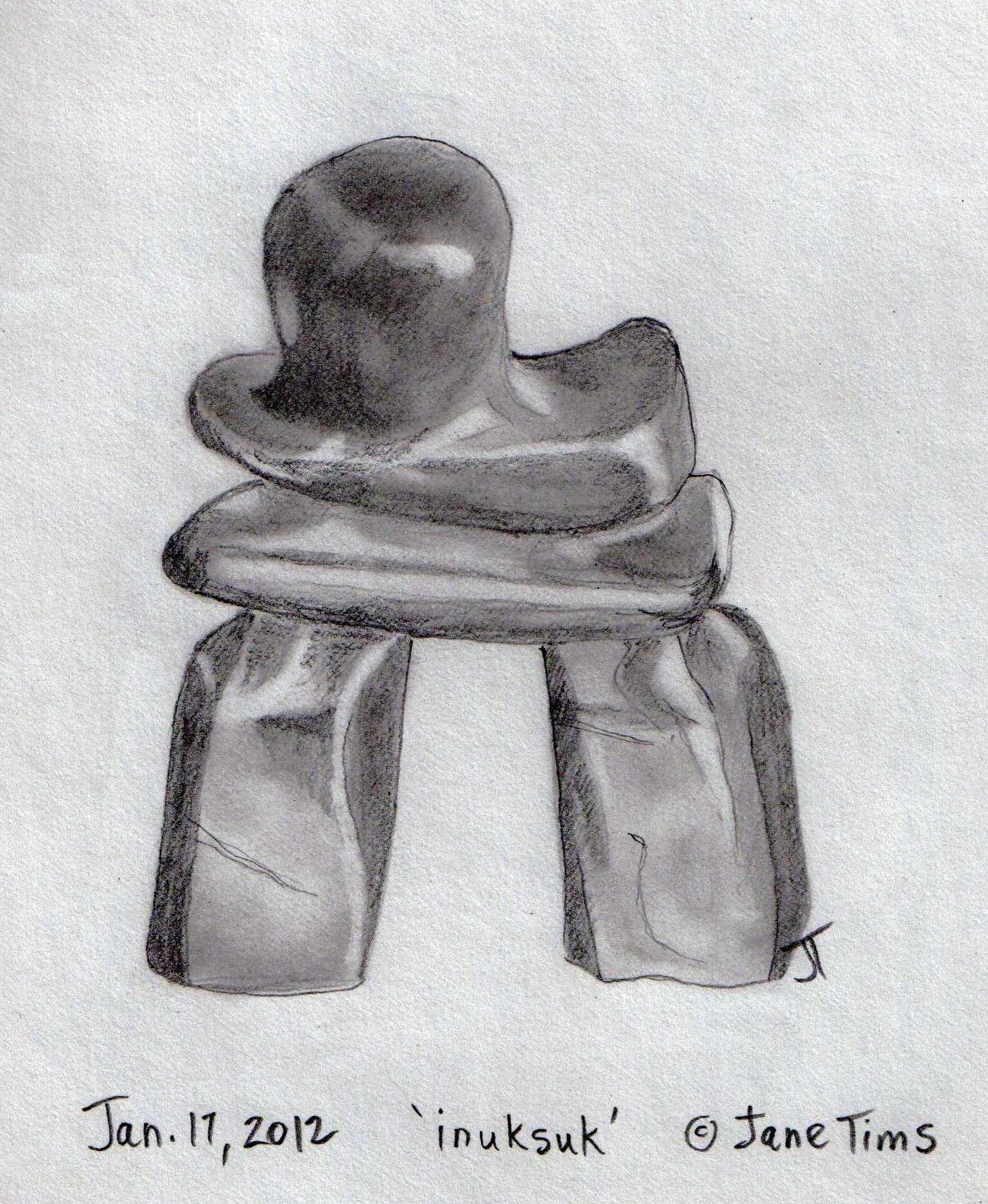
The first concerns a small statuette of an inuksuk, carved in northern Canada by an artist who created a gentle, thoughtful tribute to this traditional form.
For more information on the inuksuk, see my post for November 18, 2011, ‘monuments in stone’, under the category ‘the rock project’.
~
~
inuksuk
~
soapstone smoothed
and sculpted, carved
by a hand, skilled as ocean
salt-polish and sand
corners discovered
and shadows
edge of stone and surfaces
between solid and liquid
solid and air
~
© Jane Tims 2012
in the shed
At my Mom’s old home, there was a shed, housing the stored and discarded miscellany of her family. It had been built by my uncles in the distant past and the floor tipped and slanted after the settling of years. The shed had a special smell, not musty or unpleasant, but definitely tinged with the smell of mothballs and camphor.
There were two rows of shelves, built against the walls and around the small windows. These were grubby and cracked, but the quality of light shining through had a ghostly, ephemeral quality. I spent hours in the shed, armed with the assurances of my aunt … I could keep anything I found, as long as I promised to love and care for it.
I can never remember studying anything so intently as the items stored in the shed. I particularly remember an old trunk and its contents. Most of these were old clothes, but I found a fox fur with beady glass eyes, a fur muff in a linen bag, a small carved metal container my Mom said had once contained perfume, a small locket with a medical insignia, and a little embroidered tape measure and matching needle case. I also found two small framed pictures of flower arrangements. All of these things are still in my possession. The fur muff has been taken on our annual drive to see the Christmas lights for 31 years.
I also found a bolt of white lacy fabric I eventually used to make my wedding dress. This fabric had an important history since my grandmother had worked as a live-in nurse for the Carnegie family in Pennsylvania and received the lace as a gift.
I think the shed and its contents inspired in me a lifelong interest in antiques and in collection. One of my favourite places to spend time is in an antique shop, hunting for treasure. And my house is filled with old ornaments and books, rickety chairs and collectable dishware.
~
~
from an old trunk
~
eventually misplaced
I will wonder where these items hide
shake boxes, ransack alphabets, indulge
in games of word association, regretful
as though a family detail
is forgotten
~
a teller of oral history
a stiff neck at the archives
a keeper of heirlooms
a liar
~
for now
I will protect these, tucked
in tissue paper and labelled boxes
~
~
© Jane Tims 2011

villages and vignettes
I love to view bits of the world in miniature. Especially at Christmas, small replicas of human space make me feel comfortable. Perhaps seeing a world fit neatly into a small space is a version of the safety and calm an animal feels in its den. Perhaps looking over a diorama gives me powerful feelings of omniscience and omnipresence. Perhaps I like the impression of a story being told, from beginning to end, confined in space and time.
Our Christmas decorations are predominantly miniaturized vignettes:
our nativity scene, complete with a stable and its donkey, and a star-spangled hillside of angels and sheep…

my collection of Buyers Choice skaters, including a fellow roasting a marshmallow at a fire beside the frozen pond…

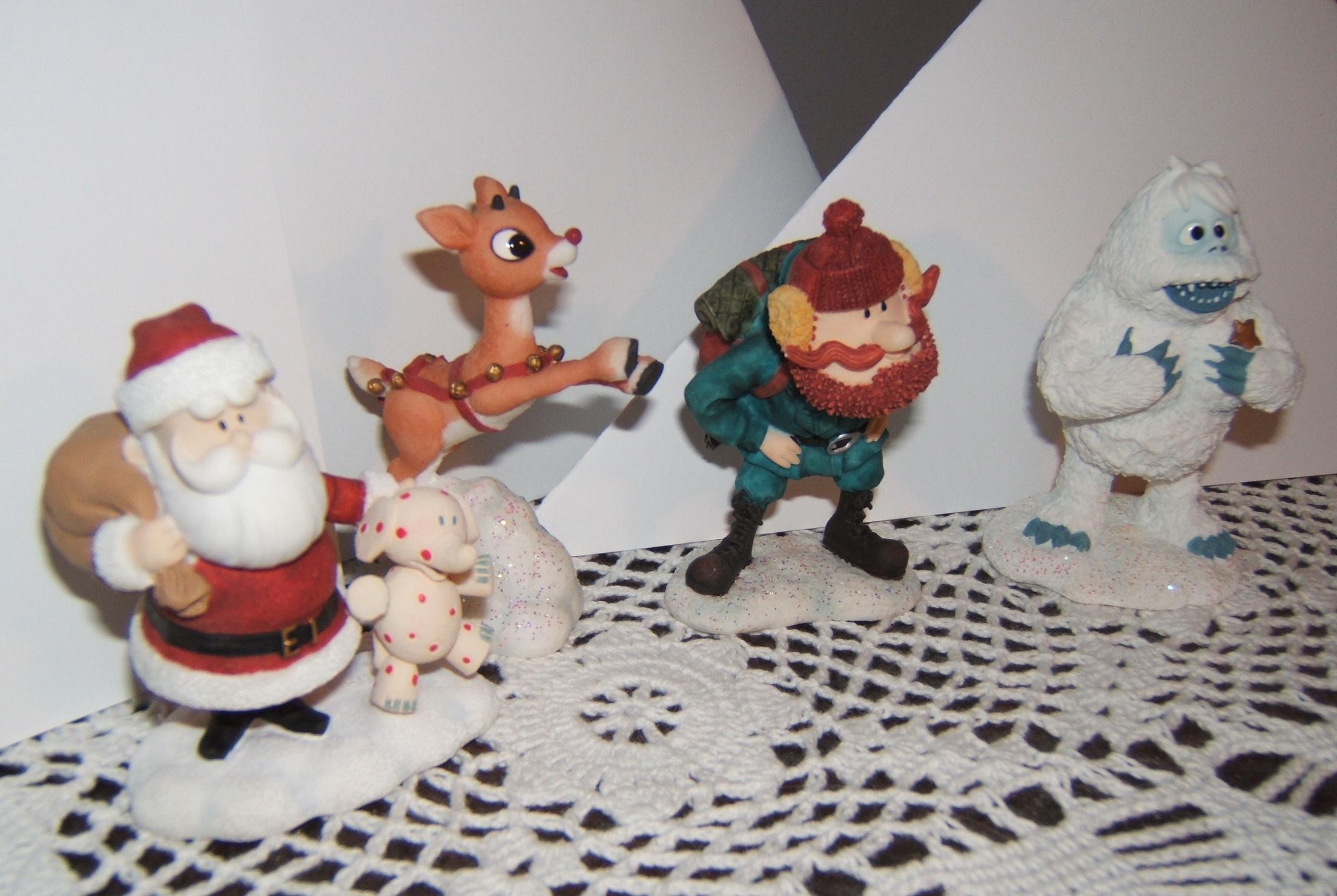
Rudolf and Bumbles from the Island of Misfit Toys…
children gathering around a pitiful Charlie Brown Christmas tree…

a frosty forest of bottle-brush trees and silver reindeer …
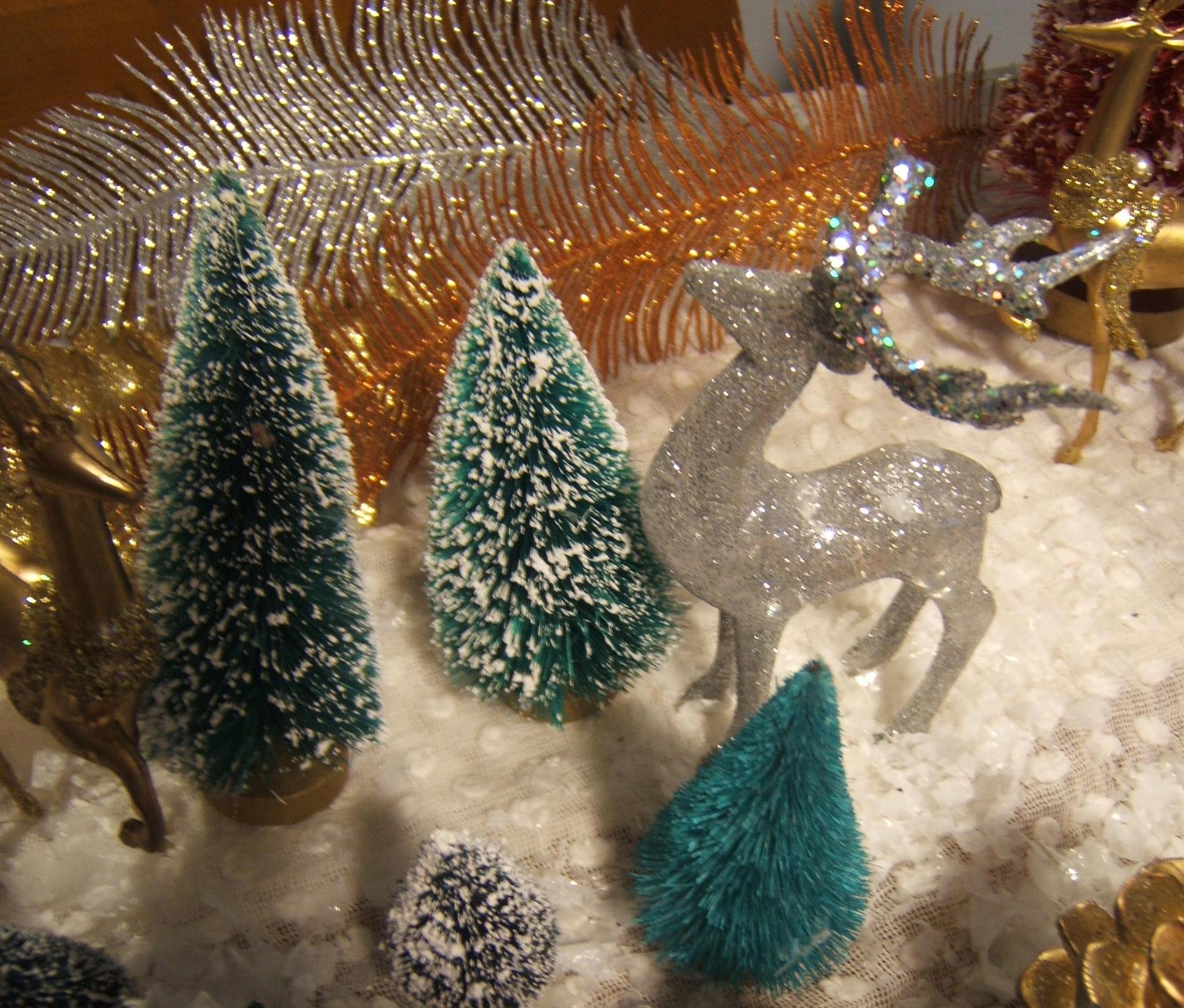
and a village with an inn, a church, and a park with a pond, a stone bridge and a park bench…
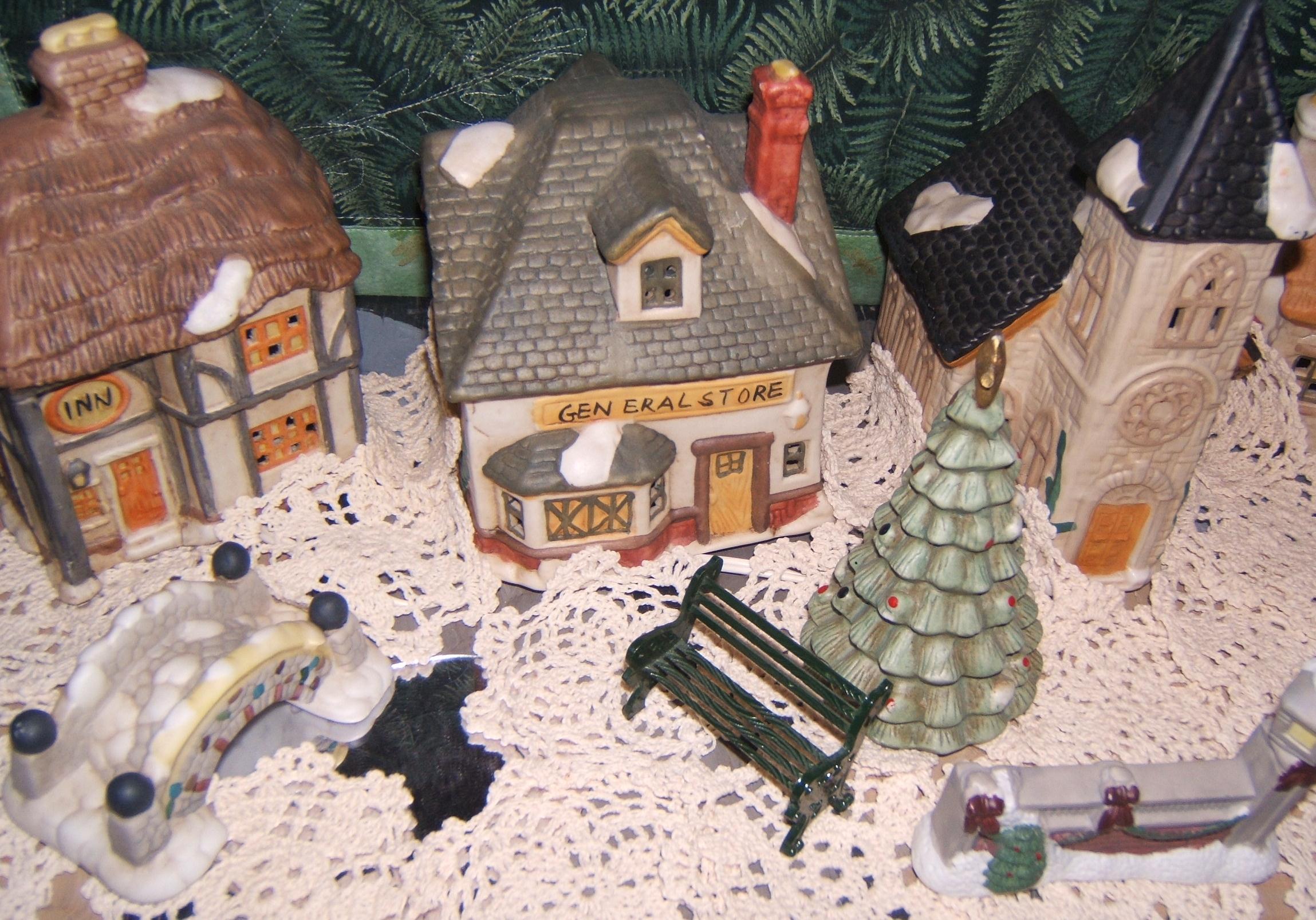
All very cute, but there is something missing.
The best scenes are those with real people. A scene of us sitting by our Christmas tree, talking and laughing. A scene of people in the bookstore, looking for a special book to give someone they love. The scene of a colleague at work, leaving a Christmas card on each desk. A scene of friends walking along a downtown street while the snow falls and the church bells mark the hour.
Merry Christmas everyone!
~
~
still street
~
the stillness of this street
its gentle curve
the steady glow of lamps
lighted windows, sturdy gates
a frozen pond, stone bridge reflected
soft snow, unmarked
and a park bench
where no one ever sits
~
~
© Jane Tims 2011

measuring my space
Niche space can actually be measured. Biologists and others apply a technique called ‘niche width analysis’ to determine the characteristics of a niche. This analysis defines aspects of ‘niche’ such as climate, food use, temperature, moisture, and so on.
One of the characteristics of my niche is – I love collections. My favorite collection is my handful of jointed rulers. I might not be able to measure every aspect of my ‘niche width’ with my collection of rulers, but I can measure any aspect of its linear distance!
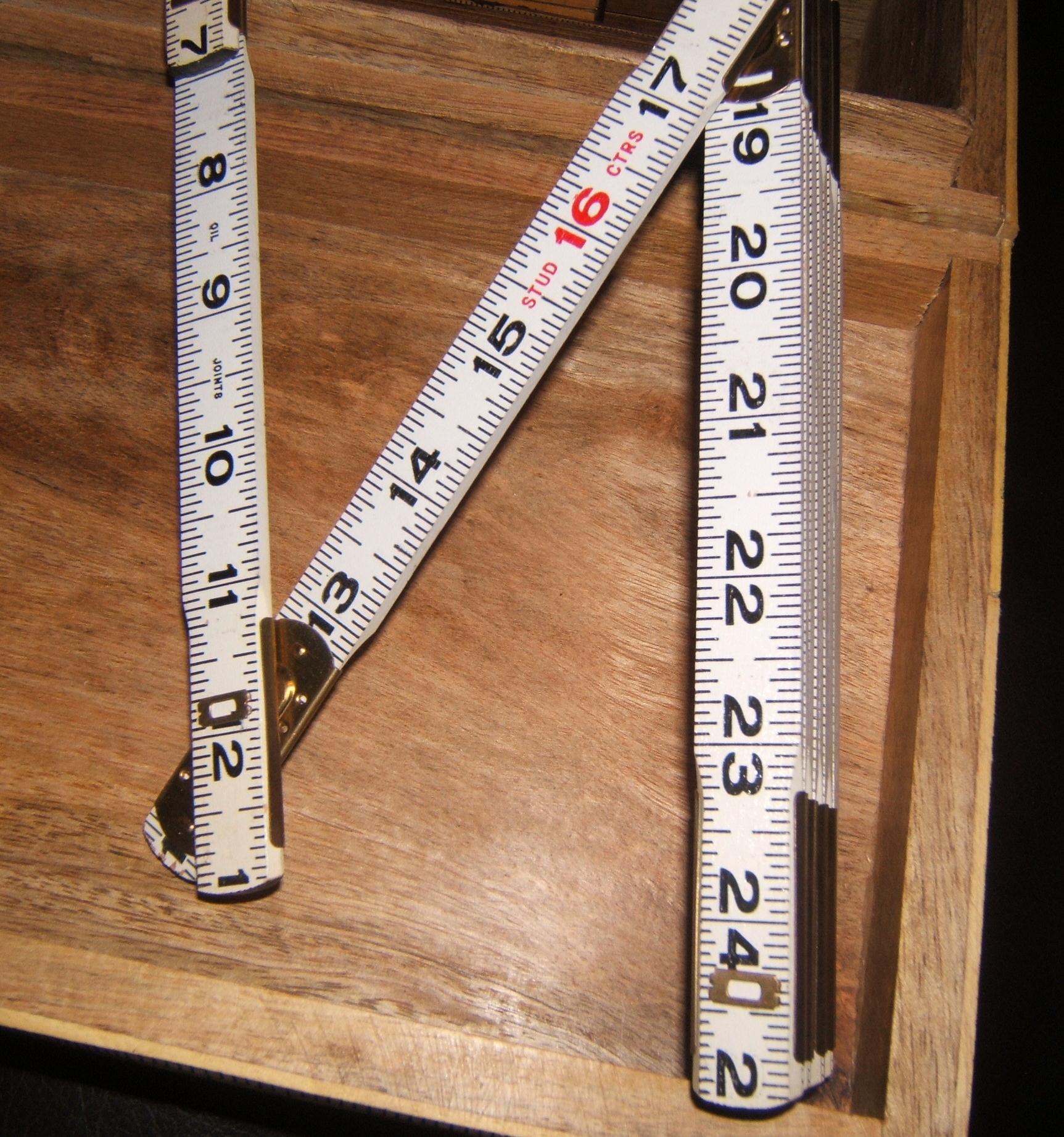
My collection of jointed rulers was given to me by my Dad. He and Mom loved to go to country auctions and they often bought items for me and my sister and brothers. Dad gave me my first jointed ruler for Christmas and then, over the years, added to my collection, one ruler at a time. The rulers were especially meaningful because my Dad was a wonderful carpenter and came from a long line of carpenters:
- my great-great-great grandfather, ‘killed-by-lightning’ William
- my great-great grandfather, ‘shipwrecked’ William (see my post ‘Briar Island Rock #1, #2 and #3′ of December 2, 2011 under the category ‘family history’)
- my great-grandfather, ‘kneeled-on-his-beard-and-couldn’t-rise’ Esau
- my grandfather Robert
- my Dad
- my brothers and sister and me (my husband and I built our own house).
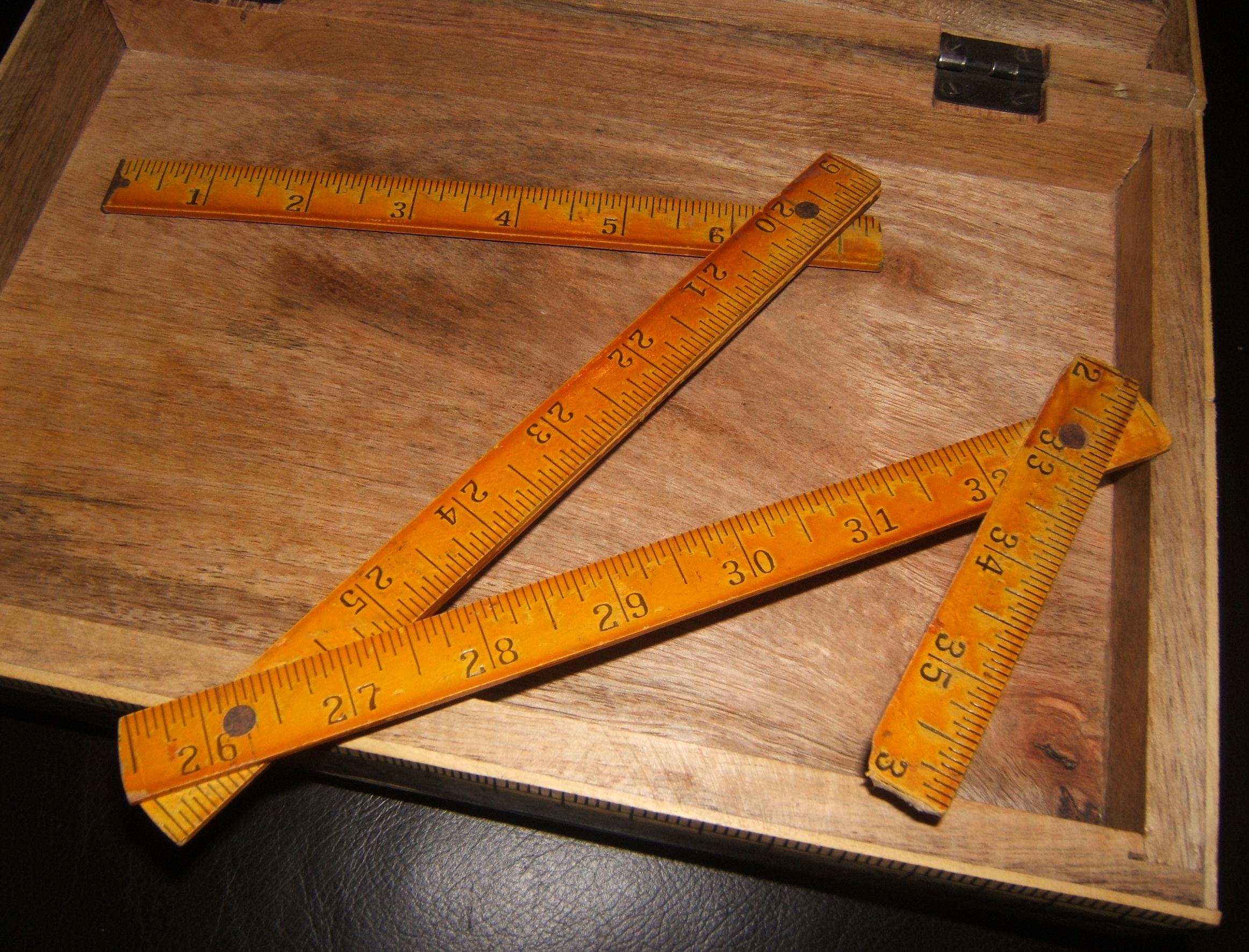
I keep my rulers in a box made of conventional rulers, and I love to take them out and look at them.

Jointed rulers have existed for a long time. They are listed in the 1813 book The Circle of the Mechanical Arts by Thomas Martin (London).

a Plate from Martin, 1813, showing a jointed 'rule' (item # 38)
Jointed rulers are not used very often by carpenters of today since the tape-measure is so much easier to store. However, plumbers still use folding rulers because they can measure twisting pipes.
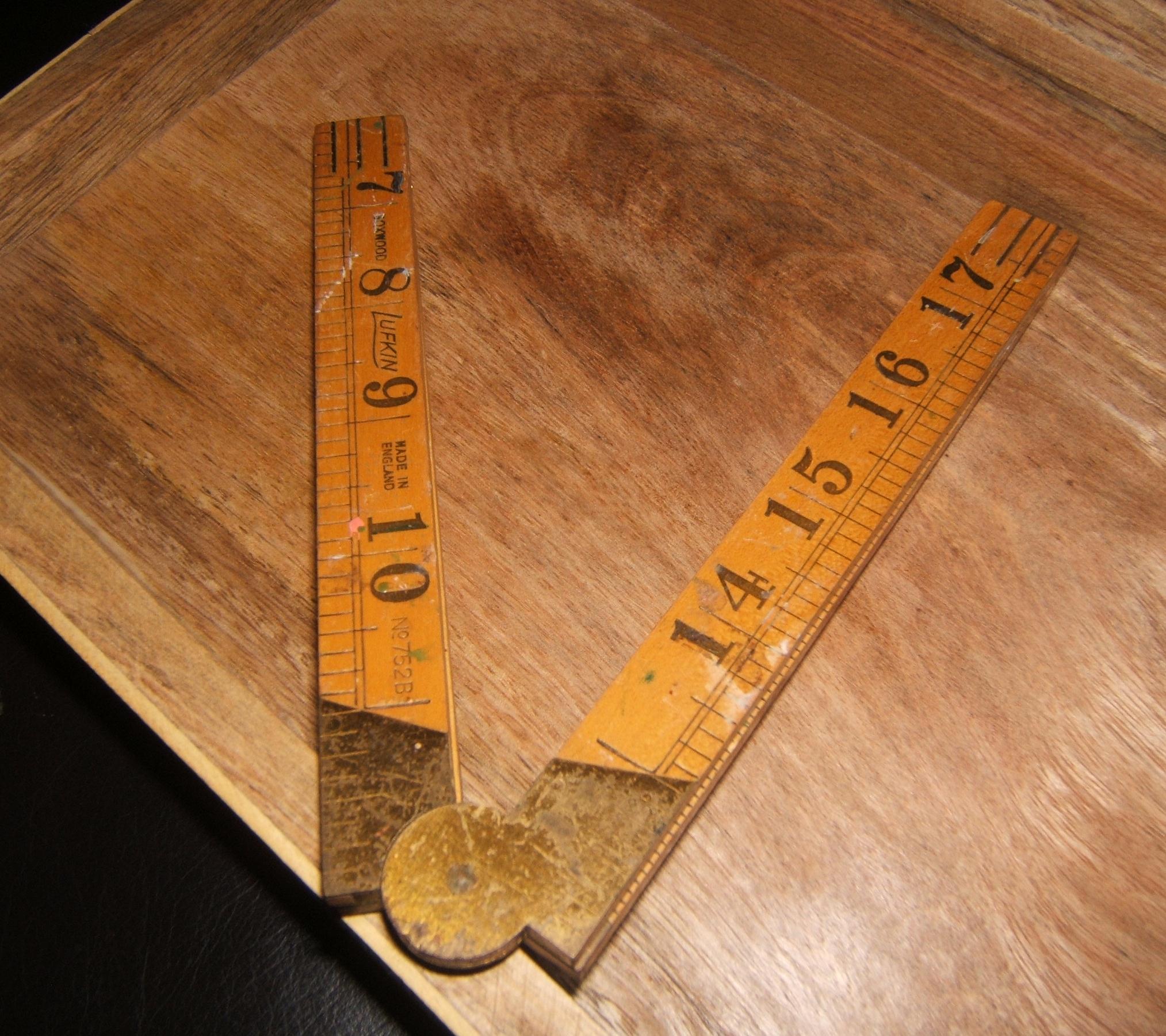
Most of my jointed rulers are made of wood with joints of brass. They can be folded away quite compactly when not in use, and unfolded when they are needed. Unfolded, they have a spidery quality. One of my favorites has a leveling glass built in…
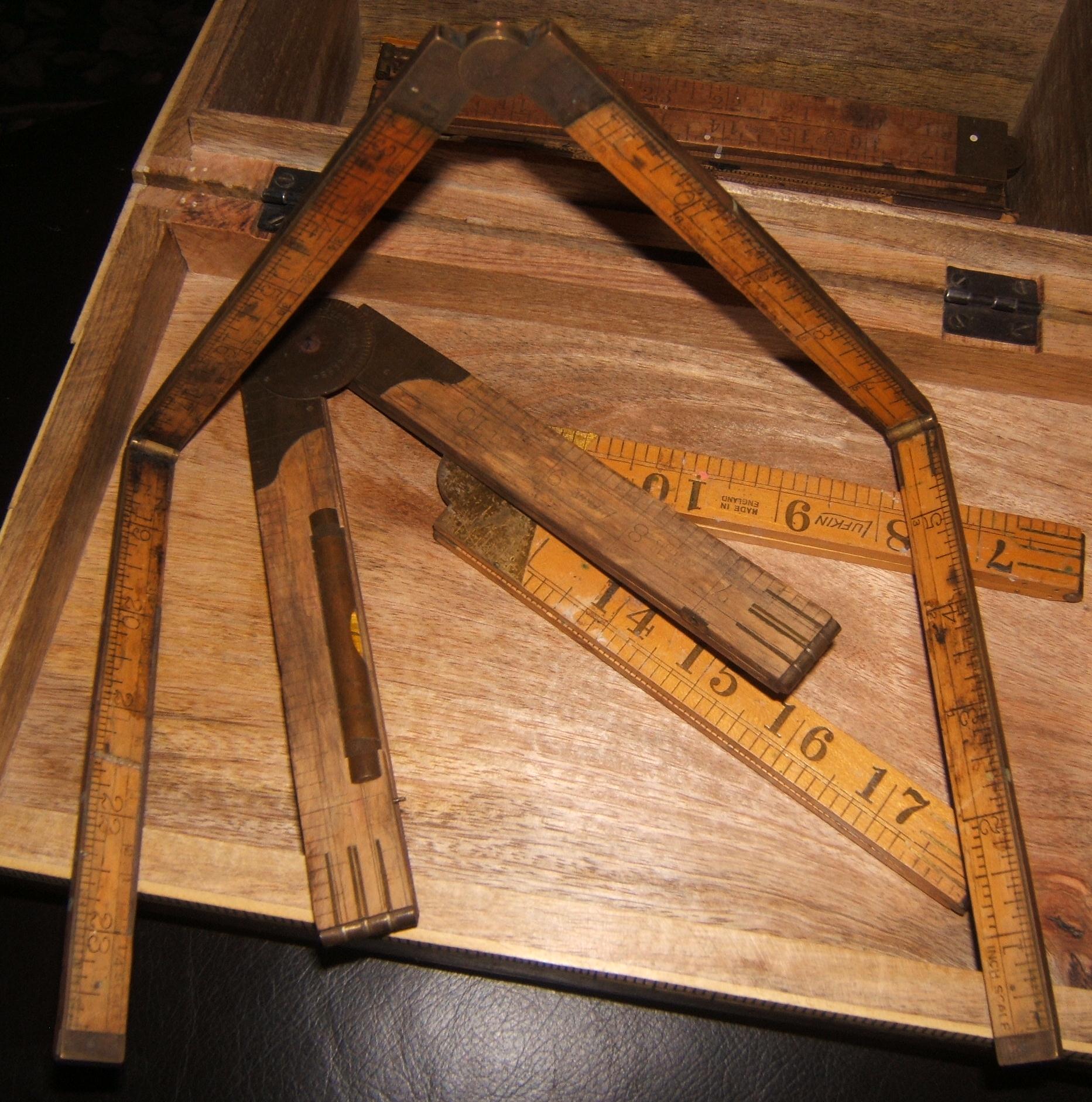
They are precisely made and have the combined beauty of varnished or painted wood, painted numbers, shiny metal and ‘mechanism’.

~
Great Blue Heron and reflection
~
on water, bent legs unite two images
of heron, brass connections
varnished wood
~
jointed rulers unfold, legs
disconnect, images detach
concentric circles swell
~
distance and diameter measured
between droplets
and trailing toes
~
© Jane Tims 2011

between the tides – sea glass
Walking on the beach at low tide creates a two-way competition for the eyes.
First there is the pull of the sea – the vistas of distant shores, islands, boats and buoys to contemplate, and the crash and retreat of the ocean waves…

Second is the compulsion to watch the beach as you walk, searching for shells and patterned rocks…
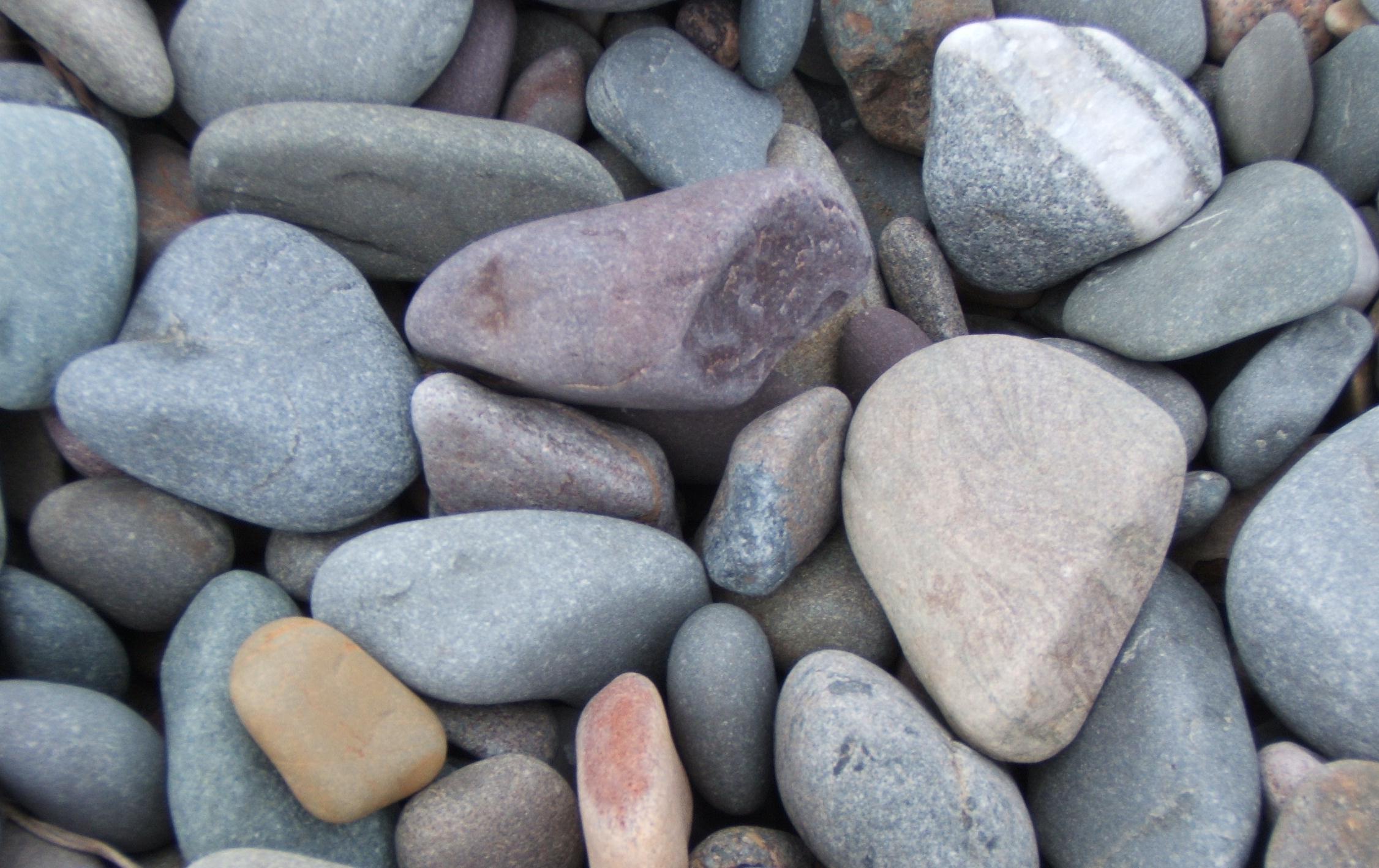
or the gem of beachcombers, sea glass…

When the tide comes in, we collectors come home from the sea, our pockets full of treasures we have found.

sea glass
~
tide turns
sea withdraws
we walk on the ocean floor
heads down
eyes conditioned to color
of sea glass translucence
of fog softened edges muffled
greens and bottle blues
rare ambers and reds
tide turns
ocean swells
glass and stone together
etched by sea
~
© Jane Tims 2011

holding on to our space
We are in a competition for space. A population of geckos has moved into our house. They are everywhere:
on the wall…
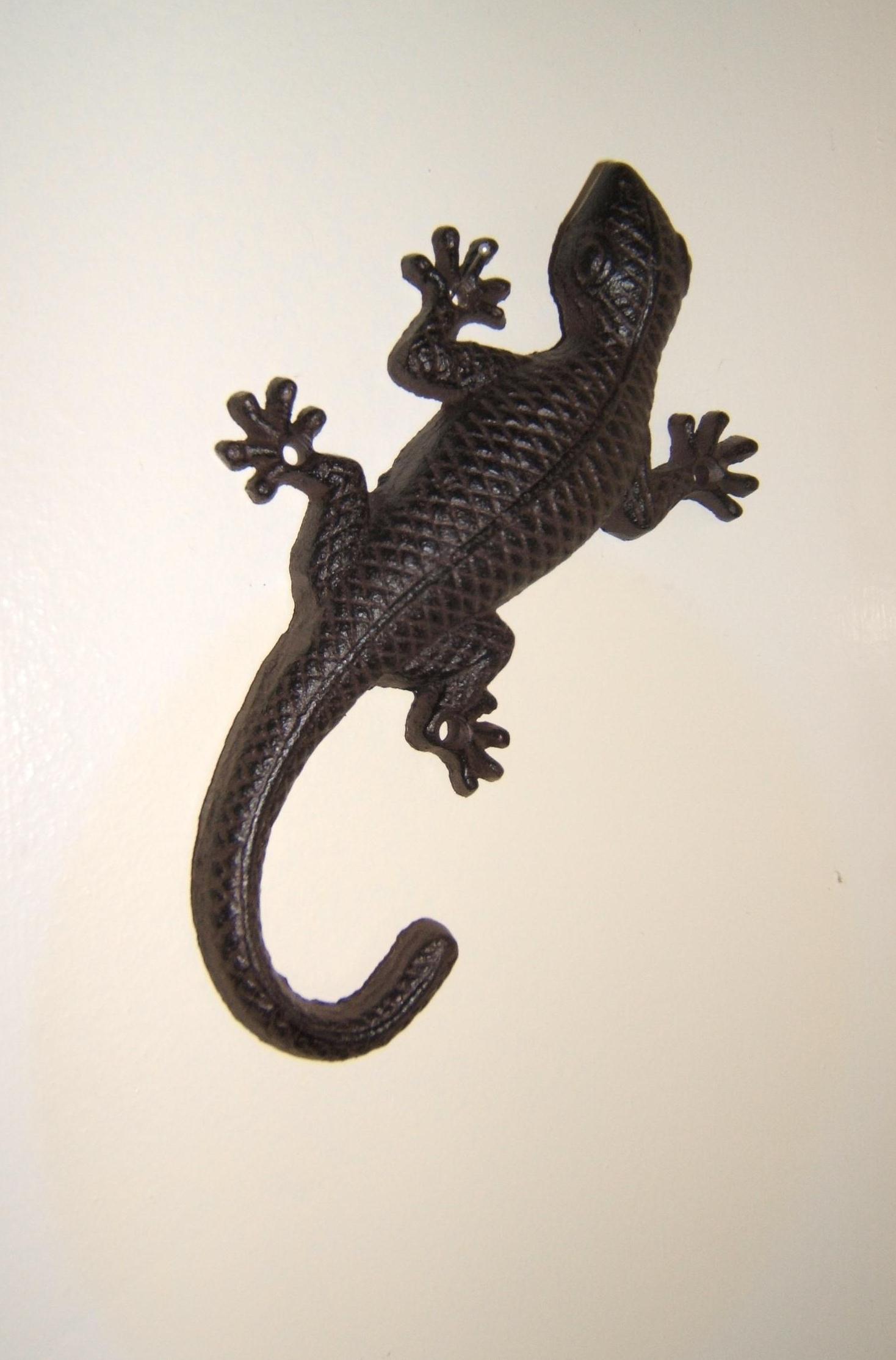
under the cupboard in the kitchen…

on the post in our stairway…
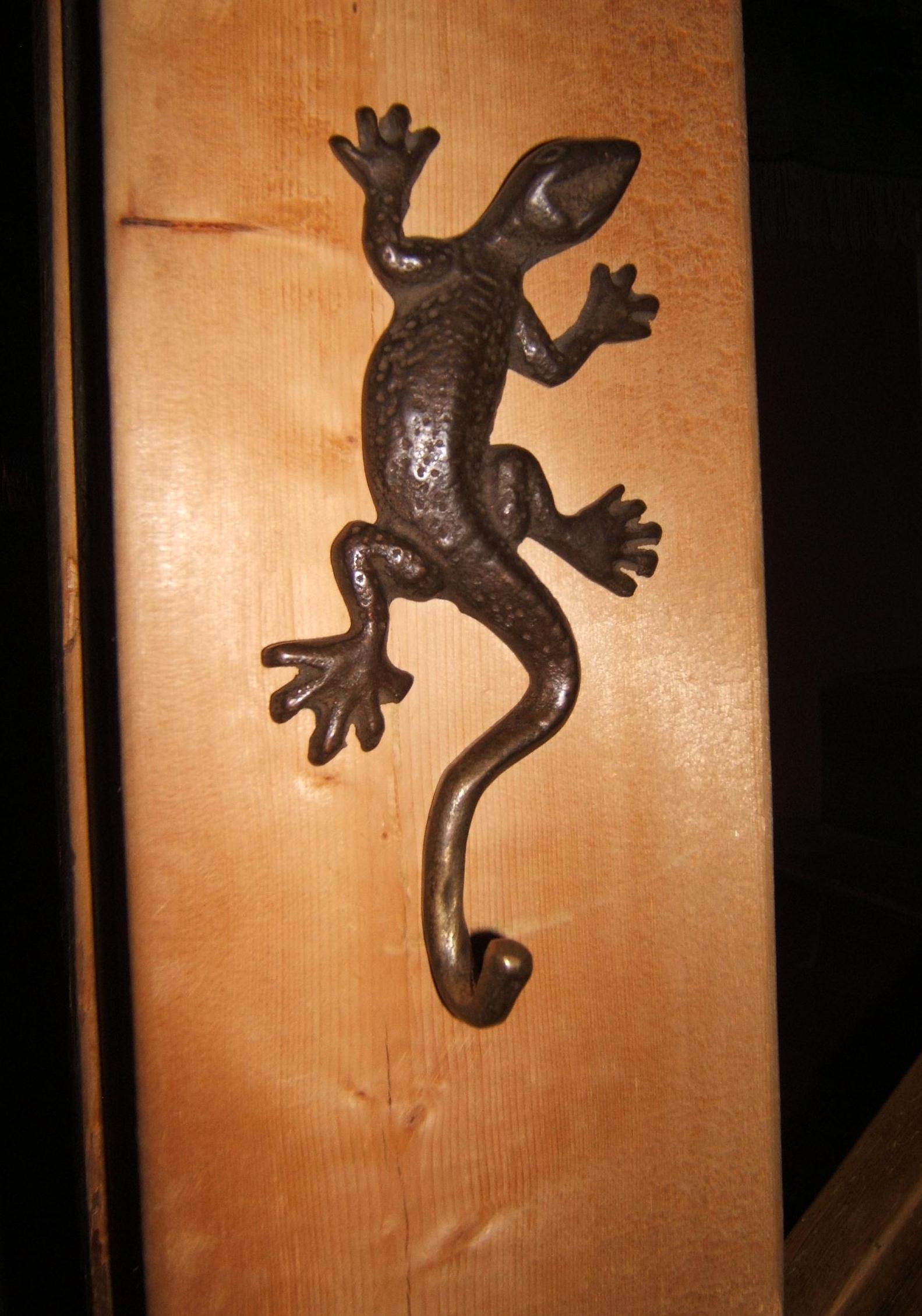
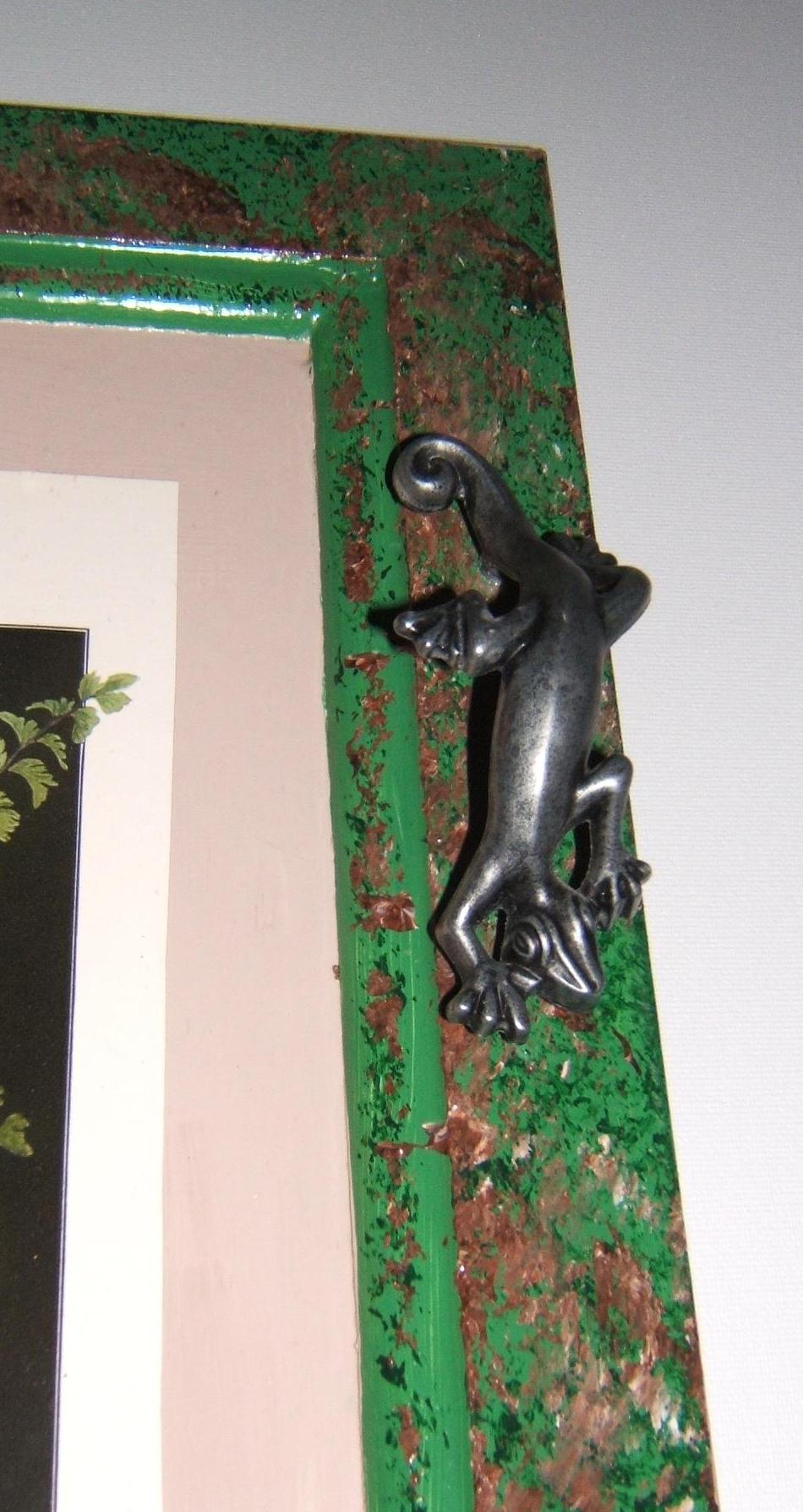
climbing down our picture frames…
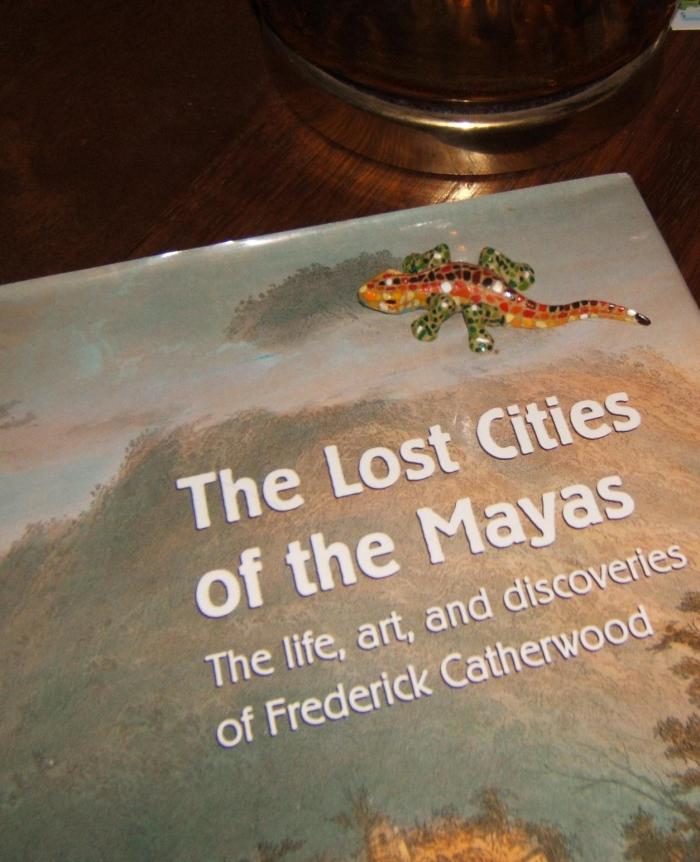
on the books in my study…
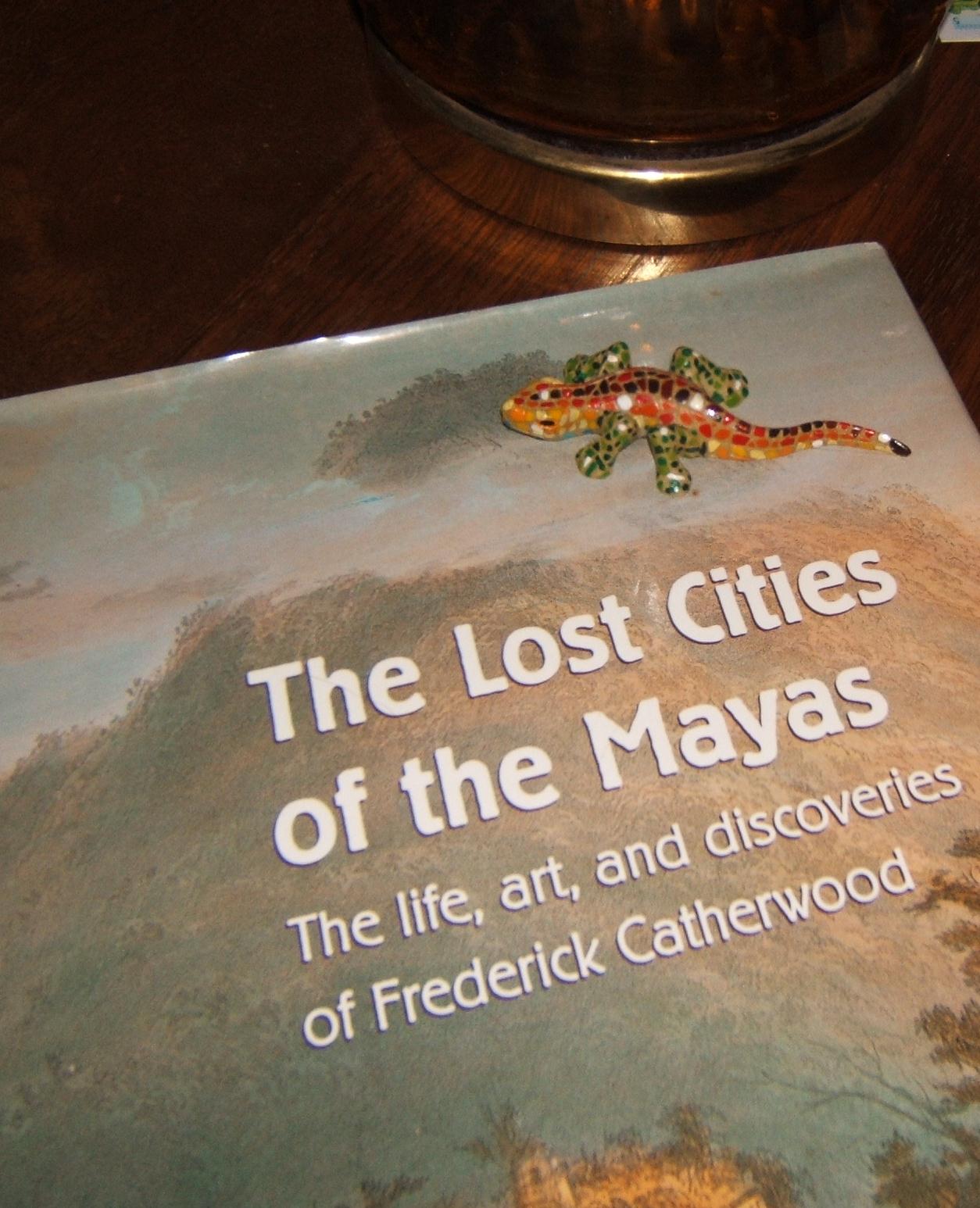
- this little fellow came all the way from Barcelona in Spain
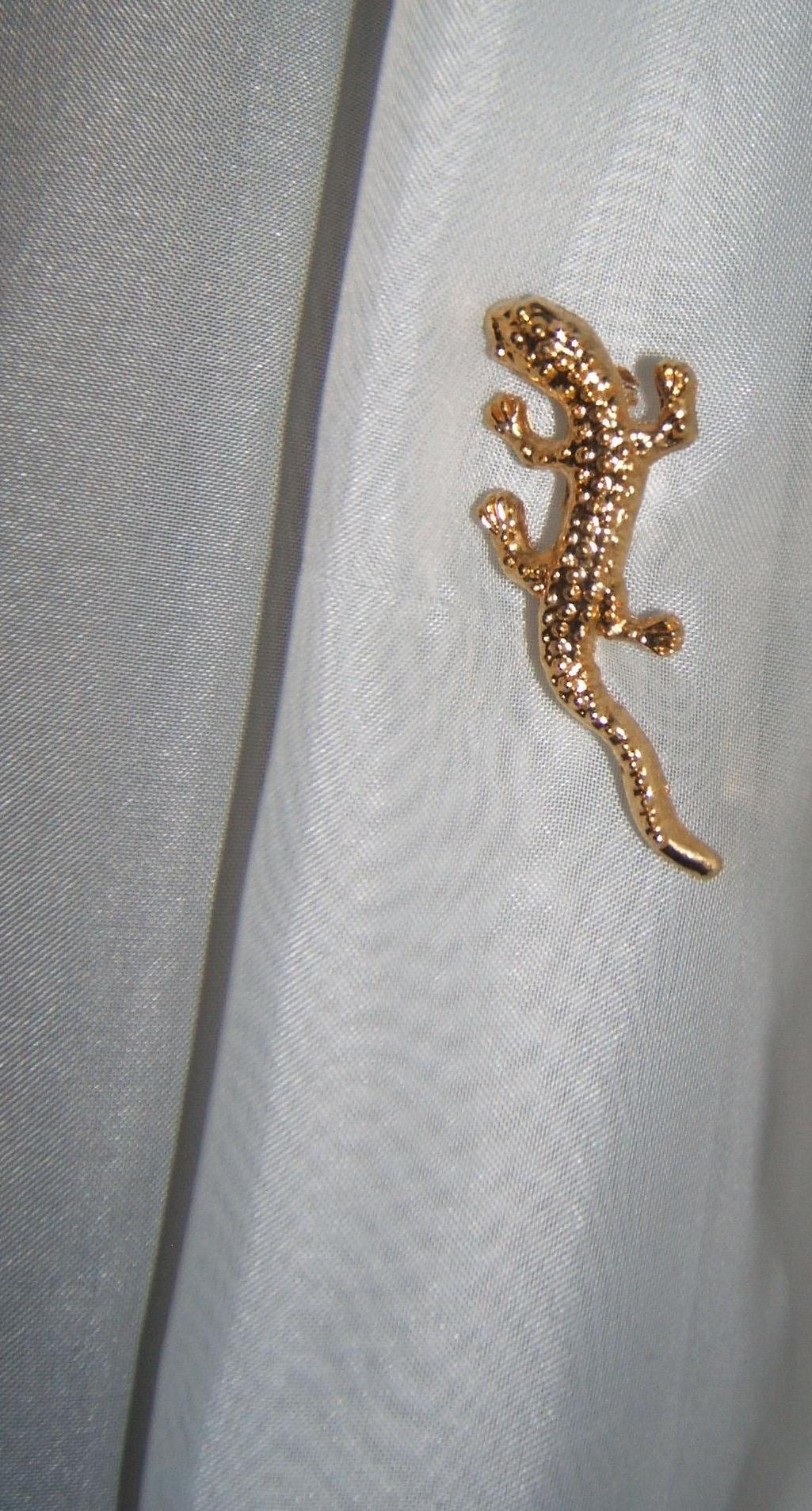
holding on
~
flex knee
reach
determined to stick
~
one foot on wall
will the molecular bond
to adhere
~
reluctant release
of rear foot
now dedicated to
surface past
~
flex knee
reach
~
© Jane Tims 2011
the glassed-in porch
My grandfather lived in a big white farmhouse. It had rooms and rooms, but the focus of life was the kitchen. On rainy days, we could play there quietly.
Sometimes we were allowed to spend the afternoon in the glassed-in porch just off the kitchen. It was whitewashed, and had filmy white curtains and wide window ledges.
On those ledges was a fastinating collection of knick-knacks and trinkets. Examining these items was very entertaining although we were not really allowed to touch anything.
I have tried to emulate this magical jumble of artifacts in my own home, but some spaces are impossible to duplicate.
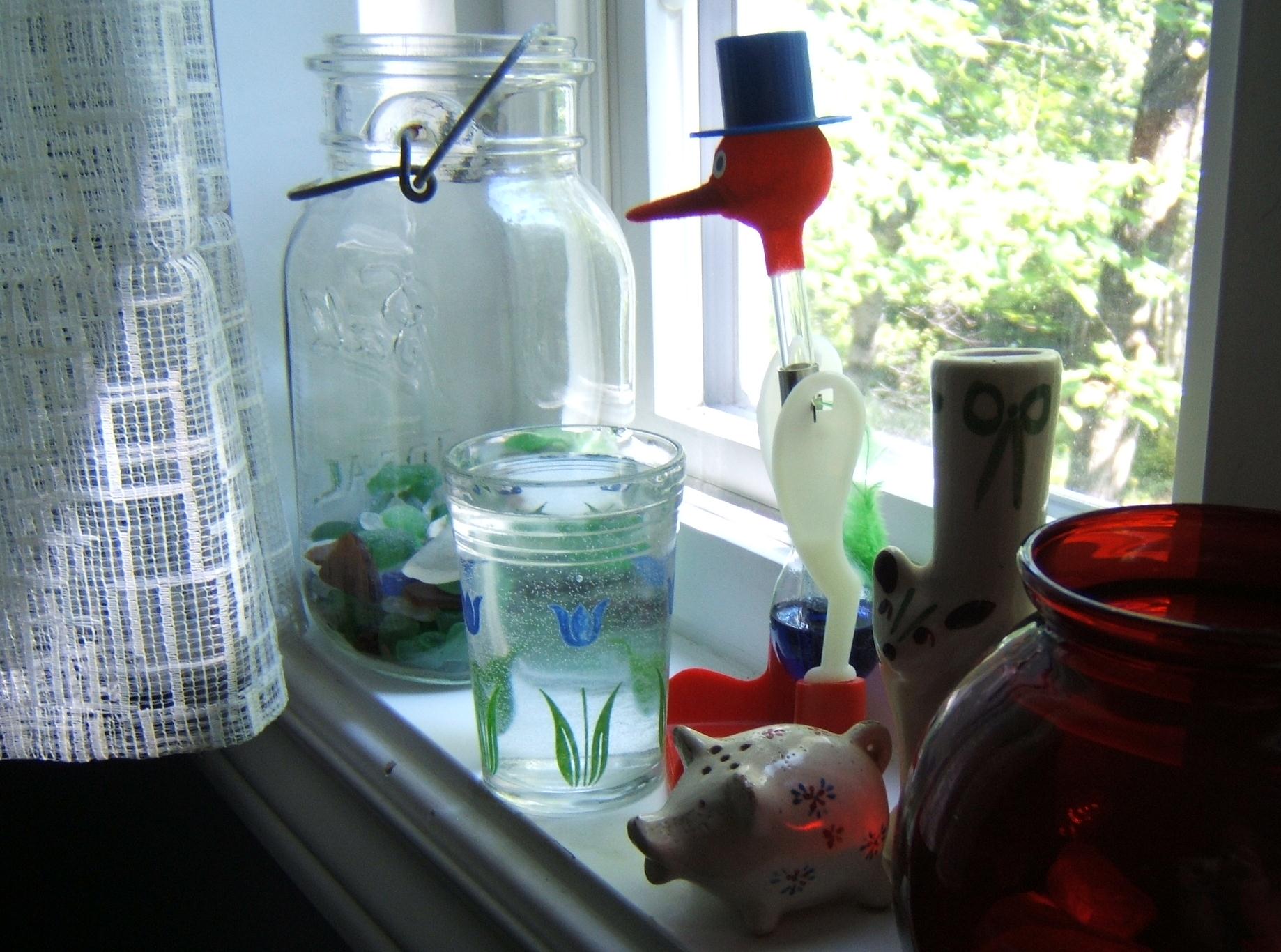
a collection on a window ledge
glassed-in porch in rain
~
rainy day glassed-in porch
tall windows and white step
down from the kitchen
to linoleum wicker table a cot
~
never-used porch door
at the windows, white ledges
keepsakes and trinkets
‘look but don’t touch’
~
big clock in the kitchen ticks
red-eared slider frantic against
the frosted sides of his bowl
rain taps at the window
~
irresistible urge to give the turtle
respite, lift the curtain to admire
the rain, lift the velvet lid
of the purple box, Port Maitland
~
iron pyrite safe inside, encourage
dippy bird to tip and drink
from the glass of water, blue tulips
and a chip in its rim
~
nudge the red and yellow-flocked
parrot above the cot, swing him
on his metal perch, rearrange ceramic chicks
to peck at whitewashed window ledge
~
focus rose bowl ruby light
on china pig, puzzle out flowers
and holes on his back, turn the bud vase over
‘where is Occupied Japan?’
~
pour buttons from the jar, sort
and match Meteghan sea glass, marbles
in a coffee can, take a ship with scallop shells
for sails along the sill
~
trace paths of hesitant rain
droplets on glass
~
© Jane Tims 2011




 nichepoetryandprose