Archive for the ‘along the roadside’ Category
swallowtails and Alexanders
Last week we did the first of our forays to get material for a new set of poems I am working on. Our drive took us to the area north of Stanley, and some two-track roads where settlements and home-sites have been abandoned.
~

the road to Mavis Mills, an abandoned community
~
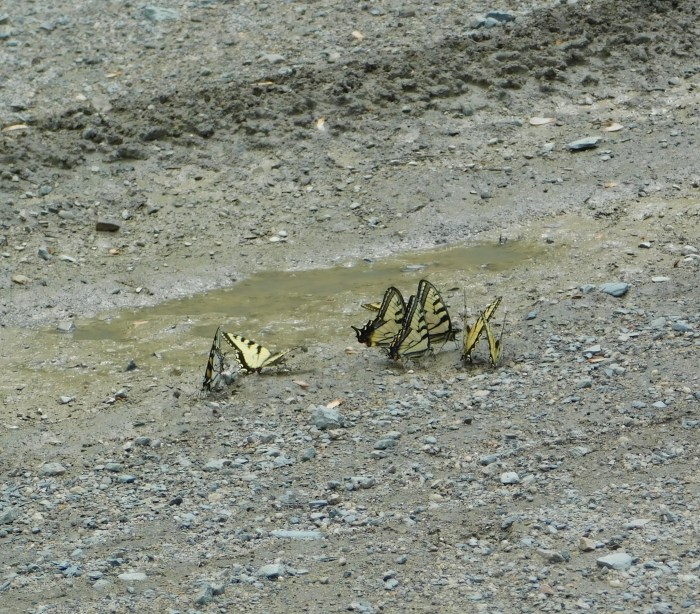
The main road was busy with butterflies: Papilio canadensis, Canadian tiger swallowtail. These are familiar butterflies, very similar to the eastern swallowtail, and once considered the same species. The males are yellow with black-rimmed wings (with a dotted yellow stripe in the margin) and four black tiger-stripes on the upper part of each fore-wing.
~
~
The butterflies were congregating on the road near water puddles. They were interested in the muddy areas rather than the water. This behavior is called “puddling” and is a way for the butterfly to get sodium ions and amino acids.
~

~
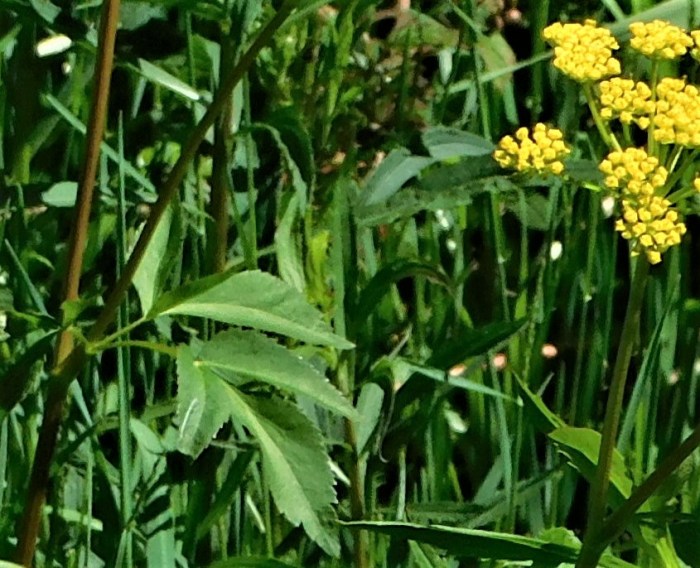
We took an old, two-track road to the abandoned hamlet of Mavis Mills and found the old settlement house sites. The once-cleared areas were populated by a pretty yellow composite flower, a member of the parsley family: Zizia aurea, golden Alexanders. These plants are usually under 30 inches high, with three serrated leaves (or three leaflets divided further into three’s) and a flat umbel of yellow flowers. The stems are red and the whole plant appears red in the fall. It is a host plant for the caterpillars of species of swallowtail butterflies. The plants grow in wet meadows and abandoned fields.
~

field of golden Alexanders in an abandoned settlement
~

~
~
We had an enjoyable drive, looking at abandoned homesteads and settlements. Since I am a botanist, I am interested in what has happened to the plants that once grew in the gardens of these homes. Some of the plants have vanished, but a few persist at the home-site and a few escape to cover ditches and countryside in bloom.
~

an old lilac bush continuing to thrive near an abandoned house
~
All my best!
Jane
Coltsfoot – first flower of spring
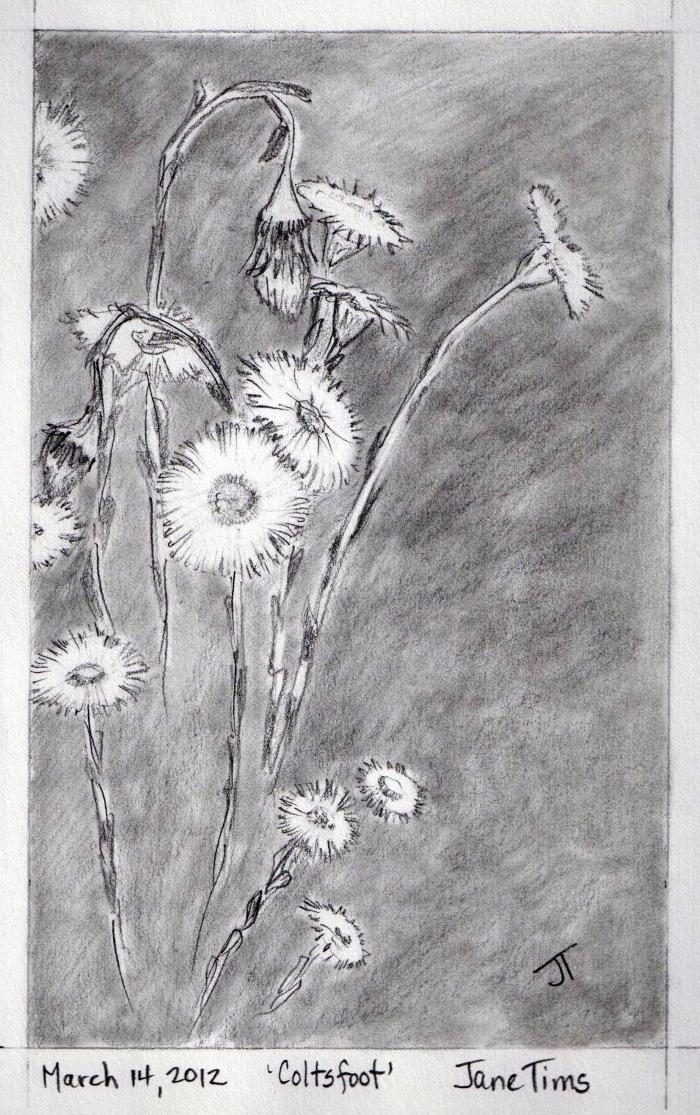
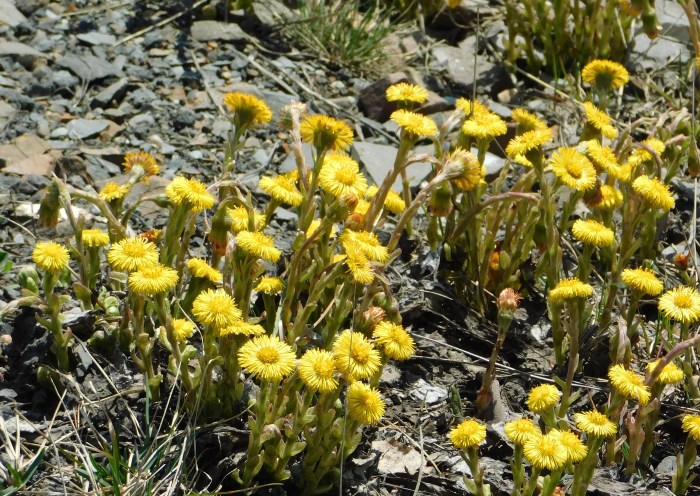
Although other flowers quickly follow, the first flower to bloom along our New Brunswick roads is Coltsfoot (Tussilago Farfara L.). Its bright yellow flowers are often mistaken for Dandelion, but Coltsfoot is recognised by a quick check for the leaves … Coltsfoot blooms before its leaves appear.
~
~
The yellow blooms of Tussilago form large patches in waste areas, beside brooks and roads, and on damp hillsides. Its dandelion-like flowers are borne on scaly, leafless stems. Later, the large, woolly leaves appear. Other names for the plant are Son-before-the-Father, which refers to the appearance of flowers before the leaves, and pas-d’âne (literally donkey-steps). The scientific names are from the Latin tussis, meaning a cough and referring to the European use of the plant as a remedy for such ailments, and the Latin word for coltsfoot, farfarus. The plant was named by Linnaeus, the Swedish botanist who established the present day system of naming plants.
~
~
Coltsfoot
Tussilago Farfara L.
~
Gold-
splashed beside the road
like prints
of a frisky colt’s feet
~
at first glance-
an early dandelion!
but-
too early
stem scaly
no leaves below the bloom
no perfume.
~
Coltsfoot,
Son-before-the-Father
(flowers before the leaves).
Introduced from
far away.
~
Old wives say
boiled greens
will ease
a cough.
~
Long ago
Tussilago
sprang from where
a burro trod
among the palms
(pas-d’ane).
~
~

~
Poem published as: ‘Coltsfoot’, Winter 1993, The Antigonish Review 92:76-77.
Copyright 2018 Jane Tims
signs of spring
Here are few of the signs of spring we saw on our drive last weekend:
~
a skunk running through the apple orchard …
 ~
~

~
pussy willows …

~
muddy roads …

~
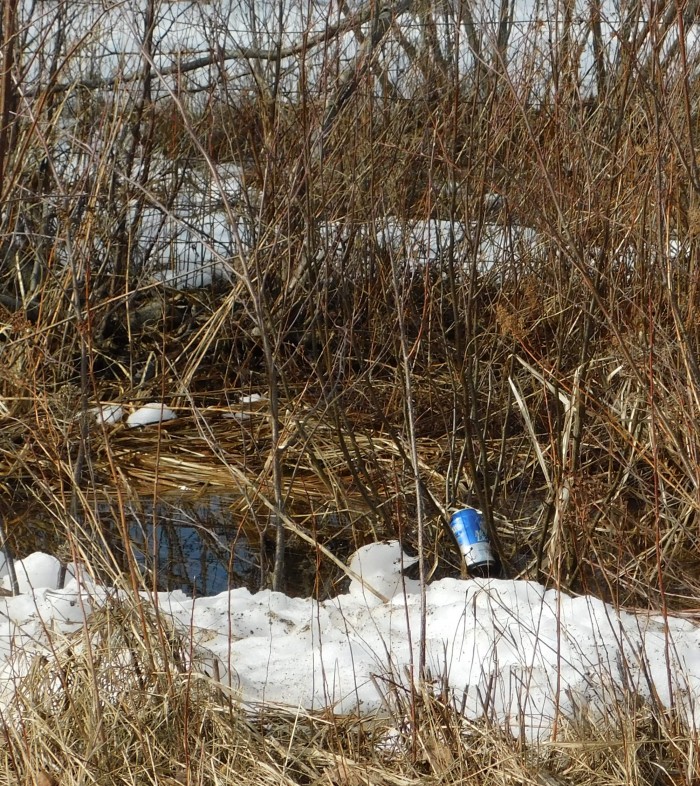
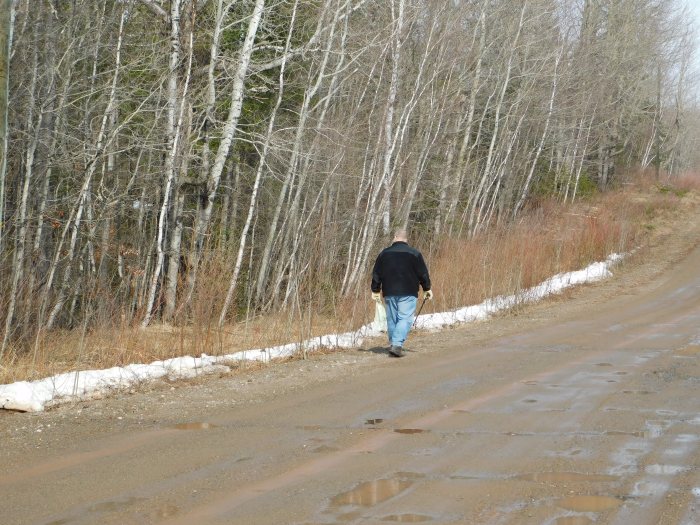
beer cans and other returnables, released from their cover of snow …
~
and a New Brunswick can-and-bottle collector out for walk …
~
Happy Spring!
~
Copyright Jane Tims 2018
birdwatching on a winter drive
Yesterday we went for a drive along the Saint John River. As the snow disappears from the fields along the river, eagles and hawks sit in the trees to catch a glimpse of possible prey. Sure enough, as we approached the Jemseg Bridge, we saw a male Bald Eagle, looking twice his normal size due to fluffing of feathers against the cold (-4 degrees Celsius). Since Bald Eagles live an average of 20 years, this may be a bird we have seen many times in our drives along the river.
~

~
I missed a good photo the first pass, so we retraced our route between the Gagetown and Jemseg bridges and were rewarded when the first Bald Eagle was joined by a large juvenile.
~

~
As we watched him, he prepared for flight, either perturbed at us for pulling over or at the other eagle for moving into his tree. At last he took off and settled in another old tree just along the road.
~

~

~
These are magnificent birds, often overlooked in our area since there are large numbers living in the vicinity of our landfill and at various places along the river.
~
 ~
~
~
Copyright 2018 Jane Tims
cornfields and Canada Geese
I have been away for a while. Off to a driving vacation in Ontario, Canada. We saw the last of summer in the cornfields of Southern Ontario.
~

~
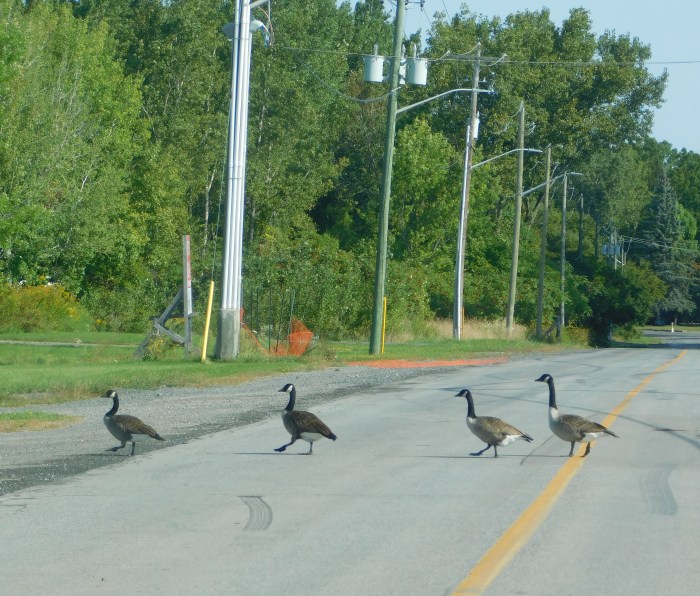
Canada Geese were everywhere. They are considered a nuisance by farmers and almost everyone else. But we enjoyed spotting the flocks in the fields and the ‘V’s in the sky. And once, we waited as a group of geese crossed the road in front of us.
~
~
I will have more about our trip in the next few days, as I check out my photos and process the memories!
~
Copyright 2017 Jane Tims
wildflowers – Bladder campion
One of my favorite roadside flowers is the Bladder campion, Silene vulgaris (Moench) Garcke. The flowers are white, with five deeply lobed petals. The flowers protrude from an inflated, papery calyx, greenish, purple-veined and bladder-like. This time of year, the flowers are almost past.
~

~
I love the scientific generic name Silene, derived from the name of a Greek woodland deity. Another common name for Bladder campion is maidenstears.
~

~
The leaves of Bladder campion are edible, used raw in a salad or cooked in a stew.
~

~
Copyright 2017 Jane Tims
wildflowers – Canada lily
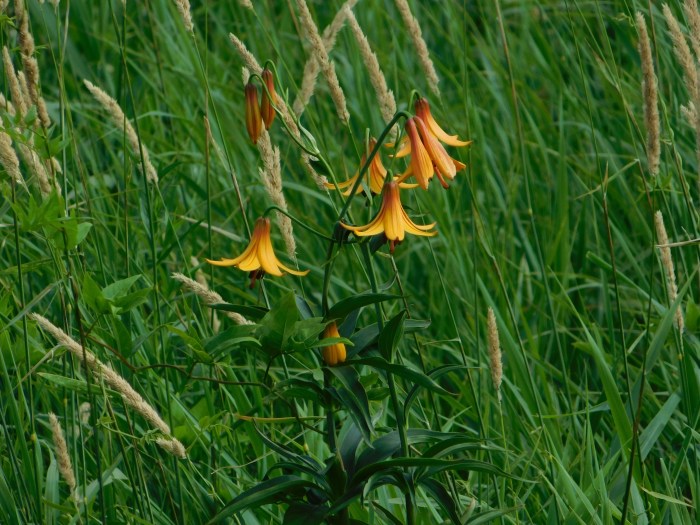
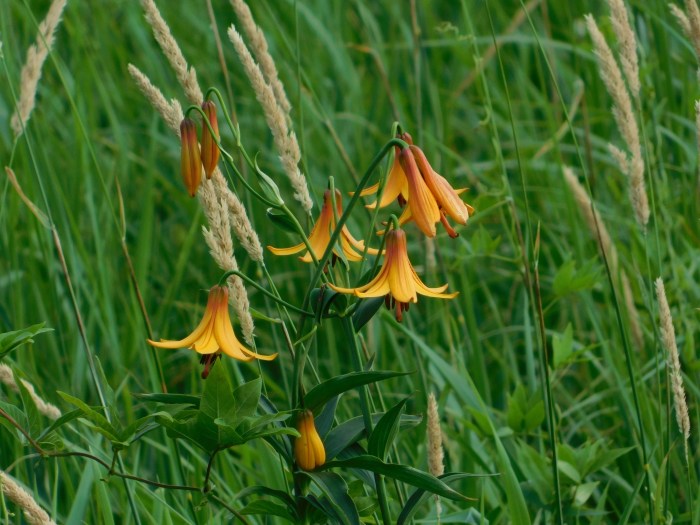
A drive this time of year through Grand Lake Meadows, along the old Trans-Canada Highway, will show you one of our prettiest wild flowers — Lilium canadense L., the Canada lily.
~

~
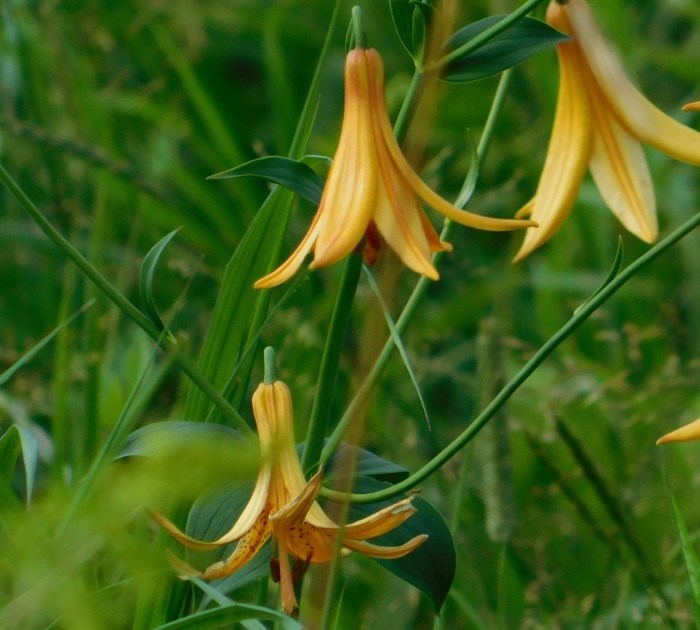
The flowers are a glimpse of orange in vast fields of greenery. The flowers are down-ward pointing, reminding me of a chandelier of light. They bloom from June through August in the moist wetlands of this part of central New Brunswick.
~
~
~
As the meadow winds flip the flowers upward, you can catch a glimpse of the dark red anthers and the spotted interior of the petals.
~
~
Copyright 2017 Jane Tims
a touch of Monet
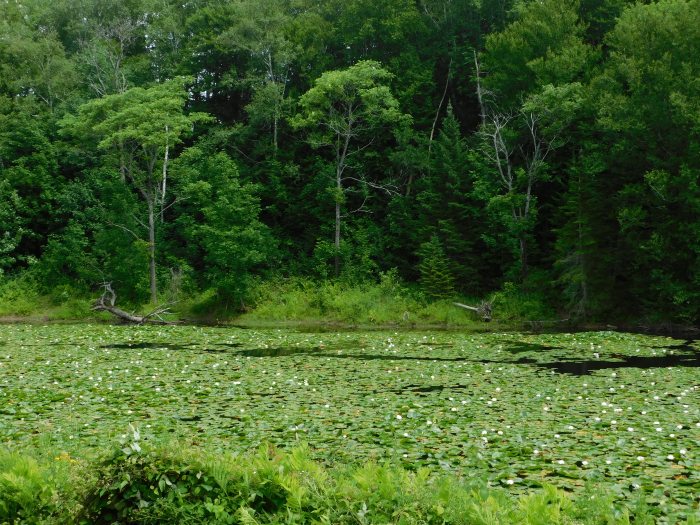
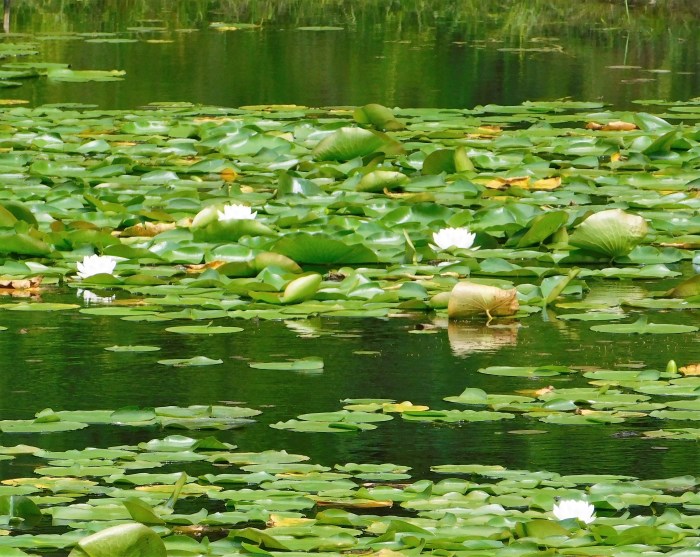
Last week, on a drive to Plaster Rock, we passed a pond along the Saint John River filled with water lilies (Nymphaea sp.).
~
 ~
~
Lovely. Calming. And reminiscent, in the way they lay on expanses of open water, of Monet’s water lilies at Giverny.
~
~
When I think of water lilies, I also remember Edgar Allan Poe’s short story Silence – “And the water lilies sighed unto one another….”
~
~
So to add to these greats, I have my own snippet from my poem ‘Bear Creek Meadow by Canoe’ (published in Canadian Stories 14 (82 ), Dec 2011 ):
~
dignity quiets our paddles
hushed voices heed
the diminishing echo
~
pliant as stems of pickerel weed
we honour the whisper
of wild rice
the edgewise touching
of nymphaea and nuphar
amphibian eyes
in the harbour-notch of lily pads
~
we are threaded by dragonflies
drawn by water striders
gathered in a cloak of water shield
~

~
Copyright Jane Tims 2017
a moment of beautiful: wild roses
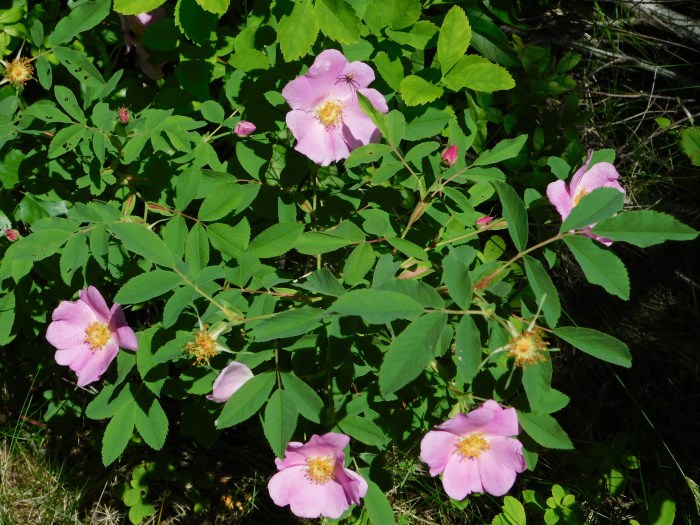
the place: beside the road into our cabin
the beautiful: pink roses in bloom (and the dark pink rosebuds)
~

~
~
Notice a little spider found his way into the photo (about 12 o’clock on a petal).
~
Copyright Jane Tims 2017
along New Brunswick’s roads
New Brunswick is a beautiful province. We also have a great road system, both for those who want to linger and those who want to get through as fast as possible.
~

~
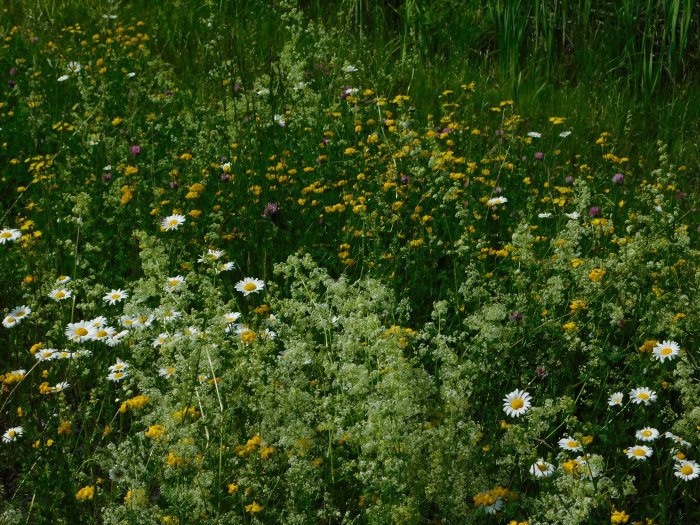
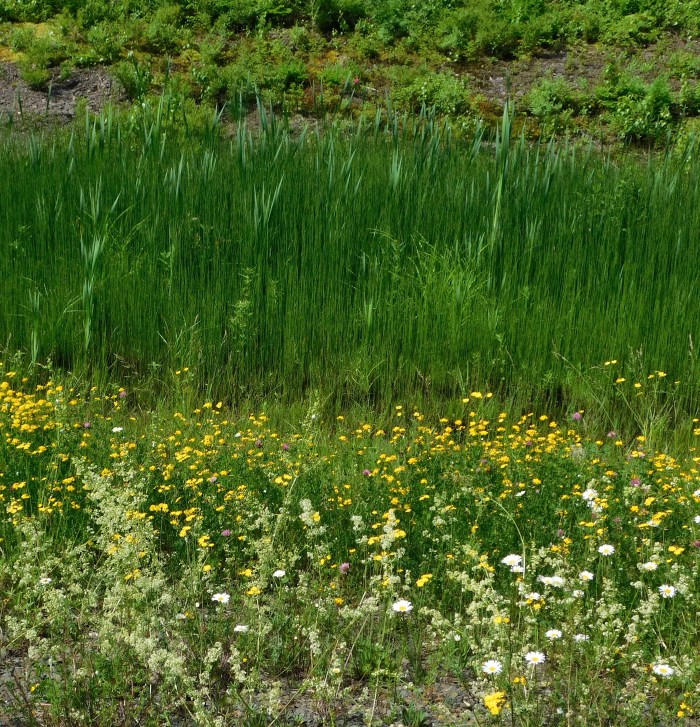
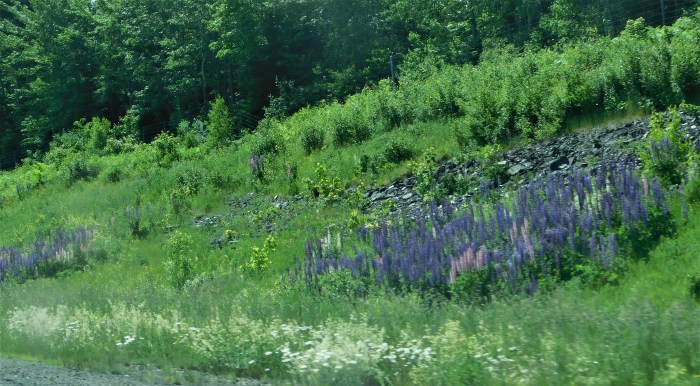
This time of year I am amazed at the beauty of our four-lane Trans-Canada highway. I think the roadside has been seeded with a wild-flower mix but many are weedy species common in New Brunswick. Whatever their origins, the results are lovely.
~

~
~
~
I have found these flowers in a quick sampling of the roadside:
Buttercup (Ranunculus sp.)
Lupin (Lupinus sp.)
Bird’s-foot trefoil (Lotus corniculatus)
Red Clover (Trifolium pretense)
Daisy (Leucanthemum sp.)
Viper’s Bugloss (Echium vulgare)
Yellow Hawkweed (Hieracium caespitosum)
Bedstraw (Galium sp.)
Coltsfoot (Tussilago farafara)
Dandelion (Taraxacum officinale)
(plus many grasses, sedges and non-flowering plants contributing to the background of green)
~
~
Long stretches of highway can be boring-beyond-belief, but, because of these expanses of bloom, I am enjoying our drives along the highway this summer.
~
Copyright 2017 Jane Tims