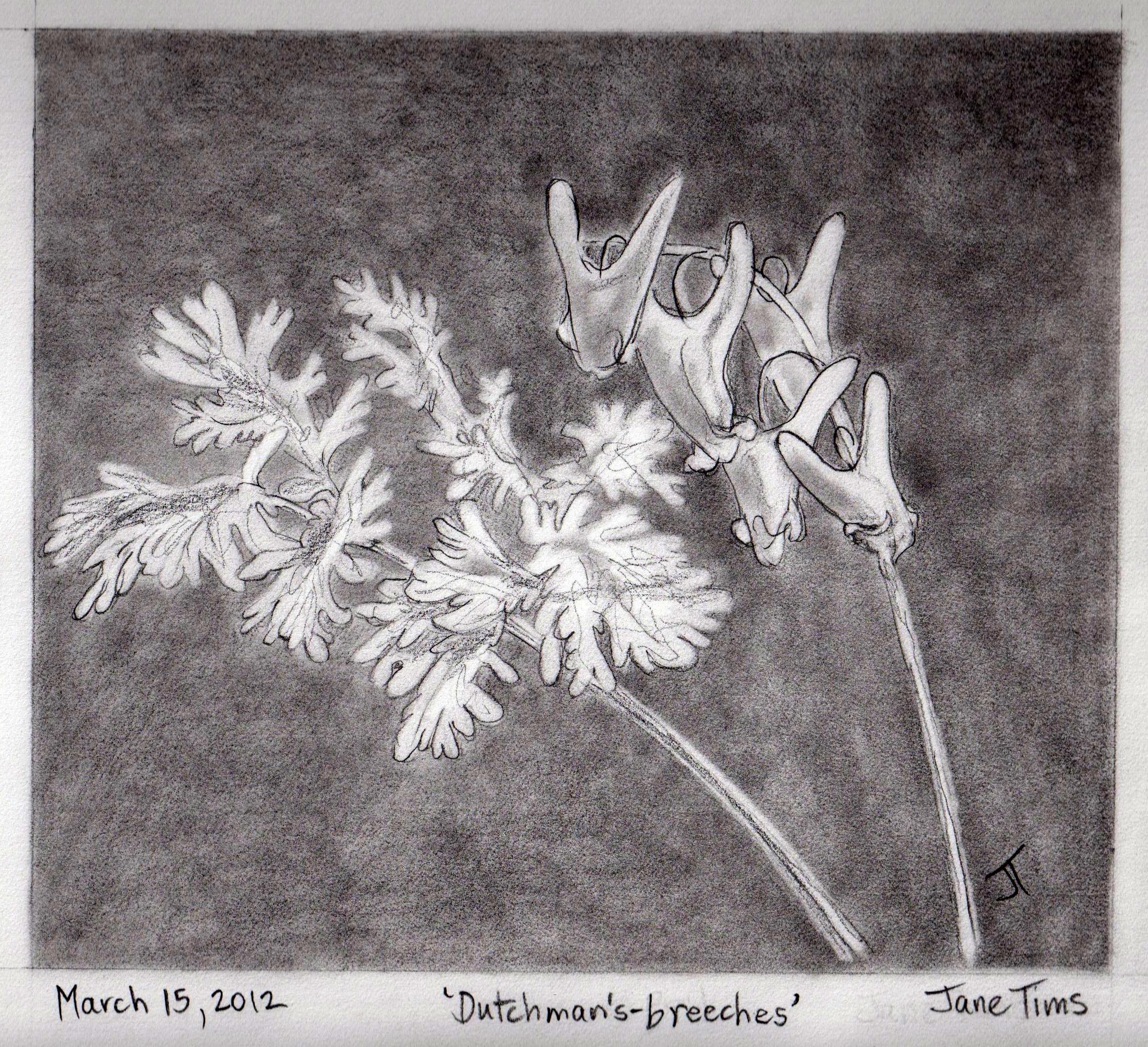
Dutchman’s-breeches (Dicentra Cucullaria (L.) Bernh.)
Our first summer home was located in a rich hardwood of Sugar-Maple (Acer saccharum Marsh.), Beech (Fagus grandifolia Ehrh.) and White Ash (Fraxinus Americana L. ). In these woods, in early spring, as the snow melted, wildflowers found ideal habitat. Many plants take advantage of the few days when the leaves of the overstory trees are still developing, and there is bright light in the understory of the woods.
One of these wildflowers is Dutchman’s-breeches (Dicentra Cucullaria (L.) Bernh.). This charming little plant blooms early in spring, in rich, rocky hardwoods. The white flowers are two-spurred, in groups of four to ten along a stem held just above finely divided, feathery leaves.
The plants is also known as breeches-flower, cullottes de Hollandais, and dicentre à capuchon. The generic name is from the Greek di meaning twice and centron meaning a spur. Cucullaria is the old generic name meaning hoodlike. The plant was named by Johann Jacob Bernhardi.
The flowers of Dutchman’s-breeches are an example of plant adaptation for pollination. The flower has a clever mechanism, in the form of fused flower parts, to ensure only certain insects (such as the bumblebee) can access the nectar and pollen.
In my copy of Roland and Smith (The Flora of Nova Scotia), I recorded my first encounter with this little plant – April 28, 1985, during one of our first visits to our property before we purchased it. We called our cabin Whisperwood, in part because of the subtle breezes in those wildflower-dotted spring woods.
~
~
Dutchman’s Breeches
Dicentra Cucullaria (L.) Bernh.
~
~
Dutchman’s breeches
brighten in sun
woodland washdays
have begun
~
spring-clean trousers
hung in rows
inflated with breath
the May wind blows
~
sprites are playing
tossing their hoods
above the damp
in the spring-fed woods
~
little fairy laundry
trembles on the line
before greening trees
block spring sunshine
~
~
© Jane Tims 1993




 nichepoetryandprose
Love the poem and a fabulous illustration.
LikeLike
dfb
April 6, 2012 at 3:19 pm
Hi. I’m glad you like my poem and drawing. This is one of my favorite flowers. Jane
LikeLike
jane tims
April 7, 2012 at 7:52 am
Hi Jane,
Dutchman’s breeches are one of my very favourites. I came to know them in the Morgan Arboretum near Ste-Anne-de-Bellevue, QC during my grad student days. I love your poem (and the rhymes!) and the sketch.
And a neat thing about the pollination adaptation – as usual, there are cheaters. Some pollinators bite the ends of the breeches and get the nectar without aiding in pollination. You often see the pointed ends with holes in them.
I’m looking forward to tromping through deciduous woods in the SJ Valley this spring – and will be watching for Dutchman’s beeches and my other forest flora ‘friends’.
Cheers,
Nadine
LikeLike
naturalsenseofwonder
April 6, 2012 at 10:38 am
Hi Nadine. Thanks for your comments. I didn’t know about these ‘cheaters’ but now that you mention it, I have seen holes in the flowers. Another dark day here in New Brunswick, but the flowers will be here soon! Jane
LikeLike
jane tims
April 7, 2012 at 7:47 am
Beautiful drawing Jane. Very informative post. Always wondered what those flowers were called.
Rhyming poems aren’t my thing … too much work I guess …but never the less it’s well done (as always).
Denis
LikeLike
Jd Beaudoin
April 6, 2012 at 9:16 am
Hi Denis. I always like to get your comments. I rarely end-rhyme any more. As you say it is too difficult and the result is often ‘cute’. This poem was written in my early writing days. Jane
LikeLike
jane tims
April 6, 2012 at 9:56 am
I love the combination of learning something new and having the subject presented so beautifully. I stand in awe of your ability to draw white flowers with pencil!
LikeLike
Jane Fritz
April 6, 2012 at 8:49 am
Hi Jane. Thanks! I am learning new things about drawing every time I tackle a new subject. The pencil as a medium is so forgiving compared to ink or paint! Jane
LikeLike
jane tims
April 6, 2012 at 9:53 am