Archive for August 2011
in the apple orchard
One of the spaces I loved the best on my grandfather’s farm was the apple orchard. It was a small orchard, perhaps twenty trees. I have never seen it in spring when the apple blossoms are in bloom, in fall when the trees are laden with fruit, or in winter when the stark bones of the trees are visible. But I knew the orchard in summer, when the green canopies of the trees shed thick shade over the meadow grasses beneath.

an apple orchard in August
In summer, the orchard was usually a private space. The farm yard could be bustling with people and animals, but the orchard was set apart. It was a still room of dark and dapple.
When I wasn’t pushing the swing to its limits, I was climbing apple trees, one in particular. Its main side branch was as thick as its trunk and jutted out parallel to the ground. A little jump and you could sit on it like a chair. Swing a leg across and you had a horse. Stand on it and you were in the crow’s nest of a sailing ship. Sit down again, lean against the trunk and you had the ideal perch for reading the afternoon away.

an apple orchard in spring (photo by G. Tims)
The orchard was usually a private space. But on Family Reunion Day, it was the focus of the festivities. Big tables covered with white cloths were assembled in a line. Enough chairs were unfolded for every person in our very large family. Cars turned in at the driveway and claimed a spot in the farm yard. Cousins rolled from the cars and were soon climbing and swinging in the orchard. The table gradually filled with a conundrum of casseroles, bean pots, roasters and platters.
After the eating was done, wire hoops went up for a game of croquet. My Dad loved croquet and would show me all the tricks – how to get through the starting hoops in a single turn and how to ricochet off the goal post. He also showed me how to bump up against the ball of another player and send their ball flying out of bounds on the next turn. Armed with my learning, I gripped my croquet mallet, certain to win. And realised my brothers and sister and some of the cousins had some strategies of their own!
After the Reunion was over and the last car was waved from the driveway, I was left alone in the orchard and it seemed more empty and silent than before.
I would love to return to the apple orchard on my grandfather’s farm and read a book in my tree one more time. Are you ever too old to climb an apple tree?
dapple
the worn blanket flung
over the bough
of the apple tree
is an old woman
she hugs the limb
reaches for a branch
or an apple
barely beyond
the crook
of her fingers
she would dare
to set her foot
on the branch
and the next
step up
put the orchard
below her
rise above
the canopy
the valley
the meander of the river
feeble
she waits
in the dapple
clings to the branch
endures the tremble
delays the fall
Published as: ‘dapple’, 1998, Green’s magazine (Autumn 1998) XXXVII (1)
(revised)
© Jane Tims
along the country road #2
Here in New Brunswick, although it is only August, the flowers along the roadside are changing. The daisies and buttercups of summer are giving way to the flowers we associate with autumn – the goldenrods, the asters, and Pearly Everlasting.
Pearly everlasting (Anaphalis margaritacea (L.) C.B. Clarke), called immortelle in French, is a weed of roadsides, fields, open woods, and clearings. Its flowers are borne in clusters on an upright, leafy stem. They are easy to dry in bouquets since most of the so-called flower consists of a small yellow floral head surrounded by pearly-white dry bracts.
The generic name is an anagram of Gnaphalium, the name of another genus of everlasting flowers. This, in turn, is an ancient Greek name for a downy plant, derived from the word gnaphallon, lock of wool. Margaritacea means pearly.
What flowers mark the change of seasons in your area?
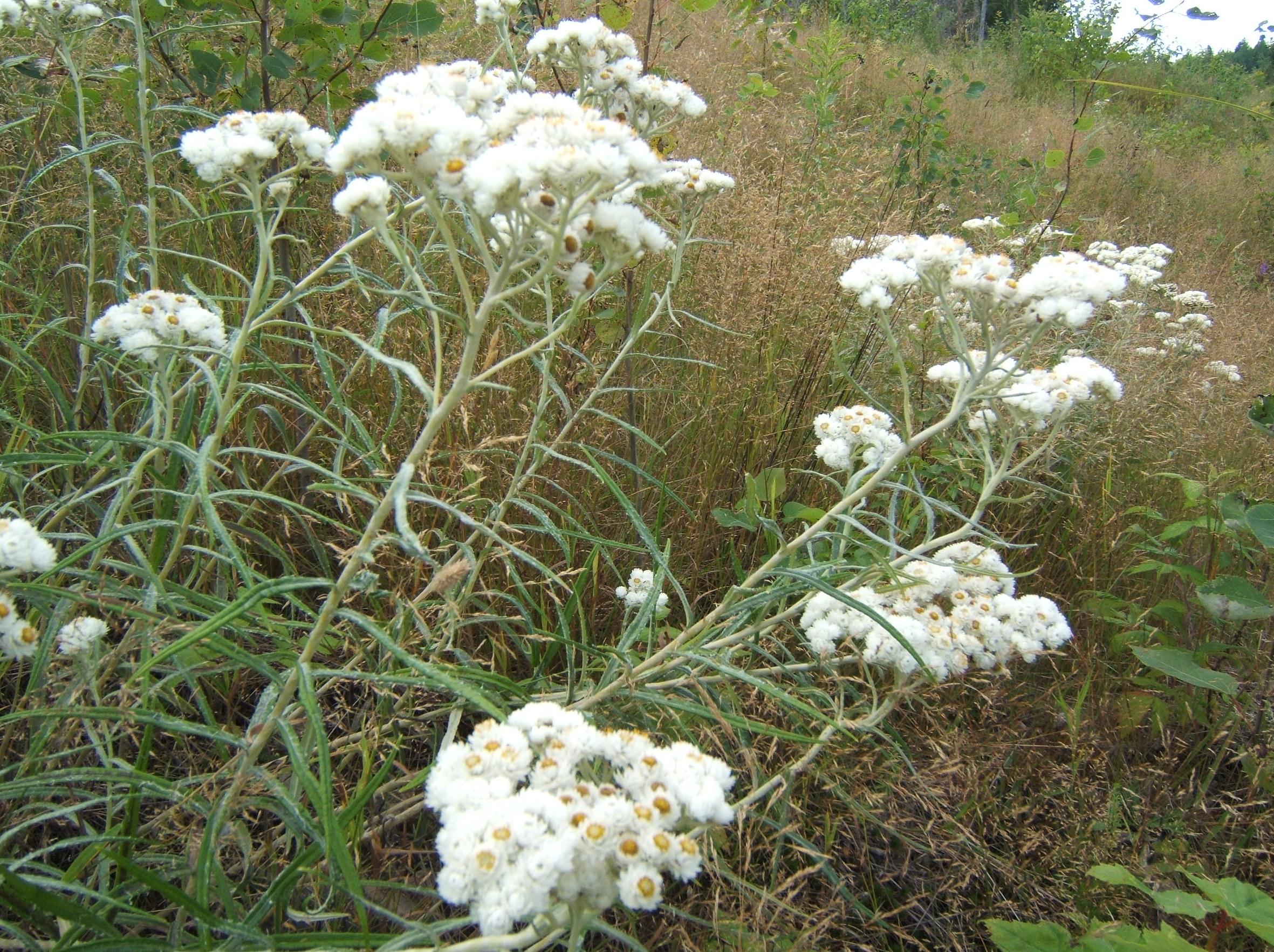
Pearly Everlasting (Anaphalis margaritacea (L.) C.B. Clarke)
Pearly Everlasting
Anaphalis margaritacea L.
Pearly Everlasting
sign of summer’s passing
yet- immortelle
picked by the road
by the armload
hung from rafters
children’s laughter
runs beneath
downy leaf, woolly stem
white diadem
perfectly matched flowers
thatched in gold
dry and old
Linnaeus-named
for Marguarite
memory sweet
paper petals keep
pale perfume
summer
grace
in a winter room
Published as: ‘Pearly Everlasting’, Winter 1993, The Antigonish Review 92.
(revised)
© Jane Tims
competing with the squirrels #1
The squirrels and I have issues. I say squirrels, because we have at least two species of squirrel (Sciurus sp.) on our property, reds and greys.
The red squirrels were here before we arrived, about 31 years ago. The red squirrels I see here today must be the great-great-great… grandchildren of the little fellow who used to shimmy down a copper wire to get to our feeder. The grey squirrel arrived only a couple of years ago and is as big as a small cat. Both reds and greys compete with the birds for the sunflower seeds and other food we put in the feeder. The two species of squirrels compete with one another for roughly the same ‘niche’ and my reading tells me that the grey squirrels will eventually displace the red.

grey squirrel cleans out feeder
I overlap with the squirrels’ ‘niche’ in one repect: we all love hazelnuts. I have two large shrubs of Beaked Hazelnut (Corylus cornuta Marsh.) in our woods. Beaked Hazelnut is a wiry shrub with large serrated leaves. Its fruit is contained in bristly beaked husks and the nut is edible, to both me and the squirrels.

Beaked Hazelnut shrub with hazelnuts in beaked husks
The question is, when do I pick my hazelnuts? It has to be the day before the squirrels pick their hazelnuts. I ask my husband every day and he says he doesn’t know…..
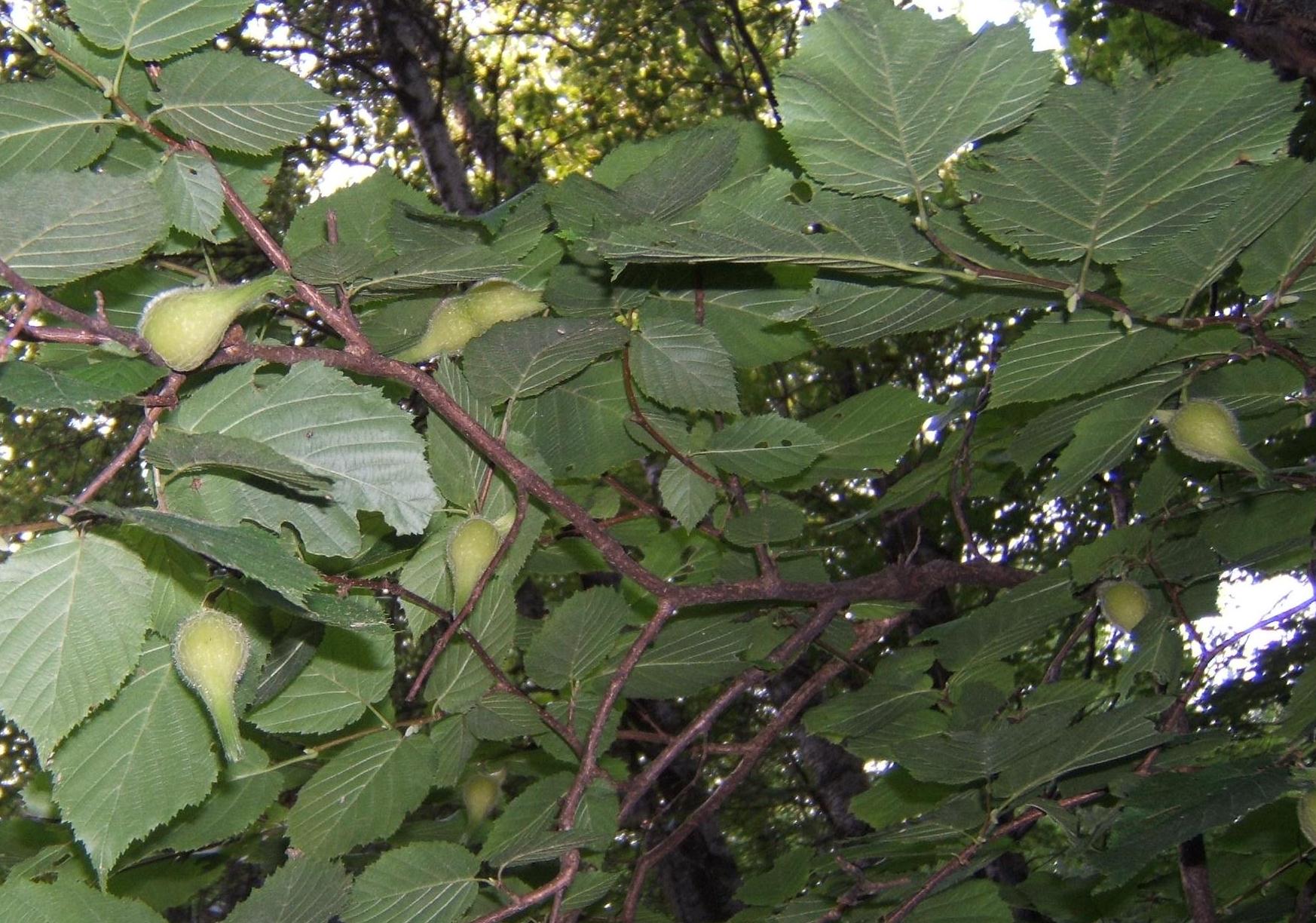
hazelnuts viewed from the underside of the shrub canopy
© Jane Tims
thriving on the roof
Our wood shed is almost thirty years old and its roof has never been re-shingled. This summer, perhaps it is trying to communicate with us.
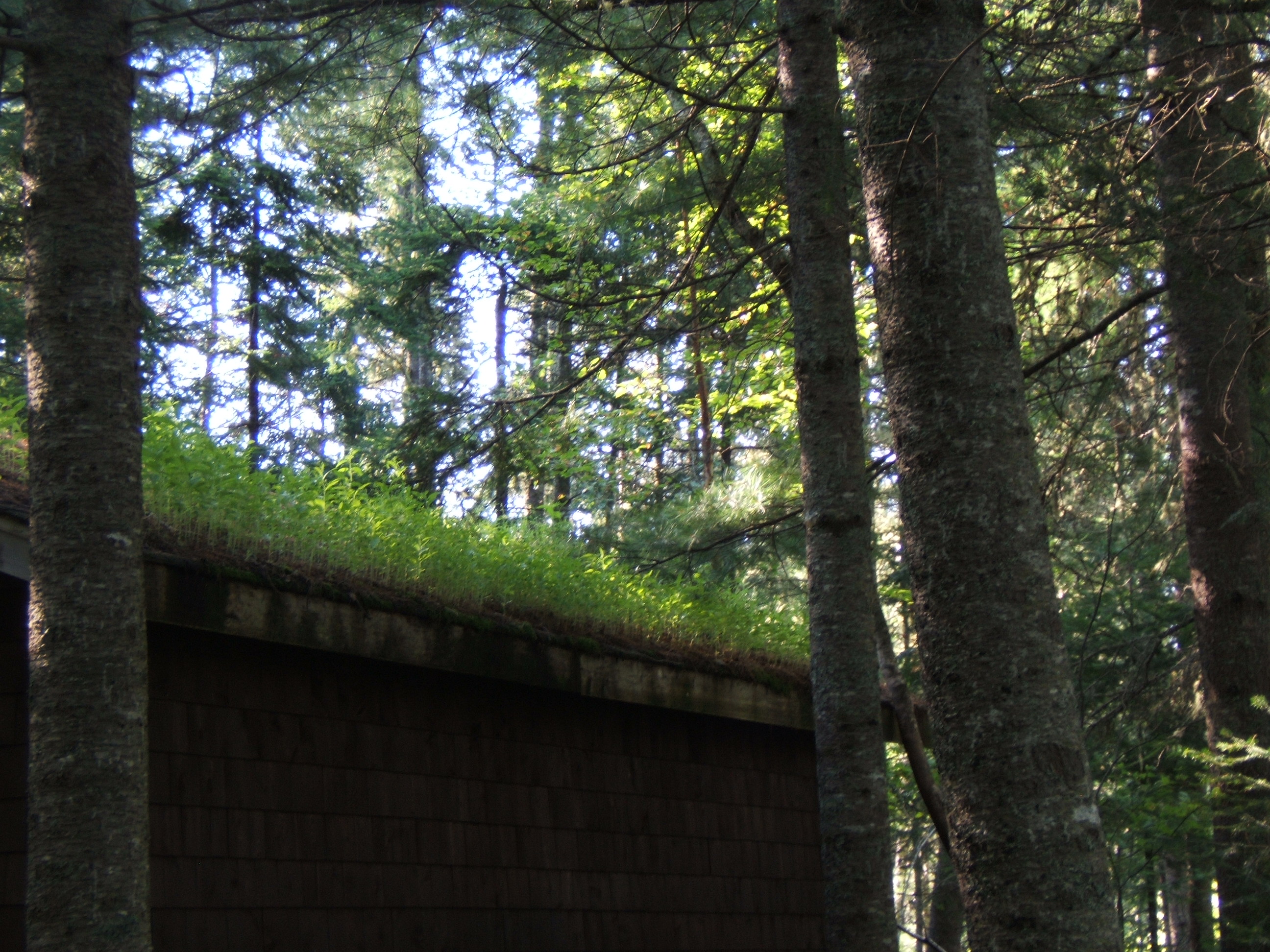
the right amount of soil, the right amount of sun
Just above the wood shed is a white pine. Each year it sheds some of its needles and these land on the roof. Over the years, they have gradually built up, forming a kind of compost. This year, a dusting of seeds found hold, sprouted and are thriving! The roof is still keeping the contents of the wood shed dry, although we expect a vigorous root to break through any time.
Sometimes, we find a space to grow and thrive where it is least expected.

thriving on the wood shed roof
‘niche’ on a rock
In July, we went to the Saint Martins area for the day and spent some time exploring the caves and beach-combing. We also took the short drive to the lighthouse at Quaco Head. The lighthouse is perched on the cliff overlooking Quaco Bay.

the Quaco Head Lighthouse ....... “The present Quaco Head Lighthouse was constructed in 1966 and consists of a square tower rising from one corner of a concrete fog signal building. The light in its lantern room produces a white flash every ten seconds, while the fog signal emits a three-second blast every thirty seconds, when needed.” from http://www.lighthousefriends.com/
If you look out over the Bay, you can see some exposed rocks where sea birds make their home, and, to the north-east, Martin Head, about 30 kilometers away.

the view to the north-east ...... Martin Head is on the horizon, to the left
Wildflowers were everywhere, but what caught my eye was a lichen on a flat rock at the base of the lighthouse. It was bright orange, like a splash of paint.
There are two orange lichens that live on rocks in the coastal area of New Brunswick, Xanthoria and Caloplaca. The orange lichen I found at Quaco Head is likely one of two species: Xanthoria sorediata (Vain.) Poelt or Xanthoria elegans (Link) Th. Fr.
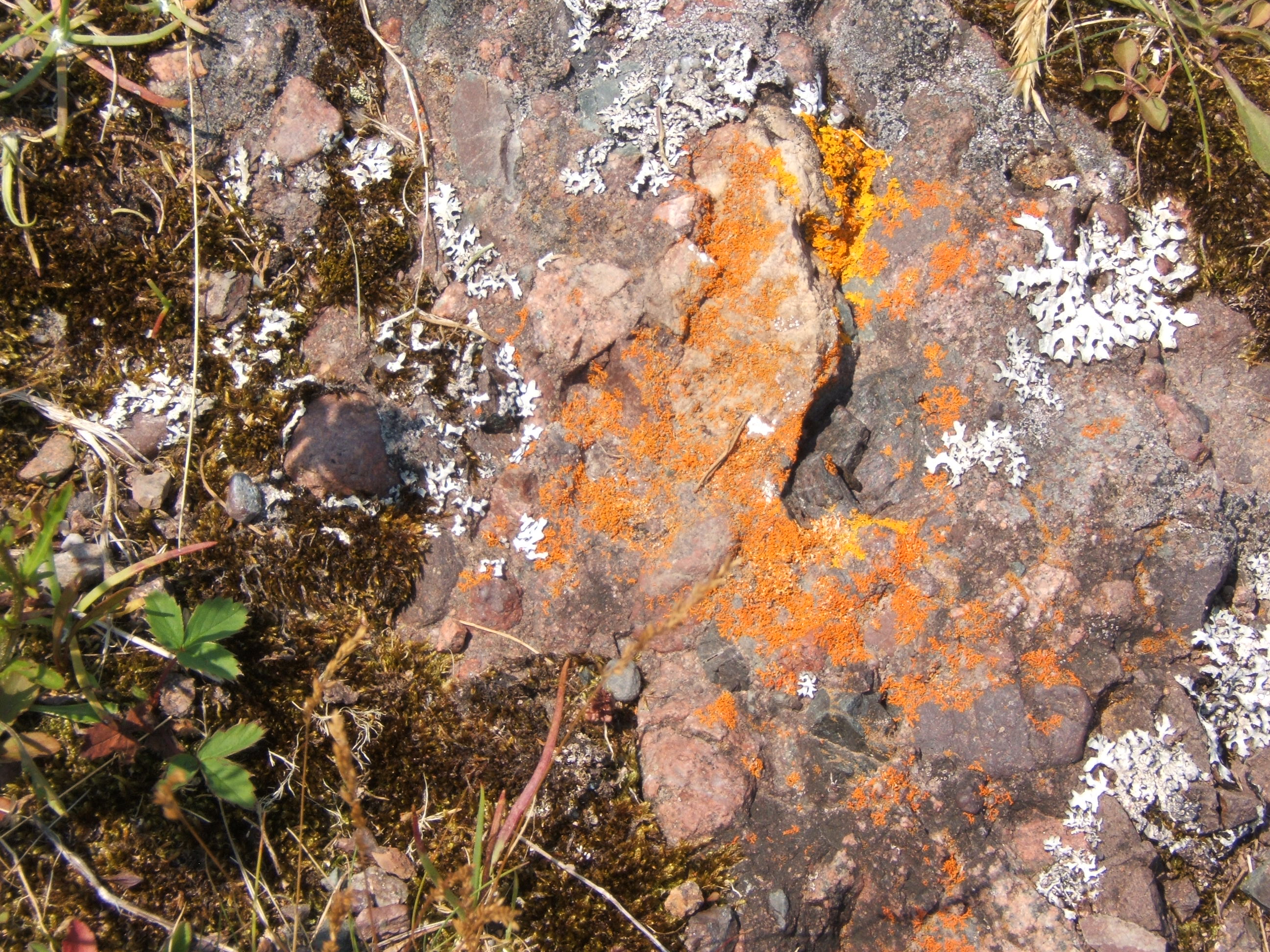
bright orange Xanthoria lichen on a rock .... there are also two or more other species of lichen present
A lichen is not a plant, but a composite organism, consisting of an algae and a fungus, living together in a symbiotic, mutually beneficial, relationship.
Ringing
Swallow Tail Lighthouse, Grand Manan
air saltfresh and balsam
walls lapped by a juniper sea
pale mimic of the salt sea
battering its foundations
its endurance
a mystery
until I found
an iron ring
anchored deep
in rock
almost lost
in lichen
Xanthoria orange
lifted and dropped
run round
its axis
clashing on stone
creak and clank of the metal door
echoes climbing the welded stair
ground glass grit of the light
fog washed clang of the channel bell
rock lashed to the lighthouse
salt breakers turned to stone
Published as: ‘Ringing’, Spring 1995, The Cormorant XI (2)
(revised)
© Jane Tims
exploring the intertidal zone
Every summer, we take a day to drive along the Bay of Fundy and explore some of the beaches and rocky shores. Last summer, we found a small cove where the fog was just lifting.
Through the mist we could see the ghostly form of a fishing weir and the distant rugged shore.

a cove along the Bay of Fundy coast
The beach was pebbles and sand, perfect for beach-combing. We wandered at random, watching for sea glass, shells and wave-smoothed rocks.
The intertidal area, between low and high tide, is an extraordinary space, not quite ocean, not quite land. The plants and animals who live in this area have very particular ‘niche-needs’. They need the rise and fall of the tide twice daily. Some plants have adaptations to help them cope with changing conditions. For example, the brown algae Ascophyllum nodosum has bladders to help it float at high tide and reach the sunlight.
When we explored the cove, it was low tide. Where the sea water was trapped among the rocks, there were tidal pools, small natural aquariums of sea life. One rock with a large hollow in its surface had its own population of bladder wrack (Fucus vesiculosis), green algae (Enteromorpha), barnacles, and a lone crab.
The barnacles are fun to watch. They are crustaceans, and live with their shells securely attatched to the substrate. An opening in the top of the shell is covered by a pair of ‘sliding doors’ called the operculum. Under water, the operculum opens and the barnacle reaches out with modified legs, designed to capture its food. The legs, known as cirri, look like feathery fingers, reaching out and pulling back, reaching out and pulling back.
The ‘niche’ of a particular plant or animal can be thought of as its ‘occupation’ in the space where it lives. For example, with respect to food gathering, the crab feeds on the larger prey in the pool, the barnacles filter out the smallest creatures, and the algae take in their nutrients from the water itself. Although they live in the same space, the crab, barnacles and algae each occupy a different ‘niche’.

one of the smallest tidal pools ever... in the hollow of a rock
Deep Cove detail
low tide
weirs and dories indistinct
pillars of fog
glide up the long beach
attention to
drifts of mica
periwinkle paths
breaking bands of wave
water kicked into rainbows
sunlight above the fog
plover tracks sprinkled on sand
cobbles, coloured glass
float ropes, plastic pink
rockweed
plaited by the sea
© Jane Tims
along the country road #1
When I was taking botany in university, a requirement of my taxonomy course was to make a ‘collection’ of plants, so I could learn how to identify them. Since I lived at home, and spent lots of time on the road, the easiest collection for me to make was of plants living along the roadside.
I made the collection, identified, pressed and dried each plant, glued them to the herbarium sheets, prepared their labels, and got a good mark in the course. The real legacy of the collection was that I developed the habit of botanizing along the road, at the edges and in the ditches. Gradually, I learned the names of the plants of the roadside better than any other group.
One of my favorite roadside plants is Common Yellow Rattle (Rhinanthus minor). In early summer, it’s a small herbaceous plant, with wiry stems and opposite leaves. In the axil of each leaf is a yellow, two-lipped flower with an inflated green calyx.
The charm of Yellow Rattle is also the reason for its common name. After flowering, when the calyx dries and turns brown, it becomes a natural rattle. If you pick the dry plant and give it a shake, you can hear the seeds clattering inside the pod.
Rhinanthus minor L. is also known as Rhinanthus Crista-galli L. The old generic name crista-galli means cock’s-comb, from the deeply toothed flower parts. The present generic name is from rhis meaning snout, referring to the shape of the flowers. In French, the plant is called claquette (tap dance), or sonnette (door chime).
Do you have a favorite roadside plant? Next time you take a walk along the road, what plants do you see and do you know their names?
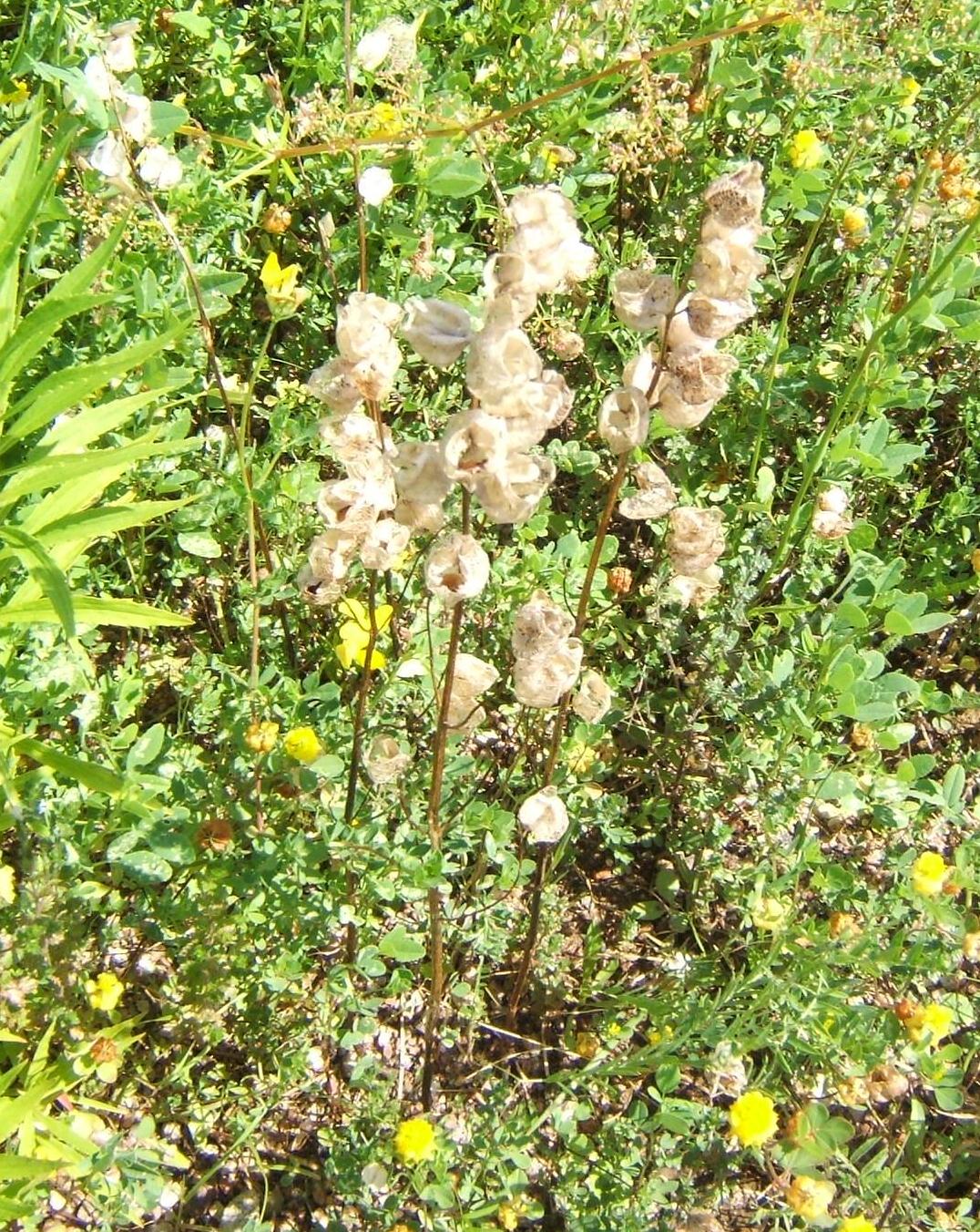
The dry brown plants are the rattling seed-pods of Yellow Rattle. Photo was taken in early August, so no flowers are present. The yellow flowers you see in the photo are two other plant species.
Yellow Rattle
Rhinanthus minor L.
weeds at the roadside
tickle my ankles
parchment whispers
like Alberta prairie
rattler whirr
I freeze
as I do when mouse feet rustle
in a house I thought empty
shake
loose seeds
in paper packets
yellow rattle snouts
test the air
crista-galli flowers
toothed as a cock’s comb
chatter at the north wind
claquette
tap dance on the chilly breeze
sonnette
quick scratching at summer’s door
Published as: ‘Yellow Rattle’, Summer 1994, the Fiddlehead 180
© Jane Tims
‘niche’ above the ground
Around us are spaces so familiar, we don’t pay attention to them anymore. I remember this when I walk in the woods near our house. On the ground, at my feet, are layers of leaves from last autumn, the carpet of mosses, the plants of the understory.
And then I remember to look up and see the space above me.
This space is the realm of the trees. It is a space shaped by their canopies, the needles of the Balsam Fir and White Pine, the leaves of Red Maple, and the dead branches and twigs of the spruce. Most of the trees reach upward, roughly perpendicular to the ground. They stand together, parallel, the masts and rigging of a sailing ship. Others have succumbed to decay and gravity and wind, and have fallen. Their trunks make diagonal slashes through the spaces above and leave gaps in the canopy.
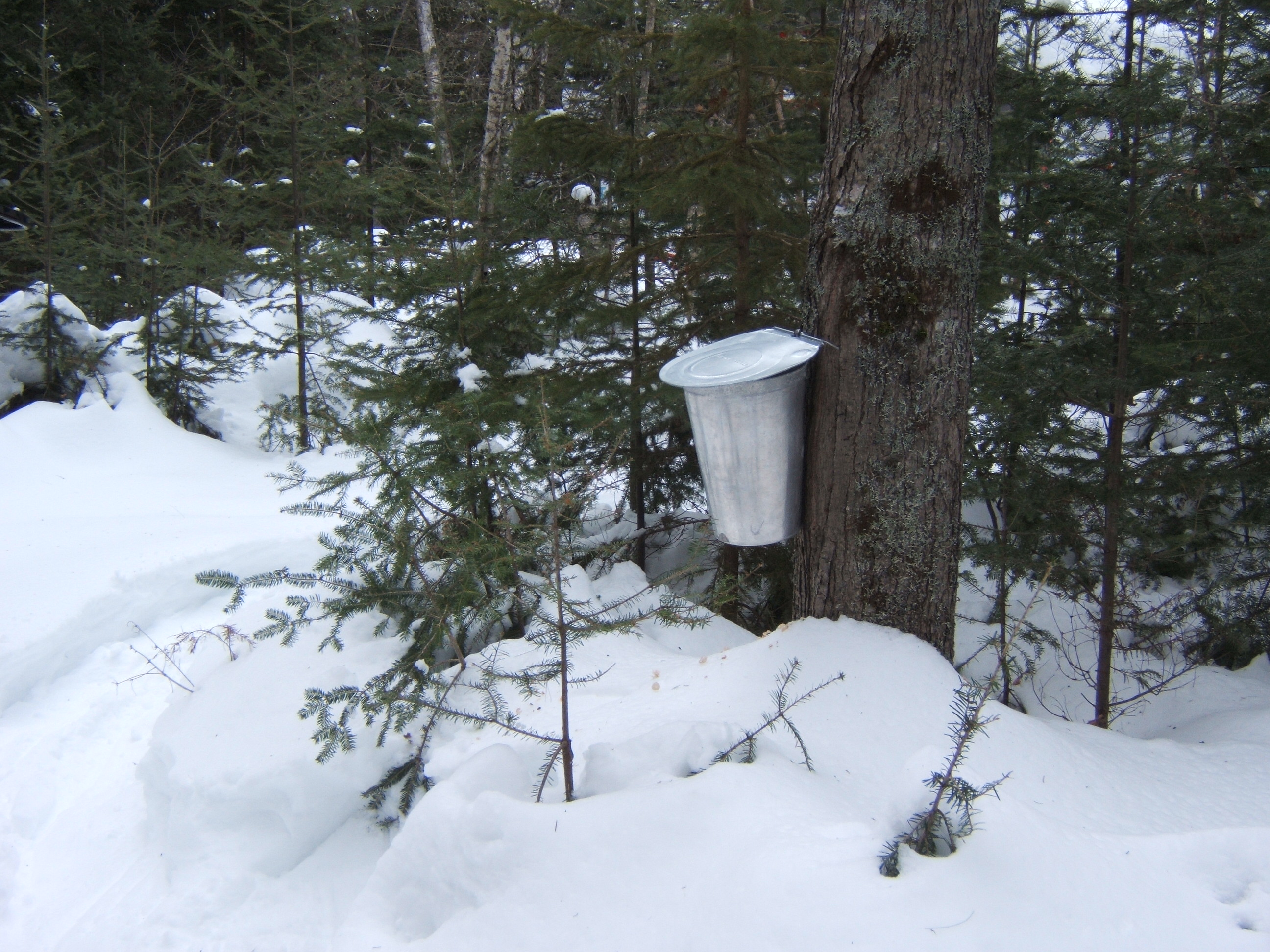
snowshoe trail and sap bucket on maple
These are spaces I cannot access, since my tree-climbing days are over. But I can move there, briefly, in winter. When the snow builds on the ground, it lifts me into the trees. I am reminded of this when I see the empty tap holes in the trunks of the maples along the trail. These are the holes left behind when we pull the taps at the end of maple syrup production in the spring. When we collected the sap, the taps were about three feet above the surface of the snow, so we could access them easily. Now, snow gone, the tap holes are above my head. Our snowshoe paths were elevated into the space above the ground. One winter the snows were so high, we had to trim the branches along the trail. Next summer we could look up and see our winter path, traced by the absence of branches in the space above our heads.

Usnea subfloridana Stirt. is a lichen often found growing on old and stressed trees in coniferous woods. The common name, Old Man's Beard, refers to the matted, stringy appearance of the lichen, hanging in clumps from tree branches. Lichens are made up of two species, an algae and a fungus, living together symbiotically.
Old Man’s Beard
Usnea subfloridana Stirt.
you and I
years ago
forced our ways
bent through the thicket
of lichen and spruce
Usnea
caught in your beard
and we laughed
absurd!
us with stooped backs
and grey hair?
found a game trail
a strawberry marsh
wild berries
crushed into sedge
stained shirts
lips
and fingers
strawberries
dusted with sugar
washed down with cold tea
warmed by rum
today
an old woman
alone
lost her way in the spruce
found beard
caught in the branches
and cried
Published as: ‘Old Man’s Beard’, Summer 1994, the Fiddlehead 180
© Jane Tims
on my grandfather’s farm
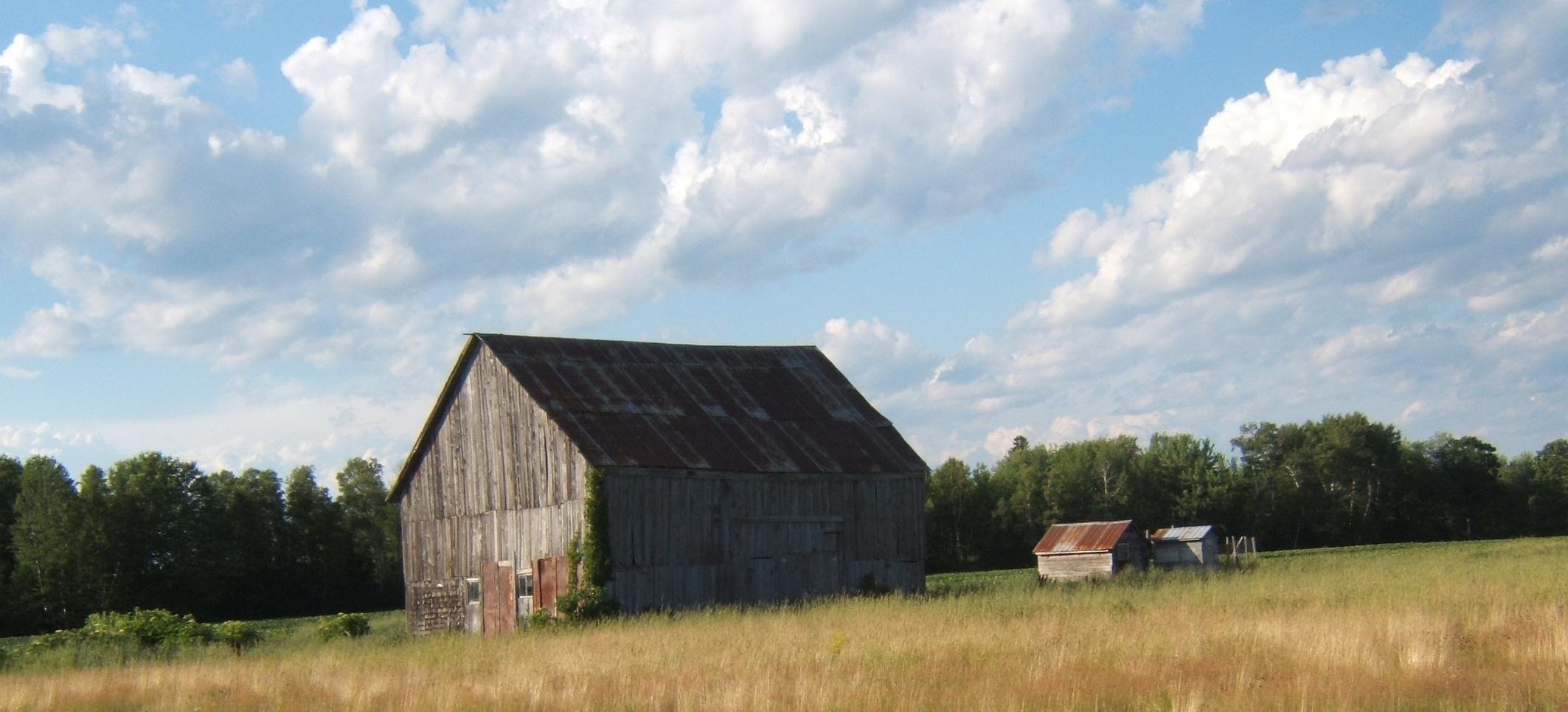
a haybarn and its out-buildings
When August arrives, I always remember the summers of my childhood. One of my favourite places to visit was my grandfather’s farm in Nova Scotia. It was a place of rambles, exploration and discovery. I looked forward to returning there each August, to reconnect with the farm and my extended family, especially my cousins. I was a city kid and loved the country life, picking berries, tramping hay, playing in the hay mow, and going for picnics at the lake.
My grandfather’s farm was part of a small community that included my aunts and uncles, and, of course, the cousins. These were families that depended on the forests, fields and lakes for their livelihood. Food was mostly local, grown on the farm or gathered from the fields and woods.
The farm was like a community itself, a miniature village of buildings. They included the main house, the big barn and various out-buildings. In my memory, there were about eight buildings in all, each with its own purpose, and its own sights, sounds, smells, tastes and stories.

The best was the big barn, built by my great-grandfather, with a high pitched roof, two lofts for hay, a central alley between, and back stalls for the cows and horses. The chicken coop was under the hay loft of the barn, sheathed in chicken wire and stuffed with new hay. Across the yard, closer to the house, was another bird coop, a loft for the more exotic birds my grandfather liked to keep: ring necked pheasants, a golden pheasant, and fantail doves. Another out-building, the noisy mink pen, was kept apart from the house, in the pasture, to hush the noise and keep the rank smell at bay.
The other buildings hover just at the edge of my recall. I think there was a lean-to beside the barn, cool and dark, housing the hay wagon, its big wooden wheels as large in diameter as I was tall. I also remember a machine shed, smelling of grease and oil, its doors always open.
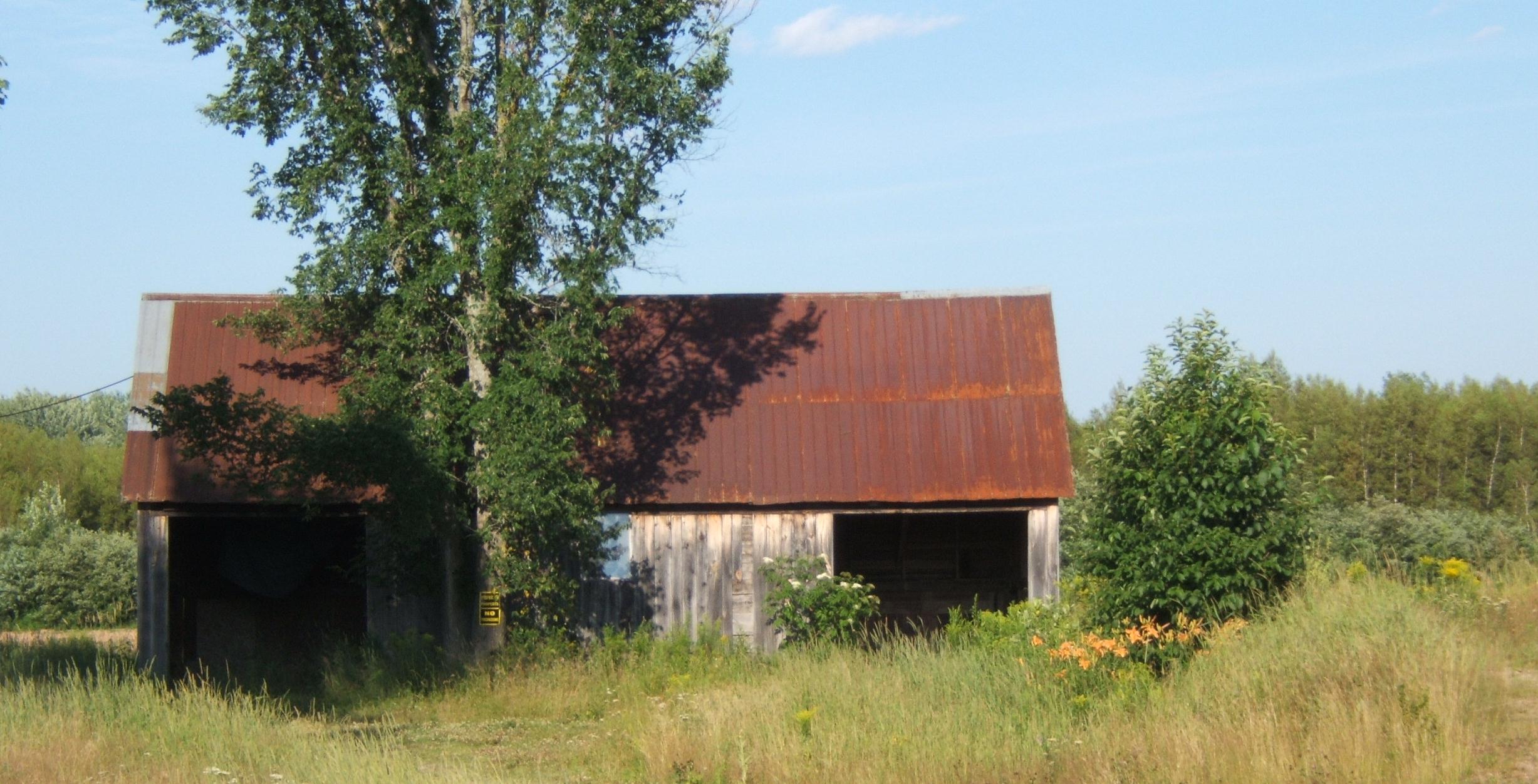
a machine shed with the remains of a garden and its old fashioned day lilies
The farm included a large acreage of pastures, fields and woods. These were also spaces to explore. My favourite was the apple orchard, and one particularly crooked tree, made for climbing. There was the farm yard with the chickens tottering about, squawking and annoying one another. Beyond the farm were the pastures, blue with berries, and the fields, edged with Black-eyed Susans, sturdy Rugosa roses, and other wild flowers. Our wandering usually followed the road, a winding way through mossy woods, leading to the lakes. Past the farm, it was a mere cart-track. Bordering the track was a fence with a swinging gate, perfect for sitting and dreaming. At one of the lakes was a favourite place for swimming, with a wooden diving board and a mythically deep pool, so clear you could see to the sandy bottom.
Farming can be a hard life, but viewed from the point of view of a child, my grandfather’s farm was a place of magic and wonder. I have tried to spend my life in surroundings that remind me of the farm. The experience of the small family farm is disappearing, but each day I try to recapture something of the feeling. I keep my garden wild, growing day lilies and Creeping Jenny at the edge of the lawn. I look forward to picking blueberries in the early days of August. And I roll down the car windows to catch the smell of new mown hay.
I wonder if your childhood included a farm and if you remember it well. Is the farm you knew still standing, or has it been abandoned with the years?
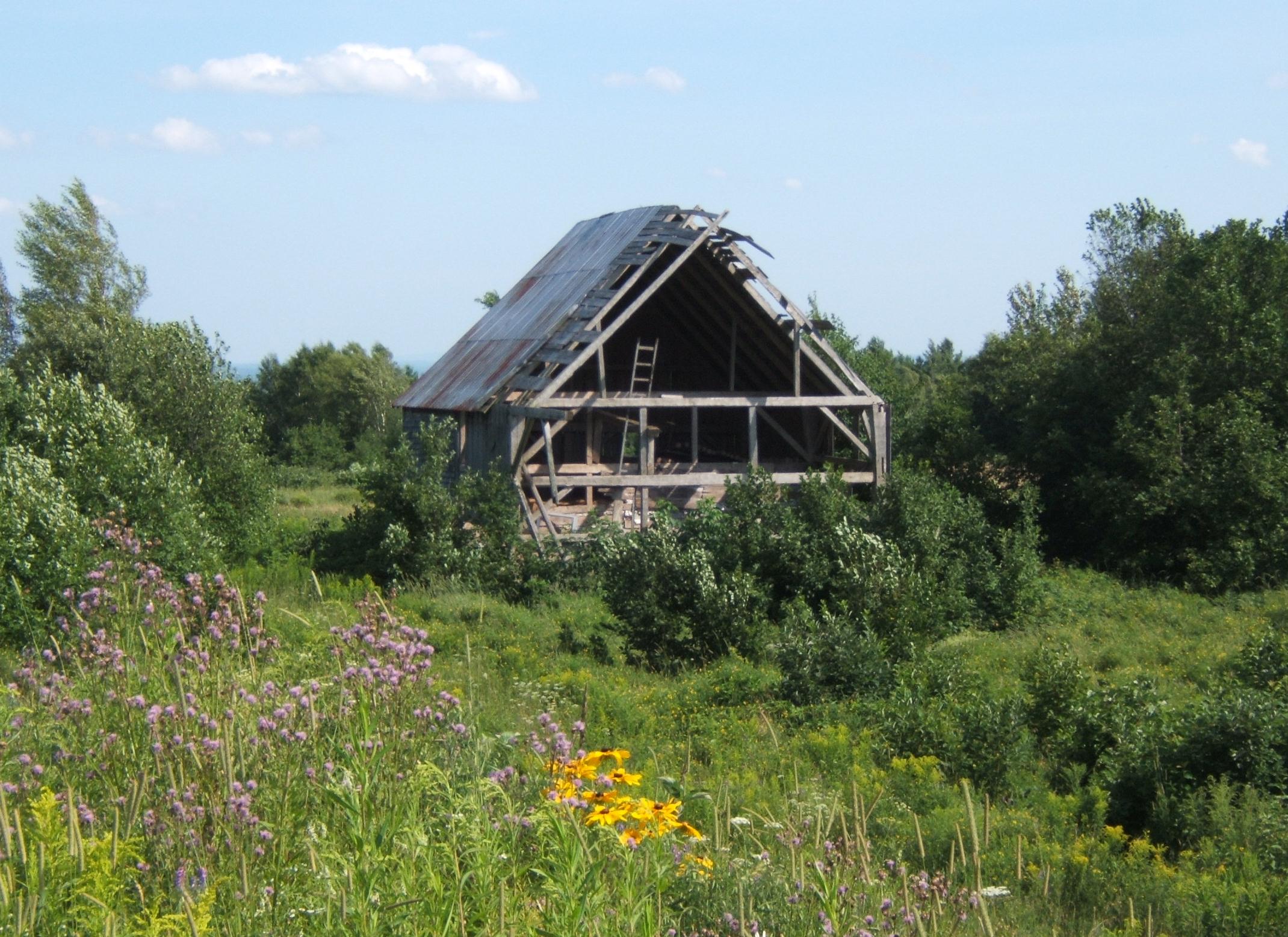
an old hay barn




 nichepoetryandprose