Archive for August 2011
water from the well
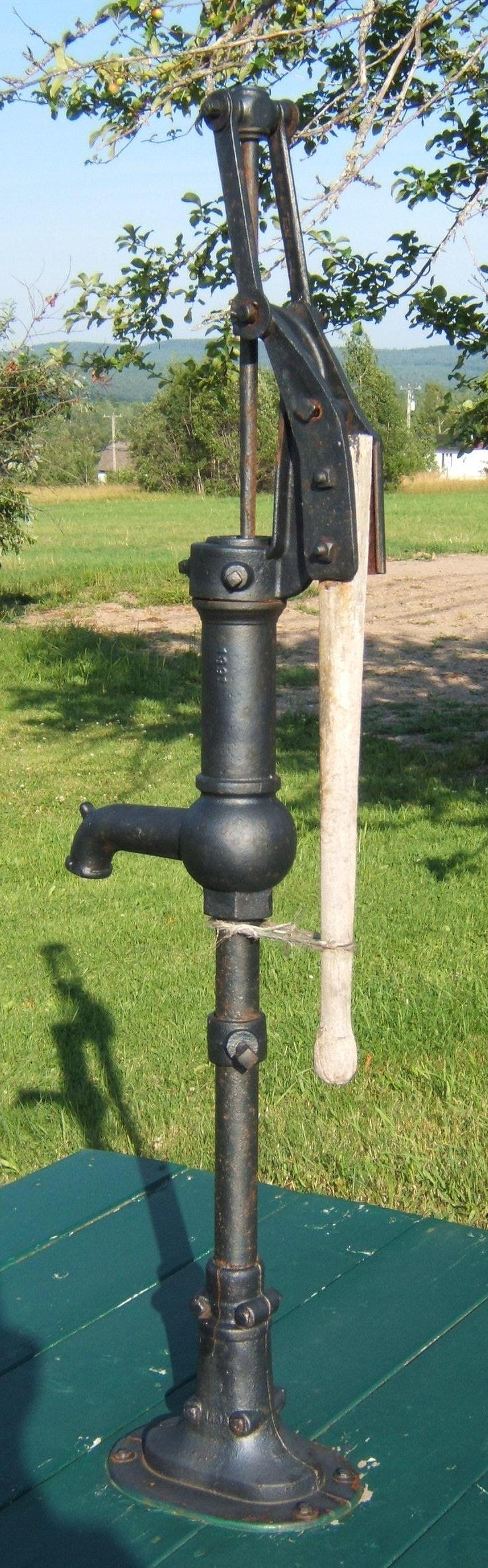
an old-style water pump
water from the well
~
taps in the house
running water hot and cold
why did my grandfather
carry in from the well
two pails of water each day?
handle pumped
well primed
~
he filled three buckets
one he poured
half into Dandy’s bowl
half he left beside the well
for the next day’s prime
~
two he lifted to the narrow step
set them down
opened the screen door
with a squeak
shut with satisfying thunder
~
carried the pails into the entry
set them down
settled his cap on a hook
row of hooks made of wire
hangers bent double and painted
~
carried the pails to the white door
a narrow door
with a latch
set them down
opened the door and climbed the stair
returned in a minute or so
carried the pails
into the kitchen
~
set one next to the sink
by the inside door
where I brushed
my teeth in the morning
enameled metal
narrow mirror
one tap for warm water, one for cold
wire basket for a bar of soap
and a bucket of water
cold from the well
~
set one pail in the pantry
narrow room by the woodstove
lined with shelves
counter where my grandfather
kneaded his bread
rolled the crust for pie
metal canister for sugar
ice box for milk and eggs
and a bucket of water
cold from the well
~
© Jane Tims 2011
the location of our picnic table
Back in our grey woods is a place we don’t visit regularly any more. Our picnic table is there, in a mossy area among mature spruce and fir, at the top of a slope. It overlooks a wet spot in the woods. In the spring the wet area becomes an ephemeral stream, and a series of vernal pools among the mosses and ferns.
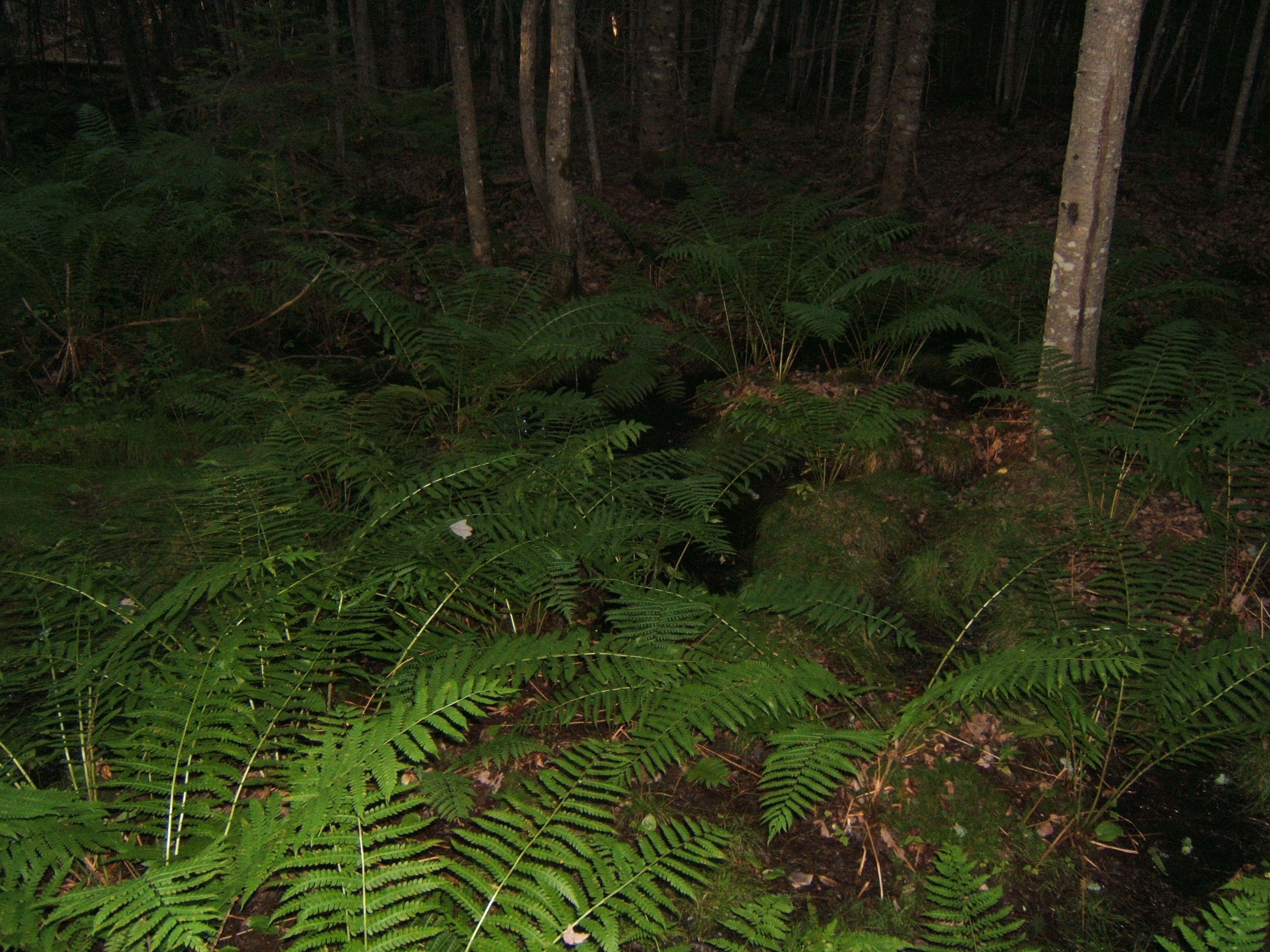
down-slope of the picnic table is a ferny area with an ephemeral stream... the dark areas in the photo are pools of water
Once, almost 28 years ago, the space was perfect for our new picnic table. The table was given to my newborn son by his Great-Aunt Jane and we took considerable care in choosing its location.

our picnic table in the woods
In years past, we took a picnic lunch there regularly. Sometimes I went there to write.
Today I pass the table when I follow the path through the woods, but I haven’t stopped to eat a picnic there in years. Another family has taken over, probably of Groundhogs (Marmota monax). They have built a labyrinth of burrows among the tree roots in the soft soil of the slope. Where each burrow exits is a mound, the remains of deep-earth excavation. One of the six burrow openings is larger than the others. My reading tells me this complex of burrows and exits provides quick escape from predators, a place to store food, and a place to hibernate.

the main entrance to the burrows, under the roots of a fir
Once this place was the ideal location for our new picnic table and our family picnics. Now the same site is perfect habitat for the Groundhog family.
concerning the location
of our new picnic table
~
share a meal with the unknown
to make it your friend
~
we find a clearing
near the path
where the sun will shine at noon
where we will not have to cut the trees
where the neighbours’ voices
and the passing cars
are quiet
~
we load the picnic table
into the cart
haul it through the woods
behind the Yamaha
~
we eat peanut butter sandwiches
and applesauce
drink cola
and sunshine
~
we laugh
make friends with the woods
and with each other
~
© Jane Tims 1983
hidden in the hollow heart of an oak
Hollow trees create mysterious spaces in the woods.
When I was young, a hollow in a tree was a secret hiding place for treasures, and one of my favourite books was a Nancy Drew mystery – “The Message in the Hollow Oak”. In the story, a hollow tree is used as a secret mailbox between long lost lovers.
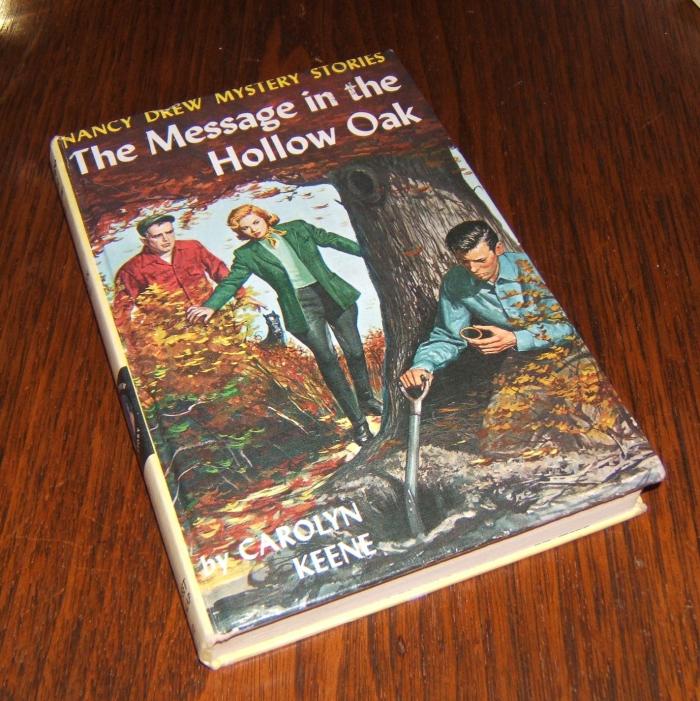
- Carolyn Keene 1935 The Message in the Hollow Oak (a later edition, probably around 1965)

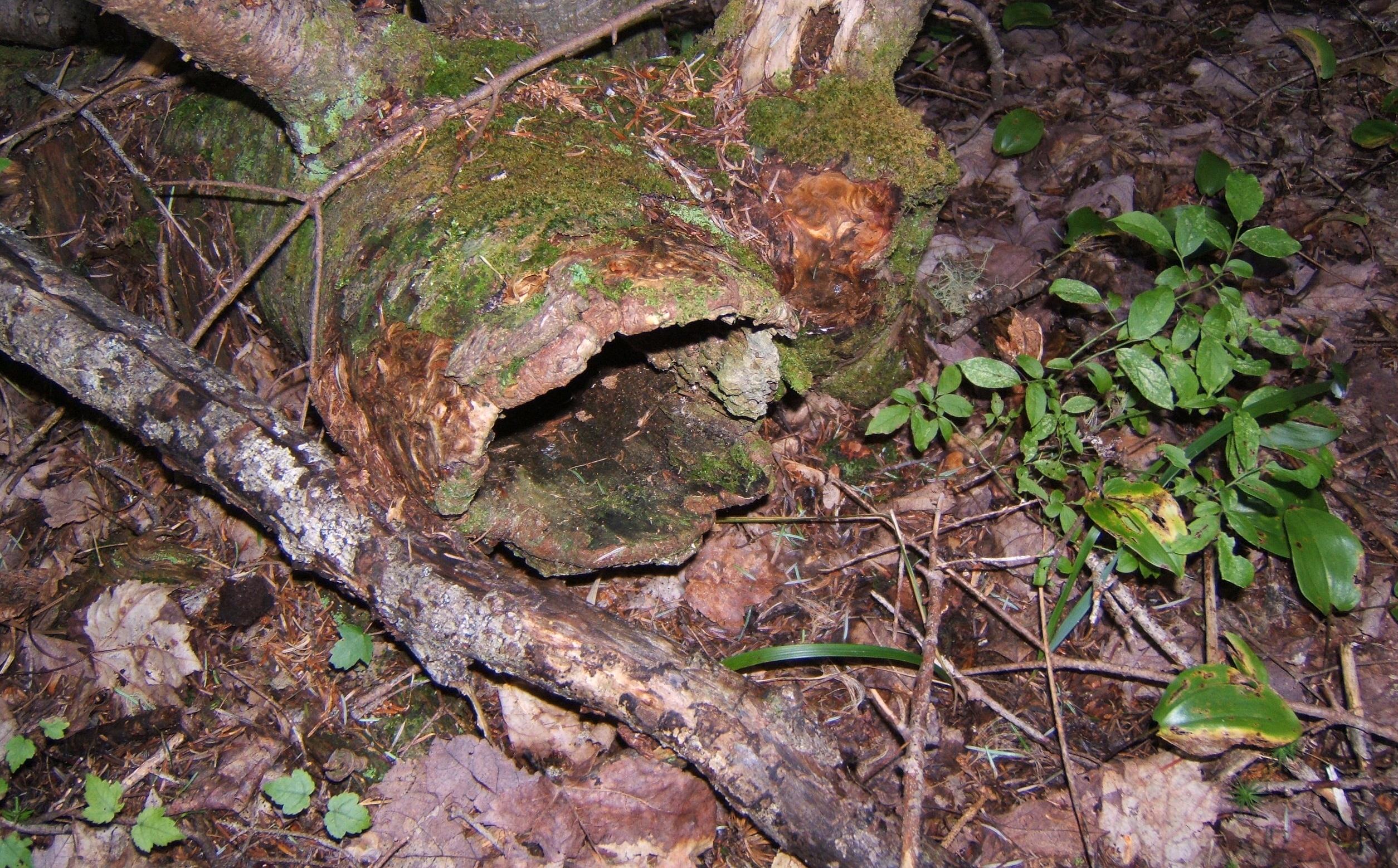
a hollow log in the woods
Cavities are usually found in mature trees. Their importance as habitat is a good reason for protecting older, mature trees in the woodlot. When my son was young, we made wooden signs saying “DEN TREE” for the older hollow trees in our woods, so we would remember not to cut them down.
Do you know a hollow tree and would you reach into the cavity to retrieve a letter???
requesting the favour of a reply
~
these leafless trees
brush against
a linen sky
ink strokes
on rice paper
letters
penned at midnight
~
hidden in the hollow
heart of an oak
afraid to reach in
to feel only
curls of bark
desiccated leaves
~
these trees
all seem the same
empty envelopes
parchment ghosts
~
branches tangled
messages
lost
~
black spruce scribbled on sky
~
Published as: ‘an answer in silence’, Spring 1995, The Cormorant XI (2)
(revised)
© Jane Tims
competing with the squirrels #2
We watched our hazelnuts carefully every day until August 11, certain the squirrels would not get them ahead of us.

our hazelnuts, almost ready to pick
Then, as humans do, we went on a small vacation, and returned on August 14, only three days later.
As soon as I was out of the car, I went to have a look at my hazelnuts.
And not one remained.

no hazelnuts
The squirrels got the hazelnuts.
No poem can express my dismay.
Next year…
Warning: 1. never eat any plant if you are not absolutely certain of the identification; 2. never eat any plant if you have personal sensitivities, including allergies, to certain plants or their derivatives; 3. never eat any plant unless you have checked several sources to verify the edibility of the plant. © Jane Tims 2012my grandmother’s eyes
Although my grandmother, my Dad’s mother, died shortly after I was born, she was always a part of our summer visit to my grandfather’s farm. Her photographic portrait, taken when she was a child, hung in the kitchen, above the cot where we played board games on rainy days.
I think about her sometimes, working in the kitchen, gathering apples in the orchard, making quilts for winter. My Dad, who called her Mama, told me how she made warm quilts by sewing wool squares from old sweaters to a blanket ‘backing’.
I know so little about her. I wish I had asked my Dad to tell me more.

my grandmother (photo taken in 1954)
Her Eyes Follow Me
~
1.
~
my grandmother
the one I never knew
was a portrait
a life-sized photograph
under curved glass
blurred at the edges
hung in the kitchen
~
she leaned over me
her eyes followed me
a child’s eyes
though she died at fifty
~
2.
~
the three of us
played a game
my brother watched her eyes
and I would creep
along the wall
~
leap out
~
her eyes found me
in an instant
~
3.
~
I know her eyes were blue
though the portrait was grey and white
~
4.
~
she is also
~
her last card at Christmas
a paper poinsettia
in the branches
of our tree
~
the dim photo of a mother
in a faded housedress
some unknown cousin
gathered in her arms
~
her last letter
love to the baby
~
5.
~
to say I never knew her
is a kind of lie
~
I knew her eyes
and they have
followed me
~
Published as: ‘Her Eyes Follow Me’, Winter 1996, The Antigonish Review 104:59.
(revised)
© Jane Tims
through Zoë’s eyes
Each space is unique to its occupier. For example, two people will experience a space quite differently. How they perceive a space depends on their mood, their individual preferences for certain tastes, smells, and colours, and their background and memories.
Animals perceive spaces very differently from humans. Their eyes and ears are tuned to a broader spectrum of colour and a different range of sound frequencies.

Zoë watches the air above her
My cat Zoë sees the world very differently from me. Her perceptions are much keener. At times, she will pay sudden and rapt attention to the empty space above her. I puzzle for a moment, look a little harder, and there it is … a tiny moth I would never have seen if Zoë had not pointed the way.
If you have a pet, are you amazed at how differently they experience their space?
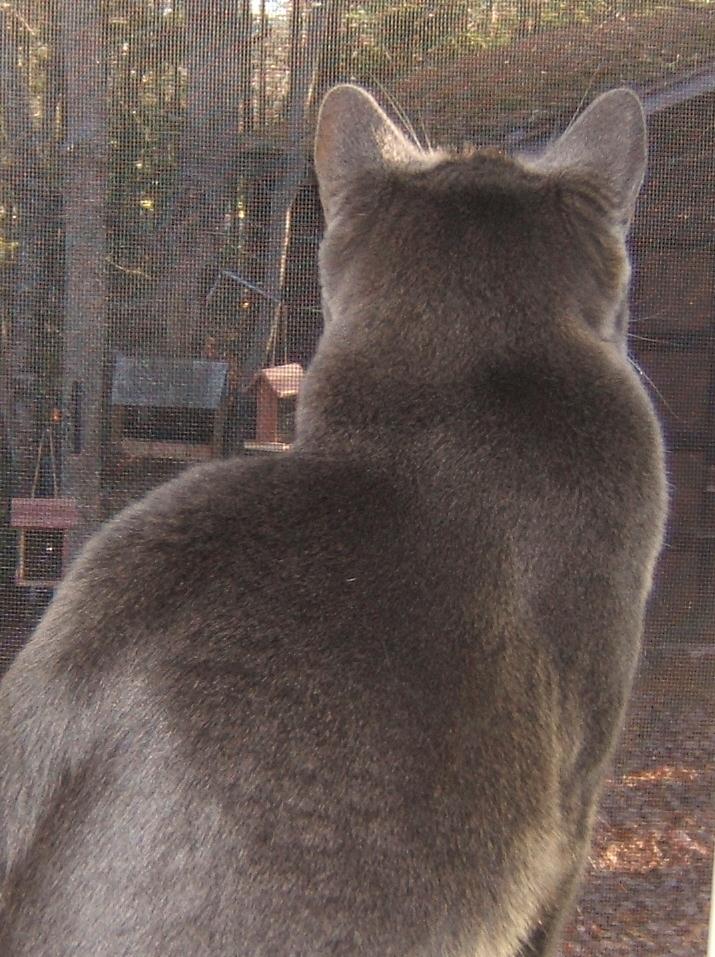
Zoe watches the birds in the feeders
Stalking the Wind
~
the cat crouches
on the window sill
puzzles out the night
considers fireflies and the moon
explores the June bug
on the other side
of the screen
pats at a maple key
wandering on the wind
~
when the door cracks open
she is ready
she slips between my feet
into the yard
~
and waits
~
all around her
the crickets
the tickle of grass
the scent of other cats
~
no moment to gather herself
and run
scooped
into the arms of her keeper
scolded inside
dour at the window
~
next time
she will not pause
bewildered
she will leap and run
kin with the fireflies
pursuit of the wind
~
Published as: ‘Stalking the Wind’, Spring 1995, Green’s Magazine XXIV (1)
© Jane Tims
along the country road #5
Not far from where I live is a new road, built a few years ago along the edge of a field. When it was first built, it was a scar on the land, its ditches unlovely smears of muck.
This year, the weeds of the roadside have moved in to fill the empty spaces with green. At one place, where the new road joins the old, it is particularly wet and the ditches have been overwhelmed with a green and orange explosion of Jewel Weed.
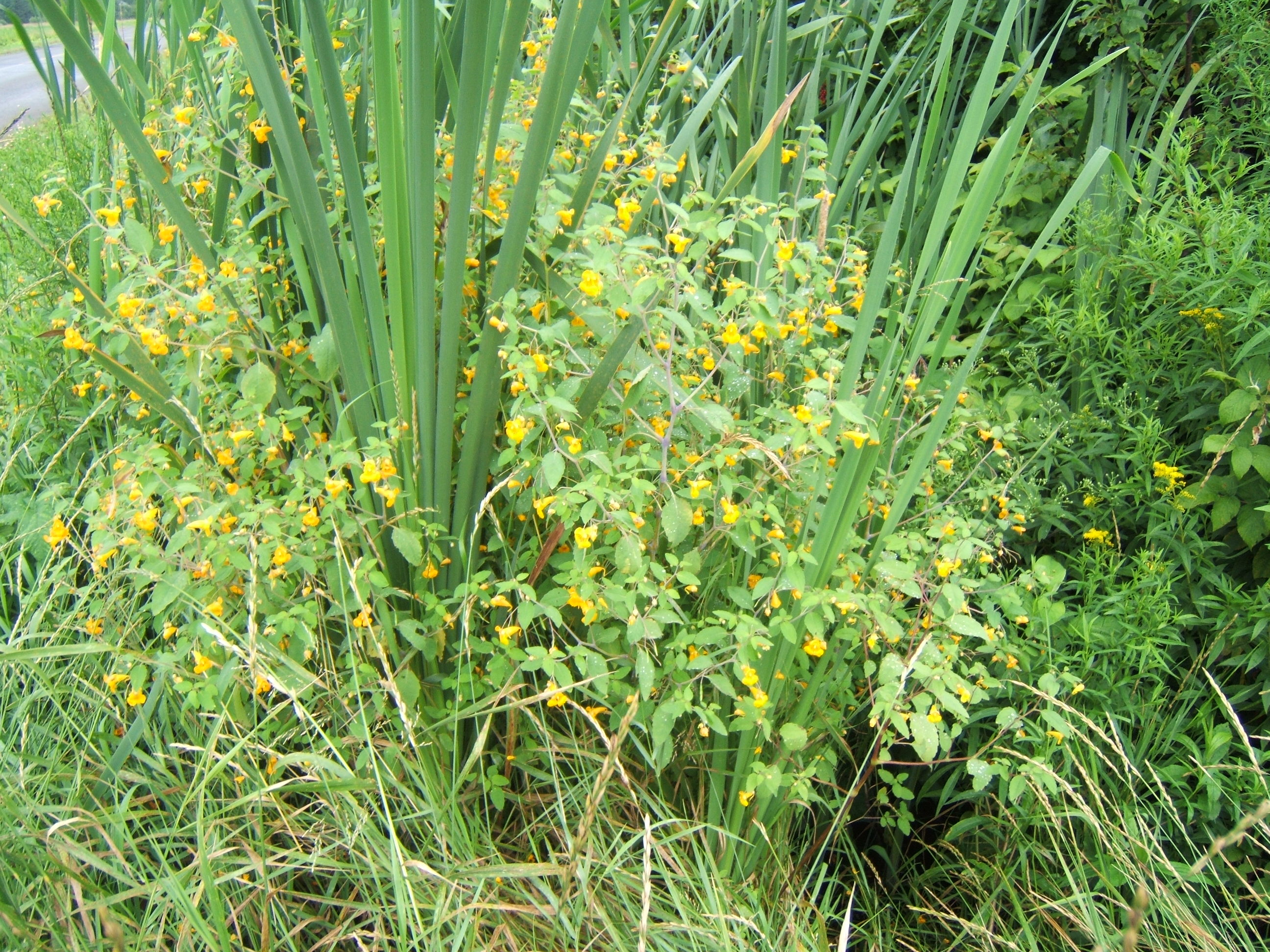
Jewel Weed growing with cattails in a wet ditch

a profusion of Jewel Weed
The botanist, Nicolaas Meerburgh, who first named the plant, called it capensis, meaning “of the cape” since he wrongly thought it had been introduced from the Cape of Good Hope into European gardens.

Jewel Weed (Impatiens capensis Meerb.)
Jewel Weed
Impatiens capensis Meerb.
~
Jewel Weed
orange and green
tangled in the gully
spotted spurred
impatiente
for a visit
from a hummingbird
~
Jewel Weed
not used as gems
for lady’s ears
not (after all)
from the Cape
of Good Hope-
Celandine tends
to mope
~
Jewel Weed
pendulant
petulant
“Touch-me-not!
or I fling
seeds from my pods
into the spring”
~
© Jane Tims
along the country road #4
My Mom was a great gardener. She could grow vegetables on the smallest corner of land and coax flowers where I was certain none would grow. When I was a little girl, and we lived in Alberta, she kept vibrant flower gardens. I remember the hollyhocks towered above my head, nasturtiums made pools of fire beside our door, and alyssum spilled over the edge of the cement walkway. One year, Mom planted sweet peas and I helped her put up a little string, unbelieving when the shoots pushed up through the soil and the papery leaves used curly tendrils to climb the string.
Another flower I remember fondly is the snapdragon, with its inflated lower lip. Its mouth yawned and looked like it could spurt dragon-fire if you pressed the petals between your thumb and forefinger.
I was never able to grow snapdragons, although I’ve tried. But one of the plants growing wild along our road has the charm of the garden snapdragon and is in the same family of plants. This little plant is called Toadflax. Its other common name is Butter-and-eggs.
Butter-and-eggs (Linaria vulgaris Hill.) is a weed of roadsides and waste places, blooming in large patches, late in summer. The flowers are spurred and bright yellow, with a lower orange lip. The inflated lower lip acts as a landing platform for insects and is hinged, to allow the right pollinators access to the nectar and pollen.
Butter-and-eggs is not a very big dragon, but it does have a mouth that yawns if you press the petals between your thumb and forefinger. Perhaps this is the reason Butter-and-eggs is known in French as guele de lion. Its other French name is linaire. This name, and the scientific name Linaria, are derived from the Latin linum meaning ‘flax’.

Butter-and-eggs (Linaria vulgaris Hill.)
abandoned spaces
When I drive through the countryside, I am drawn to the sight of abandoned farms or houses. I wonder why they have gone from being loved and used, to being alone.

abandoned farm buildings
Sometimes, the leaving is from economic necessity. Sometimes the last one who lived or worked there has died or moved on. Sometimes the government decides it can’t provide services anymore to out-of-the-way places. Occasionally, we are just seeing a moment in time, and new tenants and new life may be just around the corner.

an abandoned house
During the Depression, in the 1930s, many farms out west were abandoned because the combination of eroded land and poor economic conditions made staying impossible.
The poem below was written to remember one such place in southern Alberta. In the 1960’s, we went there once with my Dad, on a drive to explore the prairie roads.
Why do we abandon the spaces we know best?
The Reason for Leaving
~
1964
~
I remember the place
without texture
a line drawing
plainly coloured
~
two tracks on the prairie
one to come
and one to go on
~
a grey house
on a rise of green
(not grass, just green)
the door fallen away
~
a brown canal
still, without depth
sluice gears and flood gates
making the most
of insufficient water
~
and a bridge, also brown
boards laid without nails
~
~
1933
~
the truck
heavy on the driver’s side
steps down from the bridge
(the bridge ironic)
(three years, the Creek’s been dry)
~
in the rear-view mirror
a wooden house
on a low hill
a thin brown wind
and thirsty grasses
~
only the young ones
turn to stare
~
home
now hollow
stripped of voice and windows
the door left open
for tumbleweeds
~
Published as: ‘The Reason for Leaving’, 2010/2011, Canadian Stories 13 (76).
© Jane Tims
along the country road #3
A few years ago, I became interested in pressing flowers as a craft. I discovered a secret – one of the best flowers to press is Queen Anne’s Lace. Laid out on the page, it has the look of intricate crochet.
Queen Anne’s Lace, also called wild carrot, devil’s-plague, and carotte sauvage, is a tall weed with an umbrella-like cluster of lacy white flowers. The flowers are an umbel, meaning that the individual flowers all radiate from the same point on the stem to form a head. The flower is commonly seen in hayfields and waste places, and along roadsides.

Queen Anne's Lace (Daucus carota L.)
Daucus is the ancient Greek name for carrot; carota is the old generic name for carrot.
Don’t let the name ‘carrot’ fool you, as the roots are said to be somewhat poisonous. Also, beware of look-alikes. There are many flowers that can be described as a ‘white umbel’, some of them poisonous to the touch. Use an identification guide before you investigate too closely!
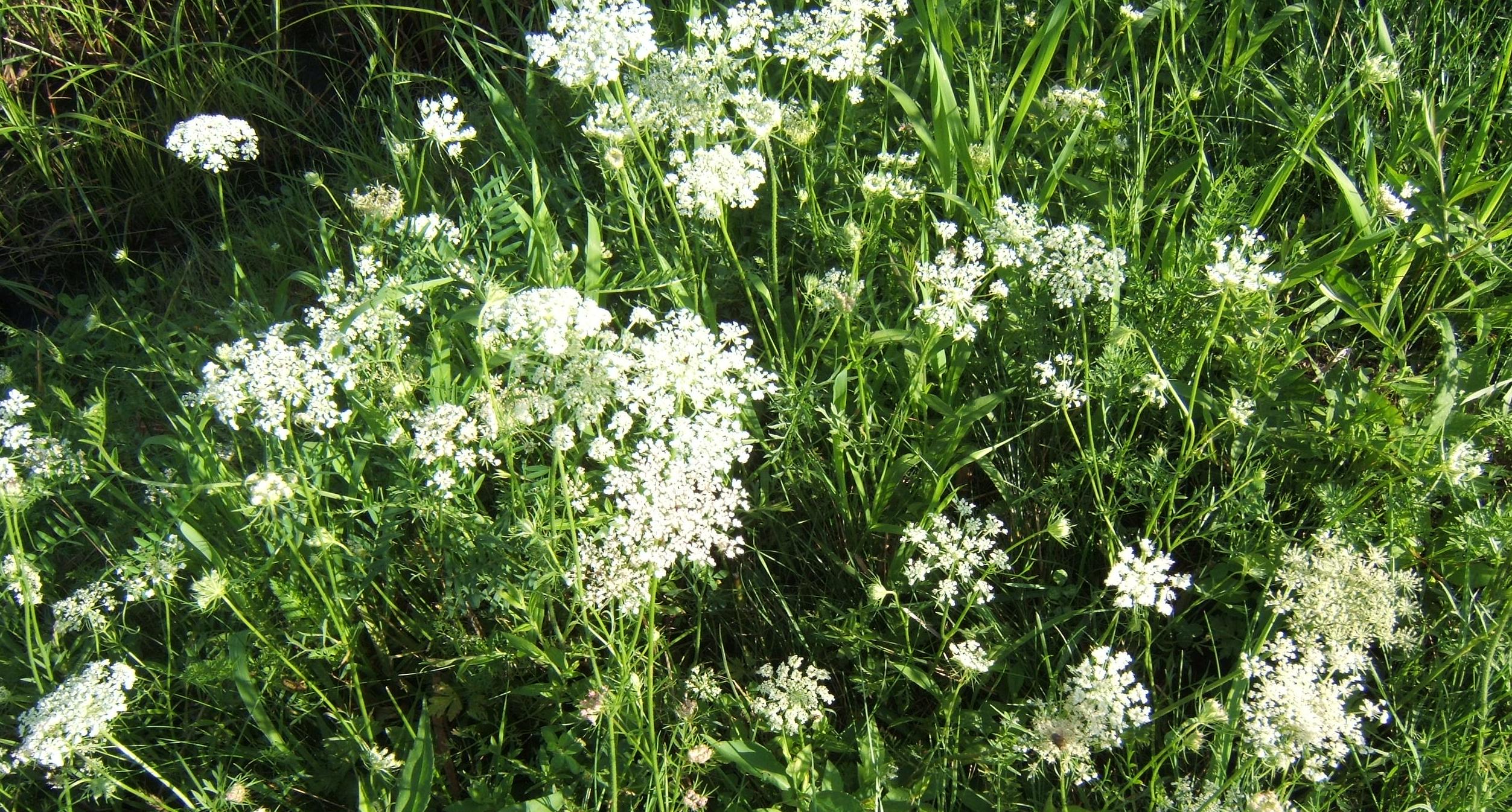
like snowflakes in summer
Queen Anne’s Lace
Daucus carota L.
wild carrot
inedible
no colour
unsuitable
as a vegetable
(poison probable)
white lace
three dimensional
tatted for Anne
‘Not Suitable’
for a Queen
(too usual)
umbrella
non-functional
(leaky)
unsuitable
for the rain
(or even drizzle)
in moonlight
unforgettable
common words
unsuitable
devil’s-plague?
ethereal!
Published as: ‘Queen Anne’s Lace’, Winter 1993, The Antigonish Review 92:80-81.
(revised)
© Jane Tims




 nichepoetryandprose