Posts Tagged ‘virtual travel’
family history – the Johnson brothers
If you have followed my blog for a while, you may be wondering what has happened to my virtual biking along the northern coast of New Brunswick.
~
Well, this is what happened. As I cycled one day, I took a side road. It was a narrow road I had not travelled in quite a few years. And as I cycled, I felt drawn further and further into the past. I began to explore this past, lured by wiggling leaves that popped up as I biked along. Yes, you have guessed it … I found myself at http://www.Ancestry.ca , building a forest of family trees.
~
I discovered I could learn about my family quite quickly… thirty minutes of biking gives me time to explore an ancestor or two … I can travel back in time to the 1880 USA Census to search the byways of Wyoming or the country roads of Pennsylvania … I can discover great-grandparents I have known for some time, or great-great grandparents I have never encountered before.
~
So, for a little while, my exercise program will not be about discovering new places, but about discovering new family members. I promise to return to the present and my virtual geographic travels eventually.
~
The first people I have met on my new travels are the Johnson brothers, my great-granduncles. They are the sons of my great-great-grandfather James Johnson. My Mom was very interested in this part of our family and worked to leave us a little of their history. I have photos of most of them, including a family grouping in a sepia tin-type. The original tin-type is small, about 2″ by 3″. Tin-types are photos imprinted on a metal surface. Most tin-types are on iron, coated with black paint or lacquer. This type of photo was popular from the 1860s through to the 1910s.
~
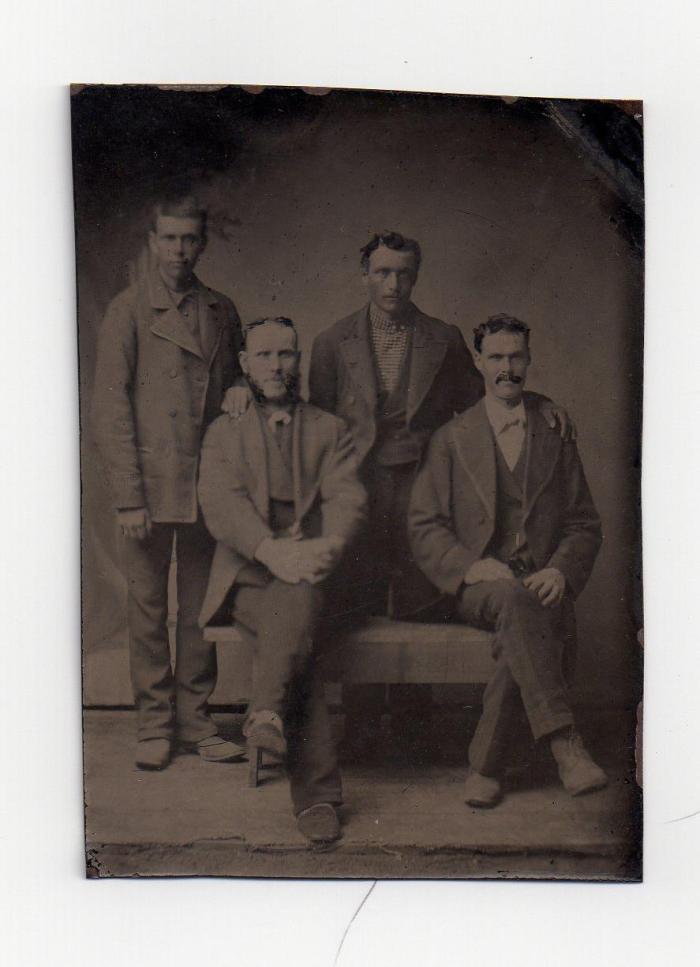
some of the Johnson brothers in an old tin-type photo
~
The brothers were John (born 1849 ), Daniel (born 1851), James (1854), Alexander (1857), and Isaac (1866). They had two sisters Kate (born 1847) and Mary Jane (my grandmother, born 1859). There is some question about which of the brothers are in the photo, but my Mom had it figured out based on the boys’ ages, and photos of them at an older age.
~
Only a few details survive for the brothers. I know birth and death dates, as well as the names of wives and children. John, James and Alexander were farmers. John and James were adventurers and visited the west. Daniel and Isaac were doctors.
~
So much information is lost, but for now, I am enjoying small discoveries about their lives.
~
Copyright 2014 Jane Tims
preserving coastal marsh (day 24 and 25)
The last few days of my virtual biking have reminded me of the need to preserve coastal areas, including barrier beaches and coastal salt marsh. Day 24 and 25 of my virtual travels took me along Youghall Beach near Bathurst. This barrier beach has been almost entirely developed with seasonal and year-round residences.
~

map showing distance travelled (map from Google Maps)
~
8-24 March 24, 2014 35 minutes (south of Youghall Beach to Youghall)
8-25 March 25, 2014 30 minutes ( Youghall to south of Youghall)
~

aerial view of Peters River salt marsh (right) and Youghall Beach (left) (image from Street View)
~

Peters River salt marsh (image from Street View)
~
One of the reasons to protect barrier beaches from development is the close association with coastal marshes and their sensitive wild life. For example, the coastal marshes in the Bathurst area, including the coastal salt marshes of the Peters River near Youghall Beach, are home to the Maritime Ringlet Butterfly. The Maritime Ringlet (Coenonympha nipisiquit McDunnough) is a small butterfly with a wing-span of four centimeters. It is buff-and-rusty-coloured, with a dark eyespot.
~
This butterfly is endangered, because it faces extinction. It is ‘endemic’ to the salt marshes of the Baie-des-Chaleurs – this is the only place in the world where this butterfly lives. The butterfly can only live in the salt marsh – the Maritime Ringlet caterpillar lives on salt marsh grasses (Spartina patens) and the adult uses Sea Lavender (Limonium nashii) as its nectar source.
~
Government and conservation groups in New Brunswick have worked together to educate homeowners about protecting the Maritime Ringlet Butterfly. They list practical steps people can take to ensure the habitat of this endangered butterfly is protected. These include: not filling in the marsh, not burning marsh grasses, not using vehicles in the marsh, not picking marsh wildflowers such as Sea Lavender, and not going into the marsh. For more information on the Maritime Ringlet Butterfly and its protection, see http://www.bathurstsustainabledevelopment.com/userfiles/file/HSP%20Final%20MR%20ENGLISH%20brochure.pdf
~

March 27, 2014 ‘Maritime Ringlet Butterfly’ Jane Tims
~
Copyright 2014 Jane Tims
flags all flying (day 17 and 18)
During my virtual travelling along the north shore of New Brunswick I often see flags flying, representing the esteem of people for their country and their heritage …
~

distance travelled (map from Google Earth)
~
8-17 February 21, 2014 30 minutes (Belledune to Devereau)
8-18 February 25, 2014 35 minutes (Devereau to Petit-Rocher-Nord)
(I also took a quick sidetrip on the highway south to Madran – the beauty of travelling virtually)
~
All along the coast of northern New Brunswick, people are proud to display their flags. As I ‘cycle’ along the road I see three flag designs …
~
The red and white Canadian flag with its maple leaf …

a Canadian flag near Campbellton (image from Street View)
~
the New Brunswick flag (based on the province’s Coat of Arms and depicting a red lion and a ship) …

the yellow, red and blue New Brunswick flag showing the ship from the Coat of Arms (image from Street View)
~
and the Acadian flag …

the blue, white and red Acadian flag showing its gold star (image from Street View)
~
The Acadians are the descendants of French colonists of the 17th century who settled in Acadia (the Maritime Provinces, parts of Quebec and Maine). Today, over 1/3 of New Brunswickers are Acadian and New Brunswick is officially bilingual (French and English).
~
The Acadian flag represents Acadians all over the world. The flag is blue, white and red, like the flag of France. On the blue field is a gold star, the Stella Maris (Star of the Sea). The star represents the Virgin Mary, patron saint of the Acadians.
~
Along the north shore of New Brunswick, the colours of the Acadian flag are represented on various objects, including telephone poles in some communities …
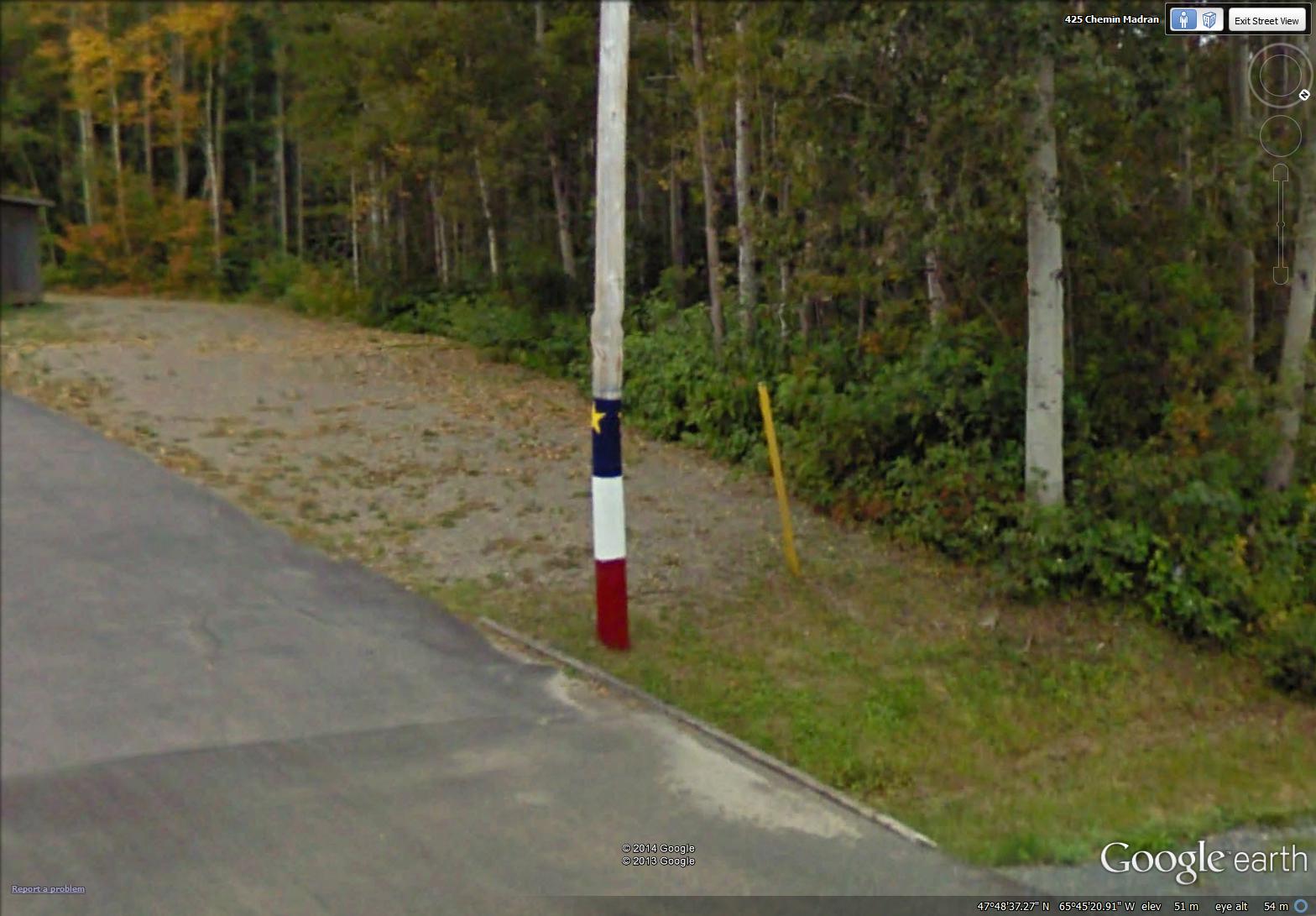
a painted telephone pole in Madran (image from Street View)
~
on lobster traps …

colours of the Acadian flag on a lobster trap (image from Street View)
~
and on rocks …

February 25, 2014 ‘roche Acadienne’ Jane Tims
~
The Acadian flag and its representations remind me how proud I am to live in a province that includes the rich culture and history of the Acadian people.
~
Copyright 2014 Jane Tims
yet another Cornwall gate
As you may have seen on my ‘accomplishments’ page, I have sold the painting ‘rainbow gate in Falmouth’. It was on display as part of an art auction at Isaac’s Way Restaurant in Fredericton.
~
The art at auction at Isaac’s Way helps local children’s charities, in this case providing opportunities for summer theatre. Once I have sold a painting, I can replace the painting with another and now ‘gate in Ponsanooth’ is up for auction! You can see the painting at https://nichepoetryandprose.wordpress.com/2014/01/24/another-cornwall-gate/ .
~
I am continuing to paint in my Cornwall gates series. This past weekend, I painted another gate from Ponsanooth entitled ‘enter’. Gates are meaningful to me, as metaphors for change and as representative of possibility. And the various building materials, stone, cement, wood and metal, are very enjoyable to paint …
~
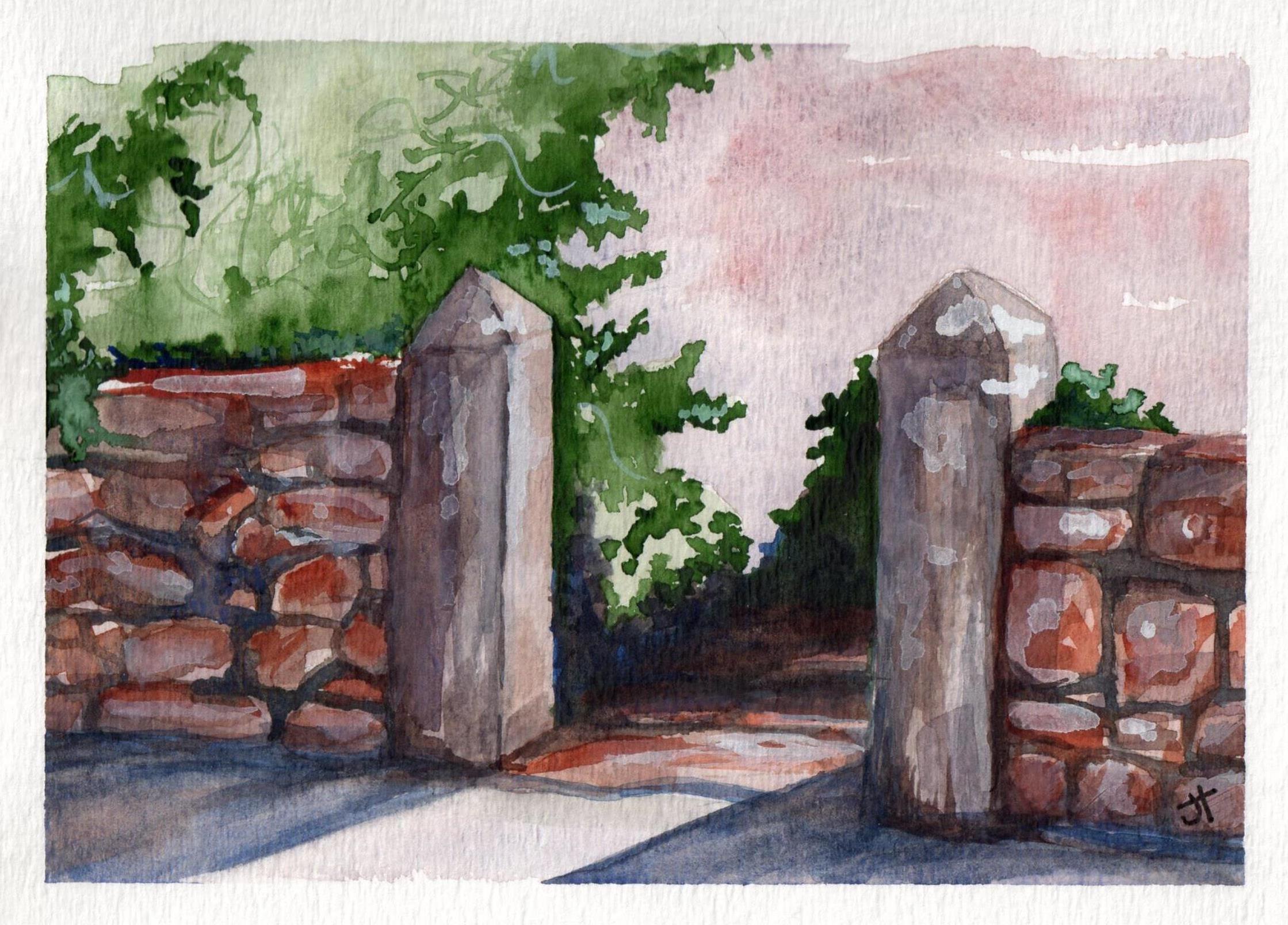
February 22, 2014 ‘enter’ Jane Tims
~
Copyright 2014 Jane Tims
industry and old barns (day 15 and 16)
One of the best things about ‘biking’ a new section of road every time I exercise is – I never know what theme is going to suggest itself …
~
~
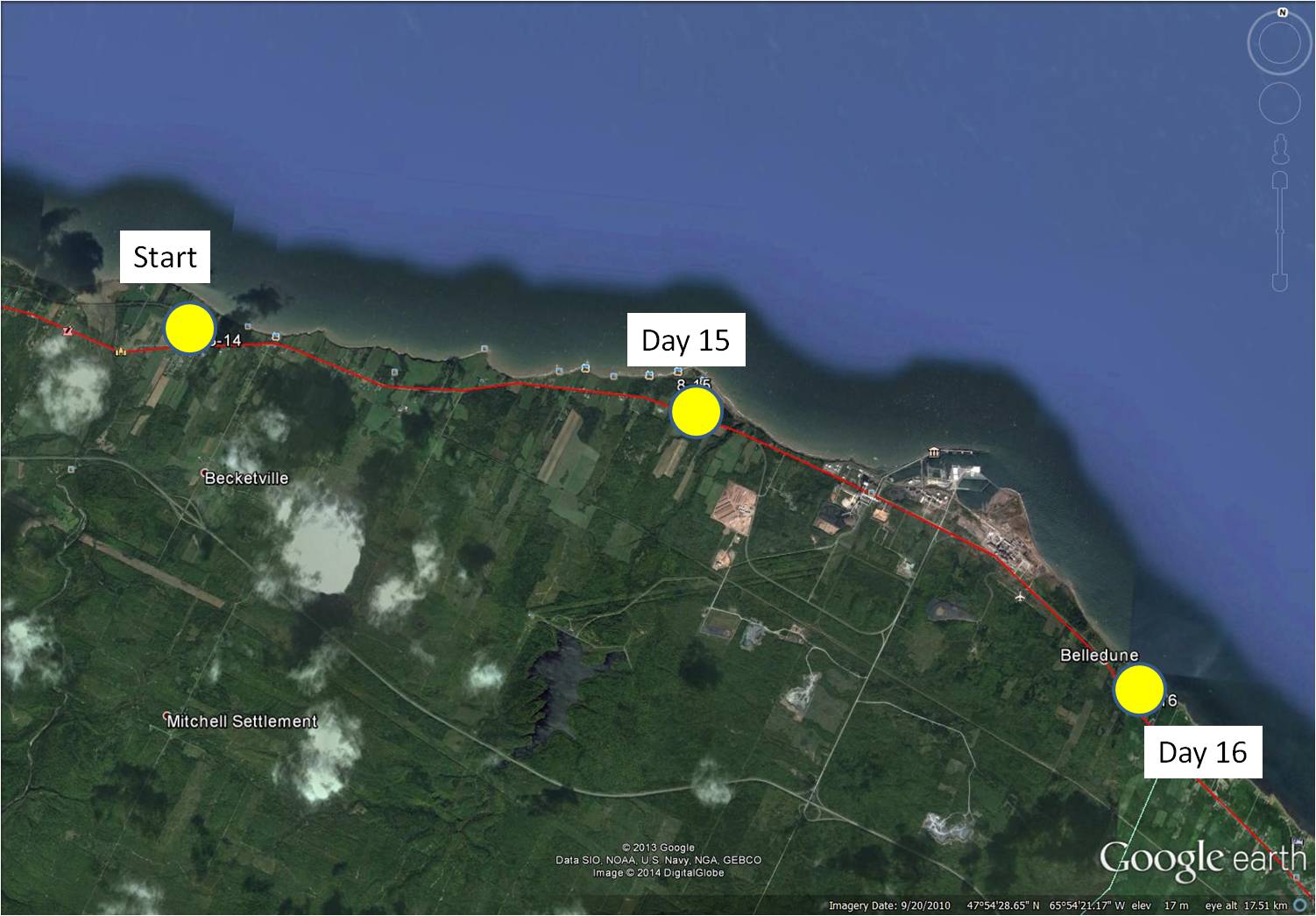
8-15 February 12, 2014 30 minutes (Jacquet River to Culligan)
8-16 February 16, 2014 35 minutes (Culligan to Belledune)
~
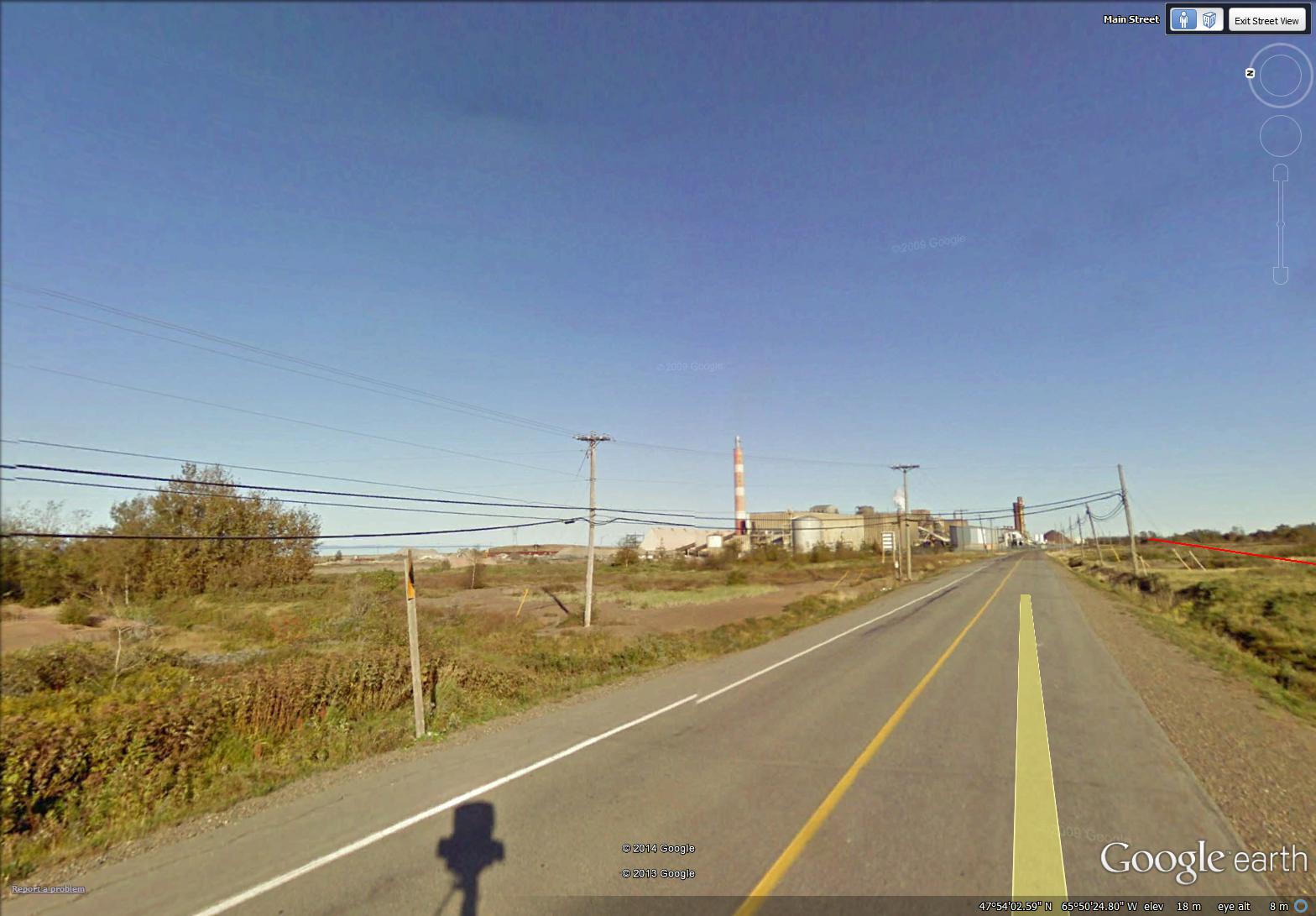
This session of virtual touring took me to Belledune. The area is quite industrialized, since it is the site of the Xstrata Zinc Canada Brunswick Smelter …
~
~
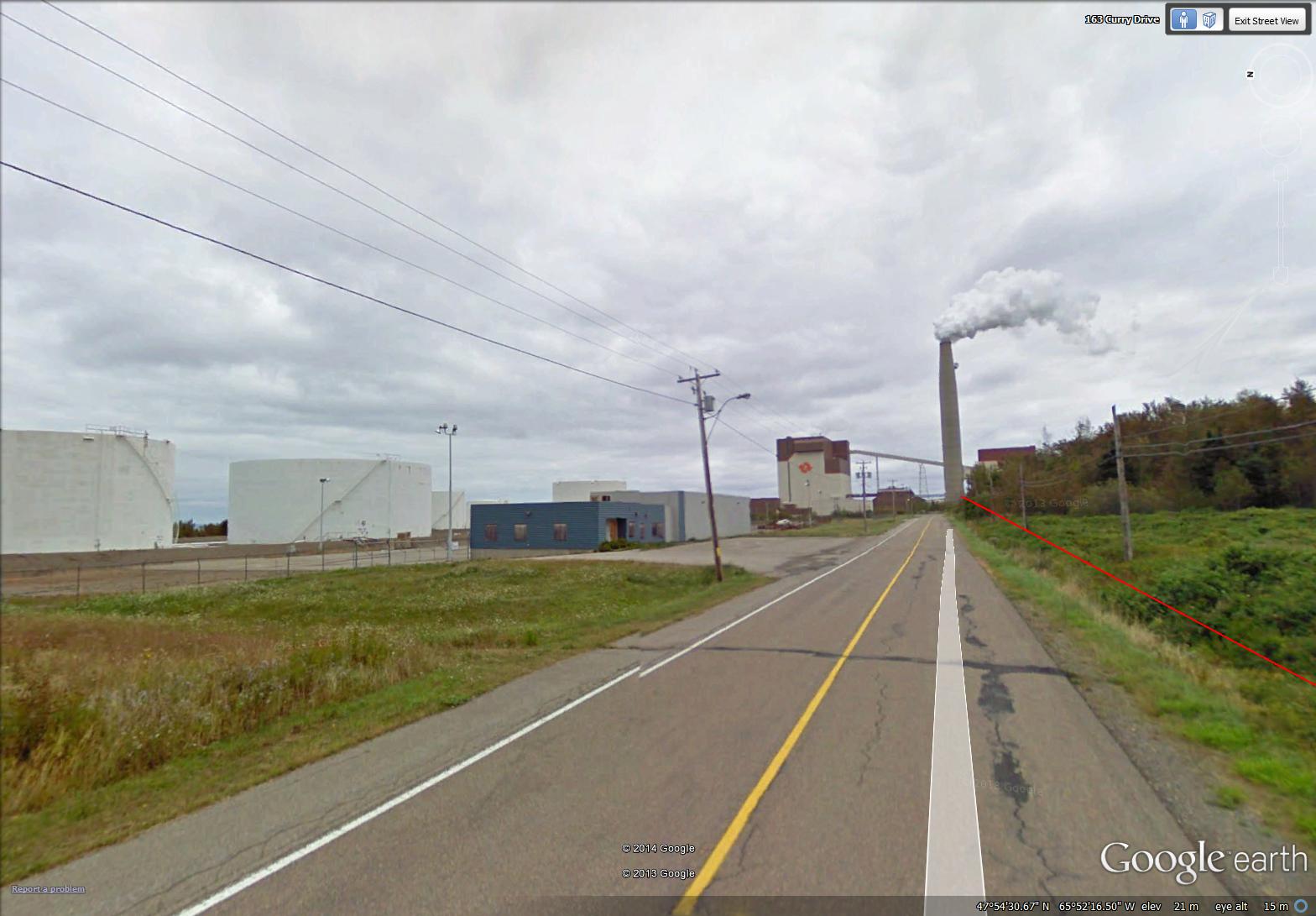
and the location of the Belledune Thermal Generating Station …
~
~
The smelter is a primary lead smelter and refinery. Its air emissions are controlled by various process-specific pollution control equipment including a scrubber and baghouse facilities.
The 450 MW (megawatt) generator burns coal and has a ‘scrubber’ to help remove sulphur dioxide emissions. At the present time, there are only two thermal generating stations still operating in New Brunswick. Most of the rest of our power comes from hydroelectric and nuclear stations; we also have some wind power.
I studied the air emissions of both the thermal generating station and the smelter at Belledune.
~
At first glance, this industrial activity in a mostly rural area may seem out-of-place. However, the smelter and generating station use the Port of Belledune. This is a world-class deep water port in the Baie-des-Chaleurs with year-round cargo handling ability. The port, one of Atlantic Canada’s most successful, offers a gateway to North America.
~
In the midst of all this industrial activity, in my search for paintings to represent my ‘travels’, I chose images of the rural landscape …
~
an old barn with red doors …
~
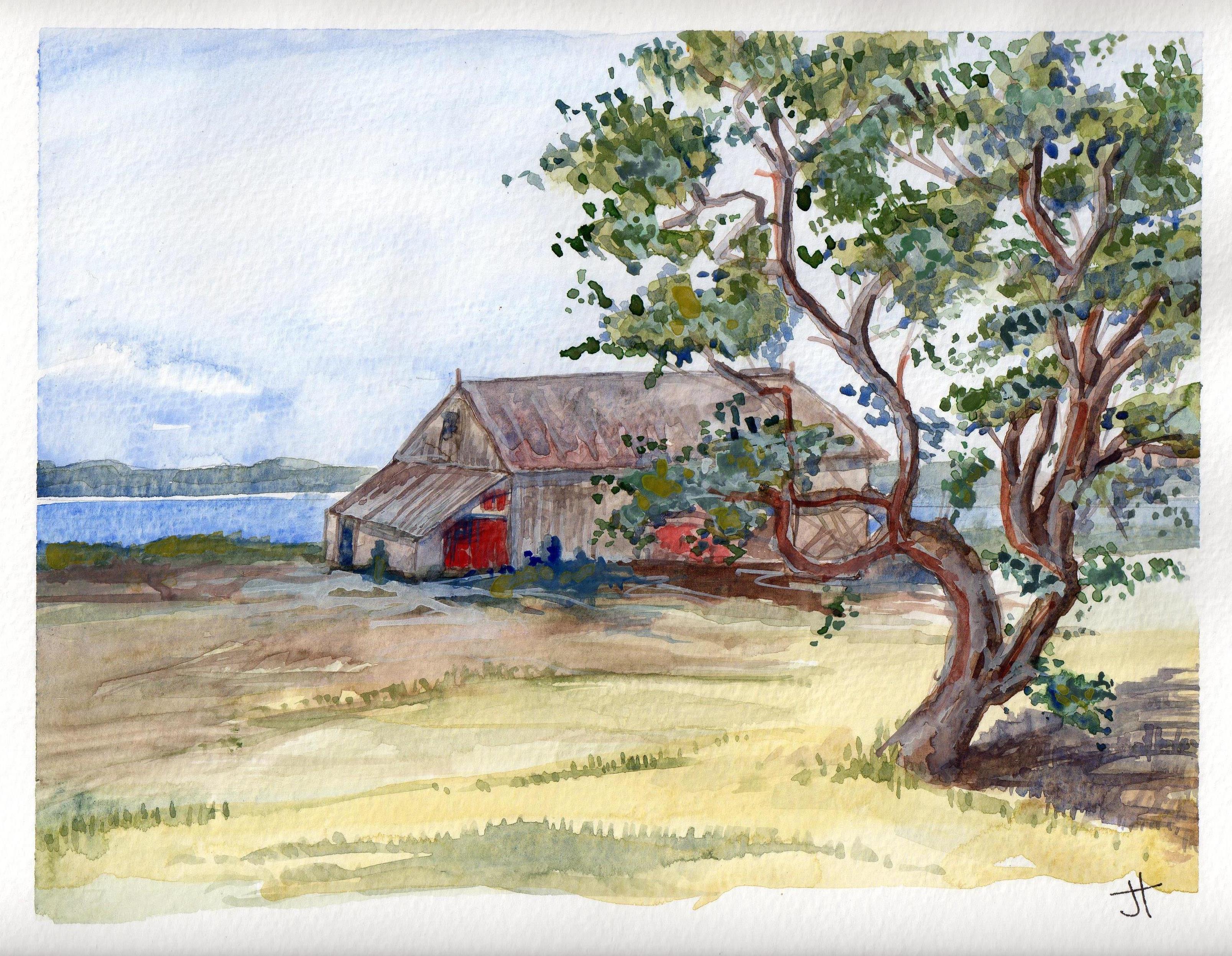
February 21, 2014 ‘barn along the bay’ Jane Tims
~
and a barn near a huge Mountain Ash, its red berries magnificent …
~
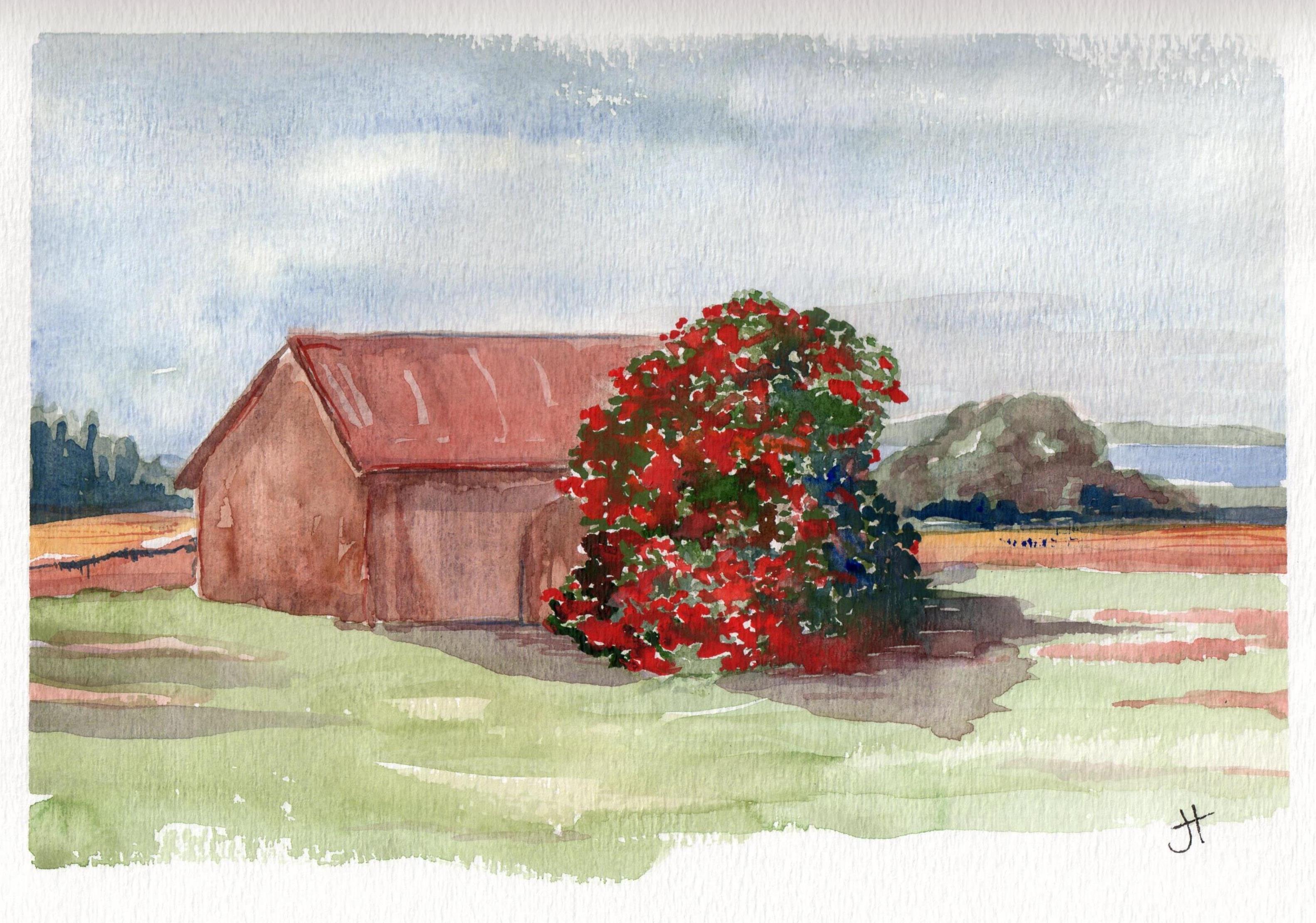
February 22, 2014 ‘red berries – Mountain Ash’ Jane Tims
~
Copyright 2014 Jane Tims
islands and gorges (day 13 and 14)
My virtual bike ride continues with a ride from Blackland to Belledune …
~
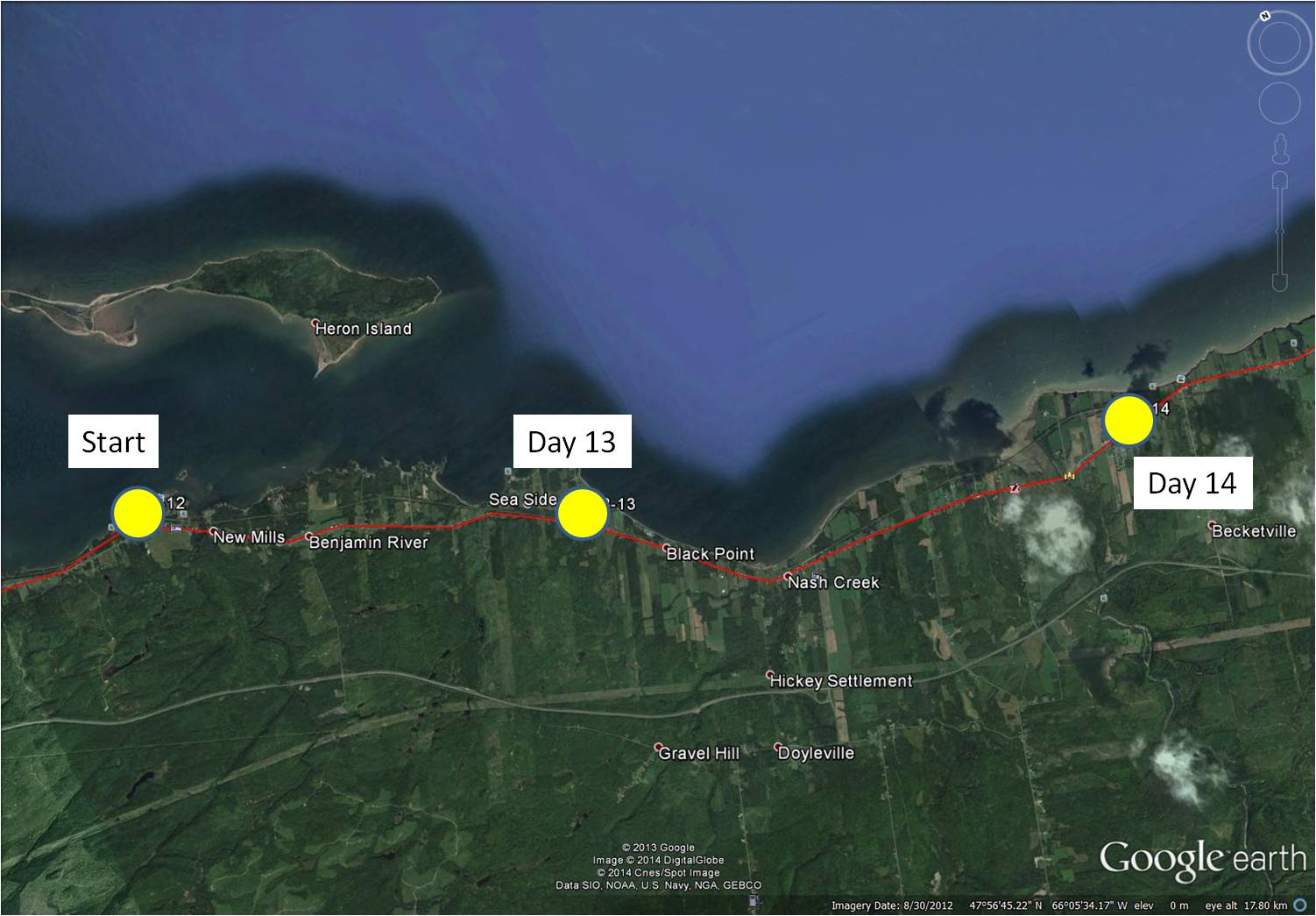
distance travelled (map from Google Earth)
~
8-13 February 5, 2014 20 minutes 3.0 km (Blackland to Sea Side)
8-14 February 8, 2014 35 minutes 7.0 km (Sea Side to west of Belledune)
~
As I have said, I have often visited the area I am ‘biking’ through as part of my past work. In the 1970s and 1980s, we visited many sites in the area to measure the levels of air pollutants in local lichens. We collected lichens of the genus Cladina (reindeer lichens) since they absorb all of their nutrition from the air and air pollutants accumulate in their tissues …
~

species of the lichen ‘Cladina’ grow in tufts on high elevation, rocky areas and in low-lying bogs
~
One of our sampling locations was Heron Island, an island 3.5 km long, lying just off the coast …
~
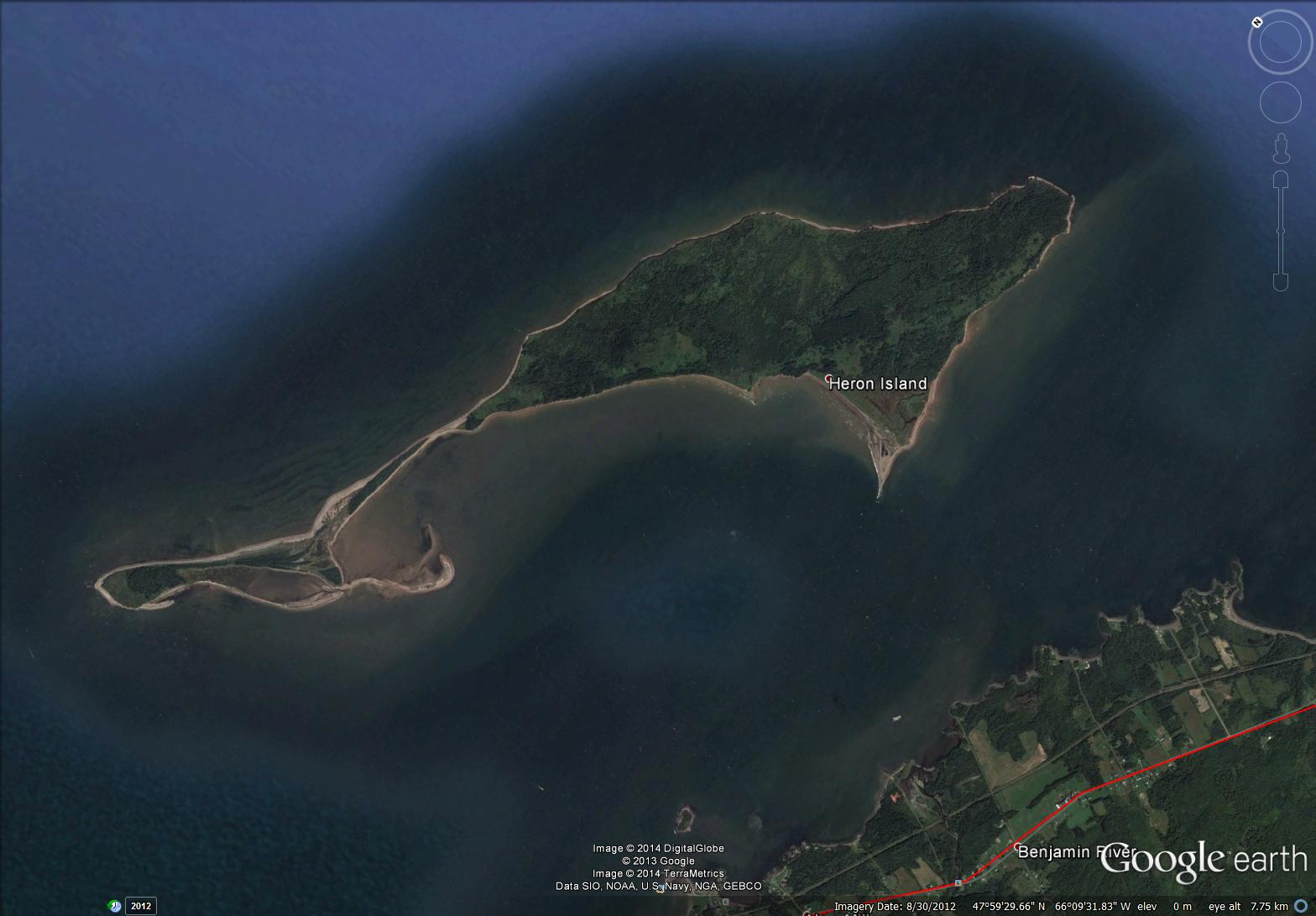
satellite image of Heron Island (map from Google Earth)
~
I have been on the island several times … it was a good place to collect lichens since there are not many local emissions to contaminate the sample (no cars, dusty roads, and so on).
~
The island is a landscape of low-lying salt marsh and beach as well as forested and grown-over old-field areas. On the boat on the way to the island, I remember watching scallop fishermen working on their barges in the shallow waters. Although people have lived on the island as recently as 1940, the island is now protected and co-managed by the provincial government and First Nations peoples who have traditionally used the island as a summer residence.
~
Today’s painting is of a rather stormy day along the bay shore just east of Heron Island …
~

February 11, 2014 ‘Baie des Chaleurs’ Jane Tims
~
Also in the area where I was ‘biking’ is the very hilly landscape of the Jacquet River. The high elevation plateau has been deeply eroded by the Jacquet River – the river and its tributaries flow through deep gorges. The 26,000 hectare ‘Jacquet River Gorge’ is one of New Brunswick’s Protected Natural Areas. Reaching the locations of our lichen collections took us deep into the area and I remember how steep the hills (and the roads) were as we went to our collection sites.
~

February 17, 2014 ‘lower Jacquet River’ Jane Tims
~
Copyright 2014 Jane Tims
a bay and a bar (day 7 to day 10)
Today I am happy to announce – it has been one year since I began my virtual travel, as part of my efforts to exercise and to motivate me to ride my stationary bike more regularly. Although I have really only biked in my tiny exercise room in our basement, I have travelled, with the help of Street View (Google Earth) to central France, to the south coast of Cornwall and, now, to northern New Brunswick. During the past year, I biked 143 days (an average of 30 minutes on each day) and over 530 kilometers. I am so proud of myself!!
~
During the last four days of my virtual biking, I went through the Town of Dalhousie, at the mouth of the Restigouche River. At this point, the river opens into the Bay of Chaleur (la Baie des Chaleur) …
~
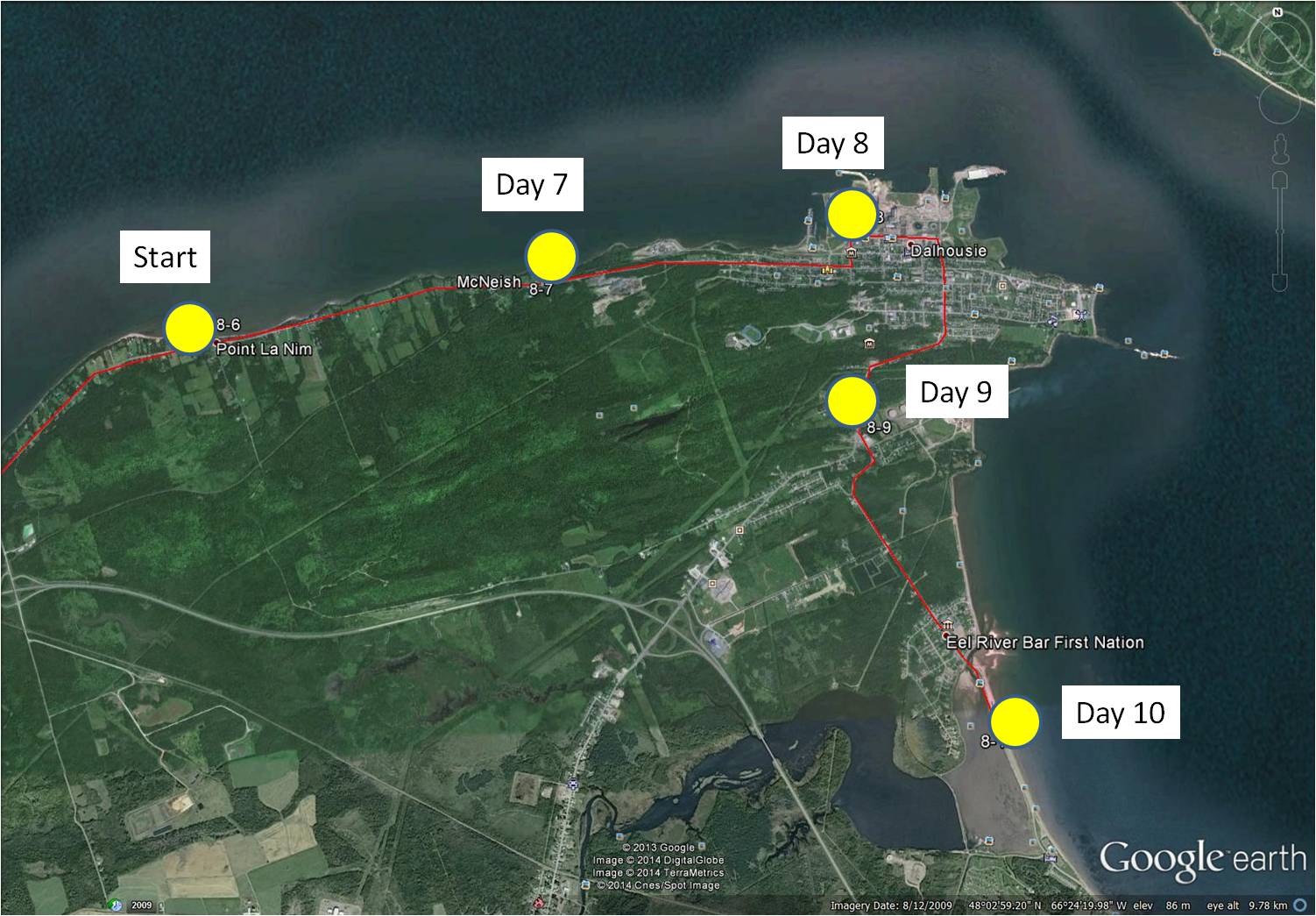
8-7 January 21, 2014 30 minutes 3.0 km (Point La Nim to McNeish)
8-8 January 23, 2014 30 minutes 3.0 km (McNeish to Dalhousie)
8-9 January 25, 2014 30 minutes 3.0 km (Dalhousie to Darlington)
8-10 January 28, 2014 35 minutes 3.0 km (Darlington to Eel River Bar)
~
One of the sights along this part of my journey is the 315 MW power generating station at Dalhousie, once operated by NB Power. This generating station was decommissioned in 2012 but remains interesting to me since I was hired in 1978 to monitor the biological effects of air emissions of the various industries in the Province. One of the reasons I travelled in northern New Brunswick was to carry out a monitoring program to study the effects of the Dalhousie power generating station.
~

Dalhousie power generating station (image by Street View)
~
At the end of my four day ‘virtual travel’ last week, I crossed the beautiful Eel River Bar. This is the location of the Eel River Bar First Nation (Mi’kmaq people). The sandy bar is a barrier beach and one of the longest natural sand bars in the world. Water on one side of the Bar is salt and on the other is fresh. The highway is built directly on the Bar …
~
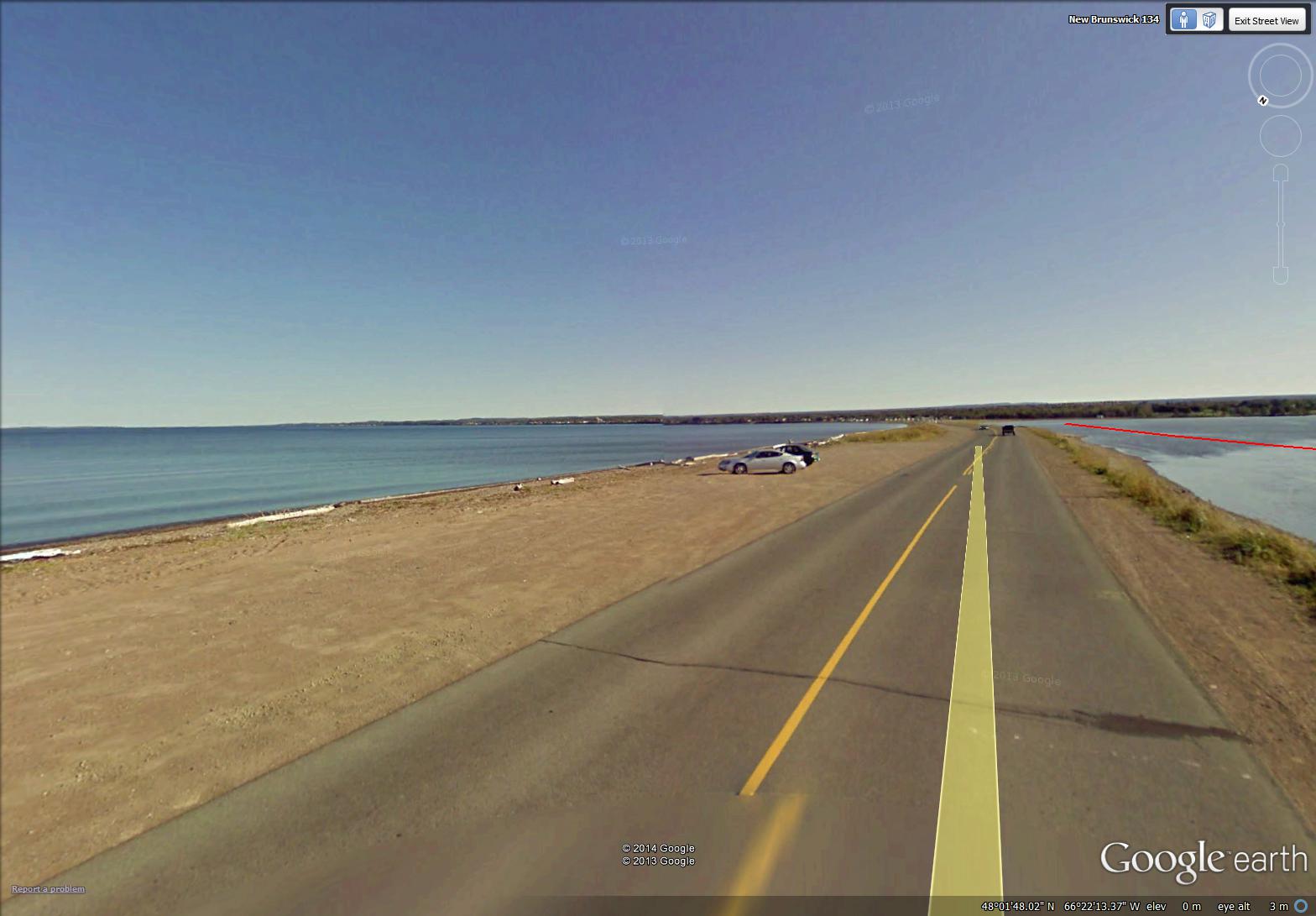
~
Across the Bay from the Bar is the low-lying peninsula of Miguasha, Quebec and the backdrop of the hills and mountains of the Gaspé peninsula. Boats at the entrance to Eel River are tethered as part of a fish netting system …

February 2, 2014 ‘boats at Eel River Bar’ Jane Tims
~
Copyright 2014 Jane Tims
another Cornwall gate
Yesterday, I completed another in the ‘Cornwall gates’ series.
They are fun to find and paint. I have learned this – trying to paint what is just beyond the gate takes away from the mystery!
~

~
Copyright 2014 Jane Tims
walk along a shady lane (day 6)
~
‘Biking’ in northern New Brunswick, I am constantly on the look-out for scenes and themes quintessentially ‘New Brunswick’. And the long lanes leading to homes set back from the road leap out at me …
~
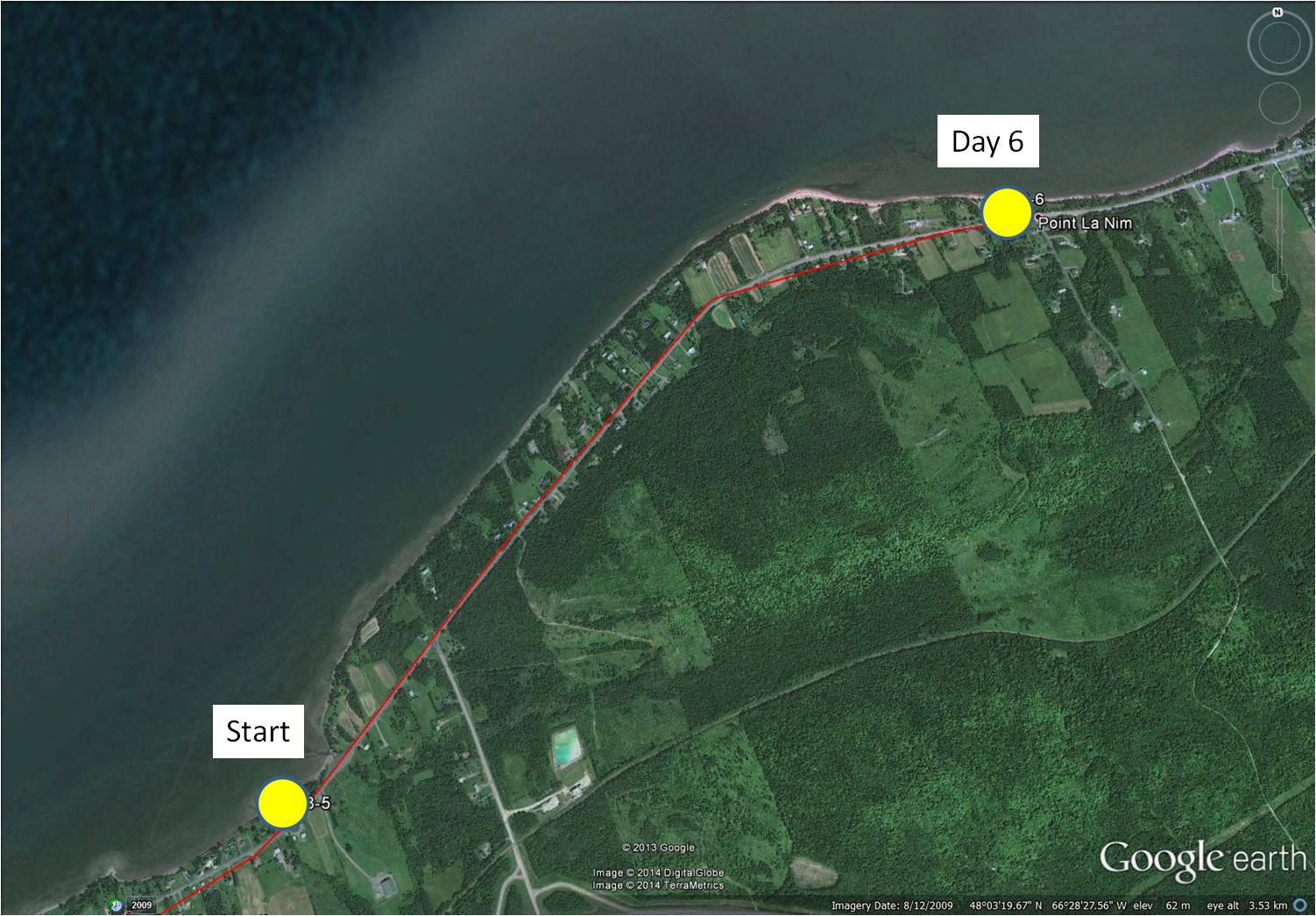
map showing distance travelled (map from Google Earth)
~
8-6 January 16, 2014 30 minutes 3.0 km (Dalhousie Junction to Point La Nim)
~
When I was a kid, I spent hours wandering up and down the long lane at my mother’s ‘old home place’. There were blueberries to pick, a lovely shade, a breeze coaxed from the hot day by the two rows of trees, and a dear silver poplar to turn its leaves in greeting as I approached the elbow of the lane …
~
It’s not the same, of course, without trees, but most lanes show the center grassy strip, flanked on either side by tracks worn by years of cars coming and going …
~

treeless lane along the Restigouche River shore (image from Street View)
~
And sometimes planted trees take the place of the narrow wooded walls of the lane in my memory …
~
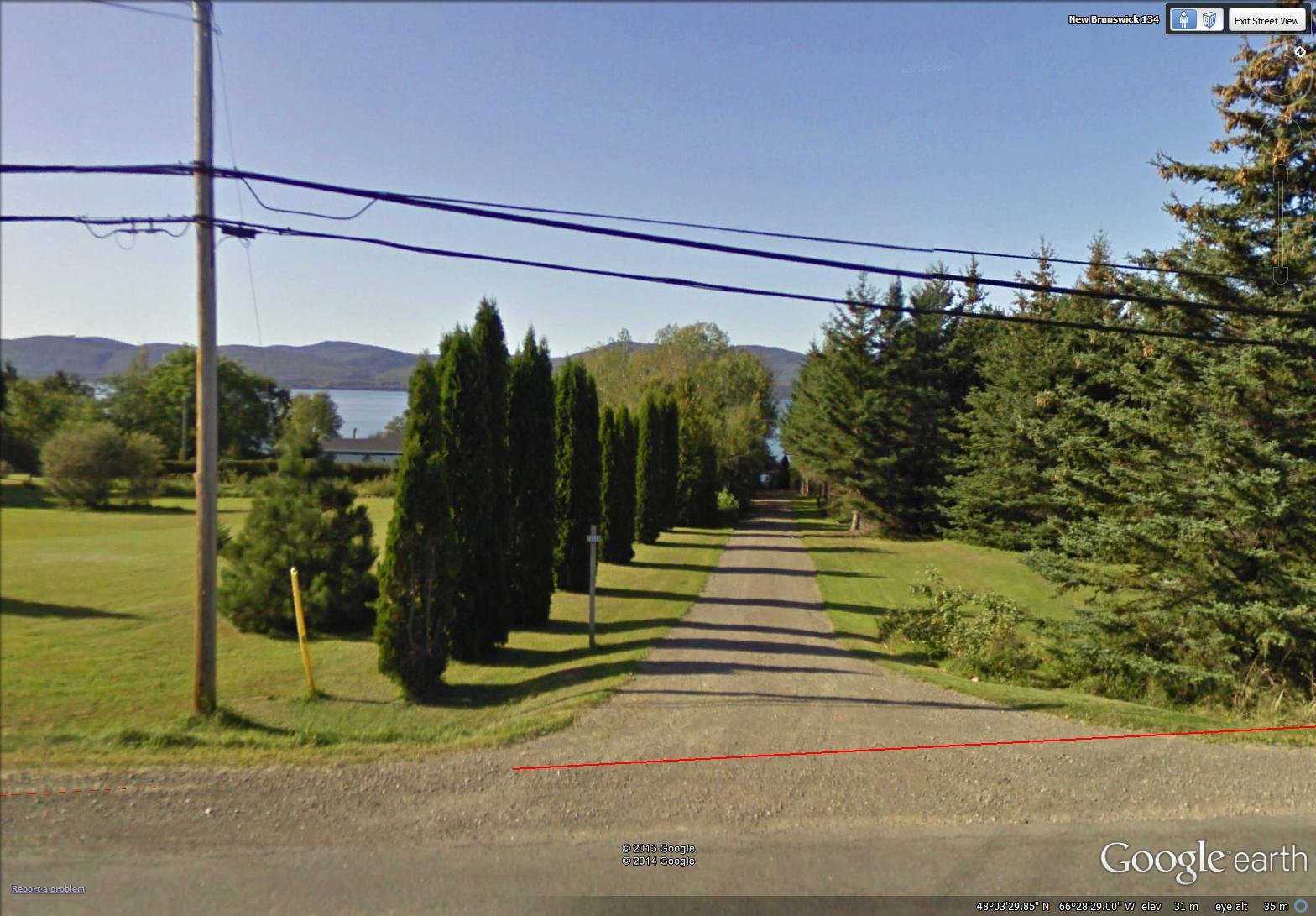
a carefully planted lane (image from Street View)
~
But occasionally, I see a treed lane and I feel like a kid again, eager to go wandering …
~
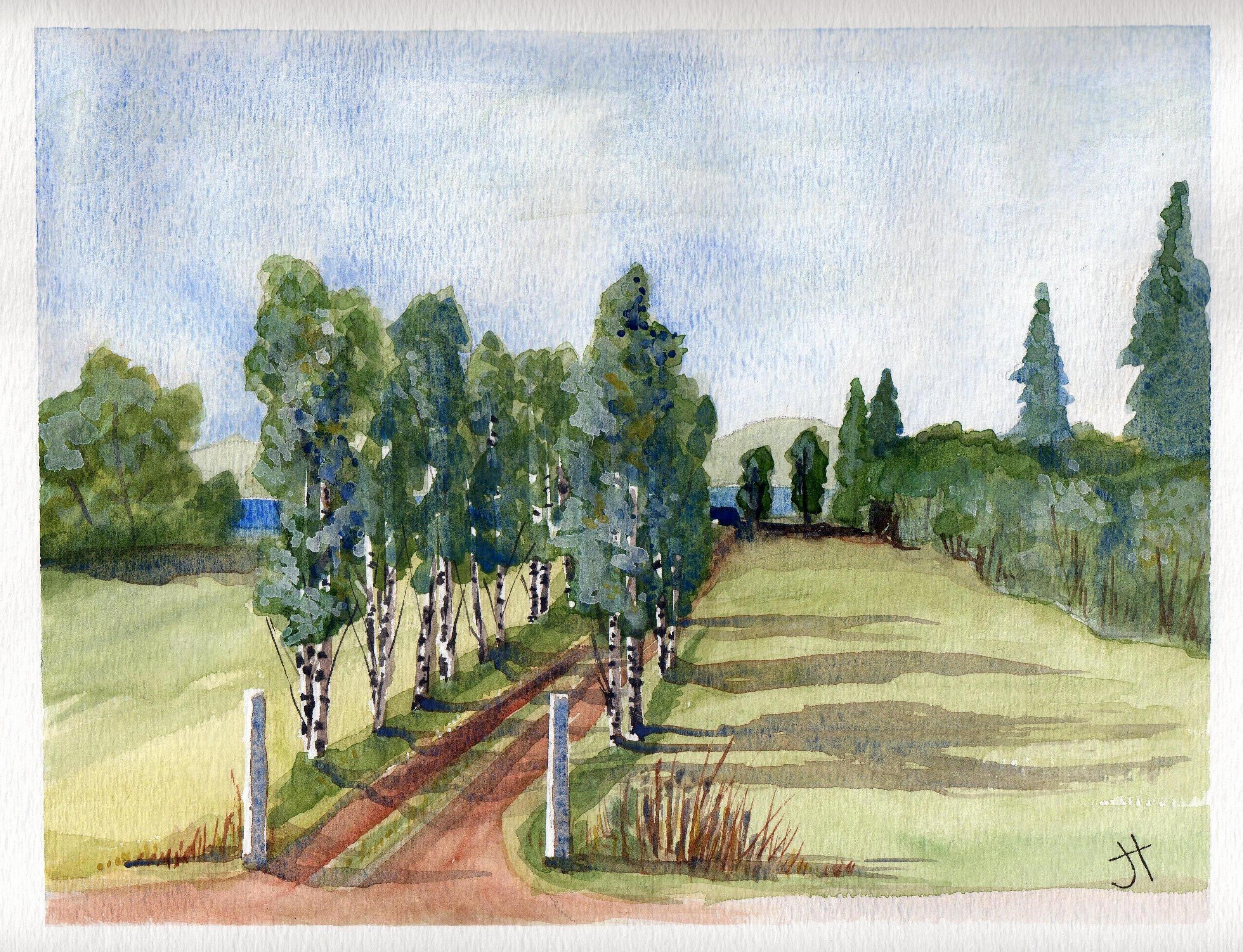
January 21, 2014 ‘lane’ Jane Tims
~
Copyright 2014 Jane Tims
Cornwall gates
~
Among the paintings I did during my virtual cycling trip along the Cornwall coast are a few on the theme of gates and entryways …
~
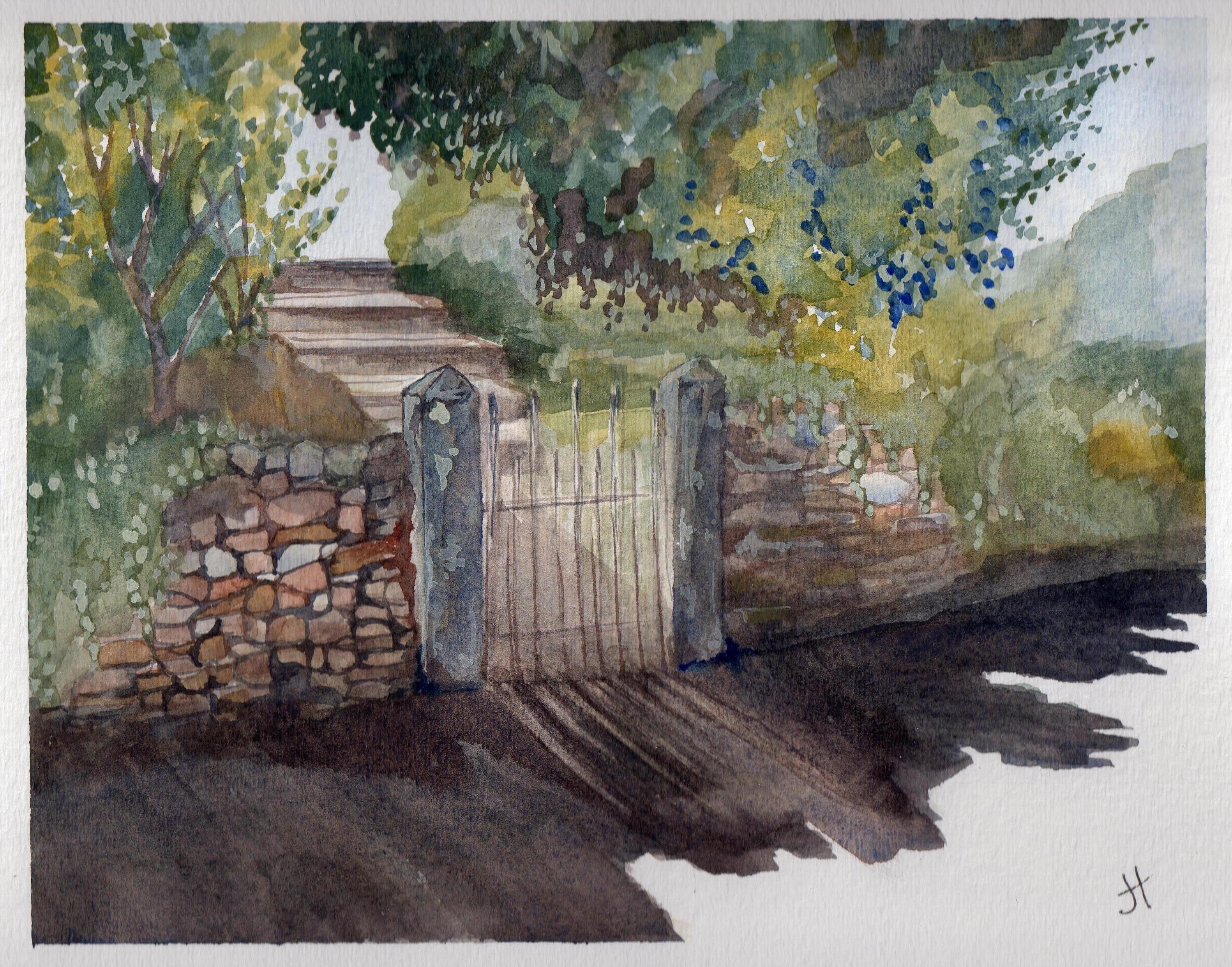
September 14, 2013 ‘afternoon by the gate’ Jane Tims
~

October 24, 2013 ‘ gate on Old Church Road’ Jane Tims
~

January 9, 2014 ‘gate in Falmouth’ Jane Tims
~

January 10, 2014 ‘rainbow gate in Falmouth’ Jane Tims
~

January 12, 2014 ‘red gate’ Jane Tims
~
Gates are symbolic of so many things. They represent any portal into a new place, a new life, a new adventure. We know what is on this side of the gate. We may not know what we will find when we open the gate and step through.
This week, I am stepping through a gate, by taking the first step toward showing my paintings to the general public. I have submitted one of my ‘gate’ paintings (‘rainbow gate in Falmouth’), for showing and sale, to Isaac’s Way at 649 Queen Street in Fredericton, New Brunswick.
~
Isaac’s Way is a fine dining restaurant as well as an art gallery. Since 2007, they have held 19 showings and auctions of the work of local artists. Paintings are shown in the restaurant and sold by silent auction. A large part of the money raised from the sale of the paintings goes to sponsor a charity. The auction ending January 26, for example, will go to help enable underprivileged children to take winter music lessons. For more information and for a look at the art in the most recent showing (ending January 26th, 2014 at 9:00 PM) go to http://isaacsway.ca/art/
~
If you are in the Fredericton area, I encourage you to visit Isaac’s Way, to see the paintings and enjoy the comfortable atmosphere and delicious menu items.
~
Copyright 2014 Jane Tims




 nichepoetryandprose