Posts Tagged ‘tide’
limits of the tide #1 – edible plants
Last week, our travels took us to the edge of the sea, where I looked for more edible wild plants. I found what I was looking for at Oak Bay, near St. Stephen. At the end of a little-used road, we came out on a gravelly spit of land jutting into the Bay.

mid-tide at Oak Bay… at high tide, most of the foreshore will be covered by salt water… at low tide, the clam-flats will be exposed
There, on the shoreline, were four plants to add to my larder of edible wild.
Three of the species formed a small community near the upper reaches of the shore: Seaside Plantain, Sea-blite and Samphire. All three are in the photo below… can you find them?

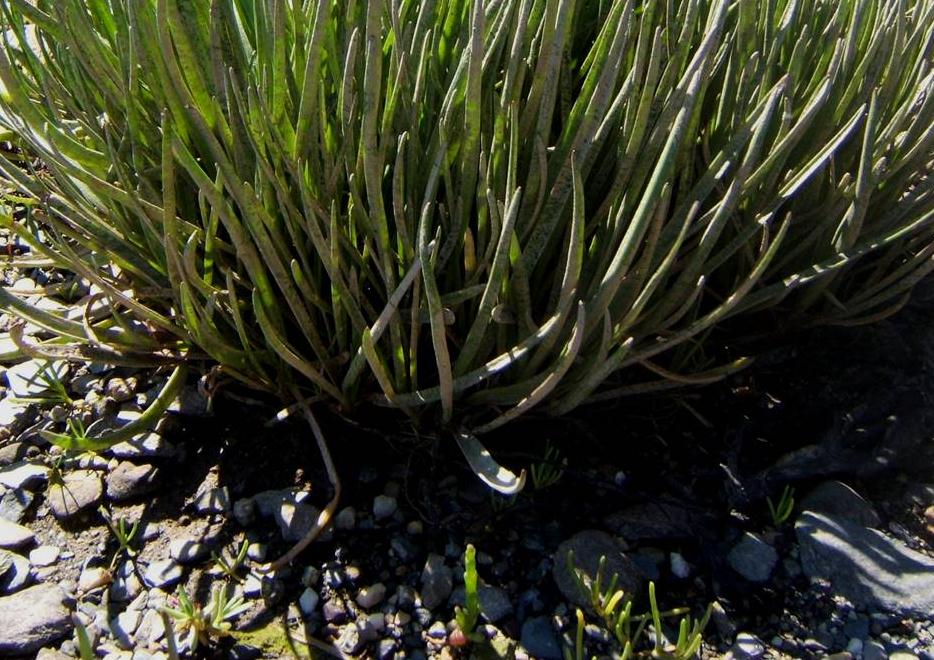
The Seaside Plantain (also known as Goosetongue) is the dense clump of long, thick, linear leaves in the photo above…
The Sea-blite is just starting to grow. Later in the season it will be as large or larger than the Seaside Plantain. In the enlargement below, Sea-blite is the small green plant to the right of the clump of Seaside Plantain…

The Samphire is also very small this time of year. Later it will be as large as the Sea-blite or Seaside Plantain. In the photo enlargement below, it is at the base of the clump of Seaside Plantain, at exactly 6 o’clock.
The fourth edible plant at Oak Bay is Orach. It grows on the upper shore, above the Seaside Plantain and beyond the limit of the tide. These plants often grow together along the coast, on salt marshes, tidal flats, dykelands and beaches.

Since the plants were not plentiful and not yet ready to pick, I took only one plant of each, for my drawings. I also took a bite of each type of leaf. Although there are subtle differences, all four were crisp and salty in flavour, a delightful nibble of the salty sea.
These are just a few of the edible plants living in coastal areas of New Brunswick. Over the next posts, I will explore these four species and a few others.
© Jane Tims 2012
Warning: 1. never eat any plant if you are not absolutely certain of the identification; 2. never eat any plant if you have personal sensitivities, including allergies, to certain plants or their derivatives; 3. never eat any plant unless you have checked several sources to verify the edibility of the plant.exploring the intertidal zone
Every summer, we take a day to drive along the Bay of Fundy and explore some of the beaches and rocky shores. Last summer, we found a small cove where the fog was just lifting.
Through the mist we could see the ghostly form of a fishing weir and the distant rugged shore.

a cove along the Bay of Fundy coast
The beach was pebbles and sand, perfect for beach-combing. We wandered at random, watching for sea glass, shells and wave-smoothed rocks.
The intertidal area, between low and high tide, is an extraordinary space, not quite ocean, not quite land. The plants and animals who live in this area have very particular ‘niche-needs’. They need the rise and fall of the tide twice daily. Some plants have adaptations to help them cope with changing conditions. For example, the brown algae Ascophyllum nodosum has bladders to help it float at high tide and reach the sunlight.
When we explored the cove, it was low tide. Where the sea water was trapped among the rocks, there were tidal pools, small natural aquariums of sea life. One rock with a large hollow in its surface had its own population of bladder wrack (Fucus vesiculosis), green algae (Enteromorpha), barnacles, and a lone crab.
The barnacles are fun to watch. They are crustaceans, and live with their shells securely attatched to the substrate. An opening in the top of the shell is covered by a pair of ‘sliding doors’ called the operculum. Under water, the operculum opens and the barnacle reaches out with modified legs, designed to capture its food. The legs, known as cirri, look like feathery fingers, reaching out and pulling back, reaching out and pulling back.
The ‘niche’ of a particular plant or animal can be thought of as its ‘occupation’ in the space where it lives. For example, with respect to food gathering, the crab feeds on the larger prey in the pool, the barnacles filter out the smallest creatures, and the algae take in their nutrients from the water itself. Although they live in the same space, the crab, barnacles and algae each occupy a different ‘niche’.

one of the smallest tidal pools ever... in the hollow of a rock
Deep Cove detail
low tide
weirs and dories indistinct
pillars of fog
glide up the long beach
attention to
drifts of mica
periwinkle paths
breaking bands of wave
water kicked into rainbows
sunlight above the fog
plover tracks sprinkled on sand
cobbles, coloured glass
float ropes, plastic pink
rockweed
plaited by the sea
© Jane Tims





 nichepoetryandprose