Posts Tagged ‘snow’
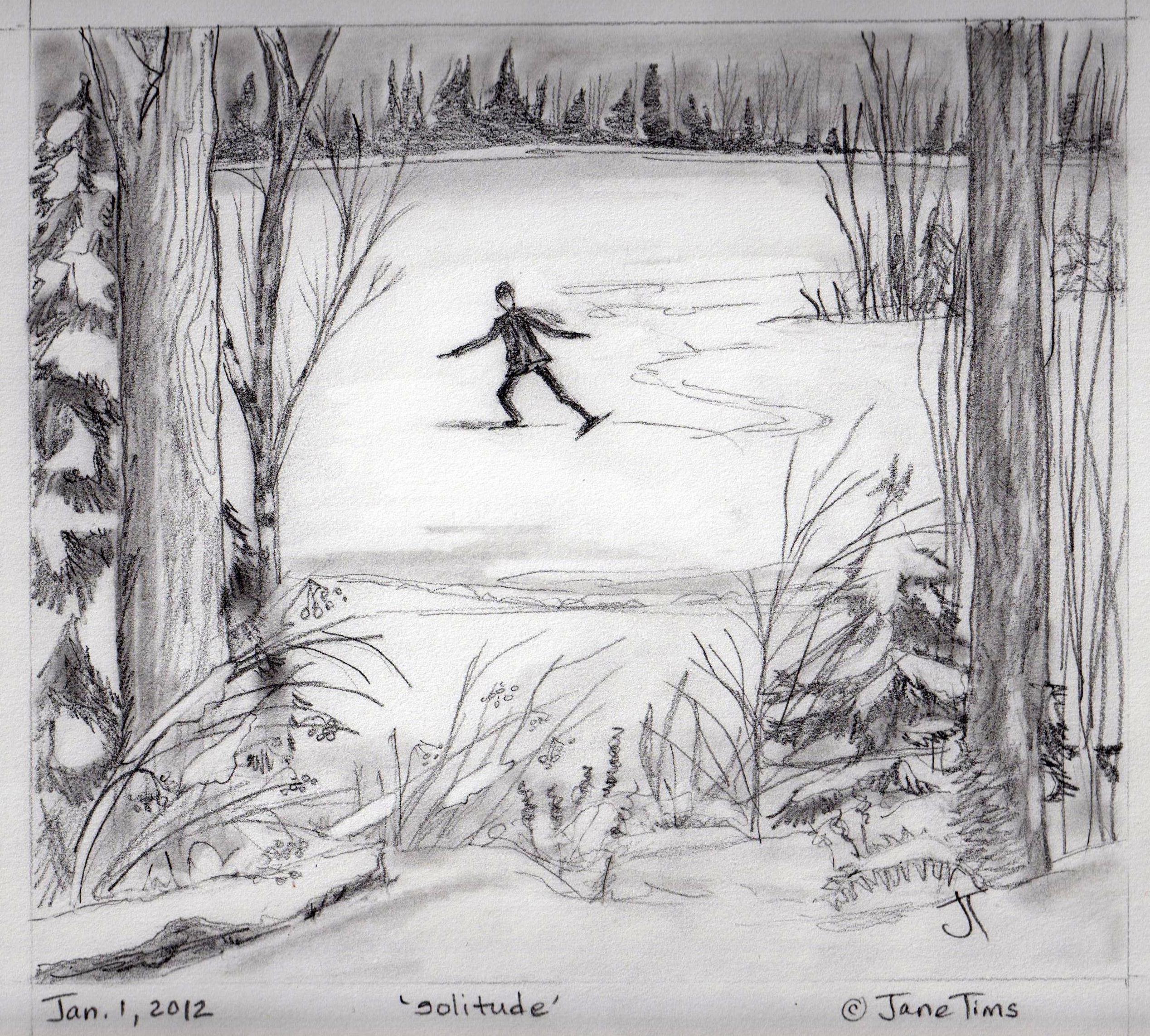
the skater
One winter day in the early 1970’s, I took a walk, alone, down to the shore of one of the chain of lakes extending from Dartmouth to Fall River in Nova Scotia. Near the edge of the lake, I sat down on a log to watch the snow fall. As I sat there, I had a memorable experience. A lone skater, on racing blades, skated into the cove. He had no idea I was there and skated with the abandon of solitude. This event remains unique in my experience and will always be one of the loveliest happenings of my life.
~
~
solitudes
~
shortest hour
shortest day
hike to the lake
on the rail line
~
stunted stride
grey rails
grey sky
blue mittens
~
2.
the cove is a glimpse
between branches
birch and maple support the sky
expectant with snow
~
I wiggle to warm
a place on a log
to watch
snowflakes like mayflies
~
bark cracks
twigs snap
mittens, knees and elbows
tucked
~
3.
the cove is an oh!
of unspoilt ice, black
smooth, bound
by ice-skinned cobbles
~
last summer I turned one
found a salamander, red as berries, crushed
beneath the weight of air
skin panting in dapples of sun
~
today all colour is trapped
in the droop of high bush cranberries
fat sickles of ice
and the electric blue of mittens
~
the snow sifts down
I lift my mitt to catch a flake
clings to the wool, white jigsaw
puzzles with atmospheres between
~
dark ice dwindles
~
4.
a cymbal rings on heavy air
not the crack of hardened bark
but the ring of steel, the scratch
ice shaved by a metal edge
~
a lone man skates
round the curve of the shore
long-limbed as a spider he strides
on racing blades
stretches his arms
~
turns one toe and leans, a compass
marks a circle on the empty page
three quick strides and a figure
he touches a hand to ice
to steady the turn
~
alone, he dances
and I am nothing
a stump, bent vibernum
berries under snow
~
neither breath nor mittened hands
only eyes, watching
and in a while
closed
~
5.
fines of snow
ease the heavy sky
the trees lean
the skater gone, the cove unwritten
~
white on the lake, the shore
the tree bark
the berries
even the mittens, white
~
~
© Jane Tims 2000
snowdrift
Wind is not visible, yet we can describe the shape of the wind. Along the shores of our lakes, White Pines are wind-blown into irregular forms to show the direction of the prevailing wind. In my poem ‘Clear Lake’ (see the post for August 26, 2011, ‘deep waters – Clear Lake’ under the category ‘waterways’), I describe these as “group of seven trees/ flung southward”. Artists from the Group of Seven were famous for their depiction of this symbol of the Canadian wilderness. A good example is the painting ‘White Pine’ by A.J. Casson.
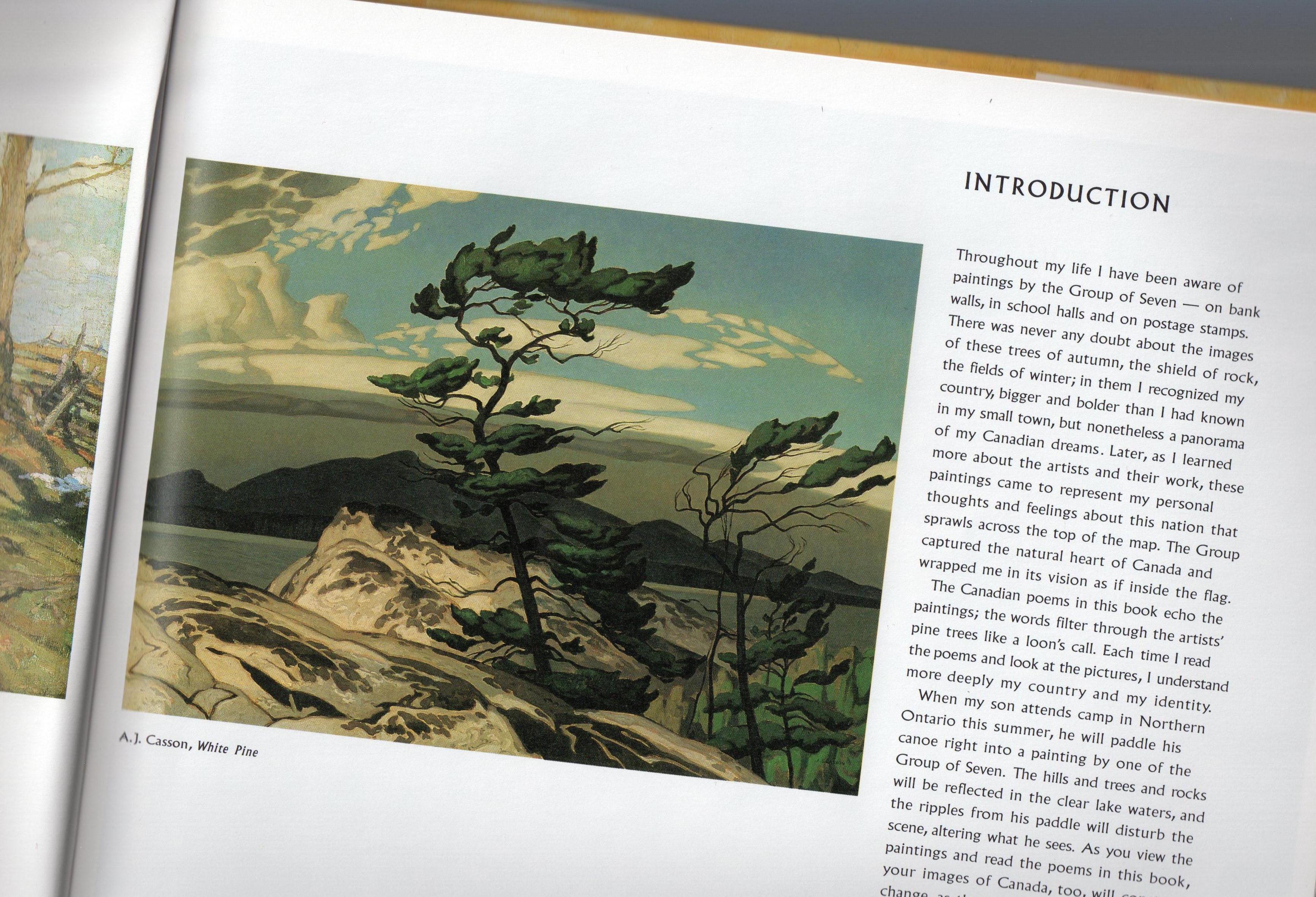
'White Pine' by A.J. Casson, from the book 'Images of Nature: Canadian Poets and the Group of Seven' compiled by David Booth, Kids Can Press, Toronto, 1995.
In winter, the shape of the snow also captures the three dimensional form of the wind. The easiest manifestation of this is the way horizontal surfaces record the direction of blowing snow.

Snowdrifts form as the wind blows quantities of snow into shapes resembling dunes of sand. As kids on the prairie, we loved these snowdrifts since we could tunnel in them and build fantastic snow shelters. Today, I can watch the drifts build across our lawn and transform its flat surface into the artistry of the wind.
~
~
Drift
~
after the storm
snow heaps
high against the wall
fingers of the wind sculpt
etch shadows
into vacant white
~
sunshine flashes
summons prisms
from hollows of snow
warmth shivers through the drift
crystal
into cataract
~
a tendril of snow
clings
damply to the wall
a lingering winter ivy
~
~
Published as: ‘Drift’, 1994, The Cormorant (Fall 1994) XI (1)
revised
© Jane Tims 2011

Northern White Violet (Viola pallens (Banks) Brainerd.)
Yesterday, we had our first dusting of snow and it persisted on the grass until the evening. It reminded me of some of those low white summer flowers whose petals look like snow when they bloom in masses on the lawn or in a field. In any season, the sight of ‘snow’ can be a charming, welcome sight.
The northern white violet, or small white violet (Viola pallens (Banks) Brainerd.) inhabits the moist ground of meadows, bogs and thickets, and it blooms profusely on our front lawn. Pallens means pale, referring to the color of the flowers. The leaves are somewhat heart-shaped.
The violets are a difficult group, taxonomically. Viola pallens is also known as Viola macloskeyi Lloyd.
Northern White Violet
Viola pallens (Banks) Brainerd.
~
stars in the northern meadow
scattered at the feet
of cattle grazing hay
violet sweet
~
hearts among the grasses
where the ground is wet
flowers pale and nodding
small white violet
~
Published as: ‘Northern White Violet’, April 2005, Refuge 14 (1)
© Jane Tims 2005




 nichepoetryandprose