Posts Tagged ‘salt’
limits of the tide #5 – Samphire (Salicornia europaea L.)
A beach-comber this time of year may easily over-look plants of Samphire (Salicornia europaea L.), also called Glasswort, Pigeon-foot, and Chicken-claws. Unless it is plentiful, it becomes lost ‘in the green’ of other sea-shore plants. The genus name, Salicornia, comes from the words sal meaning salt and cornu meaning horn. These plants consist of a branched, succulent stem, apparently without leaves or flowers. The leaves and tiny flowers are embedded in the stem.

Although Salicornia is typically a plant of coastal areas, like Sea-blite, it is also found far from the coast, in the vicinity of inland salt springs.
Samphire greens are salty, delicious as a salad ingredient, a pickle, or a pot-herb.
~
~
salt of the sea
Samphire ( Salicornia europaea L.)
~
Salicornia smoulders
on a silica shore,
flute and fire
~
Glass pipes,
mainstem and branches,
pickle green
~
Light glimpsed
through crystalline,
transparent walls
~
Seawater, rarefied,
decanted
to a Samphire phial
~
Flask of salt-sap,
brine on the tongue
Always wanting more
~
~
© Jane Tims 2012
Warning: 1. never eat any plant if you are not absolutely certain of the identification; 2. never eat any plant if you have personal sensitivities, including allergies, to certain plants or their derivatives; 3. never eat any plant unless you have checked several sources to verify the edibility of the plant.limits of the tide #1 – edible plants
Last week, our travels took us to the edge of the sea, where I looked for more edible wild plants. I found what I was looking for at Oak Bay, near St. Stephen. At the end of a little-used road, we came out on a gravelly spit of land jutting into the Bay.

mid-tide at Oak Bay… at high tide, most of the foreshore will be covered by salt water… at low tide, the clam-flats will be exposed
There, on the shoreline, were four plants to add to my larder of edible wild.
Three of the species formed a small community near the upper reaches of the shore: Seaside Plantain, Sea-blite and Samphire. All three are in the photo below… can you find them?

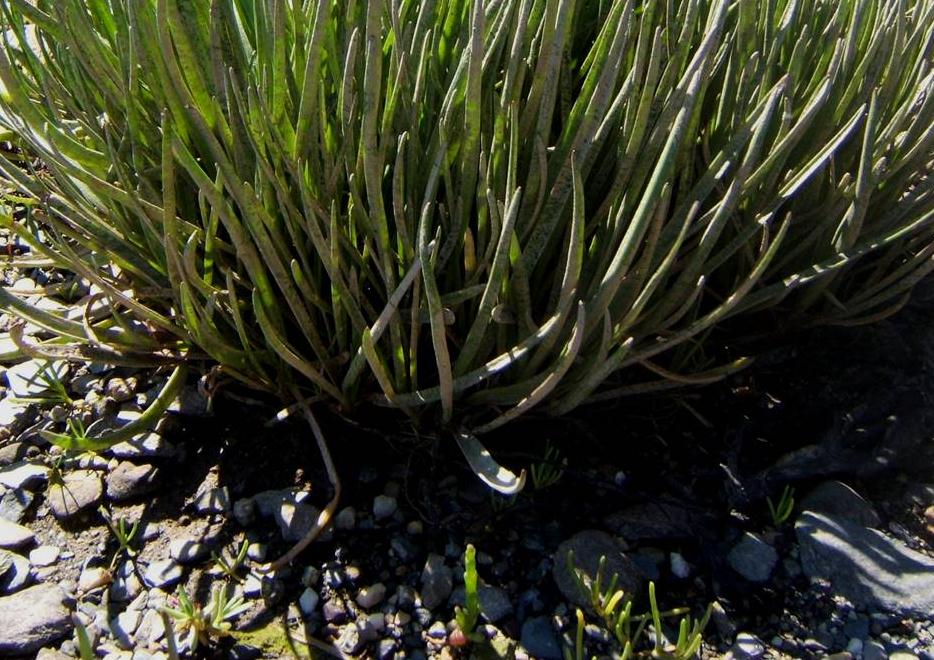
The Seaside Plantain (also known as Goosetongue) is the dense clump of long, thick, linear leaves in the photo above…
The Sea-blite is just starting to grow. Later in the season it will be as large or larger than the Seaside Plantain. In the enlargement below, Sea-blite is the small green plant to the right of the clump of Seaside Plantain…

The Samphire is also very small this time of year. Later it will be as large as the Sea-blite or Seaside Plantain. In the photo enlargement below, it is at the base of the clump of Seaside Plantain, at exactly 6 o’clock.
The fourth edible plant at Oak Bay is Orach. It grows on the upper shore, above the Seaside Plantain and beyond the limit of the tide. These plants often grow together along the coast, on salt marshes, tidal flats, dykelands and beaches.

Since the plants were not plentiful and not yet ready to pick, I took only one plant of each, for my drawings. I also took a bite of each type of leaf. Although there are subtle differences, all four were crisp and salty in flavour, a delightful nibble of the salty sea.
These are just a few of the edible plants living in coastal areas of New Brunswick. Over the next posts, I will explore these four species and a few others.
© Jane Tims 2012
Warning: 1. never eat any plant if you are not absolutely certain of the identification; 2. never eat any plant if you have personal sensitivities, including allergies, to certain plants or their derivatives; 3. never eat any plant unless you have checked several sources to verify the edibility of the plant.




 nichepoetryandprose