Posts Tagged ‘pencil drawing’
in the shelter of the covered bridge
 ~
~
in the shelter of the covered bridge
by Jane Spavold Tims
poetry with illustrations
Chapel Street Editions 2017
poems about plants and animals living in the vicinity of the covered bridge
~

~
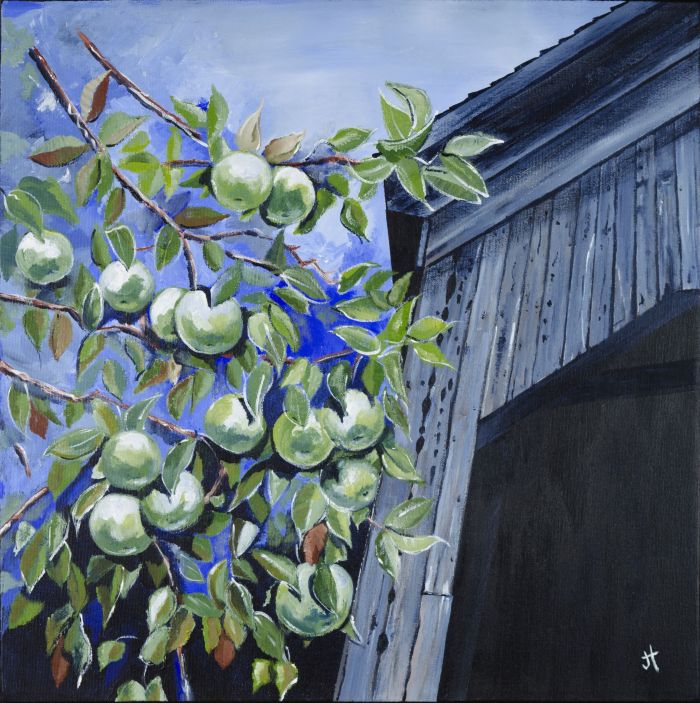
73 poems, 35 bridges, 21 illustrations
~
~
From the Preface:
Where I live in rural New Brunswick, driving through a covered bridge is a daily occurrence. The sounds of the tires on the decking, the glimpses of river and sunlight between boards, the fun of seeing a family fishing and the sight of a groundhog carrying her kit across entryway of the bridge — these are touch-stones for my existence.
The inspiration for this book came in 2015, when my husband and I crossed the Patrick Owens Bridge on the Rusagonis Stream and startled a rabbit in the middle of the span. The rabbit raced through the bridge in front of the truck. I can still see the shadow of his long ears and the scurry of his feet. Since the incident occurred during the February 21, 2015 conjunction of Venus and Mars, with the sickle moon just above the planets, I thought of all the legends about the hare and the moon. This led to the poem “conjunction” and a question about what other plants and animals find shelter in or around our covered bridges in New Brunswick.
My husband and I carried out the field work for the book during 2015. We focused on covered bridges in the entire Saint John River Valley, but we also visited bridges in Charlotte and Westmorland Counties. Travelling around the province, visiting covered bridges and paying special attention to the nearby wild life, was an ideal way to spend a spring and summer in New Brunswick. Some bridges were easy to find, others a challenge. Each bridge contributed its own personality, history and component flora and fauna.
The covered bridge is endangered in New Brunswick. In 1900, there were about 400 covered bridges in the province. By 1944, there were only 320. In 1992, when Glen, Michael and I visited some of the bridges for Canada’s 125th birthday, there were 71. In 2017, as I write this, there are only 60 remaining. Vandalism, flood, accident, fire and age claim more bridges every few years.
~
… In 2018, there are 58 covered bridges remaining …
~
Book available from Chapel Street Editions
~
dry wind
French Village Bridge
Hammond River #2
the bridge leans, upriver
wind enters, a beer can
rolls on the deck
white butterflies obey
the valley breeze
navigate the scent of wild roses
avoid the dogs
cooling off in the river
the beach folk, sunning themselves
bracts of Yellow Rattle
and Silene, inflated bladders
dry as old boards
aspens tremble
a song sparrow stutters
a loose shingle rattles in wind
~
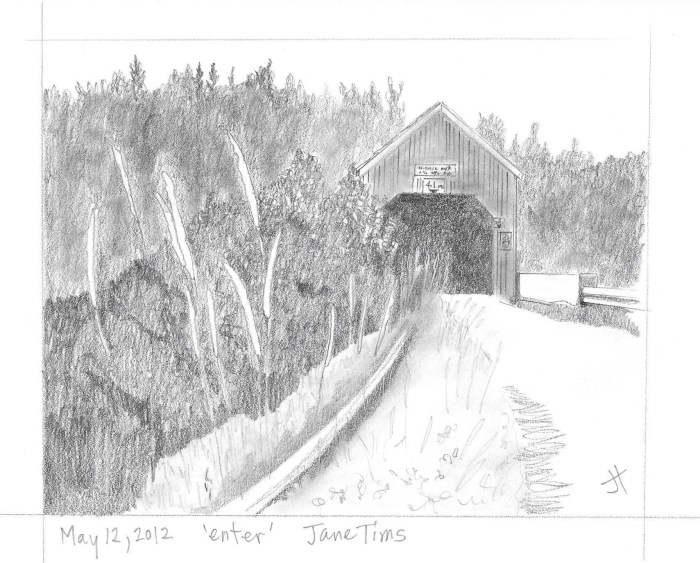
drawing of the French Village Bridge 2015: ‘enter’
~
About the Author
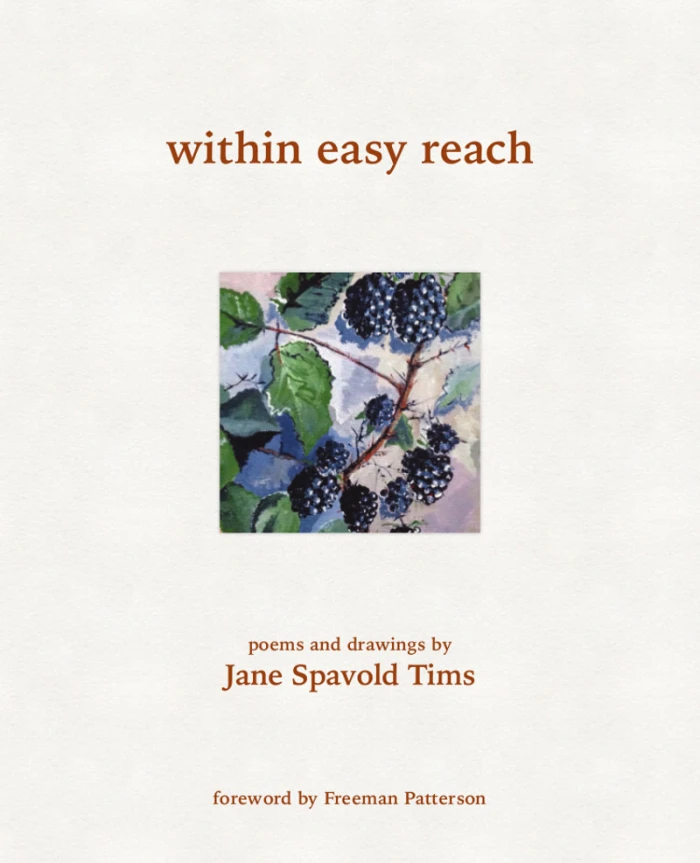
Jane Spavold Tims is a botanist, writer and artist living in rural New Brunswick, Canada. She has published two books of poetry, within easy reach (2106) and in the shelter of the covered bridge (2017), both with Chapel Street Editions, Woodstock. Her first four books in the Meniscus series, Meniscus: Crossing The Churn, Meniscus: One Point Five – Forty Missing Days, Meniscus: South from Sintha and Meniscus: Winter by the Water-climb, were published with CreateSpace in 2017 and 2018 under the name Alexandra Tims. In 2016 she won the Alfred G. Bailey Prize in the Writers’ Federation of New Brunswick Writing Competition for her manuscript of poems about bird calls. She is interested in identifying plants, bird-watching, science fiction and the conservation of built heritage. Her websites feature her drawings, paintings and poetry.
www.janetimsdotcom.wordpress.com
~
~
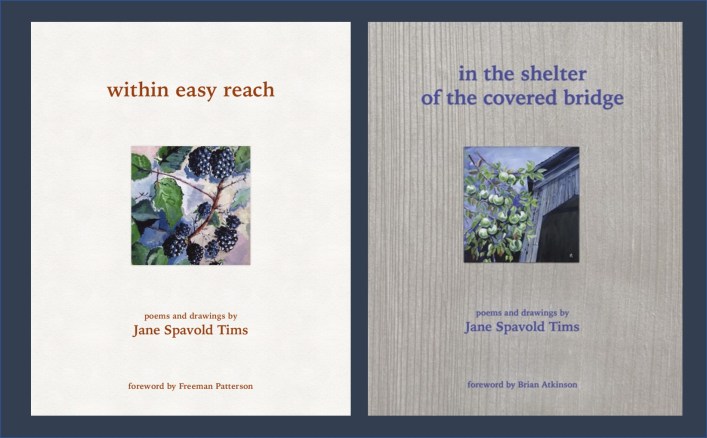
both books available from Chapel Street Editions
~
abandoned buildings
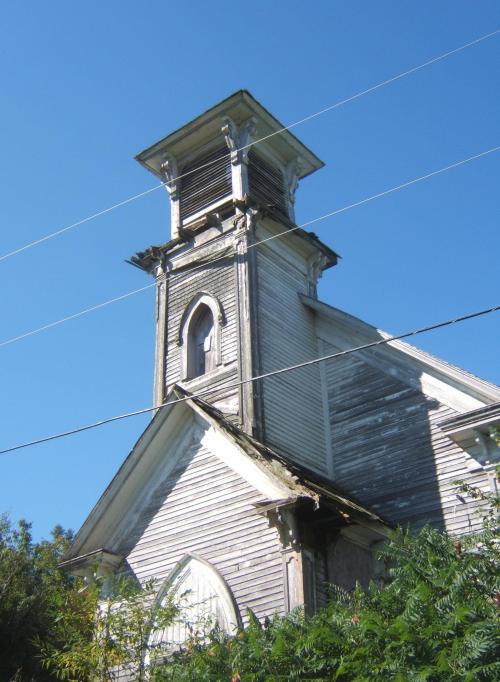
We are living in a time when many of our older buildings are reaching the end of their useful lives. Old churches, old covered bridges, old schools and old houses are everywhere, facing the indignity of old age. So many succumb, end up in landfills or as rotting derelicts. Yet these are buildings where history whispers. Buildings with stories to tell, our stories.
~
~
abandoned church
~
highbush cranberry
first, fruit hard and green
then, red, ready for wine
then shriveled raisins
hang on a leafless vine
~
the wick of a candle stub
competes with cobwebs
for thickness, thin sunlight
oozes, amber glass, a saber
along the empty aisle
threatens motes
in stale air undisturbed
where stray wind never
finds its way
~
deconsecrated and so
not desecrated when mice
squeeze under the threshold
gnaw at the pulpit, or when
vines whisper
vague obscenities
at the lintel, tap on glass
~
stripped of cross and steeple
people, prayers
stained glass and benches
removed and sold at auction
mice pause at their industry
to assess ambiguous whispers
~
the young girl who sat on the stair
sang a song to her mother
the warden who argued to fix
the seep in the roof
the Minister
who stuttered
~

~
~
Copyright Jane Tims 2018
bird feeder visitors – personalities
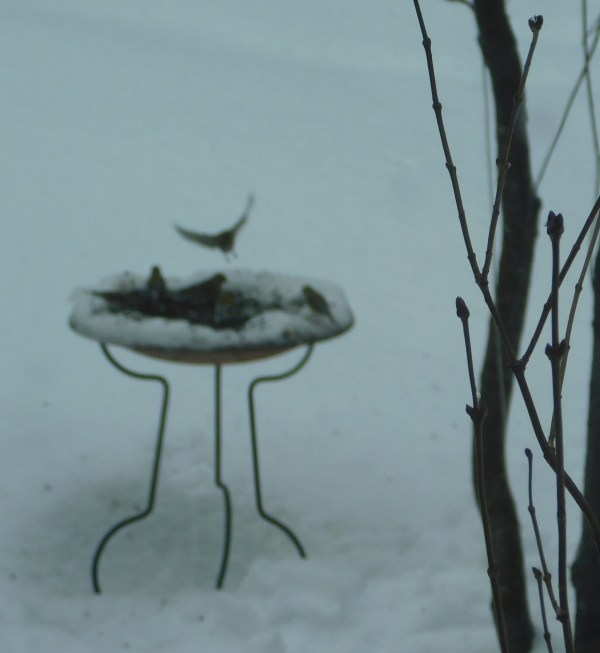
I put my feeders up late this year, but the birds have found them. So far the diversity is low, but the numbers are high. We have chickadees, goldfinches and nuthatches. I know from my bird diary of other years, redpolls, purple finches and blue jays will come later.
~
~
I spend a little time each day watching the birds. And, as in other years, I am amazed at how different are the personalities of these birds.
~

~
Black-capped Chickadee (Poecile atricapillus) – sings ‘chick-a-dee-dee-dee’ or ‘fee-bee’
- the chickadee hoards food, storing food in times of plenty under bits of bark or a patch of lichen. Canada’s Hinterland Who’s Who says a chickadee can remember where it has stored its food up to 28 days.
- the chickadee is a grab and go kind of feeder. They zoom in on a sunflower seed, pick it and leave.
- chickadees hang out in flocks, and have a hierarchy and a ‘pecking order’. The birds are very aggressive with other birds, chasing away other chickadees, nuthatches and goldfinches.
~

~
Red-breasted-Nuthatch (Sitta Canadensis) – sings a nasal ‘yank-yank-yank’ over and over
- the nuthatch walks head-downward after it lands and in Newfoundland is called the ‘upside-down bird’.
- nuthatches are very solitary at the feeder and are easily chased away by chickadees.
- they get-their-food-and-get-going, not hanging around even for a second.
- nuthatches also hoard and hide food.
- Hinterland Who’s Who says these birds carry tree pitch to build their nests!
~

~
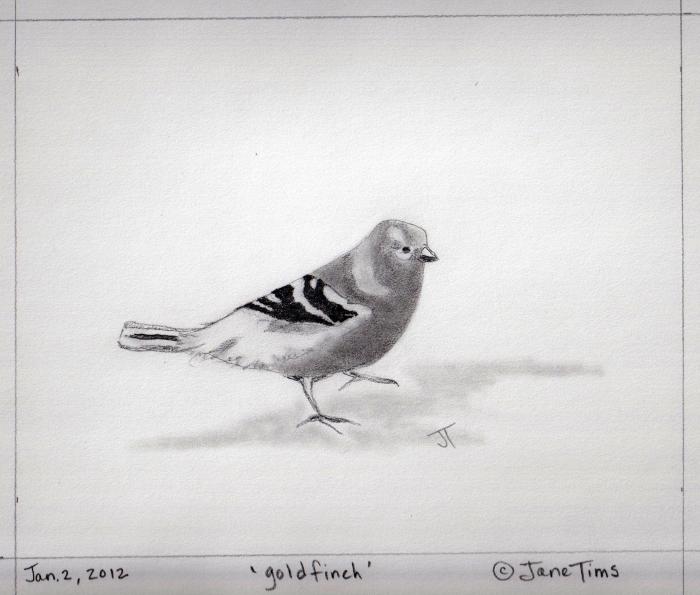
American Goldfinch (Carduelis tristis) – sings ‘perchickoree’ and flies in a series of hanging loops, potato chip, potato chip.
- at this time of year goldfinches are dull olive-yellow.
- they hang out at bird feeders, staying put until they are chased away. They arrive at feeders in flocks and feed quite happily side by side.
- although they eat sunflower seeds, they seem to prefer thistle seed.
- Hinterland Who’s Who says goldfinches go into feeding frenzies before snowstorms, putting on significant weight before times when seeds are scarce.
~
~
Do you feed the birds and what kinds of birds come to your feeders? Do they have distinct personalities?
~
Copyright 2018 Jane Tims
special book offer – in the shelter of the covered bridge
To celebrate my reading at Odd Sundays yesterday, I am selling my book in the shelter of the covered bridge (Chapel Street Editions 2017) at the reduced price of $25 (including postage) from February 16, 2018 until February 28, 2018. If you happen to live in my driving area (within 30 km of Oromocto or Fredericton, New Brunswick), the price for a hand-delivered book is $20. Just email me at timstims@nbnet.nb.ca and we will arrange for payment and delivery.
The book usually sells for $28 so this is a great deal if you love poetry, covered bridges or wild life.
~
in the shelter of the covered bridge is published by Chapel Street Editions (Woodstock) and includes over 70 poems about visits to 54 of New Brunswick’s covered bridges. The book is illustrated with my pencil drawings and has a foreword by Brian Atkinson, a well-known New Brunswick photographer.
~
“… A delightful blend of her poetry and drawings, as well as the natural and cultural history of this province …” Linda Hershey, Moncton Times-Transcript, Nov. 30, 2017, writing about in the shelter of the covered bridge
~
Copyright 2018 Jane Tims
Reading – Odd Sundays – and a special book offer
On Sunday February 18 at 2:00 PM I will be one of two featured readers at Odd Sundays in Fredericton. Wayne Curtis, well-known New Brunswick author, is also featured!
~
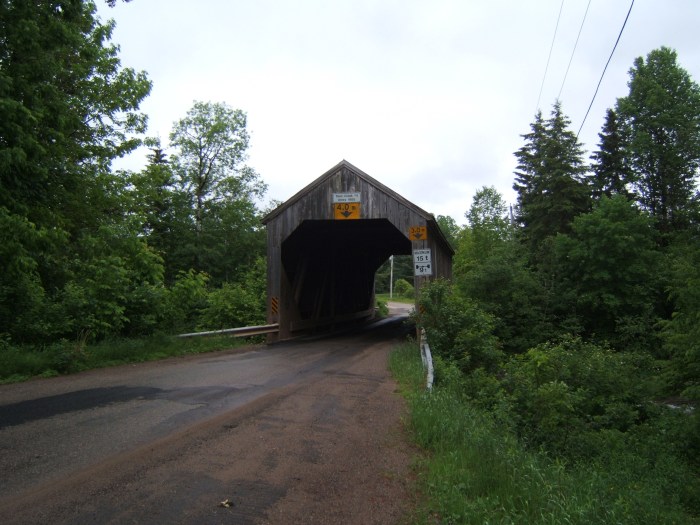
Moores Mills Bridge near Sussex, north entrance, 2015
~
I will be reading from my new poetry book ‘in the shelter of the covered bridge’ (Chapel Street Editions, 2017). If you love covered bridges, you will enjoy my poems. Each one was written after a visit to a particular covered bridge and the poems feature the plants and animals (and humans) who look to the covered bridge for shelter. Some love stories among the lot, since we will be near to Valentine’s Day! The book features my poems and my pencil drawings of some of the plants and animals I encountered.
~
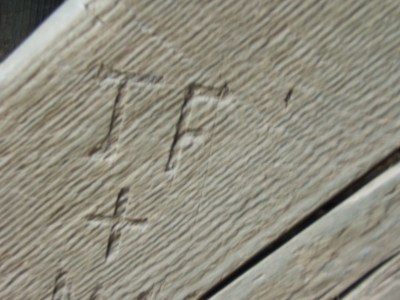
carving inside Moores Mills Bridge near Sussex
~
!!!!!!!!!!!!!!!!!!!!!!!!!!!!!!!!!!!!!!!!!!!!!!!!!!!
As a special deal associated with this event, you can get a copy of the book (which sells for $28) for $25, postage included. Just email me at timstims@nbnet.nb.ca and we will arrange for payment and delivery. This offer last from today February 16, 2018 until February 28, 2018.
!!!!!!!!!!!!!!!!!!!!!!!!!!!!!!!!!!!!!!!!!!!!!!!!!!!
~
~
I hope if you are in the Fredericton area, you will come to hear me read. The event is at Corked on Regent Street in downtown Fredericton. Come and enjoy a beverage and the readings. You may win a book in the draw or decide to read your own work in the open mic segment of the program.
~

Moores Mills Bridge near Sussex, south entrance, 2015
~
Remember to email me and get your own copy of ‘in the shelter of the covered bridge’. Nice gift for someone who loves covered bridges.
~
Copyright 2018 Jane Tims
feeding the birds
I am late this year with putting out bird feeders. Two reasons: the reported difficulty with disease in bird feeders last year and my general lack of time.
~
This morning I made a bird feeder from a coke bottle (my son and I used to do this when he was little) and filled three of our feeders. The old sunflower seed feeders, difficult to clean and too expensive to toss out every few days, are in the trash.
~
Presenting my new home-made feeder for sunflower seeds! I may add a simple roof to keep the snow out. I can replace it at intervals to keep it clean.
~

~
The finch-feeder with nyjer (thistle) seed:
~

~
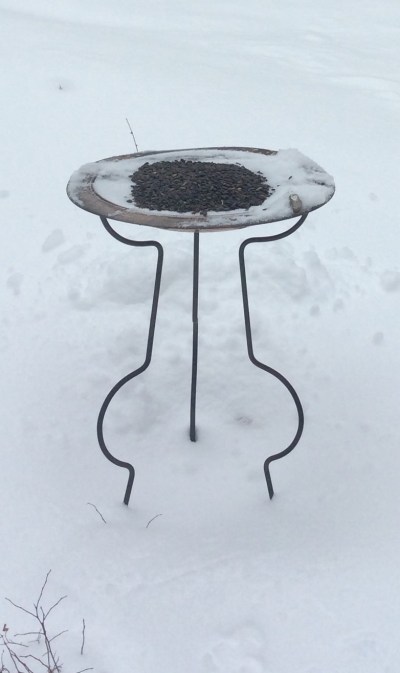
A pile of seeds in our frozen bird-bath, for the squirrels and deer:
~
~
As I came in from outside, I heard a chickadee in the larch tree, so I am hoping they will find the feeders soon.
~
one of the illustrations in my book ‘in the shelter of the covered bridge’ (Chapel Street Editions 2017)
~
Copyright Jane Tims 2018
ordinary magic
~
Although I am a biologist and understand that even the magical can usually be described in concrete terms, I prefer to not try to ‘puzzle out’ at least some of the ‘magic’ in my life. After all, what is more delightful and truly mysterious than a six-sided snowflake, the pattern of veins in a basil leaf, the smell of lavender at bedtime, the pungent, cold-busting taste of turmeric, or a line in a movie that brings tears to your eyes.
~
When I wrote the poem below, I was playing Dungeons and Dragons regularly and keeping watch for the magical in life. I still have the small blue jar with the magical false bottom.
~
 |
~
ordinary magic
~
small blue jar
emptied of face cream
has a false bottom when held to the light
a bright inverted inner shell
hovers untouchable
~
the peel of an orange
spurts flammable oil
cantrips of fire
~
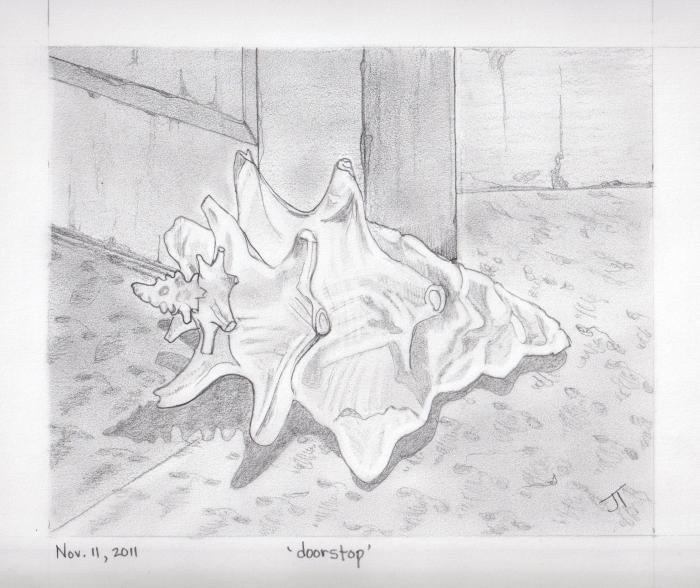
press a shell to your ear
murmur of ocean
~
~
~
Copyright Jane Tims 2018
spirit guide
As a biologist, I believe that human beings are fundamentally connected to the natural world. We are part of that world. To live, we need to eat and drink and breathe. We respond to the cycles of climate and weather.
~
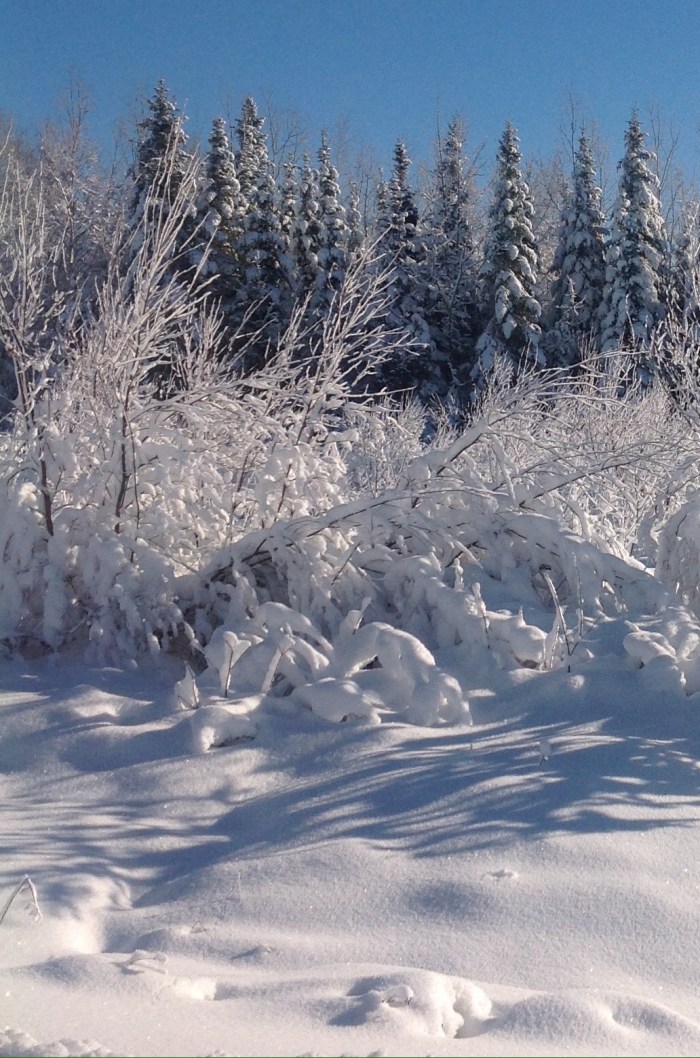
I believe, to be whole, we need to experience nature on a daily basis. In winter it is so easy to hide within our warm houses and pretend we are immune. But when I have hibernated for a few days, I start to long for a snowflake on my tongue, the glimpse of a bird, the sound of ice cracking on the lake. I need fresh air, a moment spent counting the sides on a flake of snow, the dripping of maple sap into a metal pail, the chortle of a black crow, flying overhead.
~
 ~
~
Call me crazy, but sometimes I am certain our connection with nature is one of communication. I am stopped by the knowing look of my cat staring at me as if she cannot understand my lack of understanding. I ask for a prayer to be answered and hear the low tremolo of a loon from the lake. I am startled by the constant return of a yellow bird to the window in the months after my mother dies. I watch my hand painting detail in a landscape and am amazed at how a white line can capture the essence of a leaf.
~
~
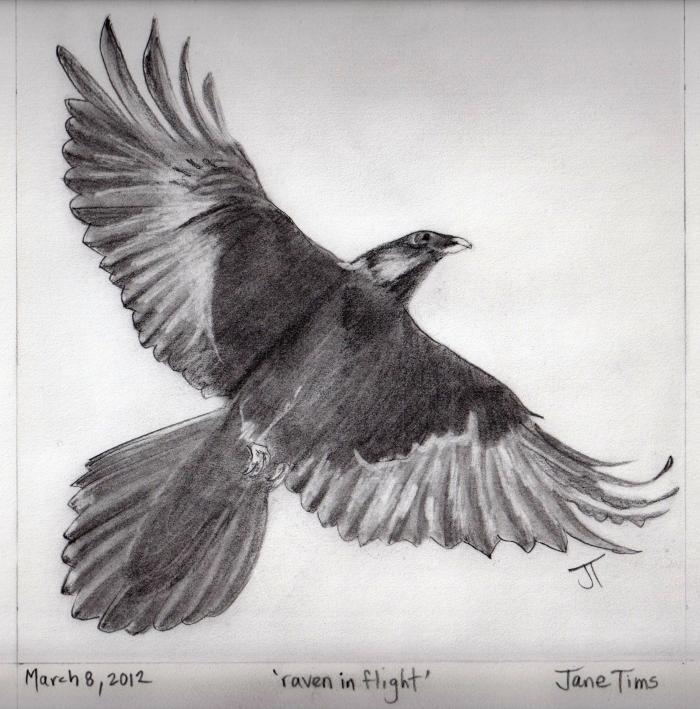
I also feel kinship with a particular animal. Some days it seems to express my disgruntlement with life. Other days, my joy. When I think of sound, the first sound I remember is the beat of wings on overhead air.
~
~
spirit guide
~
after the proper length of fast
after the proper exposure to fire
I open my eyes
but I see no animal spirit
only black
~
I listen
silence
unless you count the compression
of a single beat of wing
~
I stretch and feel the atmosphere
detached
partitioned by sharpened feather fingers
and the zigzag trail
of some multi-legged crawler
~
my mouth is filled
with the down
of fallen angels
(also feathered black)
~
the stink of burning quills
~
where is a crow
when you need to experience
more than the characteristics of crow?
~
~
~
Copyright Jane Tims 2018
my new book of poetry available now!

Late at night in February 2015, as my husband and I crossed the Patrick Owens Covered Bridge on the Rusagonis Stream, we startled a rabbit in the middle of the span. The rabbit raced through the bridge in front of the truck. I can still see the shadow of his long ears and the scurry of his feet. Since the incident occurred during the February 21, 2015 conjunction of Venus and Mars with the sickle moon, I thought of all the legends about the hare and the moon. This led to the poem “conjunction” and a question about what other plants and animals find shelter in or around our covered bridges in New Brunswick.
~
I am please to announce that my resulting book of poems ‘in the shelter of the covered bridge’ is now available. The book includes 21 of my drawings and more than 70 poems. The Foreword is written by my friend Brian Atkinson who wrote New Brunswick’s Covered Bridges (Nimbus, 2010).
~
~
‘in the shelter of the covered bridge’ is now available through my publisher Chapel Street Editions http://www.chapelstreeteditions.com and at upcoming readings. You will soon be able to find it at Westminster Books in Fredericton and Tidewater Books in Sackville.
I hope you enjoy the book and take every opportunity to drive through one of our covered bridges in New Brunswick!
~
~
conjunction – February 21, 2015
Patrick Owens Bridge
Rusagonis River #2
~
Venus and Mars
sickle of mid-winter moon
planet and moon light scamper
into crevasses
~
headlights of the half-ton enter
overwhelm planet shadow
startle a winter hare
erect on haunches, paw lifted
~
frosted by sky-gaze, worshiping
the sliver of moon, dismayed
at desecration, round glare
of the truck’s predatory eyes
~
fright to stop a heart
or flight to mobilize
hind-legs straighten
before fore-legs turn
~
long ear shadows
quit the length of the bridge
ahead of whiskers, chin velvet
and rabbit wisdom
~
~
From ‘in the shelter of the covered bridge’, Chapel Street Editions, 2017
~
Copyright Jane Tims 2017
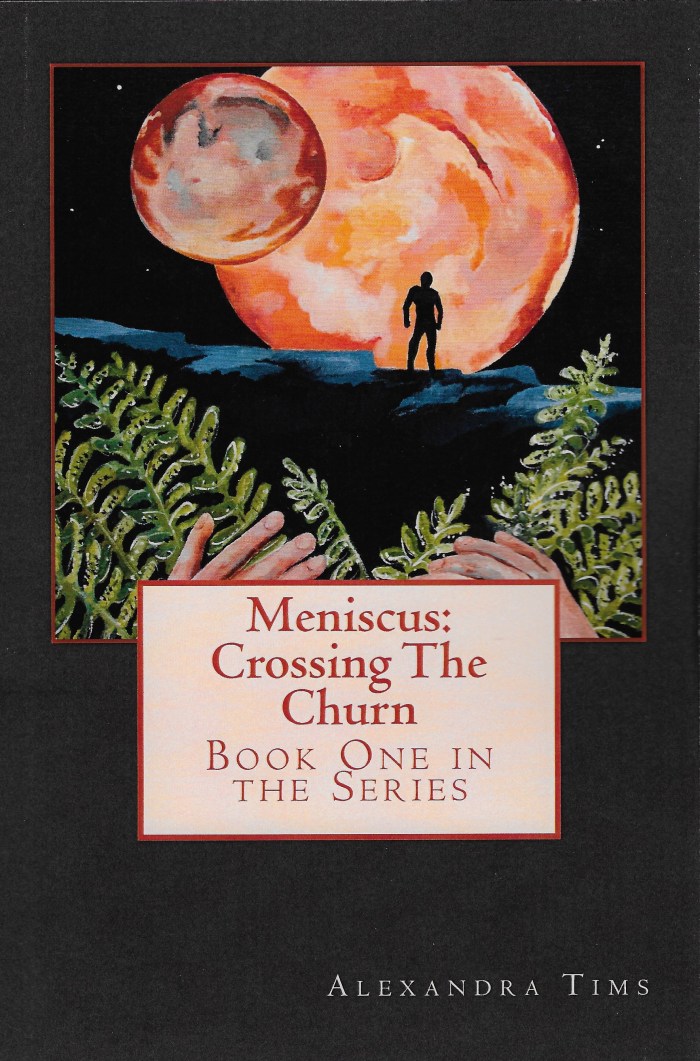
get your free copy of Meniscus: Crossing The Churn
The first book in my science fiction series is available free in Kindle format from now until October 8th. https://www.amazon.com/dp/1542342635
~
What lives in the grell burrows?
Why does the Slain carry an ivory button with him?
Who gave Odymn her purple running shoes?
What plants are good to eat in the Meniscus woods?
How do Odymn and the Slain get water in the Darn’el desert?
How did Odymn get her name?
Does the Slain speak English?
What is the Slain’s occupation?
~
Just a few questions you’ll be able to answer if you read Meniscus: Crossing The Churn.




 nichepoetryandprose