Posts Tagged ‘oak’
harvesting colour – oak and iron
~
As autumn approaches, I intend to shift my ‘harvesting colour’ experiments to ‘fall themes’. I want to colour wool with ripe berries, autumn leaves and acorns. I decided to begin with oak leaves. They are still green here in New Brunswick, but I associate the oak tree, strong and ‘knowing’, with the maturity of fall. I picked leaves from the Northern Red Oak (Quercus rubra) by our garage, a tree begun naturally, probably from an acorn buried by our squirrel population.
~

~
The dye in the pot was pale brown … I was certain the wool would be another shade of brown. Hoping for variety, I added a liter of my iron acetate (horseshoe, nail and vinegar mix) and left the wool to simmer. I forgot it on the stove, running to save it after a couple of hours. And what I pulled from the dye water was amazing, a dark brown, almost black, length of wool roving.
~
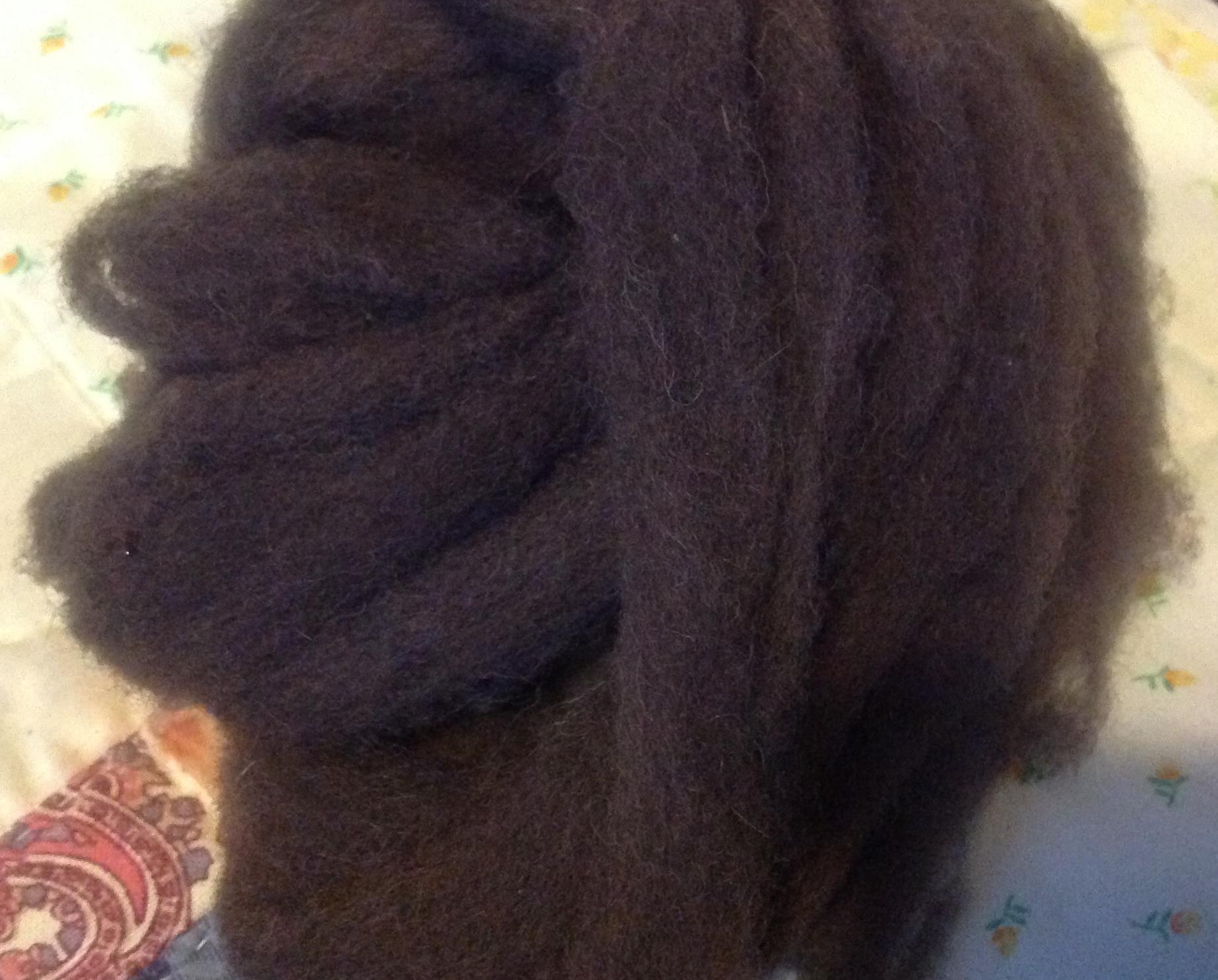
dark brown, almost black, wool, alum treated and simmered with oak leaf dye and iron acetate
~
Spun, it makes a lovely counterpoint to my yellow and light brown wools.
~

spun wool, dyed with Goldenrod (yellow), Meadowsweet (peach) and Oak leaves/iron modifier (dark brown)
~
I am almost ready for my weaving project. I have decided to arrange the bands of colour in alphabetical order so, in future, I will be able to better recall the plants used to make the dye. When I look at the woven runner, I will remember harvesting the oak leaves from our tree and the excitement of seeing the dark wool lift from the pot.
~
Copyright 2014 Jane Tims
a closer look at trees (days 48, 49 and 50)
~
One of the natural history lessons learned during my trip to California concerned the oak. On a trip to ‘Safari West’ near Santa Rosa, our guide pointed out the scarred trunks of various trees. The bark was embedded with acorns! The Acorn Woodpecker places the acorns in holes in the bark of these trees, storing them for a later source of food. The storage trees or ‘granaries’ are used over and over through the years!
~
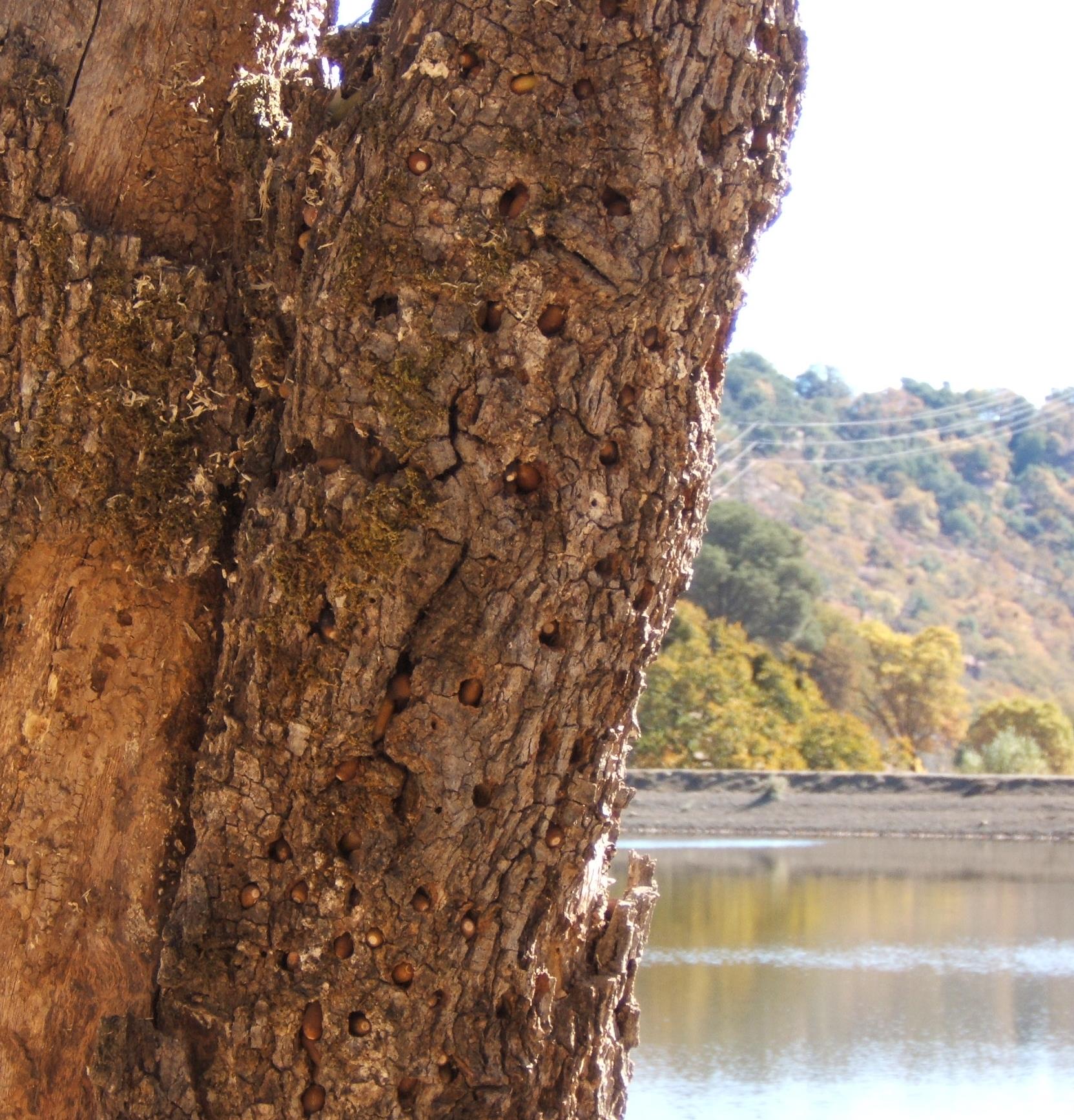
acorns planted in a ‘granary’ tree by the Acorn Woodpecker
~
Perhaps as a result of seeing so many new tree species in California, I have looked more closely at the trees I see in Street View as I cycle ‘virtually’ along the Cornwall coast. Identification is usually difficult since the images do not show details. However, occasionally a leafy branch is close enough to see the leaves clearly. So far, I have seen the Common Ash, the Field Maple, and the English Oak. In the image below, you can see the lobed leaves of the English Oak.
~
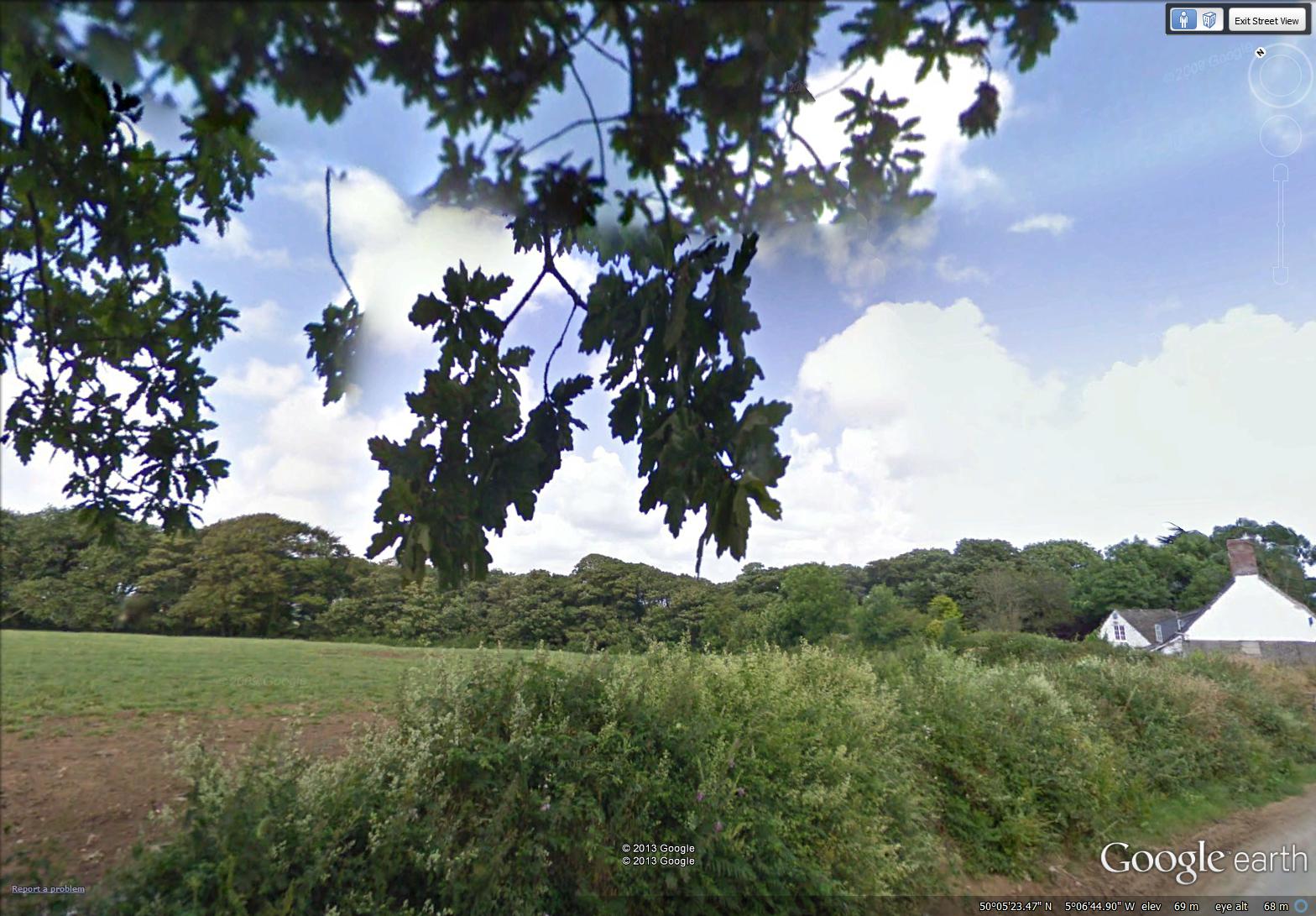
lobed leaves of an English Oak along the road to St. Anthony (image from Street View)
~

map showing distance travelled (map from Google Earth)
~
7-48 November 21, 2013 30 minutes 3.0 km (from Mawgan to St. Martin)
~

November 26, 2013 ‘oak on Fords Hill’ Jane Tims
~
7-49 November 23, 2013 35 minutes 3.0 km (from St. Martin to Helford)
~
November 26, 2013 ‘maple and oak near Helford’ Jane Tims
~
7-50 November 25, 2013 30 minutes 3.0 km (from Helford to St. Anthony-in-Meneage)
~
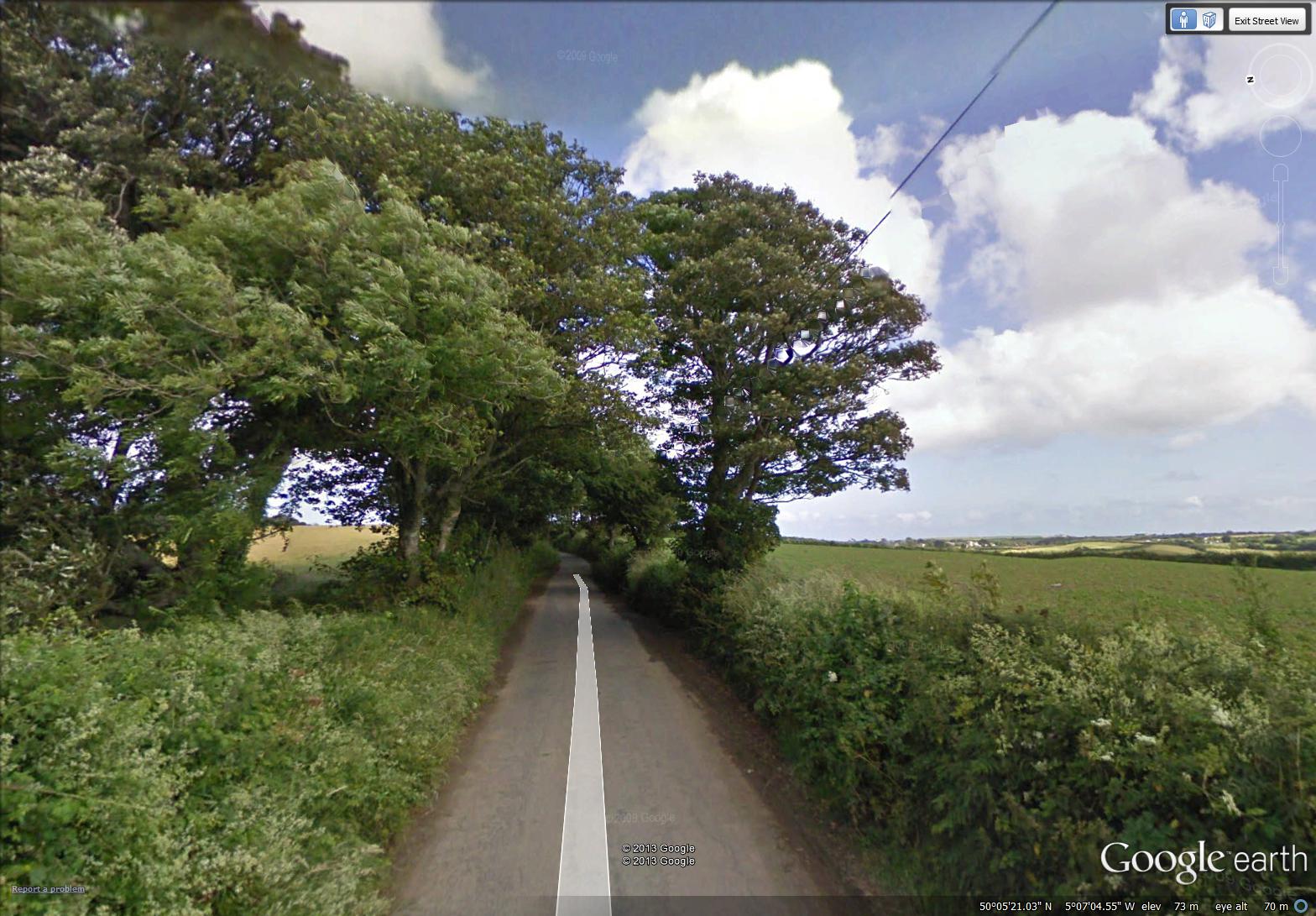
Oak and Ash along the road to St. Anthony (image from Street View)
~
Copyright 2013 Jane Tims
hidden in the hollow heart of an oak
Hollow trees create mysterious spaces in the woods.
When I was young, a hollow in a tree was a secret hiding place for treasures, and one of my favourite books was a Nancy Drew mystery – “The Message in the Hollow Oak”. In the story, a hollow tree is used as a secret mailbox between long lost lovers.
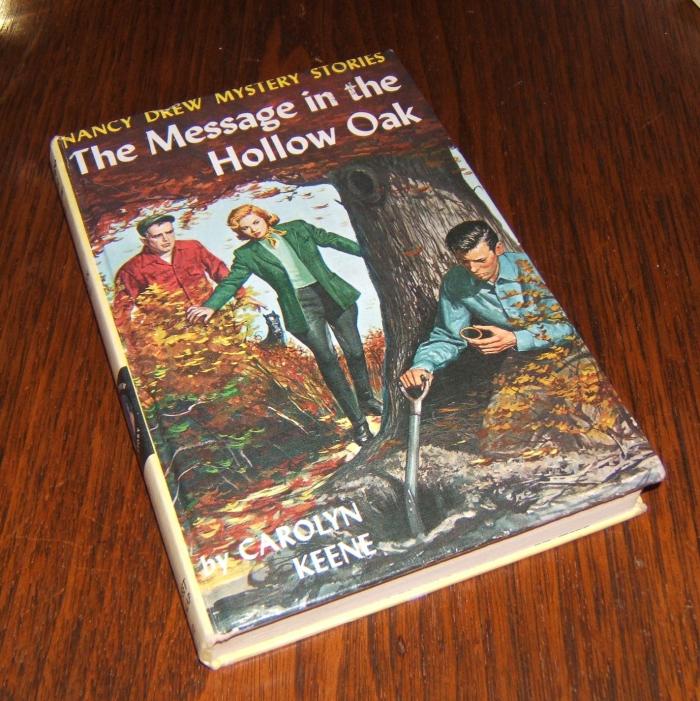
- Carolyn Keene 1935 The Message in the Hollow Oak (a later edition, probably around 1965)

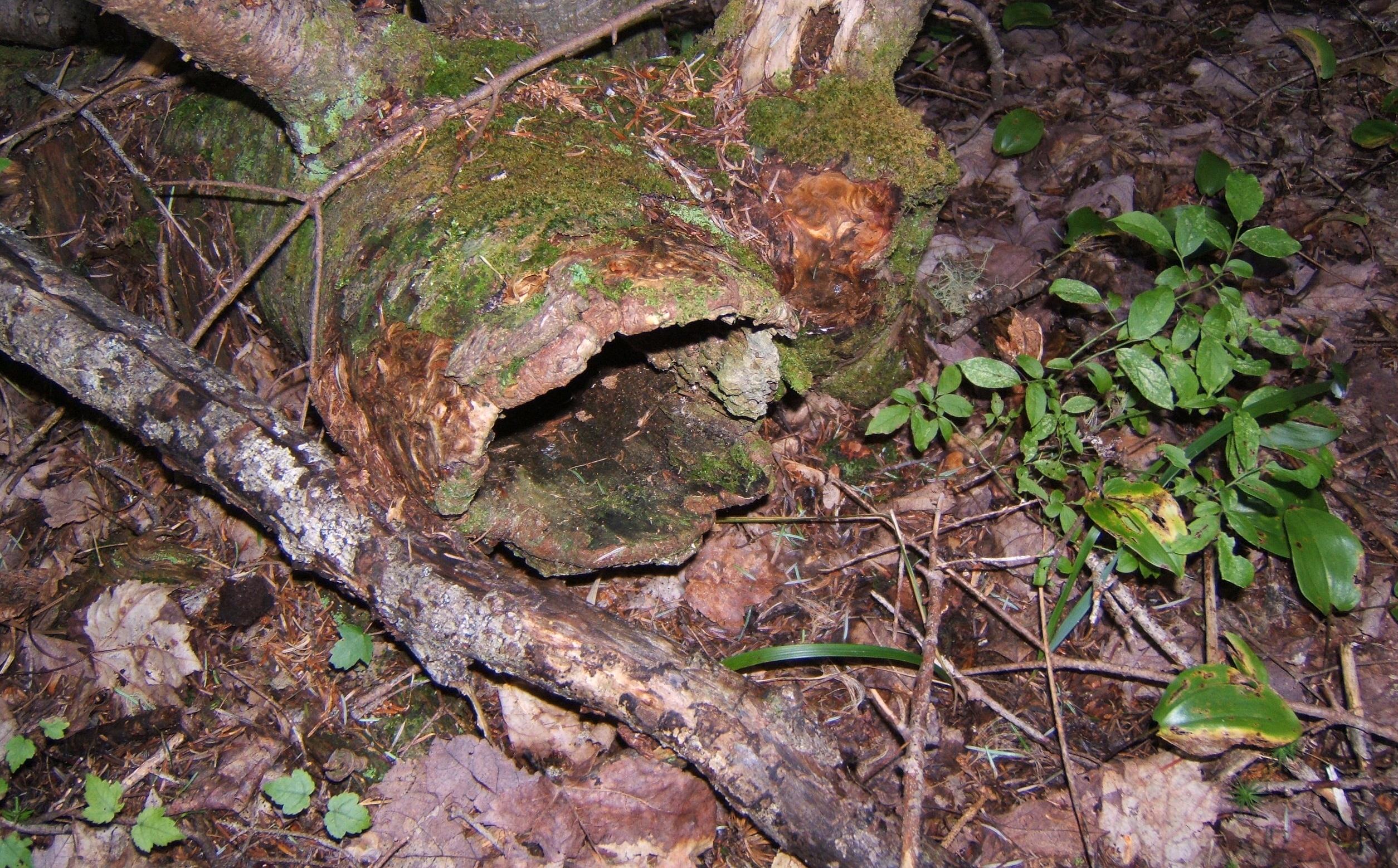
a hollow log in the woods
Cavities are usually found in mature trees. Their importance as habitat is a good reason for protecting older, mature trees in the woodlot. When my son was young, we made wooden signs saying “DEN TREE” for the older hollow trees in our woods, so we would remember not to cut them down.
Do you know a hollow tree and would you reach into the cavity to retrieve a letter???
requesting the favour of a reply
~
these leafless trees
brush against
a linen sky
ink strokes
on rice paper
letters
penned at midnight
~
hidden in the hollow
heart of an oak
afraid to reach in
to feel only
curls of bark
desiccated leaves
~
these trees
all seem the same
empty envelopes
parchment ghosts
~
branches tangled
messages
lost
~
black spruce scribbled on sky
~
Published as: ‘an answer in silence’, Spring 1995, The Cormorant XI (2)
(revised)
© Jane Tims




 nichepoetryandprose