Posts Tagged ‘morning bird chorus’
spring chorus – winter wren
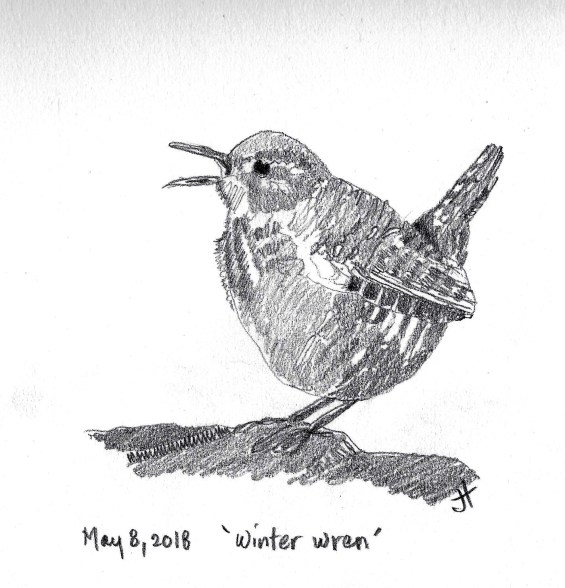
This morning I added a new bird to our spring chorus singers – the winter wren.
~
It is the first I have heard of him this year. At 6:45, just after dawn, he began his amazing song. His tweets and runs and burbling sound so joyful and each song lasts about seven seconds, very long for any bird song. He may be a winter wren but to me he is always the ‘scribble bird’.
~
To hear the winter wren sing, click here .
~
He joins my growing list of morning singers:
- black and white warbler – ‘sweet, sweet, sweet, sweet, sweet’
- American robin – ‘cherry up cheery-eee’
- nuthatch – ‘yank, yank, yank, yank’
- phoebe – nasal ‘fee-bee’
- snipe – winnowing
- our neighbour’s rooster
~
I often include elements of the morning bird chorus in my poetry. This poem, written about the Salmon River Covered Bridge, is in my poetry book in the shelter of the covered bridge (Chapel Street Editions, 2017). To obtain a copy of the book, go to Chapel Street Editions or contact me through the comments.
~
The Salmon River Bridge, near Sussex, Kings County, was built across the Kennebecasis River in 1908. Today it is used as a rest area. In the absence of traffic, wild life occupies the bridge. Virginia creeper covers one corner of the roof and rose bushes crowd the edges of the road.
~
scribble
Salmon Bridge
Kennebecasis #7.5
~
The robin, chary. Her beak drips
with wet meadow grass and chickweed.
She clucks, longs to add another strand
to her nest in the rafters,
~
woven with the trill of a scribble bird,
a winter wren delirious. And downy
woodpeckers, wing-flare and scrabble,
flirt in the willows, weeping.
~
A warbler (yellow blur-bird)
and a red-wing, toweeeee.
Pink roses, meadowsweet
chip, chip, chip, so-wary-we
~
and beneath the bridge
in soft mud beside pulled grass
the bleary track of a black bear
claws and pads
~
~
Published, in the shelter of the covered bridge, Chapel Street Editions, 2017
~
~
All my best,
Jane
spring chorus – snipe
For the last two mornings, about 9:00, about one and a half hours after sunrise, I hear a song that is not a song. A winnowing ‘hoo, hoo, hoo, hoo, hoo, hoo,’ like a repeated, trailing set of high pitched notes, echoes in the grey woods. This is the mating display and call of a snipe. The amazing thing is, the call is not coming from the snipe’s throat, but from its feathers. As it flies, the air moving through the tail feathers makes the ‘call.’ To hear this sound, visit here.
The snipe is a bird of wetlands and marshes. It has a long bill and black, white and brown feathers. There is still lots of snow on the ground but this bird seems anxious to get on with the season.
The only other birds singing this morning were the crows and our neighbour’s rooster!
~

winter wren and the morning bird chorus
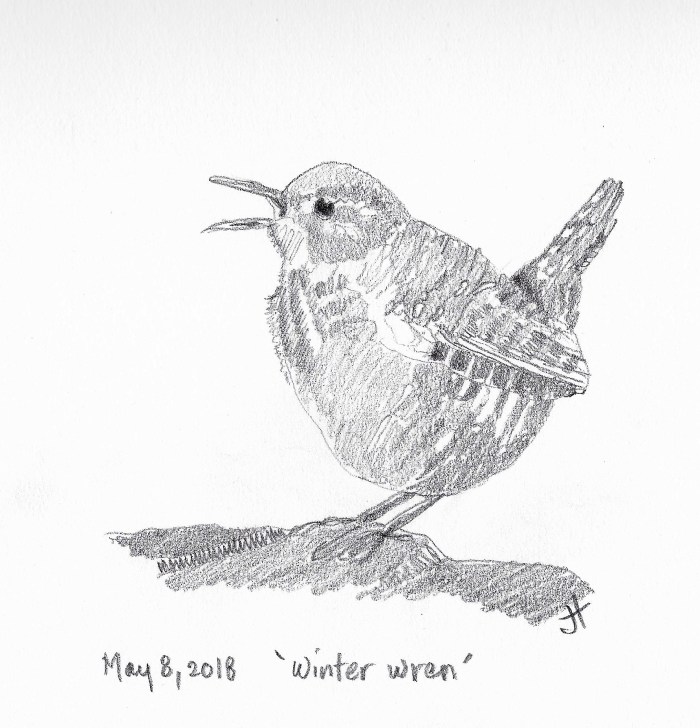
This morning, just after sunrise, I listened to the song of the Winter Wren. This little wren and its tiny tail shiver as he sings. I call his song a scribble-song. Its powerful trills and whistles last for several syllables. The Cornell Lab of Ornithology website All About Birds describes it as “a rich cascade of bubbly notes.” To me it celebrates the busy joyfulness of our Grey Woods in spring. To hear the song of the Winter Wren, go to https://www.allaboutbirds.org/guide/Winter_Wren/overview
~
~
I have listened to the morning bird chorus every day for the last week. This morning I heard:
Black-capped Chick-a-dee
Northern Parula
Winter Wren
Eastern Phoebe
~
I often include elements of the morning bird chorus in my poetry. This poem, written about the Salmon River Covered Bridge, is in my poetry book in the shelter of the covered bridge (Chapel Street Editions, 2017). To obtain a copy of the book, go to Chapel Street Editions or contact me through the comments.
~
The Salmon River Bridge, near Sussex, Kings County, was built across the Kennebecasis River in 1908. Today it is used as a rest area. In the absence of traffic, wild life has occupied the bridge. Virginia creeper covers one corner of the roof and rose bushes crowd the edges of the road. In mid-May, when we were there, birds were busy in and around the bridge, preferring to be left to their own springtime activities.
~
scribble
Salmon Bridge
Kennebecasis #7.5
~
The robin, chary. Her beak drips
with wet meadow grass and chickweed.
She clucks, longs to add another strand
to her nest in the rafters,
~
woven with the trill of a scribble bird,
a winter wren delirious. And downy
woodpeckers, wing-flare and scrabble,
flirt in the willows, weeping.
~
A warbler (yellow blur-bird)
and a red-wing, toweeeee.
Pink roses, meadowsweet
chip, chip, chip, so-wary-we
~
and beneath the bridge
in soft mud beside pulled grass
the bleary track of a black bear
claws and pads
~
~
Published, in the shelter of the covered bridge, Chapel Street Editions, 2017
~
~
All my best,
Jane
Hermit thrush
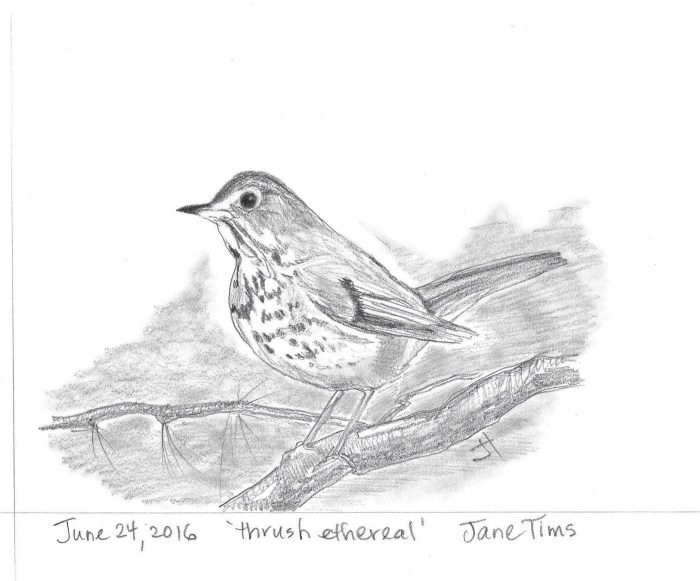
Another surprise in the morning bird chorus — a Hermit thrush. I have been listening for it all spring and at last, this morning, the ethereal notes.
~
~
How to describe the song of the Hermit thrush? T.S. Eliot described it in The Waste Land, in V: What the Thunder Said :
… sound of water over a rock
Where the hermit-thrush sings in the pine trees
Drip drop drip drop drop drop drop …
and
… who is the third who walks always beside you …
and
… In the faint moonlight, the grass is singing
Over the tumbled graves …
~
A technical description of the Hermit thrush song is ‘a beginning note, then several descending musical phrases in a minor key, repeated at different pitches.’
~
The song is clear, flute-like. To me the essential characteristics are the change in pitch at the beginning of the new phrase and the hint of water within. If you watch the Hermit thrush while she is singing, she stands tall, tilts her head back, looks into the distance with her bright black eye, lifts her feathers ever so slightly and opens her beak. Her throat swells a little but otherwise you are left to wonder, where do those notes begin?
~
If her song was another sound, it would be a flute in the forest.
If it was a smell, it would be the sweet scent of mayflowers, as you part the leaves with the back of your hand.
If it was a touch, it would be lifted hairs at the back of your neck.
If it was a taste, it would be syrup drizzled over iced milk.
If it was an image, it would be guttation drops on strawberries.
~
~
What other words describe the song of the Hermit thrush?
clear
precise
covert
alone
sweet
tremolo
pure
hidden
pensive
thoughtful
thicket
froth on a dancing wave
raindrops trembling on the tips of leaves
the step from rung to rung on a ladder
~
If it was a vowel, it would be every vowel
If it was a consonant, it would be ‘c’, ‘l’, ‘r’, or ‘v’
~
~
Hermit thrush
~
Catharus guttatus
~
neither visceral nor guttural, ethereal
tip-toe in tree tops
air pulled into taffy thread
a flute in the forest
froth on a wave
~
rain trembles on leaf tips
guttation drops on strawberry
a lifted curtain of mayflower
~
I saw you there
hidden in the thicket
and I followed
~
climb the ladder and sing
then step to the rung below
heads up, thoughts of the new day
parting of the beak
pulse at the throat
hairs lift
at the nape
of the neck, fingers
warble the keys
between middle and ring
catharsis
~
~
Copyright 2016 Jane Tims
Mourning dove
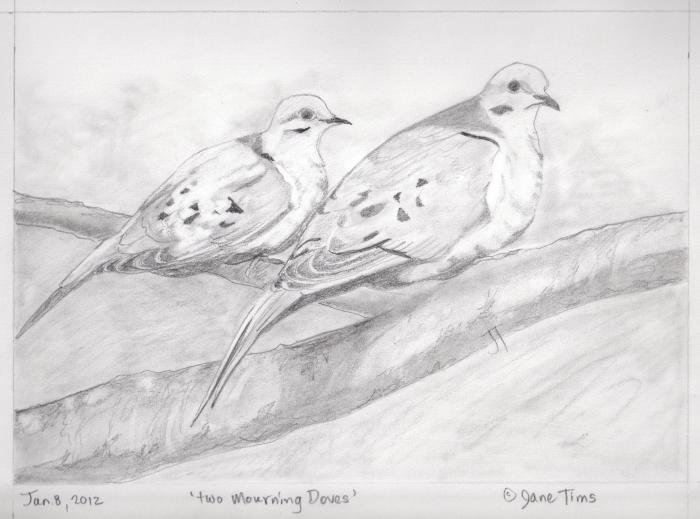
I woke this morning to another new bird in the mix of the morning bird chorus — a Mourning dove. In this area, the Mourning dove is a common bird, seen pecking at seeds beneath feeders or hanging out on the telephone lines. But I haven’t heard one in our grey woods for a while.
~
~
The call of the Mourning dove gives it its name. It begins with a low question and continues in a descending series of coos.
Oh no, no, no, no, no
Dear me, me, me, me, me, me
I decided to try and capture this sound in words.
~
Mourning
Melancholy
Monotonous
Sad
Solemn
Hollow, mellow
A reed, the inside walls of a bottle
An emerald bottle, buried to its neck in the sand
Breath across the mouth of a bottle
A child’s feeble attempt at a whistle
Light and shadow inside a vessel of glass
~
If the call of a mourning dove were a colour it would be amethyst
If the call of a mourning dove were a sound it would be wind blowing down the stairway of a tower
If the call of a mourning dove were a taste it would be chowder, thick and left too long on the fire
If the call of a mourning dove were a touch it would be a wooden shawl, wrapped round and round until it was no longer warm but strangling
If the call of a mourning dove were a song it would be hesitant, riff-driven, repeated over and over
If the call of a mourning dove were a smell it would be the cloying perfume of lilac
~
If it was a vowel, it would be ‘o’ or ‘u’ and sometimes ‘y’
If it was a consonant, it would be ‘m’, ‘n’, ‘r’, or ‘w’
~
Heavy or light
Loud or soft
Tall or short
Sad or happy
Bright or dull
Sharp or dull
Nearby or distant
Solemn or joyous
Spacious or confined
~
So, from all this, a poem. This is the second draft of a poem about the mourning dove which never mentions the bird except in the title.
~
Mourning dove
~
Zenaida macroura
~
wind wakens, descends the stair
notices shadow, gaps in cladding
the hollow of the tower, breath
across the mouth of a bottle
amethyst, buried in sand
~
the reed widened, a solemn song
the riff, the echo, a distant train
expands across the valley
and a child hollows her hand
shapes her lips for a kiss
~
tries to whistle, her breath
a sigh, a puff to cool
the chowder, still simmers
on the fire, thick
and needing stirring
~
potatoes, corn and onions
curdled cream, a woollen shawl wrapped
round and round, warmth tightened
to struggle, viscous as lilac
unable to breathe
~
~
For other posts and poems about the Mourning dove, see https://janetims.com/2012/01/16/keeping-warm/ and https://janetims.com/2015/01/30/for-the-birds/
~
Copyright 2016 Jane Tims
morning chorus
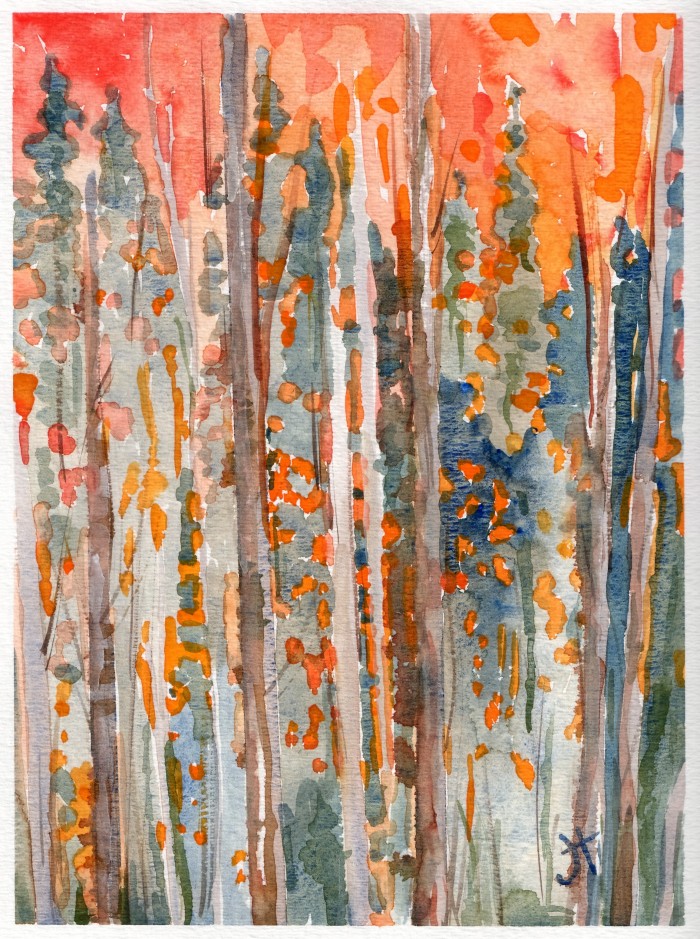
This morning it began at 5:02. First the relentless delirious Robin.
Cheerio, Cheerie, Cheer-up … Robin
Oh dear Canada, Canada, Canada … White throated sparrow
Whee, whee, whee, wheezie … Black-throated green warbler
Ah-ah-rooo … Local rooster
Teacher, teacher, teacher … Ovenbird
Tweet-terreet-terreet-tereee … Goldfinch
All happy to greet the day.
Now 5:42
~
November 3, 2015 ‘morning fire’ Jane Tims
morning chorus
Each morning I have a short quiet time after rising. I spend this time in my guest bedroom. I do some stretching. I watch the sun rise among the trees. And I try to sort out the morning bird chorus.
~

~
The morning bird chorus is known to be a complex social interaction among birds of various species – a communication we humans can listen to with wonder, but little understanding.
~
We have lots of birds in our area and the woods are thick with birdsong. Although ours is a residential area, we have many hundred acres of woodland behind us and no houses between us and the river. Our back woods are mixed conifer and hardwood, mostly balsalm fir, spruce, red maple and white birch. We have nearby wetlands and, of course, the river.
~

~
I now regret not learning to identify the birds from their songs earlier in my life. Although I can name many birds by sight, I have a feeling I know many more by their sounds. This summer I have tuned up my ears and spent lots of hours trying to learn to recognise the birds by their songs. Perhaps because of their variety and complexity, learning the songs is more difficult than just listening and comparing. Once I have heard a few birds, my memory becomes jumbled trying to distinguish between them.
~
I use three main tools to help me identify and remember bird sounds.
- mnemonics – short phrases to describe and remember various bird songs. These phrases help narrow down the possibilities when I hear a bird sing. Many lists of bird song mnemonics exist, but I like the simple listing from the Fernbank Science Center in Georgia http://www.fernbank.edu/Birding/mnemonics.htm
- recorded songs – although there are many sites with bird song recordings, the one I like the best is Dendroica- NatureInstruct http://www.natureinstruct.org/dendroica/spec.php/Dendroica+Canada#sp_select . Once you select a bird, you can hear calls recorded by birders in various parts of the range.
- a list of the calls I know and new songs I hear, described in my own words and with a diagram of the way the song progresses, in a shorthand of my own. I use words like: trill, flute, scratch, liquid, repetitive, bored, delirious …
~
The Cornell Lab of Ornithology has some excellent tips for those who would like to learn the songs of local birds.
http://www.allaboutbirds.org/Page.aspx?pid=1189#_ga=1.202457239.768663648.1437046200
They suggest listening for rhythm, tone, pitch and repetition of a bird song. By listening for these qualities, one at a time, you can start to make sense of the variability and help your memory.
~
Here is a list of the participants in this morning’s bird chorus outside my window:
- odd high-pitched sound at the first grey light of morning, probably not a bird
- immediately, an American Robin – ‘chirrup, cheerup, cheery cheer-up’ – we have a nest of robins at the start of our woods road
- a Mourning Dove, intermittent – ‘oo-oo-hoooo’ – very sad sound – a pair perches on the wires along our main road
- a White-throated Sparrow – ‘I love dear Canada-Canada-Canada’
- a Hermit Thrush – an ethereal, flute-like phrase, repeated over and over, each time at a new pitch – close at first and then gradually moving further away
- an Eastern Phoebe – a nasal ‘fee-bee’, repeated – a nest in the eaves of our shed
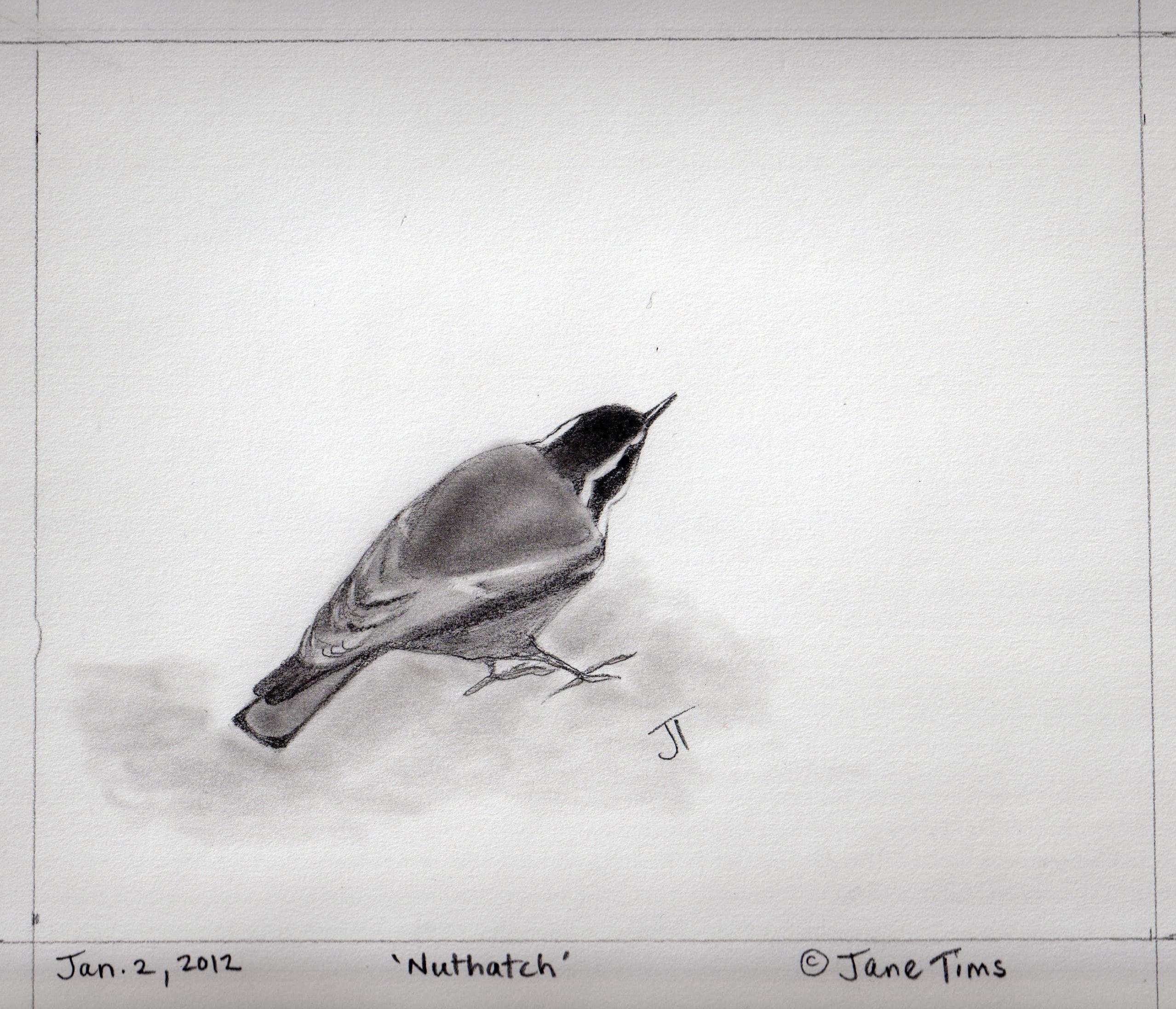
- a Red-breasted Nuthatch – a monotonous low-key ‘yank yank yank yank’, like a cross between a bored duck and a bullfrog
- the ‘caw caw caw’ of a Crow
~
I wonder if you ever listen to the morning bird chorus. What birds do you hear?
~
~
Copyright 2015 Jane Tims




 nichepoetryandprose