Posts Tagged ‘Hyakutake’
places off-planet #4 – Comet Hyakutake 1996
Comet Hyakutake had a nucleus of about 2 km in diameter and a tail-length of 570 million km. The Ulysses spacecraft is known to have flown through Haykutake’s tail. One of the comet’s notable characteristics was its blue-green color. It was bright to the naked eye for only a few days.
I remember Hyakutake as a ‘knock-you-off-your-feet’ surprise. I knew it could be seen, but I hadn’t made any effort to look for it. One night as I arrived home, I saw it shining through the trees at the end of the driveway, and climbed the snowbank at the end of the drive to investigate. I saw the comet and literally stumbled backward in amazement!
Did you see Comet Hyakutake in 1996?
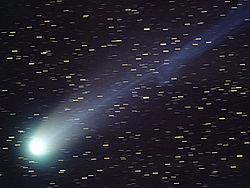
photo is from Wikimedia Commons
taken by E. Kolmhofer and H. Raab of the Johannes-Kepler-Observatory
~
~
Hyakutake
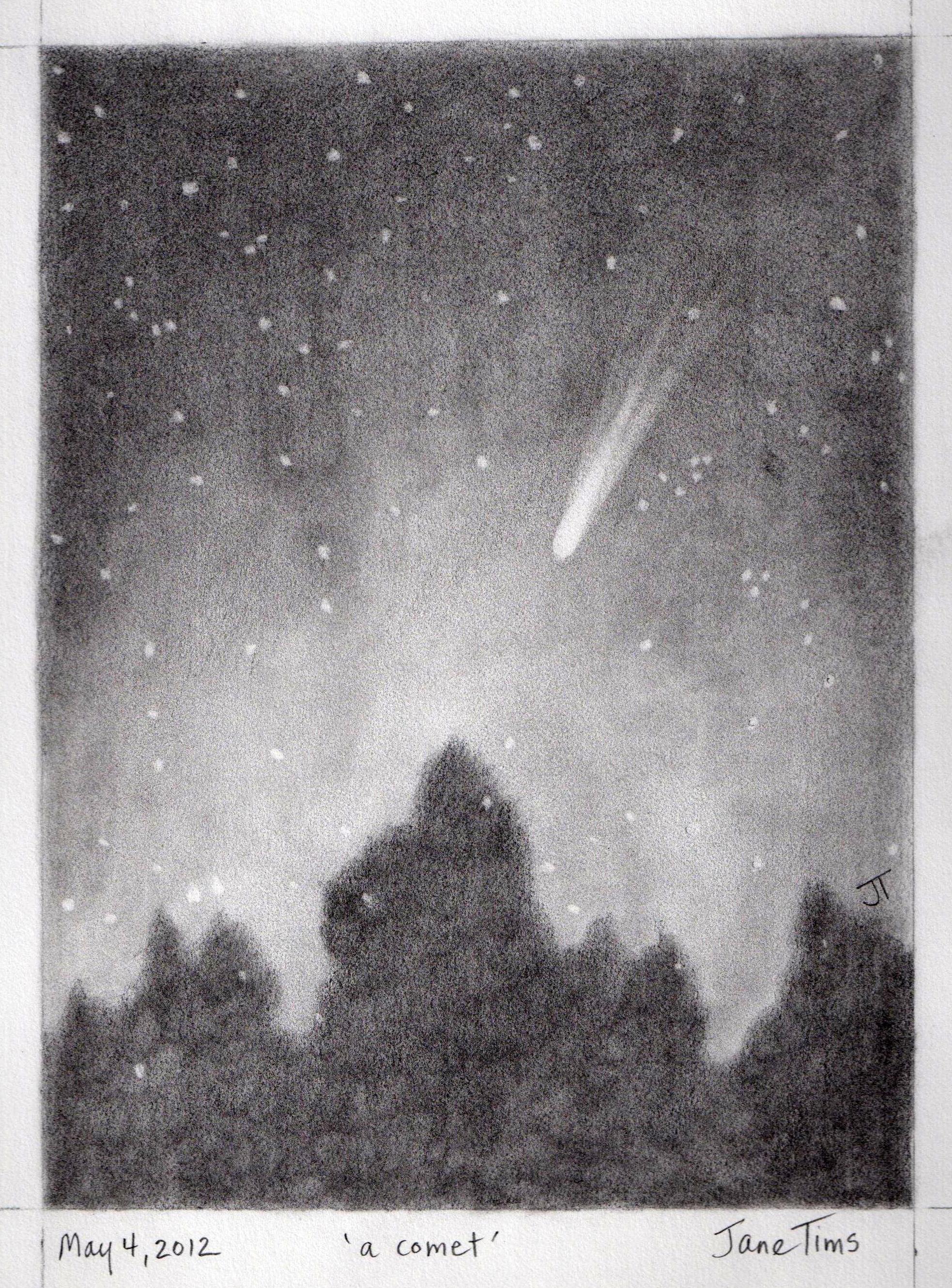
a comet
~
she runs in the solar wind
pale night woman
her face to the sun
hair and petals streaming
~
ephemeral, strewn in whispers
soft fistfuls of light
tresses tangled
in the fingers of the forest
~
~
© Jane Tims 1997
places off-planet #2 – three comets
In my life so far, I have seen three major comets – Halley’s Comet in 1986, Hyakutake in 1996, and Hale-Bopp in 1997. There have been comets since then, I know, but I have always been asleep!
A comet is composed of a ‘nucleus’ of rock, dust and frozen gas, and a tail. The tail is formed when the gasses in the nucleus are heated by the sun and create an atmosphere or ‘coma’. The sun’s radiation and the solar wind cause the coma to flow away from the sun as a tail. Since the comet can be moving away from the sun, sometimes this means the comet moves in the direction of its tail!
How many comets have you seen?
~
~
Comet
~
from the Greek
koman
~
to wear long hair
~
© Jane Tims 1997





 nichepoetryandprose