Posts Tagged ‘history’
early schooling – what to do at recess
When I was young, recess was a big deal. You had to take a treat to eat and something for play. In Grade Three, tops were all the rage. My Dad made me a top from a wooden spool and we painted it in a rainbow of colours. I can still see it spinning on the concrete step. We also played hop-scotch, ball games like Ordinary Secretary, marbles, skipping and tag.
~

April 30, 2016 ‘top made from a wooden spool’ Jane Tims
~
I am lucky to have some of my Dad’s writing about his early years and his experiences in a one room school. He went to the Weaver Settlement School in Digby County in Nova Scotia in the late 1920s and early 1930s. He tells about some of the activities at the school, especially at recess. Fishing was popular, as well as playing ball and trading jack knives.
~
… There was a well out beside the school and it was a good appointment to take care of the water-cooler for a day of a week … Gave a student time off from books…
~
… There was a brook nearby … In fall we usually built a dam so the brook became a pond for winter … A place to skate or just play on the ice …every moment of recess and noon was spent there …
~
… The big contest was ‘who comes to school first in bare feet ’ … Our parents had control, not full control as there were hiding places for shoes and stockings along the way to school …
~
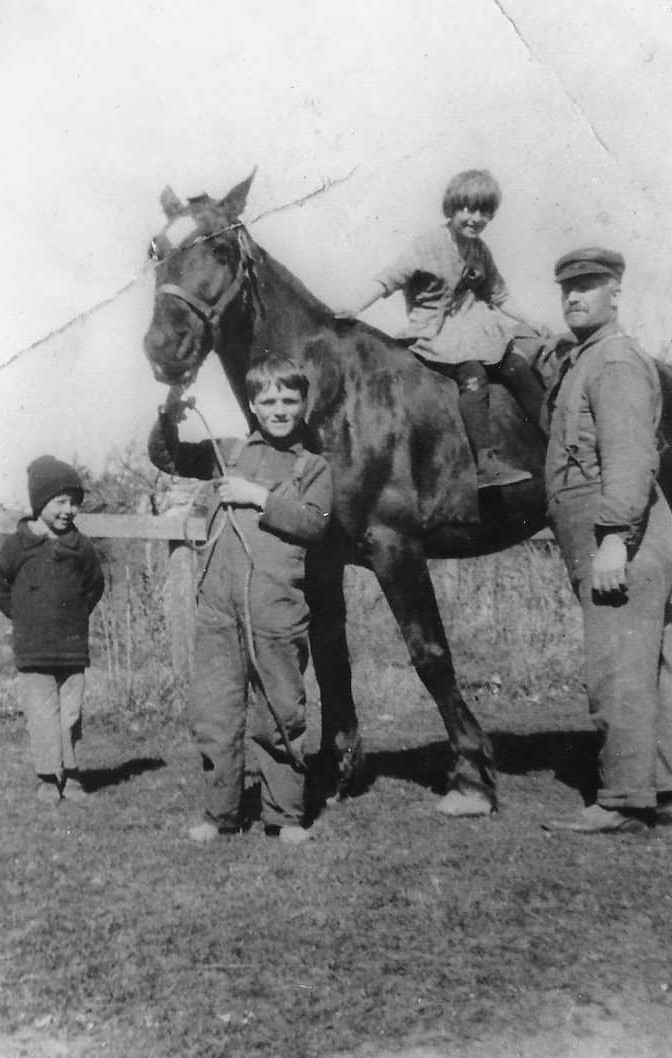
Dad with the family horse Goldie in about 1930
~
I am certain recess is still a favorite time for school kids – time to talk with friends, play games and get a little break from the classroom. I think we could all build a little ‘recess’ into our busy lives!
~
Copyright 2016 Jane Tims
early schooling in New Brunswick and Nova Scotia – including nature study
Of all the classes given in 1888 in New Brunswick, I would have liked ‘Useful Knowledge’ the best. This is where I might have learned about birds and plants and butterflies.
~
Bringing ‘Useful Knowledge’ into the classroom may have been a greater challenge than it appears. The focus was on the three R’s (reading,’riting, and ‘rithmetic) and scarce resources meant less time for ‘frivolous’ subjects. In the neighboring province of Nova Scotia, educators faced a challenge when they tried to bring studies about the out-of-doors into the classroom. The situation in New Brunswick would have been similar.
~
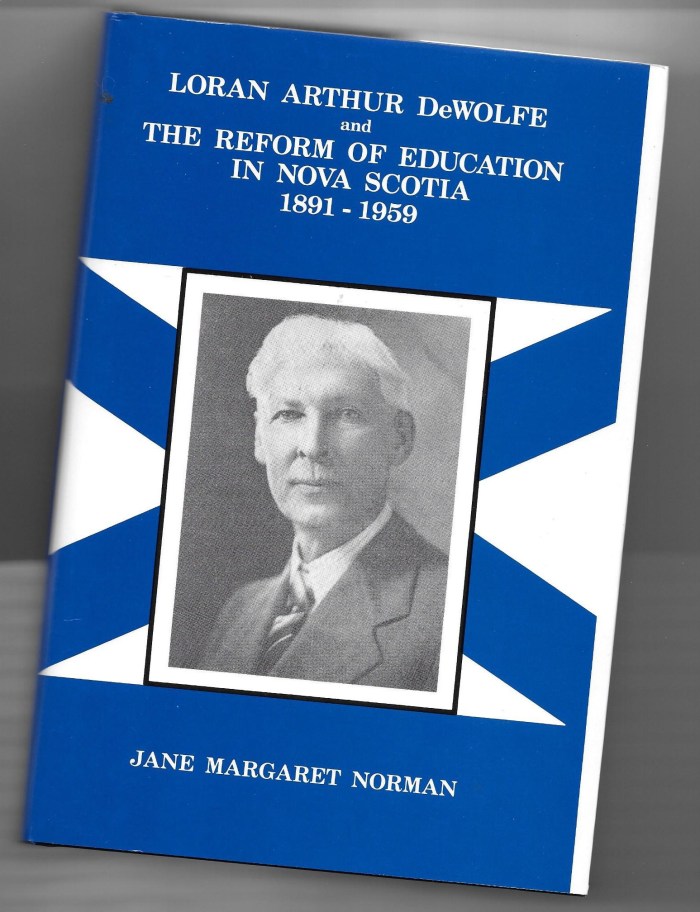
In her book Loran Arthur DeWolfe and The Reform of Education in Nova Scotia 1891-1959 (Truro, Nova Scotia: Atlantic Early Learning Productions, 1989), my aunt, Dr. Jane Margaret Norman described the situation in the late 1800s and early 1900s in Nova Scotia. Dr. DeWolfe, Director of Rural Science Schools in Nova Scotia from 1913 to 1924, focused on including studies of nature and in particular agriculture in the schools. These were times of rural out-migration – interest in staying and working on the family farm paled in comparison to the adventures promised by leaving for the west. Dr. DeWolfe was convinced that the only way to keep people in rural areas was to interest them, from the start of their education, in the world of nature.
~
~
His solution was to include in the curriculum ‘field days’, ‘spring gardens’, folk dancing, lessons in canning food, ‘Planting Days’, and school fairs. My dad, who would have attended elementary school in the late 1920s, remembered Dr. DeWolfe visiting his school in rural Digby County. He told my aunt that Dr. DeWolfe “… always had something to say about nature.”
~
My dad as a boy (holding the horse Goldie). Dad grew up in a rural area and attended a one room school. He remembered Dr. DeWolfe’s visits to that school and his emphasis on paying attention to the out-of-doors. Dad became a teacher and, as my teacher in Grade Six, taught me about the solar system and the cause of our seasons. He also taught me how to make a whistle from a willow twig.
~
In New Brunswick, by 1888, ‘Useful Knowledge’ would have introduced many students in New Brunswick to nature studies. In rural schools (Ungraded Schools in Country Districts), the classes in Standard I (Grade 1) included ‘oral lessons on animals’ and, in Standard II (Grade 2) ‘natural specimens where possible’. Standard III (Grade 3) included ‘lessons on agricultural products of the district’, and Standard IV (Grade 4) studied ‘agricultural topics’ from Tanner’s First Principles of Agriculture. In addition to Tanner’s First Principles of Agriculture, Standards V and VI (Grades 5 and 6) used Bailey’s Natural History. Liberty Hyde Bailey (1858-1954) was a horticulturist, naturalist and advocate of nature study.
~
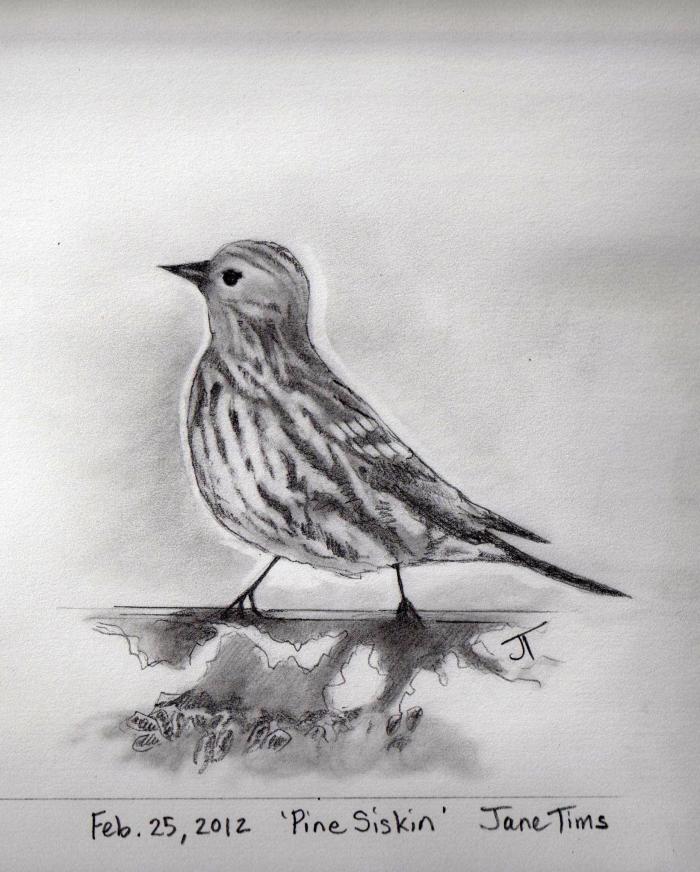
” … Stuffed birds do not sing and empty eggs do not hatch. Then let us go to the fields and watch the birds. Sit down on the soft grass and try to make out what the robin is doing on yonder fence or why the wren is bursting with song in the thicket. An opera-glass or spy-glass will bring them close to you. Try to find out not only what the colors and shapes and sizes are, but what their habits are … ” from the Birds and I , Liberty Hyde Bailey. http://libertyhydebaileyblog.blogspot.ca/
~
~
Copyright 2016 Jane Tims
Useful Knowledge
I have continued to read the Annual Report of the Schools of New Brunswick 1888 (Fredericton, 1889) by the Chief Superintendent of Education, to discover more about New Brunswick’s one room schools.
~
Since I am a botanist, interested in natural history, I wondered what students in 1888 were taught about the natural world. Below, I have listed the subjects included in ‘Useful Knowledge’ in Standards I through VI (Grades One though Six). The theme of temperance, moderation in alcohol consumption, was central to ‘Useful Knowledge’ in Grade Four and beyond. I also like the animals listed in Standard IV – Animal Life !
~.
Standard I (Grade 1)
Minerals.—Distinguishing and naming coal, slate, clay, iron, lead, etc.
Plant Life.—Distinguishing and naming common garden vegetables, flowers,
field crops, trees in the neighbourhood.
Animal Life.—Distinguishing and naming principal parts of the human
body by means of pictures ; to point to and name principal parts of familiar
animals.
Standard II (Grade 2)
Minerals—Pointing out objects in school room made in part or in whole of
iron or any mineral. Names of implements made of iron, steel, &c. Cooking
utensils of iron, tin.
Plant Life.—Distinguishing parts of plants—stems, leaves, roots.
Animal Life. —Distinguishing and naming the chief sub-divisions of the prin
cipal parts of the human body and lessons on such parts as skin, nails—use and
care of. Familiar animals—their food, habits, uses.Standard III (Grade 3)
Minerals (Oral).—Lessons on minerals or stones in the district—names and
how distinguished from each other.
Plant Life (Oral).— Agricultural products of the district. Trees, shrubs,
herbs—different ways of distinguishing one from another, &c, by form, colour,
and size of trunk, branches, leaves, bark.
Animal Life (Oral).—Ear and Eye—use and care of. By means of pictures, to distinguish and name such animals as are treated of in the Reader, and give their
prominent structural characteristics. Domestic and wild animals of the district.
Oral lessons on all Useful Knowledge Lessons in Reader before the pupil is
required to memorize the answers to the questions.Standard IV (Grade 4)
Reader.
Minerals (Oral).— Principal Minerals of the Province, localities and uses.
Oral lessons on Metals (similar to those in Useful Knowledge lessons in
Reader).
Plant Life (Oral).— Names of the principal forest trees of the Province—
their uses. Agricultural productions of the Province.
Animal Life (Oral).— Organs of Respiration —-Effects of alcoholic stimulants thereon. Domestic and wild animals of the Province. General structure of such animals as are treated of in Reader. Oral lessons on Useful Knowledge lessons in Reader before the pupil is required to memorize the answers to the questions.Standard V (Grade 5)
Minerals.—General qualities and uses of the more useful metals and minerals
of the Province (Oral).
Plant Life. —General characteristics of the useful and hurtful plants of the Prov
ince (Oral).
Animal Life.—Organs of digestion and circulation. Effects of alcoholic stimu
lants thereon. Adaptation of structure to habit of such animals : the cow, the
squirrel, the camel, the lion, the elephant and the whale (Oral).Standard VI (Grade 6)
The Mineral Kingdom.—Lessons to be illustrated by specimens, (Text-book,
Part I, Baileys Natural History).
Physical effect of alcoholic stimulants upon the human system. Lessons
to be illustrated by experiments where practicable. Text-book, Palmer’s Tem
perance Teachings of Science, Chaps. I-IV inclusive.
Physics, (Oral).—Hotze’s First Lessons in Physics for Teacher’s use only.
Lessons 1-13 inclusive.
~
Long after my own days in elementary school are past, I am still learning about the ‘Adaptation of Structure to Habit’ of such animals as the squirrel:
~

Adaptation of structure to habit of such animals : the cow, the
squirrel, the camel, the lion, the elephant and the whale. Part One: The Squirrel, perfectly adapted to stealing seed from birdfeeders.
~
~
Copyright 2016 Jane Tims
Schools of New Brunswick in 1888
I love beginning a new project … love learning, love doing the research, love the dusty old books holding the information.
~
A project about the old schools of New Brunswick won’t be totally new to me. I grew up hearing the stories my Mother told about teaching in one-room schools. In University, I wrote a research paper about school in the 1800s and how schools were situated in the community and in the landscape. And I am always interested in older buildings and how they survive in the built landscape.
~
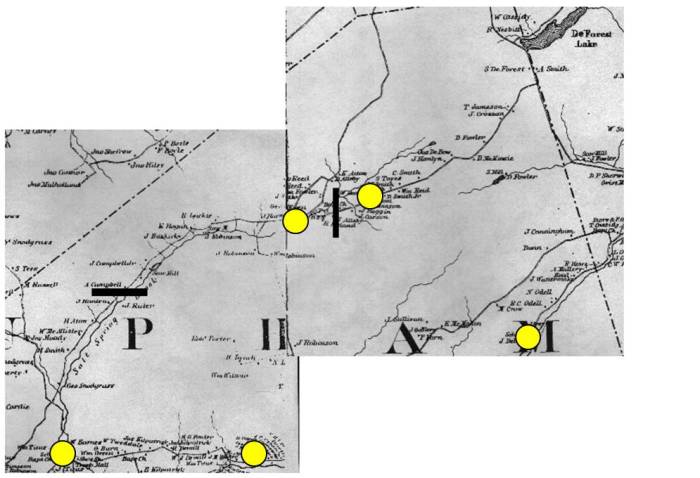
location of some schools in Upham Parish, Kings County in 1862, showing the effects of linear settlement on school location (map shown is from H.F. Walling, Topographical Map of the Counties of St. John and Kings New Brunswick, 1862)
~
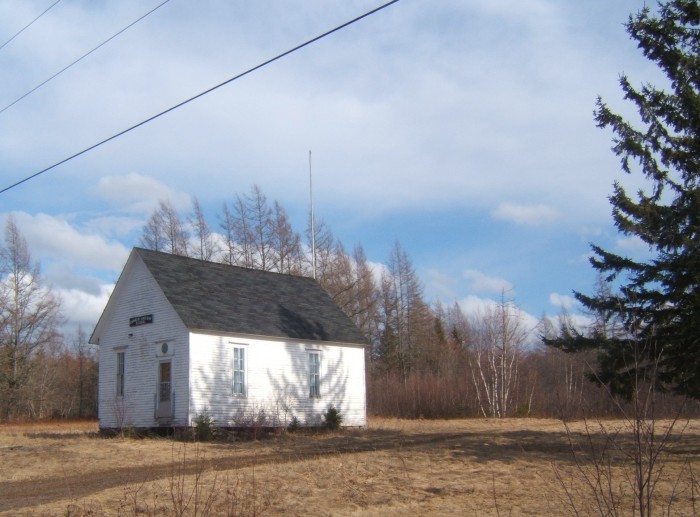
My first step to research this topic was to take a drive in the countryside, to find some old schools (see post for April 26, 2016). My next step is to do some more reading about the school system in the nineteenth century.
~
I began with an old book, not dusty at all, but available on-line at Google Books (https://books.google.ca/books): Annual Report of the Schools of New Brunswick 1888 (Fredericton, 1889) by the Chief Superintendent of Education.
~
In 1888 there were 1,532 schools in New Brunswick. Some of these would have been larger schools, but the majority were one room schools in rural settings. There were 1,587 teachers and 59,636 pupils. Only 50% of these students were ‘daily present’ during the time the school was in session – “…falls far short of what it ought to be …” reports the Superintendent! He suggested that teachers could help a lot if they would “… carefully inquire into the cause of every absence …”
~
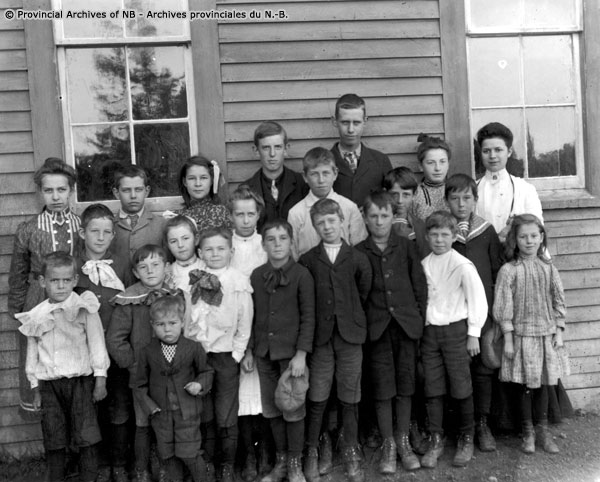
children and teacher at Carter’s Point School on the Kingston Peninsula (Source: Provincial Archives of New Brunswick)
~
The report contains over 1000 pages and lists the classes given most often:
Reading, Spelling, Recitations
Oral Lessons on Morals
Physical Exercise
Health, including Temperance
Composition
Print Script
Writing
Number Standards/ Arithmetic
Geography
Useful Knowledge (for example Plant Life)
~
I love the description of the Health instruction:
pure air, sunlight, good water,
wholesome food, proper clothing, cleanly and temperate habits, avoidance of draughts,
and the sudden checking of perspiration, dry feet, etc.
~
I think I will go check my perspiration and feet …
~
~
Copyright 2016 Jane Tims
Where is Frank?
In an attempt to keep making progress on my explorations of family history, and to justify my monthly contributions to Ancestry.com, I have implemented ‘genealogy Saturday’. On most Saturday’s, I pledge to discover more about my family, and to organize into a written account the information I already have. We’ll see how long this intention lasts.
~
I continue to be interested in the life and family of my great-grandmother Ella (Mary Ellen) Hawk Norman (1859-1933). I now have information on much of her life. Thanks to the City Directories at Ancestry.com, I know where she lived almost every year from 1894 onward.
~

My only photo of my Great-Grandmother Ella (Hawk) Norman (in about 1928). She is second from the right, with her hands folded. The group is standing in front of Harowitz’ Restaurant in Scranton, Pennsylvania where she worked as a pastry cook in the early 1900s.
~
I also know about her husband, my great-grandfather Frank Norman, from the date of their marriage in 1886 onward
(see my post about their marriage
https://janetims.com/2014/05/15/the-tale-of-a-marriage-certificate/
and about Frank’s fall from a horse https://janetims.com/2014/05/12/searching-the-newspapers-2/).
But I know nothing about him before 1886. Most of all, I would like to know the names of his parents, my great-great-grandparents. Of my sixteen great-great-grandparents, these are the only two names I do not know.
~
Unfortunately, the name Frank Norman was common in the mid-eighteen hundreds. I know from various documents that Frank was born about 1855 in Missouri. There were about forty Frank Normans born in Missouri in the mid-century and deciding ‘who was who’ has taken a major effort.
~
I used the following ‘rule base’ to help me sort through the many Frank Normans:
1. Discard any females (the names Francis or Frances have been used for both males and females)
2. Discard any Franks born before 1845 or after 1870 (he was at least 16 in 1886 when he married and no older than 40). Since Frank’s birth year (1855) comes from two sources and is likely near to correct, I was more stringent than this when looking at each record. I have often found birth dates in the Census suspect, probably because people were vague when providing information to the Census taker.
3. Discard any Frank Normans who had other spouses before 1896, especially those with children born in the 1880s (Ella and Frank divorced in 1896, so he could have remarried). This takes careful searching through the Census records and family trees, going back and forth to see who was in the various Frank Norman families. It is too bad we don’t have the 1890 Census !
~

Hooker, Laclede County is in south-central Missouri; Bethany is in Harrison County in northern Missouri
~
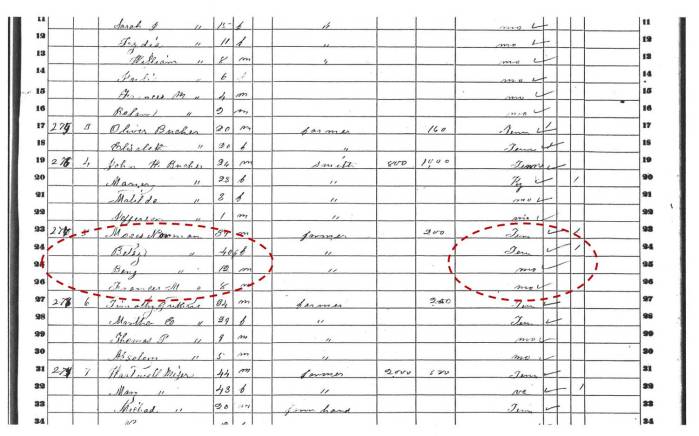
After all this, I have found only one Frank Norman who meets my criteria. Francis M. Norman (born 1852 Missouri) lives with his father Moses Norman (born 1821 Tennessee), his mother Betsy (born 1820 Tennessee) and his brother Benj (born 1848 Missouri) in Hooker, Laclede County in Missouri (1860 Census).
~
~
There were two Moses Norman families living in Hooker, Laclede in 1860. The other Moses Norman (born 1895 Tennessee) lives with wife Lucinda and their children. Moses 1895 was a landowner in Laclede. Although I have not been able to connect the two Moses Normans, it is reasonable to think they were related. In the Census, they are living fifty houses from one another, perhaps a long way in the days of large farm properties and the ‘open country neighborhood’.
~
I cannot find Moses and Betsy in any Census after 1860. A person named Benj (died 1873) is buried in the Moses Norman Cemetery in Sleeper, Laclede and this may be Moses’ (1821) son Benj.
~
On Frank’s Application for a Marriage Licence (1886), he wrote that he lived in Bethany, Harrison County, Missouri. There were Norman families in the Bethany area by 1880 and Frank may have gone there from Laclede to live or work.
~
I may never know the names of my great-great-grandparents for certain, but Moses and Betsy sound like good candidates. I will keep looking until the powers invent a time travel machine just for genealogists!
~
Copyright 2016 Jane Tims
one room school houses – hiding in the landscape
Last Friday, we took a drive along the west side of Grand Lake, in the Youngs Cove area of Queens County, New Brunswick. We were searching for old one room school houses. As far as I know, there is no list for these buildings in Queens County, New Brunswick, although a list does exist for nearby Kings County.
~
I had seen one old school in the Whites Cove area, so we began there. This school was operated as a local craft store for a few years but is now a private cottage. The one room school is in good shape, painted bright red. The round plaque in the gable of the roof says 1837. The building had two front doors – one for boys and one for girls.
~
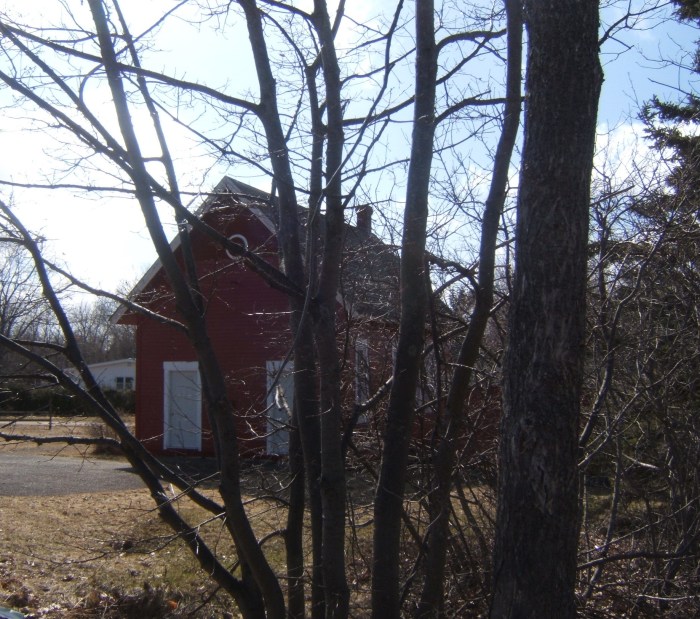
Whites Cove school house
~
We then continued toward Chipman, taking old roads when possible. I know that in the late 1800s and early 1900s, each small community (each Parish) had its own school, so we watched for the tell-tale design of the one room school house – a small, rectangular, one-storey building with a steep-sloped roof and rather high side walls. Each school had two or three tall rectangular windows on each side and one or two front doors. Some New Brunswick schools had a small anteroom or vestibule on the front. The bell-tower common on school houses in the United States was not typical of one room schools in New Brunswick.
~
We followed the road along the shoreline of the peninsulas extending into Grand Lake. In particular, we were watching for the older homes that show what the community may have looked like a hundred years ago.
~
As we came over a hill, we first saw the Rees school house. It had some of the characteristics I describe above. However, I am new to one room school hunting, so I was not really certain this little building had once been a school. And then my husband pointed to the sign on the small road opposite the building – School House Lane. The school house was being used as a cottage and was in poor condition with broken windows and a crumbled brick chimney. But I was happy to see the original stone foundation, a straight roof line, a large flat stone as a threshold, original clapboard on the front of the building, and evidence of the original vestibule.
~

Rees school house
~
Thrilled by our discovery, we continued to the next community and followed a side road. Almost immediately, we saw the Cumberland Bay School, announced by a sign above the door. It was a typical school house design, built on a hill. There was a rock foundation (with some brick) and a straight roof. The building was in good shape with evidence of regular maintenance and use, perhaps as a hall. A cold wind was howling and I felt sorry for the kids who must have come to school in all kinds of bitter weather.
~
Cumberland Bay school house
~
After seeing three school houses, we felt like pros. We took the next road along the shore, toward Cox Point, and found a school house outside the community of Range. It was set back from the road, used in conjunction with a family cottage. The roof was straight, the side windows were intact and the shingles were in good repair.
~
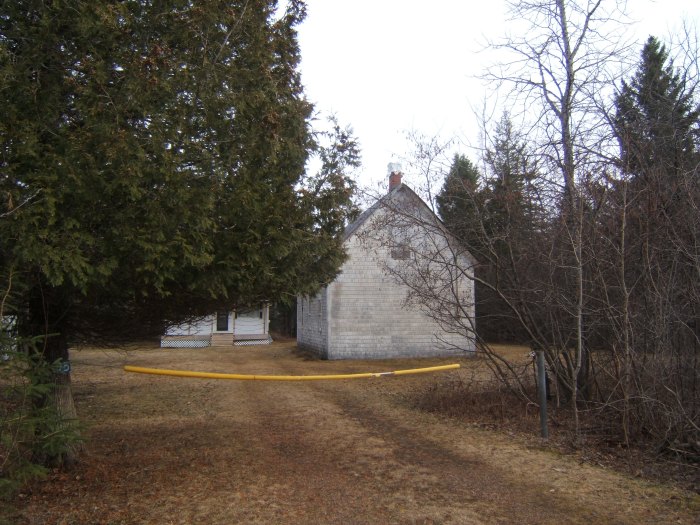
Range school house
~
I was delighted with our drive – we had discovered three school houses we did not know about! I also got a feel for some of the characteristics of these buildings and how they fit into the local landscape.
~

a map showing the old school houses we found … you can see a pattern emerging … I expect there were once school houses in some of the other communities indicated on the map
~
Why am I interested in this topic? My interests in landscape, the environment and history all come into play. I am also beginning to think about my next poetry project and have decided to explore the idea of school houses in the landscape.
~
To do this project, I will think about the setting of the school house in the community and how topography (hills and lakes and rivers), vegetation (fields and forests, orchards and big old swinging-trees) and other built landscape (bridges, churches, stores and farms) would have influenced the students, teachers and members of the community. Visits to old schools, some talk with people who remember attending these old school houses and reading at the Provincial Archives would give me lots of material for my writing.
~
Do you have examples of old one room school houses in your area? Did you attend school in a one room school house? I would love to hear your stories!
~
Copyright 2016 Jane Tims
in the shelter of the covered bridge – shelter?
‘shelter’
– n.
1. protection from danger, bad weather, etc.
2. place giving shelter or refuge.
-v.
1. act or serve as a shelter to; protect; conceal; defend.
2. find refuge, take cover.
(Oxford English Dictionary)
~
As I refine the results of my poetry project, ‘in the shelter of the covered bridge’, I am thinking about the idea of ‘shelter’ and how important it is to all living things.
~

~
A covered bridge changes the landscape, alters the environment and encourages habitat diversity. It changes the availability of light, water and air. It provides cover from harsh environments.
~
Some examples of finding shelter in a covered bridge:
Plants:
- seeds on the wind, waylaid, find a place to germinate
- grasses growing beneath the bridge get less light as shadows thicken – sometimes there is too little light to grow at all
- a crack between boards in the floor of the bridge provides a space to grow away from competition from other plants
- mosses and lichens find a place to thrive in the rotted hollows of posts and timbers
Animals:
- birds use rafters and beams as nesting sites
- spiders find places to attach their webs
- mice store seeds in nooks and crannies
- birds hunt insects on the sun-warmed boards of the bridge
Humans:
- travellers find brief respite from wind and snow and rain
- friends and lovers find meeting places, out of the view of curious eyes
- visitors find surfaces for expression – graffiti, vulgarity, art, a space to say ‘I was here’
- children of all ages find a place to shout, hear echoes, remember
~
~
shelter
~
the engine dies – after midnight
not far from home
~
snow builds on track
eyelash and mitten
~
wind conceals the road
sweeps the bridge
~
enter, a lull and chill subsides
bright of snow subdued
~
no solitude – a mouse ticked
off, her hibernation interrupted
~
and ghosts carve names, spray
broad epithets in purple
~
inspire defiance, kick me
out, into the storm
~
~

~
Copyright Jane Tims 2016
in the shelter of the covered bridge – the record we leave
The Odellach River #2 Covered Bridge (Tomlinson Mill), built in 1918, is the only covered bridge remaining in Victoria County, New Brunswick.
~
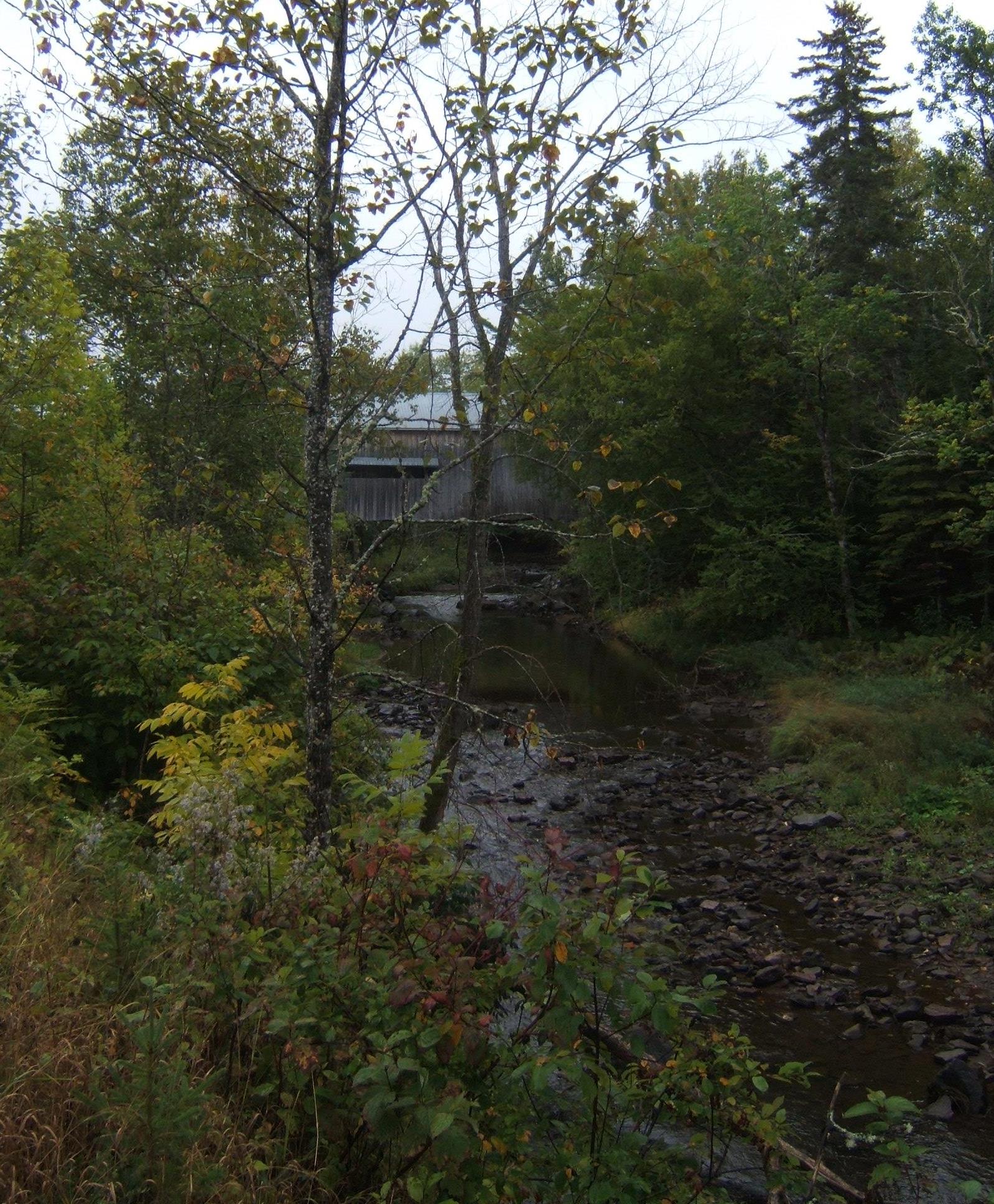
Odellach River #2 Covered Bridge, Victoria County, New Brunswick
~
It is a charming bridge, with a long roofed window on one side.
~

long window in Odellach River #2
~
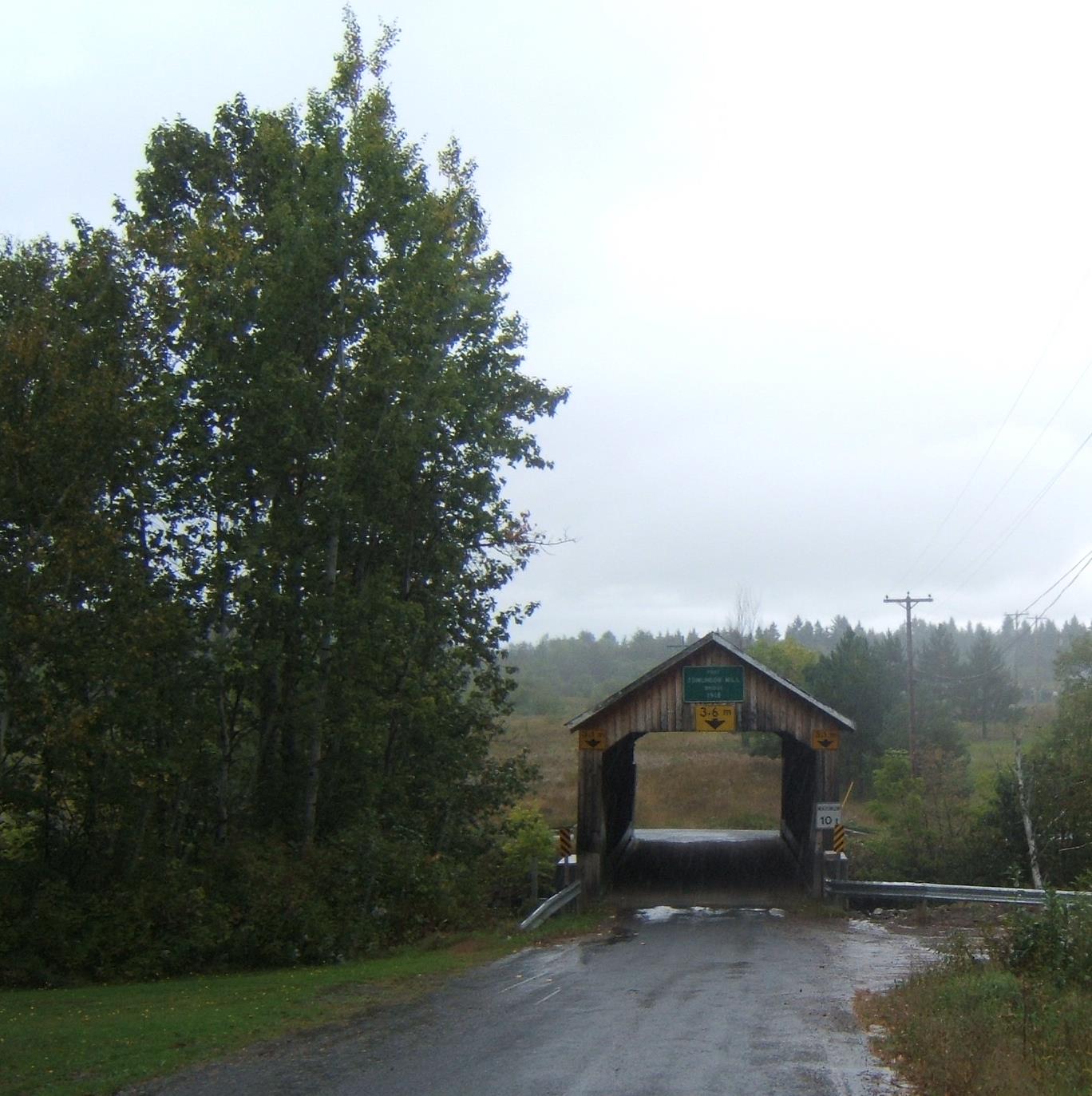
Odellach River #2 Covered Bridge, Victoria County, New Brunswick
~
The sound of the nearby mill is part of the personality of the bridge. A small distance away are the foundations for an old water mill.
~
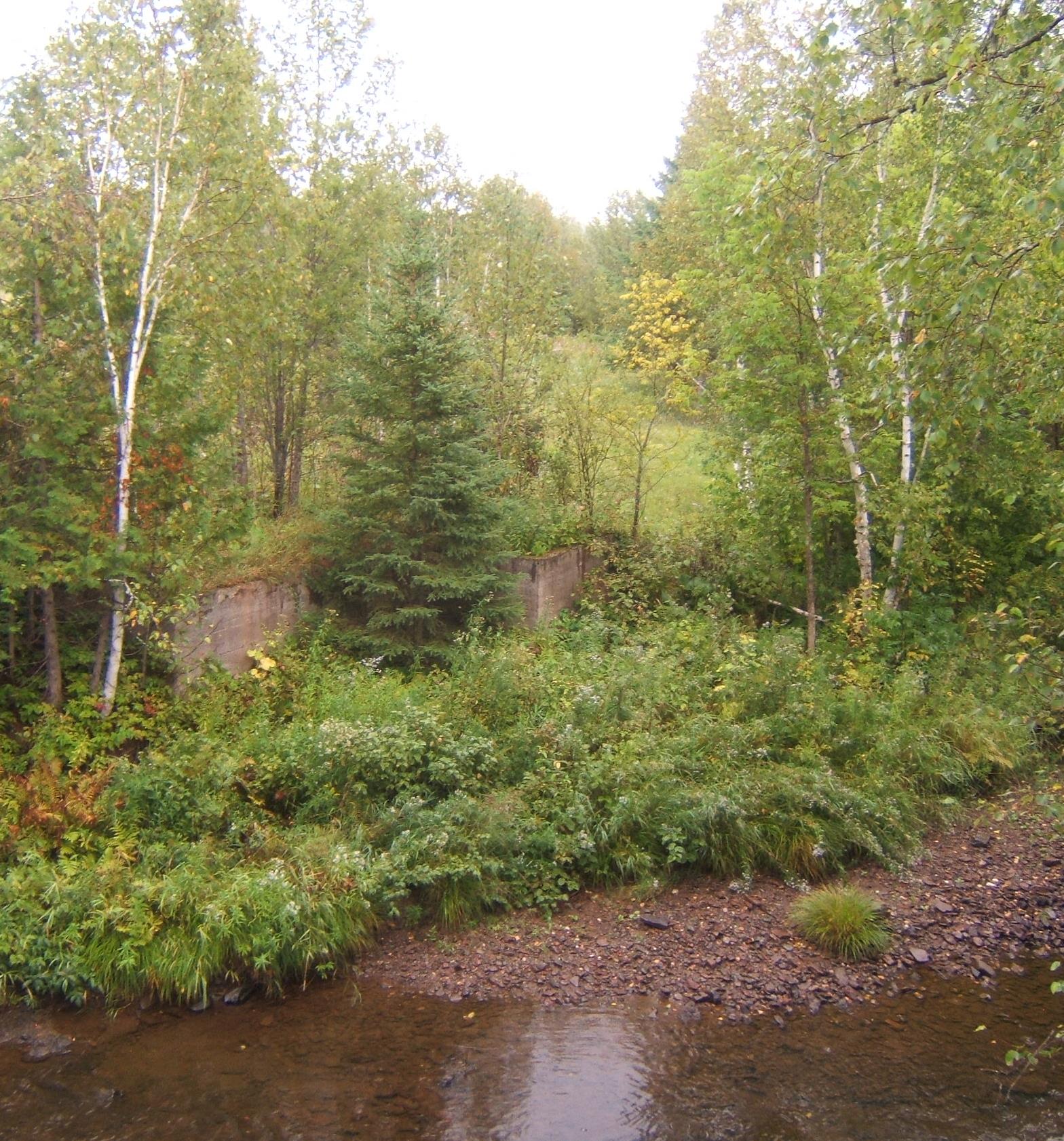
old mill foundation – Odellach River #2 Covered Bridge
~
Every covered bridge has a record of people who have visited. Some carve initials, some make brief statements, some draw. I know from finding my own initials 20 years after I left them, that these records persist.
~

CT in the Odellach River #2 Covered Bridge
~

CT and RF in the Odellach River #2 Bridge
~
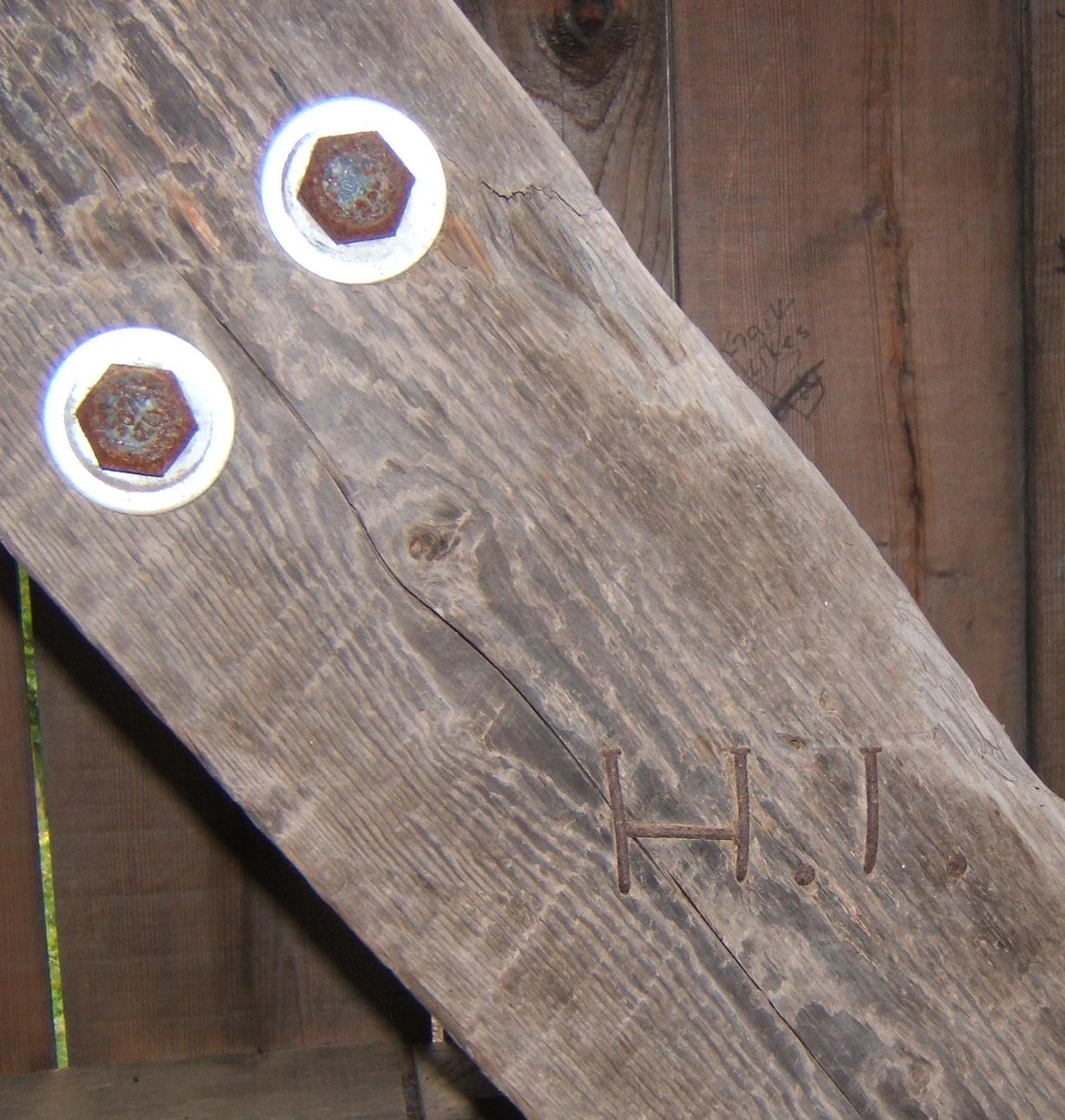
initials made with nails in the Odellach River #2 Covered Bridge
~

how was the summer ‘orange’ ? … who was Laurel?
~

who were the ‘Hillbilly Bikrs’ ?
~

graffiti, names and initials left on a wall of the Odellach River #2 Covered Bridge
~
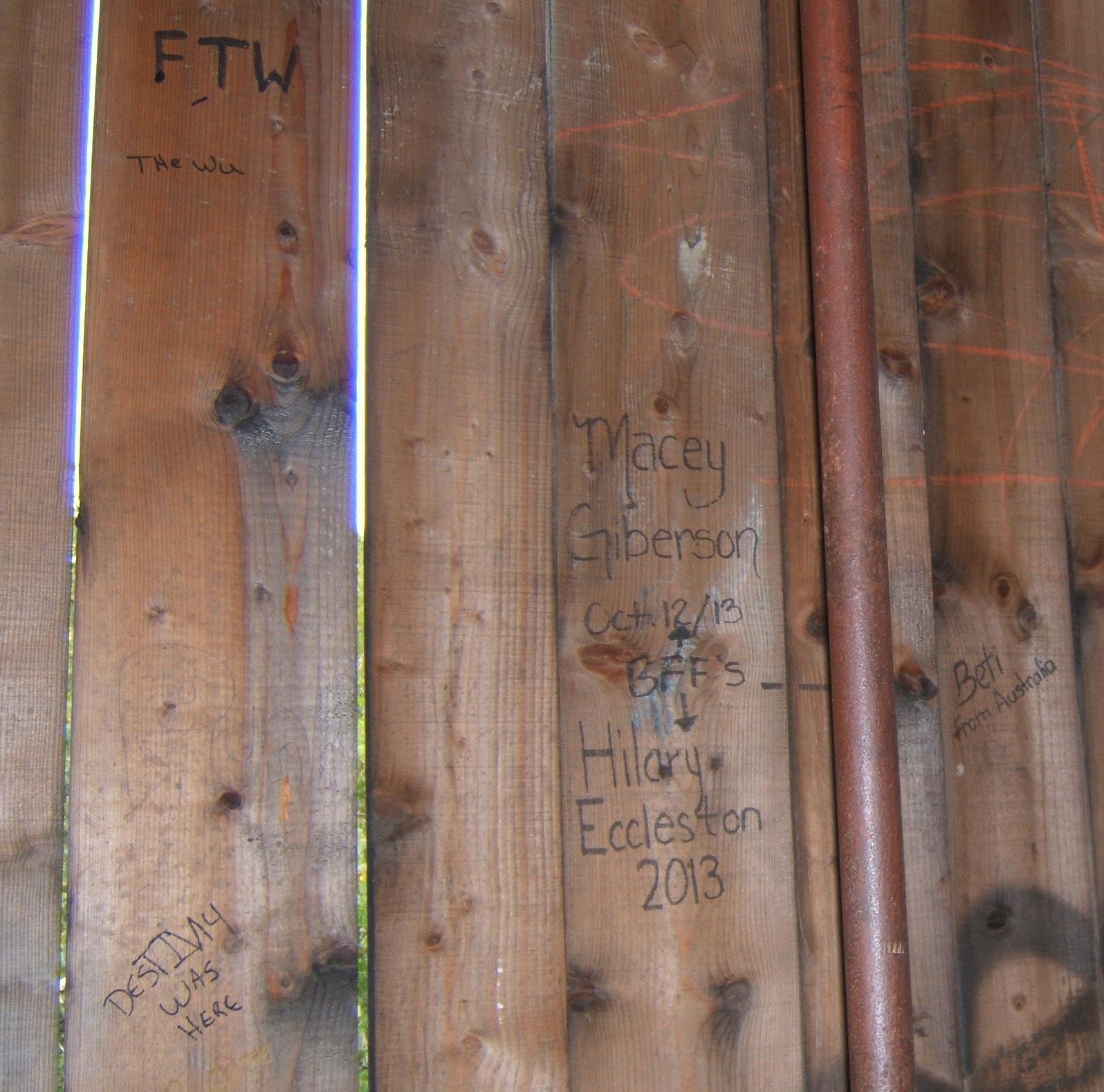
Beti from Australia … Hilary and Macey were BFFs … Destiny was here … FTW – ‘the Wu’
~

some of the inner structure of the Odellach River #2 Covered Bridge, Victoria County, New Brunswick
~
Have you ever left your initials or a message for others to find?
~
Copyright 2015 Jane Tims
in the shelter of the covered bridge – update
Although my blog has been a bit silent this fall, I have been working! Among other projects, I am making great progress on my poetry manuscript ‘in the shelter of the covered bridge’.
~

~
To provide experiences and inventory the plants and animals living in and around covered bridges in the province, my husband and I have visited 28 covered bridges in the drainage basin of the Saint John River and 5 covered bridges in Charlotte and Westmorland Counties. I have a few more bridges to visit, but to give a little seasonal diversity to my project, I’ll travel to these in early winter.
~

Reading at WordsFall 2015, an annual event of the New Brunswick Writers’ Federation (photo by WFNB)
~
As a result of these bridge visits, I’ve written 60 poems. I read five of these last weekend at two writers’ events: WordsFall (Writers’ Federation of New Brunswick http://wfnb.ca/ ) and Odd Sundays (a monthly Fredericton reading event). The poems include the results of my work on different poetic forms – in the manuscript I have examples of the sonnet, ghazal, haiku, tanka and villanelle.
~
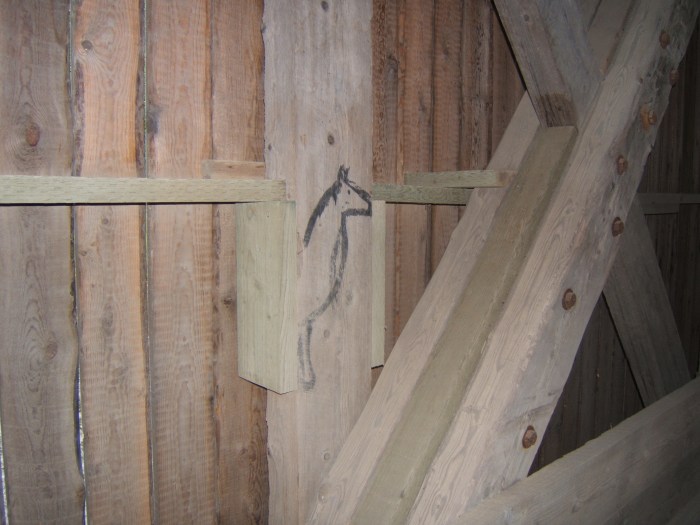
black horse painted in the Quisibis River Covered Bridge (Pont Lavoie)
~
As I develop the manuscript, and to help organize the poems, I have sorted them into categories:
- gaps between boards (deterioration and loss)
- liminal, shore to shore (transitions)
- grit of a blade (carvings and history)
- notch of a lily pad (habitat)
- a blade of grass between thumbs (mystery)
- heads of timothy (miscellaneous)
- a loose board rattles (sounds)
~
Writing these poems has given me a glimpse into the living world of the covered bridge. We may cross a bridge daily but it takes a little time to know a bridge and discover the life there. Most of the animals living in or around a covered bridge are timid or hidden, and avoid human contact. The plants provide the setting for the bridge but there is a pattern to the places they grow and some will only be seen if visitors to the bridge slow down. And carved in the beams are the stories of the humans who have been part of the history of the covered bridge.
~

Baker Brook #2 Covered Bridge – a deer and a crow are watching us from the hay field
~
Copyright 2015 Jane Tims
in the shelter of the covered bridge – a ghazal
Yesterday, we drove to see a few bridges in north-western New Brunswick. One of these was the North Becaguimec River #4 (Ellis Covered Bridge) in Carleton County.
~
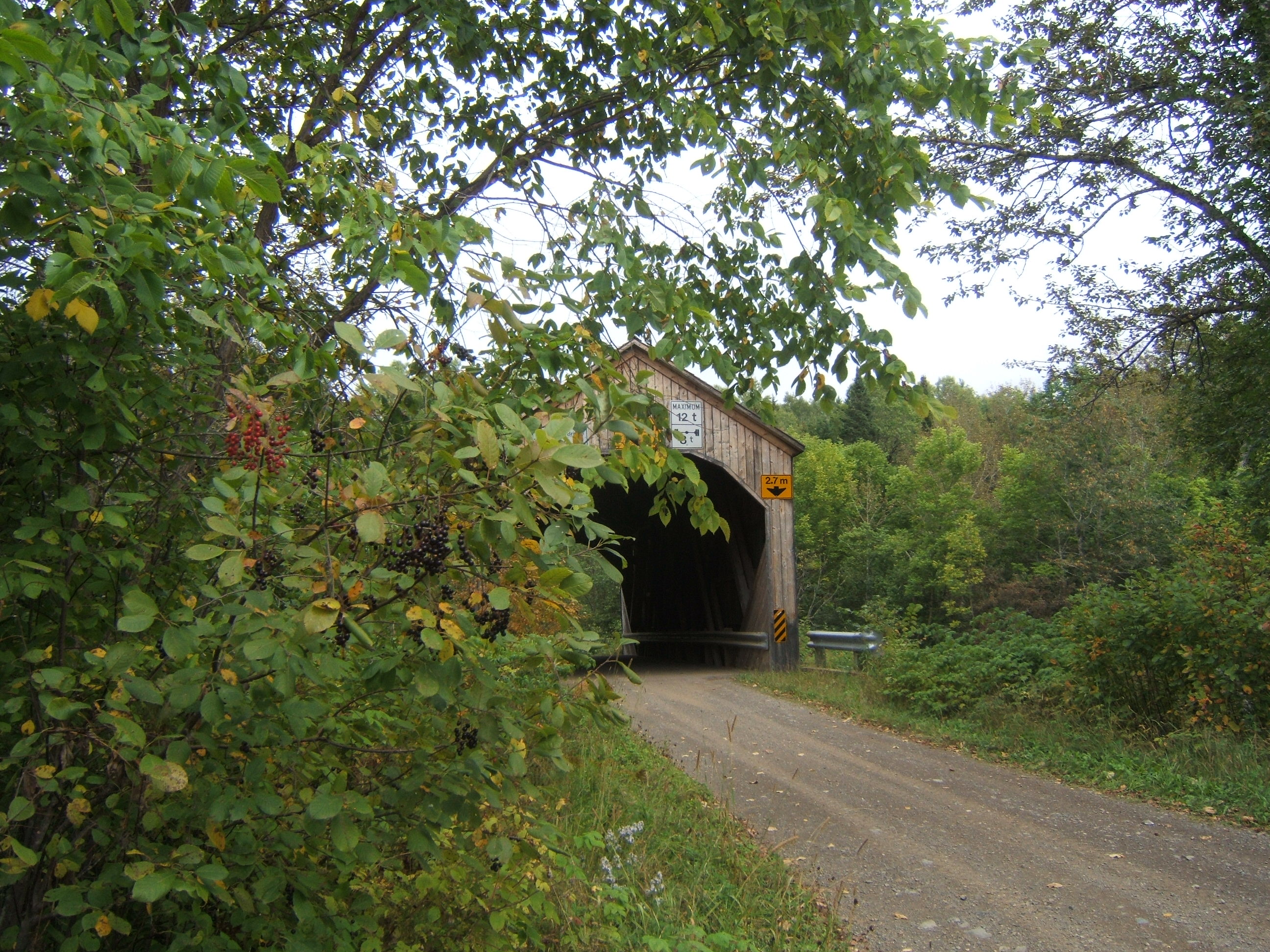
the North Becaguimec River #4 (Ellis Covered Bridge) in Carleton County (Sept 2015)
~
The bridge was built in 1909 and is 18.3 meters long. It shows lots of recent maintenance, including a shingled roof and new timbers and boards in the roof area.
~
The late summer season dominates the atmosphere of the bridges we are visiting. At this bridge, the choke cherries are black, the purple asters are the dominant flower and clematis has set its fuzzy balls of seed.
~

the North Becaguimec River
~
The North Becaguimec is a rocky brook, very shallow after a dry summer.
~
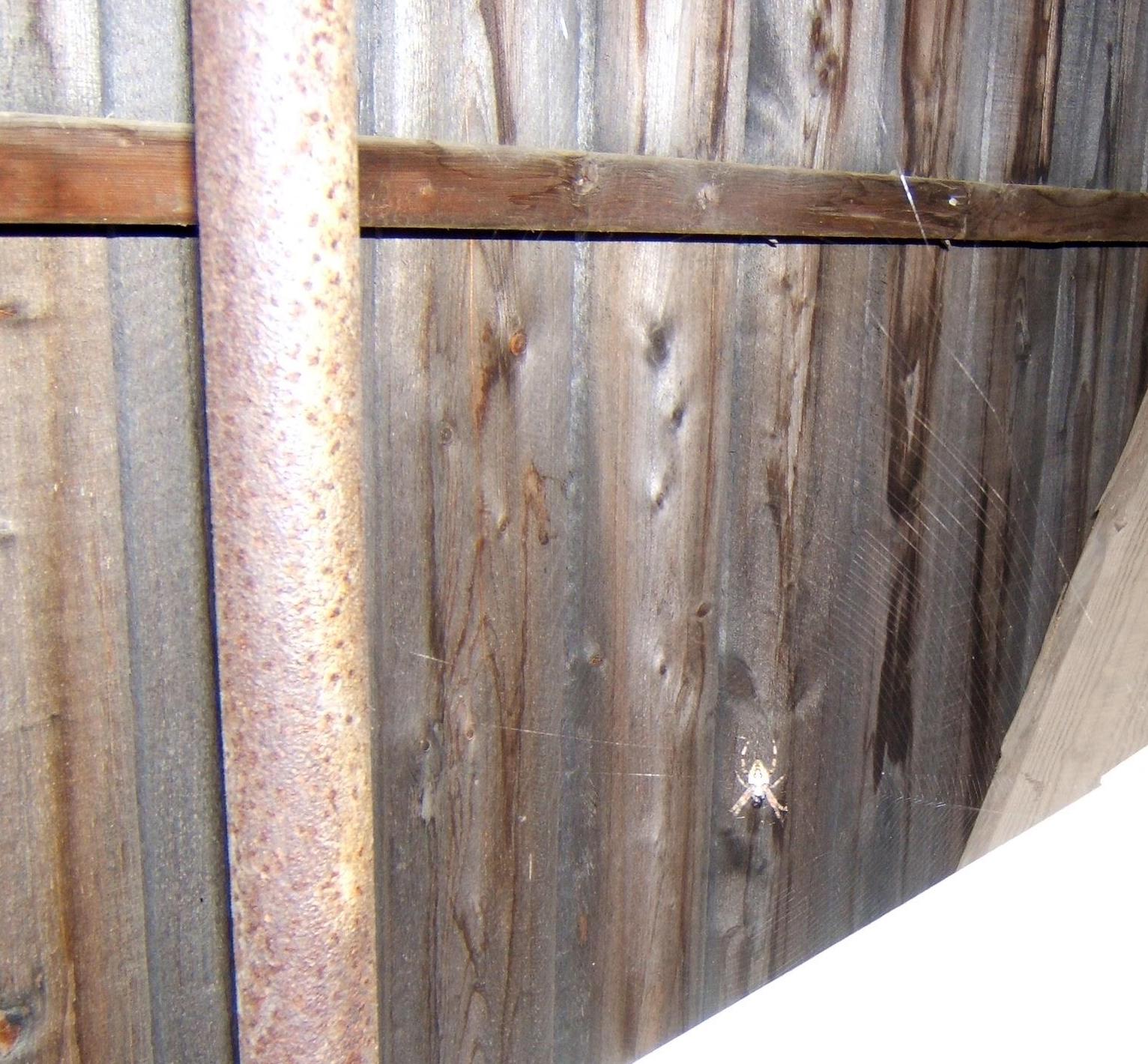
Although there are usually lots of spider webs in a covered bridge, this was the first time I saw a spider. The spider was still and stubborn, not moving for me or my camera.
~
~
As I have said before, in making my manuscript of poems about plants and animals living in the shelter of the covered bridge, I have been trying some different poetic forms. This is my first ghazal.
~
Ghazals are meant to tell of the pain of loss and the triumph of love in spite of loss. A ghazal consists of 5-15 couplets. The second line of each couplet repeats a refrain established in the first couplet. The poem can follow any meter but the meter must stay consistent in every line of the poem.
~
~
the spider waits
~
North Becaguimec River #4 (Ellis Covered Bridge)
~
in the covered bridge a spider weaves and sets its bait
between the beams, and confident, the spider waits
~
cedar shingles, boards replaced and rafters new
but traffic sparse, and in the web the spider waits
~
aster, shepherd’s purse and mullein crowd the road
no risk from the press of tires, and the spider waits
~
after the flood, drifts of birch and maple high
on the river shore, the spider mends its web and waits
~
a skater bug steps and skips on the river’s skin and fears
the water’s dry, and in its web the spider waits
~
on aging crib work velvet moss and lichens grow
landscape formed on rotting wood, and the spider waits
~
years since they wrote their names on the wall of the covered bridge
crickets sing, and in its web the spider waits
~
~
Copyright 2015 Jane Tims
~




 nichepoetryandprose