Posts Tagged ‘history’
from the pages of an old diary – community
It is obvious from my great-aunt’s diaries, her community activities were as important to her as any other aspect of her work. This work was about people… about spending time with her friends and pursuing the idea of ‘many hands make light work’. She also had specific skills to contribute to the community. She loved to bake, sew, quilt and visit.
She belonged to three community groups:
- the Women’s Missionary Society (W.M.S.) – met on Tuesdays (about 23 women)
- the Red Cross – met on Fridays (about 9 women)
- the Xmas Club – met once per month (about 10 women)
The Red Cross worked on specific projects, for example a baby layette for a new mother, or a quilt for a family in need. The Red Cross had a room, perhaps in the Presbyterian church (on March 27, 1957 my great-aunt wrote, ‘ … I went to A.C.’s funeral up at our church. then went down to R.C. room and quilted for a while…’). She often mentions ‘binding’ a quilt at home as part of her contribution. The clubs also made quilts to raise money (a ‘square’ could be bought for $.10, April 12, 1957), and held rummage sales (June 1 and June 8, 1957).
The W.M.S. was associated with the Presbyterian Church and had a program each week. My great-aunt mentions preparing the ‘lesson’ with another woman. The group worked with the Red Cross to make quilts for charity (Dec. 3, 1954), and sent flowers to funerals (Nov. 18, 1954). They also interacted with the CGIT group (Canadian Girls in Training), a church-based program for girls 11-17 (April 2, 1957). I remember attending CGIT when I was in Junior High and according to the Internet, it continues today. When she writes about the W.M.S., my aunt always writes the ‘S’ as a dollar sign ($), suggesting she associated the group with money. She does not do this for her references to the R.H.S. [Regional High School)!
The Xmas (Christmas) Club met once a month at a member’s home. They held a summer picnic (July 22, 1954 and July 17, 1957) and a Christmas Dinner in early December where they exchanged presents (Dec. 6, 1954 and Dec. 2, 1957).
My great-aunt was also interested in the administrative side of these groups. She made note of how many attended and who missed each meeting, as well as attendance at community events and how much money was made.
In addition to her clubs, my great-aunt also did personal charity work, taking ginger ale to sick people on many occasions, making rolls and squares for various teas and meetings, and hemming sheets for the hospital (May 28, 1957). She was also a good neighbor, sharing a buttercup root with a friend, for example (May 19, 1954). It is noticable from the diaries that community members helped one another to get around, giving each other ‘lifts’. For example, she writes, ‘R. took M., M., [and] I down to Xmas Club… B. came for us.’
Another important weekly activity was going to church. My great-aunt and great-uncle attended church regularly, and sometimes went to other community churches for special occasions. At Easter in 1957, they drove to the Presbyterian Church in New Glasgow to see the 3000 white Easter lilies on display. She also attended the World Day of Prayer services (May 5, 1954, and May 8, 1957) and ‘read a piece’.
Reading my great-aunt’s diaries, I am left with an image of her place within the small community where she lived and the importance of the daily interactions among people. These interactions were the community life-blood, enabling people to keep communication going, to support community economies and to keep the population healthy and supported.
Compared to this, how do we contribute to our communities today?
~
~
reckoning the day
-respose to a diary entry for March 28, 1957
~
Thurs cold snow flurries. I finished cleaning kitchen. hemmed 4 sheets for hosp. I. G. here got my blue dress to fix. Mrs. C. called got sheets. H. B. here for Red Cross money. S. M. house burned.
– A.M.W.
~
they wait to collect
your phial of tears
chill at the doorstep
outside the heat dome
where snowflakes sizzle
a moment before they melt
~
twisted metal hangers, closet a shell
lined with ashes, empty of dresses
~
quilts and bed-sheets blackened, edges
hemmed in charcoal
~
kitchen the worst, paint curled
against metal, china charred
crockery smashed, the tines of forks
splayed every way
~
pattern on linoleum
scoured clean beneath layers
of flammable wax
~
~
© Jane Tims 2012
from the pages of an old diary – technology
The 1950’s were changing times. Families in North America were experiencing a post-war boom and the first influx of new technology. My great-aunt records some of this change in her diary.
Here are some of the entries for 1957:
Jan. 3 ‘car wouldn’t start’
Feb. 23 ‘I got my electric egg beater to-day’
March 10 ‘went over to A.J. in evening to see T.V.’
(her diary has several references to going to friend’s homes to watch T.V.)
May 1 ‘Electric men here from Pictou grounding the telephone.
will be safe from lightning.’
May 7 ‘… our T.V. came to Drug store through Simpson’s. $269.95′
May 11 ‘ B. [and] A. set the T.V. up. K., J. [and] I went to Forbes [a store]
they stayed til after 11 to see T.V.’ – after this, friends come regularly to watch
‘the fights’ (Aug. 3, 1957) or ‘wrestling’ (Sept. 21, 1957)
Aug 31 ‘…car not working…’
Sept. 3 ‘…took the car to a garage.’
Sept. 4 ‘…car not working…’
Sept.5 ‘…Dad [her husband] took car up to L.S. to fix…’
Oct. 13 ‘…Our T.V. went on the blink’ ( after this she has several entries where her nephew,
my uncle, drops in to fix the T.V., for example Oct. 20, 1957)
Oct. 27 ‘…were home alone all eve. listening to T.V.’
(note the used of the word ‘listening’ – they had listened to the radio)
~
A couple of entries for 1954 caught my eye:
Jan 4. ‘…lights were out a lot in eve.’
Aug. 16 ‘Did a big wash. wringer not working right…’
Sept. 27 ‘… did a small wash by hand…’
Oct. 4 ‘… S.M. came in eve [and] put new roller in washer.’
~
Today, our innovations come fast and furious. I sometimes wonder what the next really ‘new’ technology will be and how my great-aunt would have recorded it in her diary.
What are your technology milestones?
~
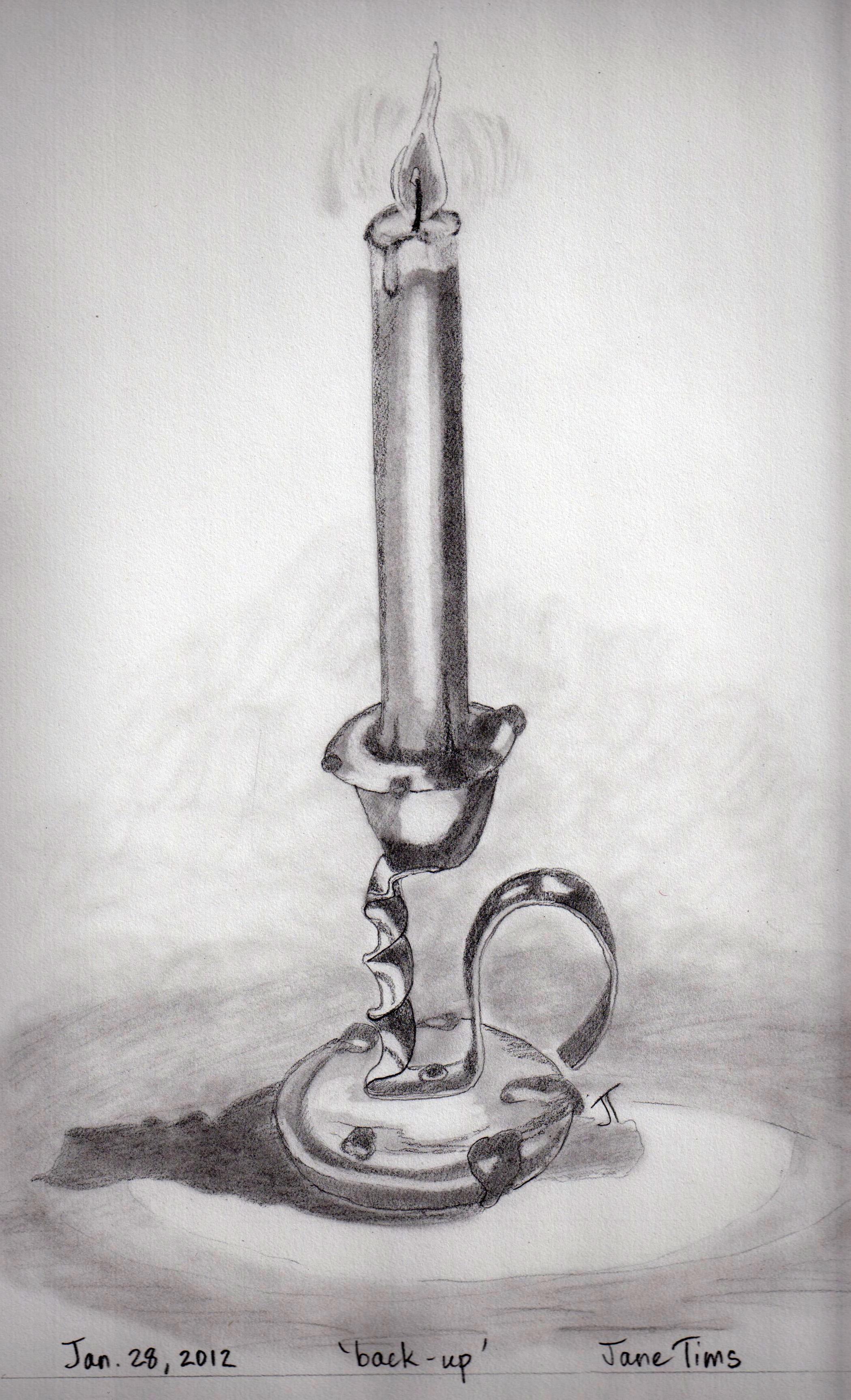
Copyright Jane Tims 2012
from the pages of an old diary – ironing day
Do people iron anymore? In these days of permanent press and busy scheduling, who even has an iron?
Until my husband retired last year, I ironed a shirt for him every work day for 30 years. They were permanent press shirts, too, but no one could ever remember to retrieve the shirt from the dryer when it could be hung up without wrinkles. And so, I ironed.
Most people grimace when I tell them this, but I found it an enjoyable task. It was soothing work, with the warmth of the iron, the cool of the fabric, the rhythmic slide of the iron back and forth, and the ironing of each part of the shirt, always in the same order.
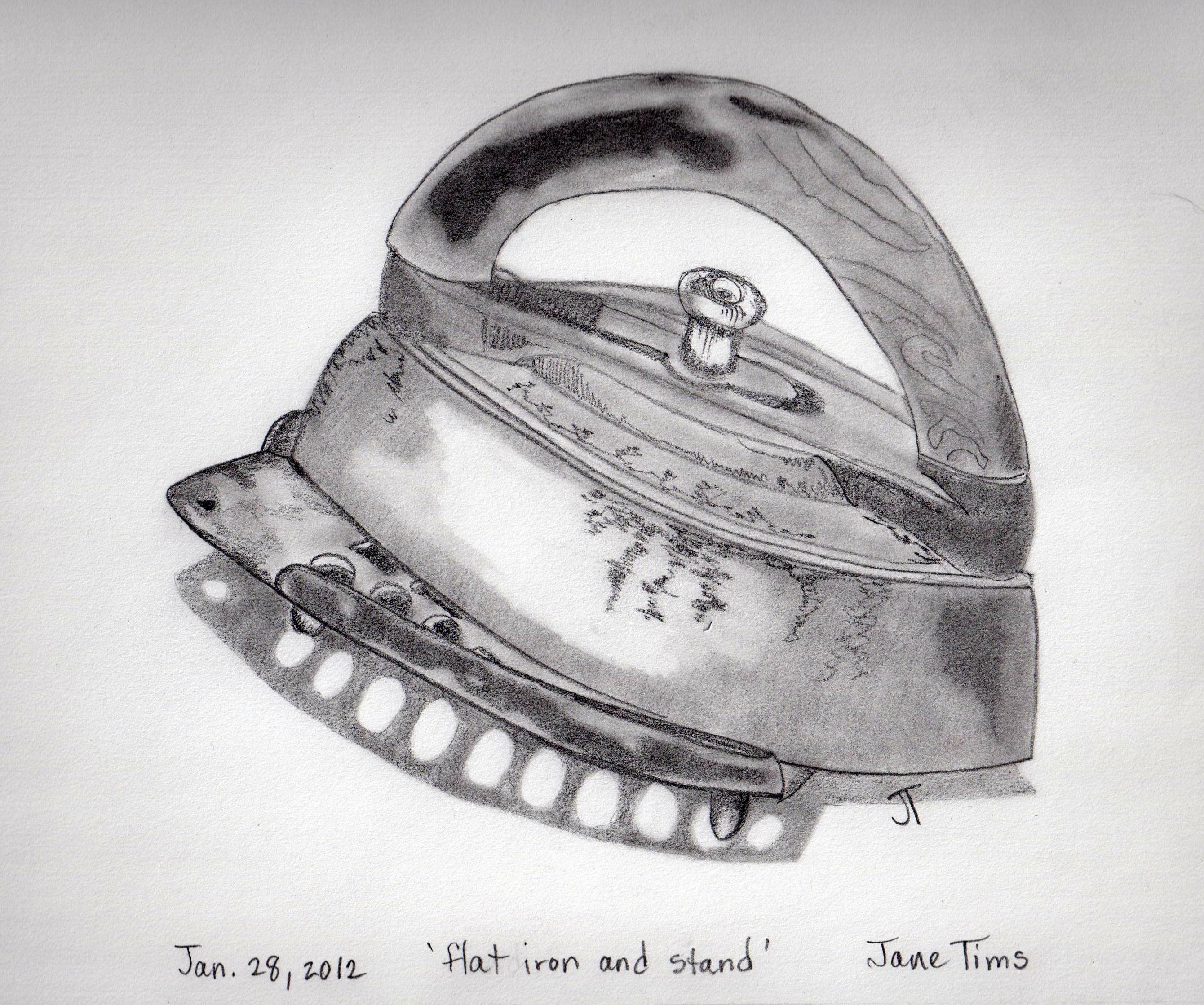
Ironing wasn’t always so easy. On our hearth are two flat irons and a stand, the ones my Mom’s family used for ironing when she was a little girl and they had no electrcity. Each flat iron could be fitted with a handle, and irons were exchanged as the first iron cooled and had to be replaced with the hot iron on the wood stove. Inattention would be rewarded by a neat triangle of burn on the ironed linens.
My great-aunt would have used an electric iron. In her diary, during 1957, an entry like ‘did a big wash and hung it out’ occurs approximately every second week (she and her husband lived alone, so this was probably an effective and efficient approach). In every case, the diary entry the following day says ‘did a big ironing’. In 1957, she did her ‘big ironing’ 25 times, a major task in her round of housework.
~
~
ironing day
~
a wedding band wears thin
endless washing of dishes
scrubbing of floors
holding wrists, stroking arms
and heads
~
worn as wooden handles
on the flat irons by the stove
hand clasps and presses
back and forth, the lift to test the heat
to fit a hotter iron from the fire
to seal the press, prevent the burn
~
a molecule of gold, residue
on every task
~
~
© Jane Tims 2012
from the pages of an old diary – spring cleaning
My great-aunt’s diary shows she cleaned her house with regularity. She had a big two-story house on the main street of the village, with a porch on the front. On the main floor the rooms included a kitchen, pantry, storeroom, dining room, small front room and sitting room. There was also a ‘little porch’ and a ‘little entry’ where the wood box was kept. Upstairs she had the main bedroom, a ‘spare room’, a bathroom, and other rooms, joined by a hall and a ‘little hall’. The house had a cellar, and an out-house.
Each year, she punctuated her regular cleaning with a vigorous bout of spring cleaning, beginning in late March and lasting through May. She also did another round of ‘doing up curtains’ and ‘cleaning storm windows’ in October. Her spring cleaning was methodical, involved a room or a couple of smaller rooms each day, and went from floor to ceiling. Painting was included as part of the process.
In 1957, the diary entries related to spring cleaning are:
Mar 26 ‘cleaned my kitchen ceiling walls’
April 1 ‘I painted some in pantry… I washed dining room ceiling.’
April 2 ‘I painted some this a.m.’
April 3 ‘I finished painting the pantry.’
April 5 ‘I cleaned china closet. linen drawers.’
(I have one item from her linens, an embroidered table runner with her initial)
April 8 ‘I painted one rocking chair.’
April 15 ‘I cleaned the small front room.’
April 16 ‘I cleaned sitting-room.’
April 17 ‘I cleaned dining-room.’
April 18 ‘I did the dining room curtains up also the tidies in rooms. went over the house. ’
April 27 ‘we took the storm windows off cleaned windows on the out side.
I also cleaned ½ store room.’
May 1 ‘I finished store-room cleaned bath room.’
May 6 ‘I did the spare room washed curtains got them up. ’
May 7 ‘I wash[ed] my bedroom curtains this a.m did them up this eve.’
May 8 ‘I cleaned the back front rooms upstairs. washed ceilings did the floors.’
May 14 ‘cleaned the bathroom little hall’
May 15 ‘cleaned hall stairs.’
May 21 ‘I cleaned little porch.’
May 23 ‘I cleaned the cellar
painted window sills upstairs windows wood-box down stairs in little entry.
also cleaned out-house.’
House cleaned, she turned her attention to the garden. On May 20, she wrote ‘I planted my glads dahlias.’ and on May 25, her husband made and painted a new flower box for her.
~
~
cobwebs
~
bits of cloud spellbound
by ceiling
they mesmerize
and float, dust appended
to spider’s web, thought appended
to tongue, nothing built on nothingness
rumours banished by a broom
~
© Jane Tims 2012

a linen table runner, embroidered with scalloped edges and her initial, made by my great-aunt
from the pages of an old diary – the weather
For any given date, the first entry in my great-aunt’s diary is a note about the weather. Weather was important to my great-aunt. It dictated what could be done during the day, if a wash could be put on the line, if she could go out walking to visit family and friends, and if a fire had to be kept going.
She described the weather in various ways: ‘nice fine day’, not very cold’, ‘dark day’, ‘fine very cold’. Sometimes it just says ‘nice day’.
Bad weather was sometimes called a ‘dirty cold day’ (April 11, 1957).
Some days were described in a bit of detail. On September 23, 1957, she wrote, ‘fine in the morning very windy cloudy in late p.m.’ On March 20, 1957, she wrote ‘a big snow storm on drifting and blowing.’ March 21, 1957, the first day of spring, says ‘roads all blocked still snowing some’.
Christmas Day, December 25, 1957, was ‘quite cold, a few snowflurries’.
On November 26, 1957, it was so cold, she wrote ‘I washed, clothes froze before I could get them on the line’.
It might be interesting to compare the actual weather records for 1957 with the weather she recorded!
~
~
September storm
-response to a diary entry for September 5, 1957
~
Thurs. rained hard last nt [night] also thunder and lightning.
Dad took car up to L.S. to fix. I made dough-nuts [and]
biscuits, did a small wash. went up street.
– A.M.W.
~
last night dismal, thunder wobbled
the windows, a leak
in the pantry, the rain in curtains
across the yard, forked lightning
the clothes pole vulnerable
car would not start, the driveway in runnels
freezer and the day’s baking
at the mercy of indecisive
electricity
~
~
© Jane Tims 2012

- socks and mittens knit by my grandmother (my great-aunt’s sister)
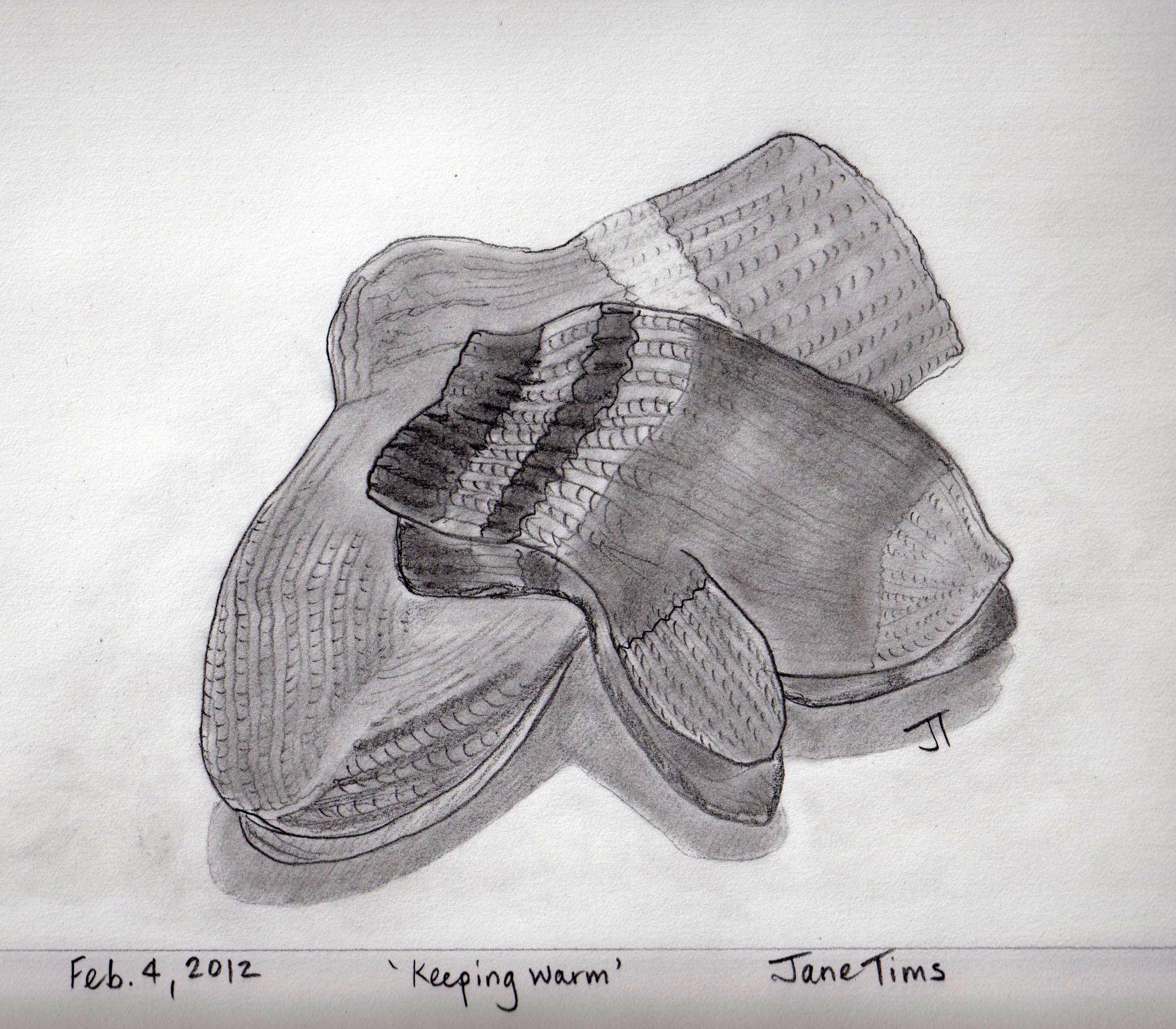
Copyright Jane Tims 2012
from the pages of an old diary – words about women’s work
I have been thinking a lot about ‘women’s domestic work’ these days. This not only because I do some housework myself from time to time (!), but because I am taking a History course – “Canadian Women’s History”.
One of the assignments for the course is to read a woman’s diary or journal and learn about what life was like for her through her words. I am lucky to have a set of six five-year diaries from my great-aunt who lived in Nova Scotia and I have decided to look at her diaries for my project. The diaries cover the years from 1944 to 1972 . Since I was born in 1954, I have chosen 1954 and 1957 as years to study.
Her diary for a particular year is a simple record of her daily activities. Simple, but what a lot of information is found in a few lines of text!
I have reviewed all of her entries for the year 1957 and find she covers the following topics in her entries:
- the weather
- people who visited
- people she visited
- housework done (she includes her husband’s work around the house)
- community work done
- community events (such as funerals or weddings)
- letters written or received
- special trips
- unexpected events (such as the car breaking down)
- family health
One thing I notice about her diaries, is her faithfulness in making an entry every day for 29 years! So many diaries I have begun fizzle after the first month or so of writing!
Another aspect is the value of her words. Over 50 years later, I can still find helpful advice in the way she did her work and the emphasis she put on participating in her community. I can find specific information of the birth dates of relatives or the date our family arrived for our summer vacation in a particular year. In addition, for anyone interested in the daily life of women in the 20th century, a set of diaries like hers is an invaluable resource and window into history.
Over the next few posts, I am going to look at various aspects of the daily life of my great-aunt and consider how similar or different life is for me today.
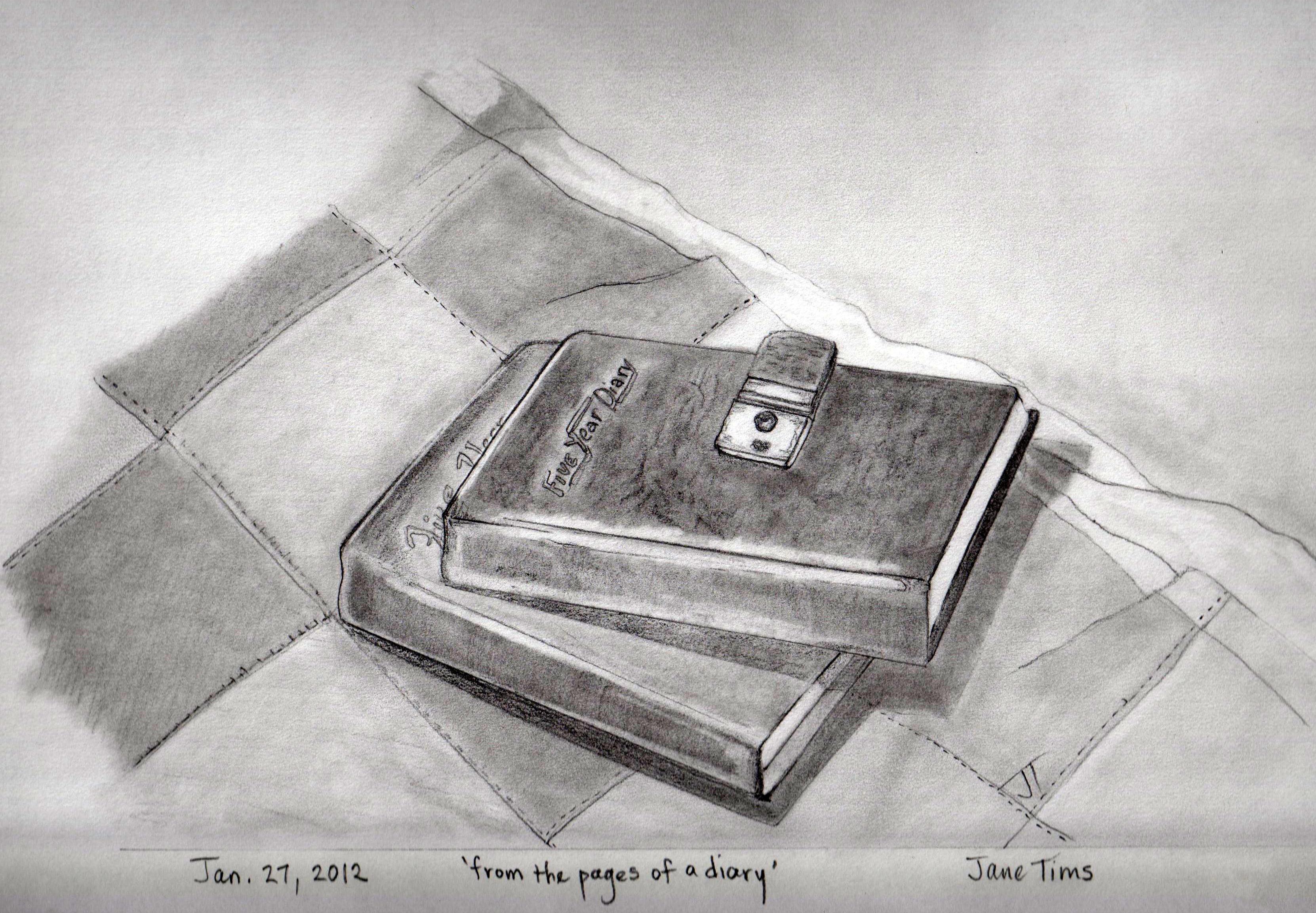
two of the six diaries my great-aunt wrote from 1944 to 1972 ... the quilt is one she made during the last years of her life
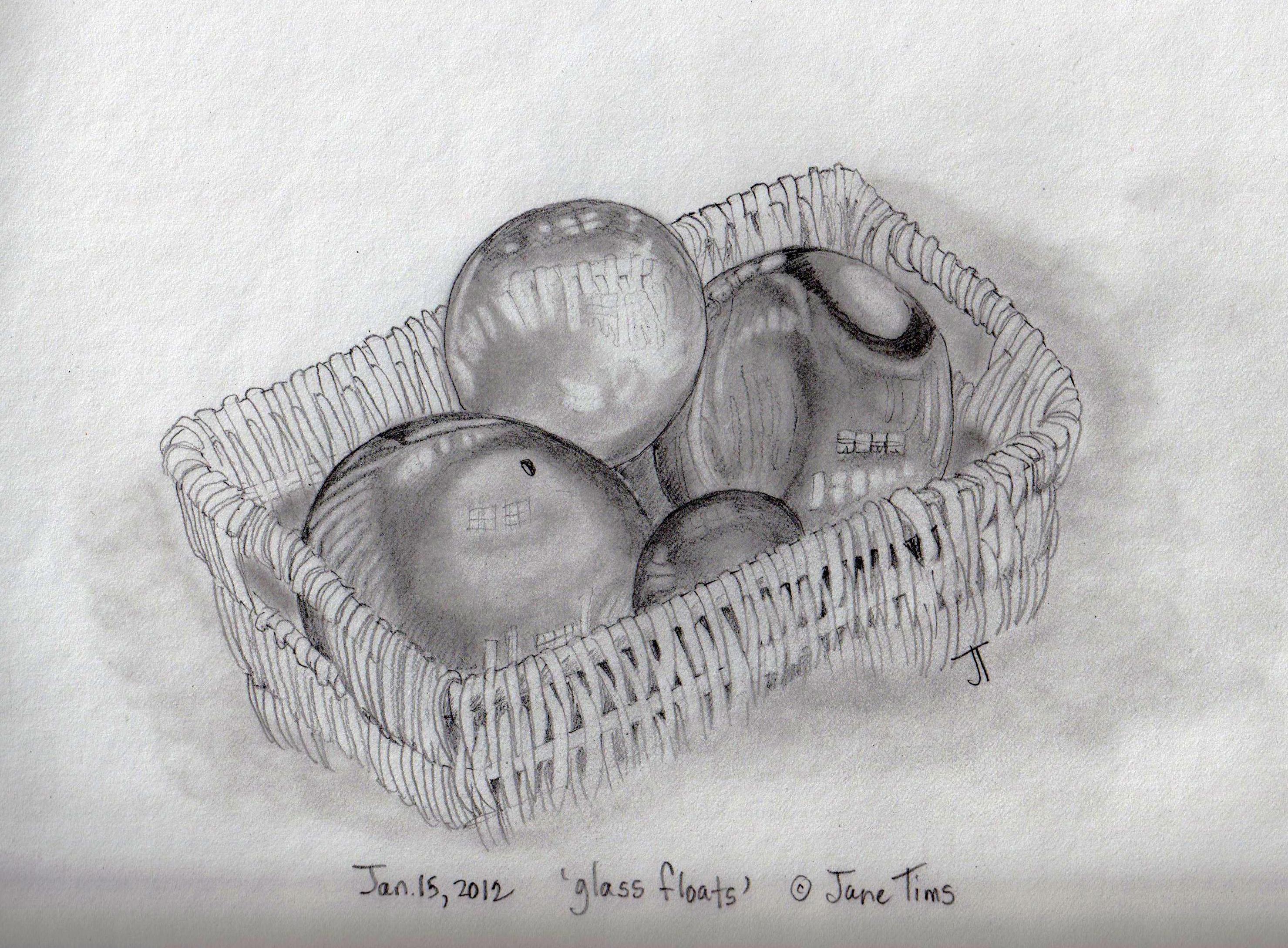
eight days – glass floats
In days before plastic and styrofoam, fishermen used glass and wood to make floats to keep their nets buoyant.
These floats are colorful symbols of the people who make their livelihood from the sea. In fishing communities in the Maritimes, we often see fences and walls festooned with painted wooden floats and buoys.
Glass floats are rarer because they are so breakable. At home, my Dad’s collection of sea shells was always accompanied by a couple of glass floats he found at auctions. On my piano, I have a small collection of glass floats in my favorite color, green.
The tradition lives into the next generation… when I visited my family in Ontario for eight days, earlier this month, I was delighted to see a basket of variously-colored glass floats on the hearth of the wood stove.
~
~
glass floats
~
the fog’s still glow
penetrates glass
and air incorporated
an age ago
~
weightless, flamboyant
on salt water
swell
~
glass inflation
tethered by hemp
on an ocean
whipped to froth
~
~
© Jane Tims 2012
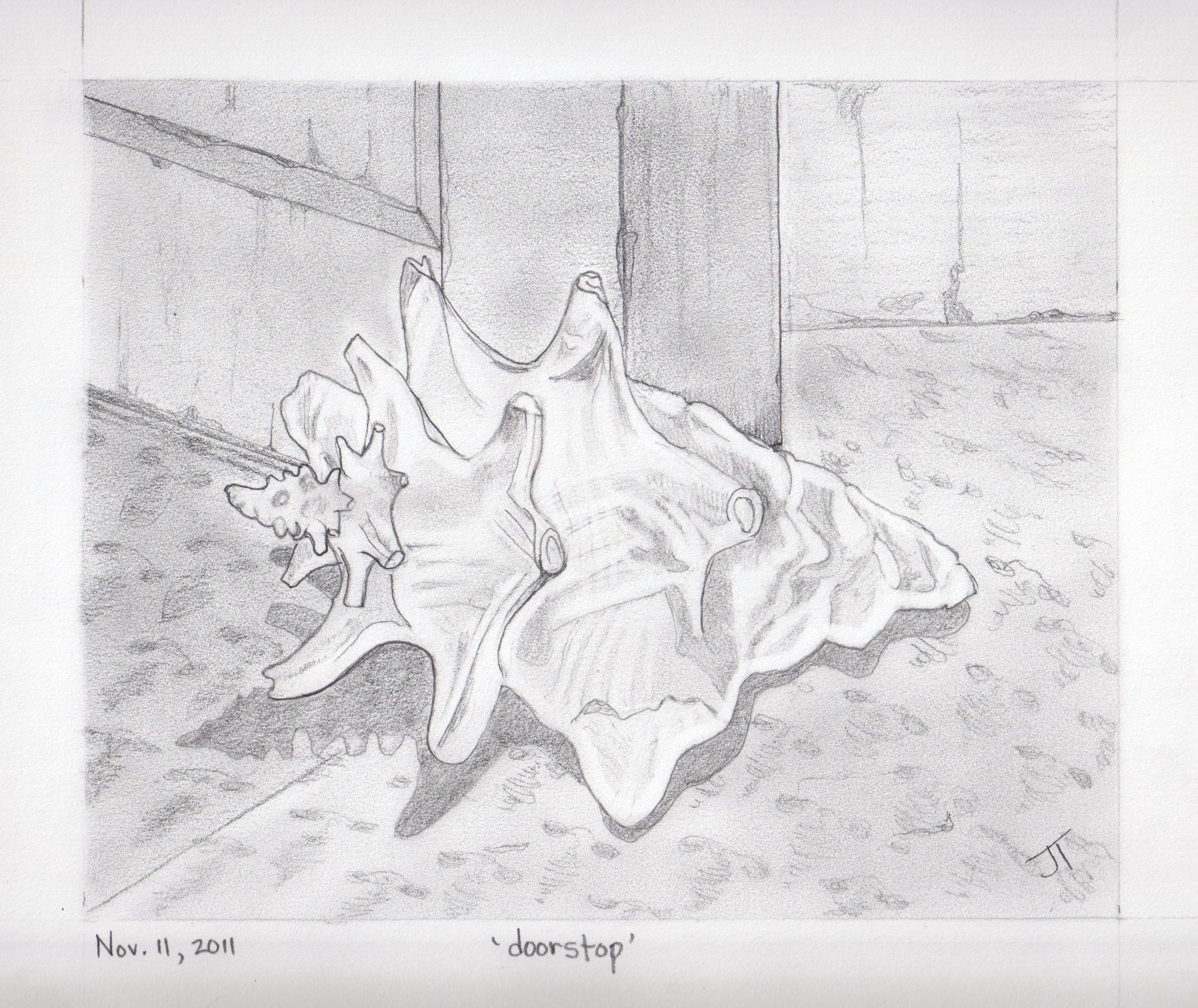
a conch shell doorstop
Do you have a conch shell for a doorstop in your home?
If you visit a farm or home museum in the Maritime Provinces (Nova Scotia, New Brunswick or Prince Edward Island), look down as you enter the house. You will often see a large sea shell used as a doorstop. These are usually a conch-type shell (the Queen Conch is a large Caribbean sea-snail). The shells were usually brought to maritime doorways by seafarers who collected them on their travels.
My grandfather’s house had one of these shells, a large white conch with a pearly pink interior and whorls of spines. Always on duty at the door of the glassed-in porch, it was an imported marvel of the exotic seas.
I remember my Dad holding it to my ear, saying, “listen”. From deep within the shell came the steady hum of the ocean, like the sound of waves advancing and pulling back from the shore.
This shell was part of my Dad’s life, growing up in the big farmhouse. As an adult, Dad gradually built his own collection of sea shells, large and small, usually buying them at auctions. A couple of the large shells are now in my own home. When I am far from the ocean, I can still lift one of those shells to my ear and hear its eternal roar.
~
doorstop
~
kitchen door kept
open with a conch shell
stop
~
spines cropped
by incoming and outgoing
careless cousins
~
ignore
complaining ocean
captured roar
~
© Jane Tims 2011
Copyright Jane Tims 2011
measuring my space
Niche space can actually be measured. Biologists and others apply a technique called ‘niche width analysis’ to determine the characteristics of a niche. This analysis defines aspects of ‘niche’ such as climate, food use, temperature, moisture, and so on.
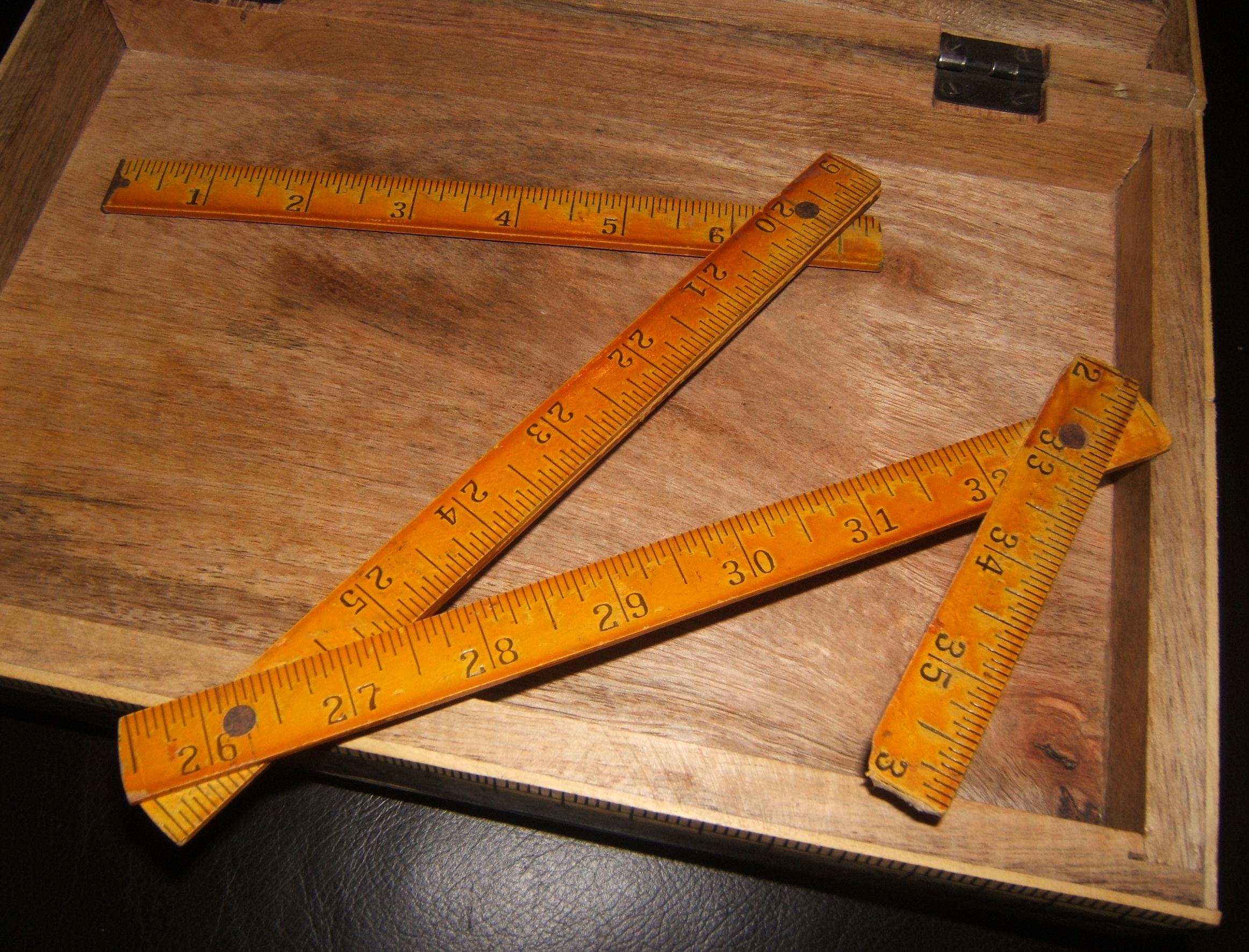
One of the characteristics of my niche is – I love collections. My favorite collection is my handful of jointed rulers. I might not be able to measure every aspect of my ‘niche width’ with my collection of rulers, but I can measure any aspect of its linear distance!
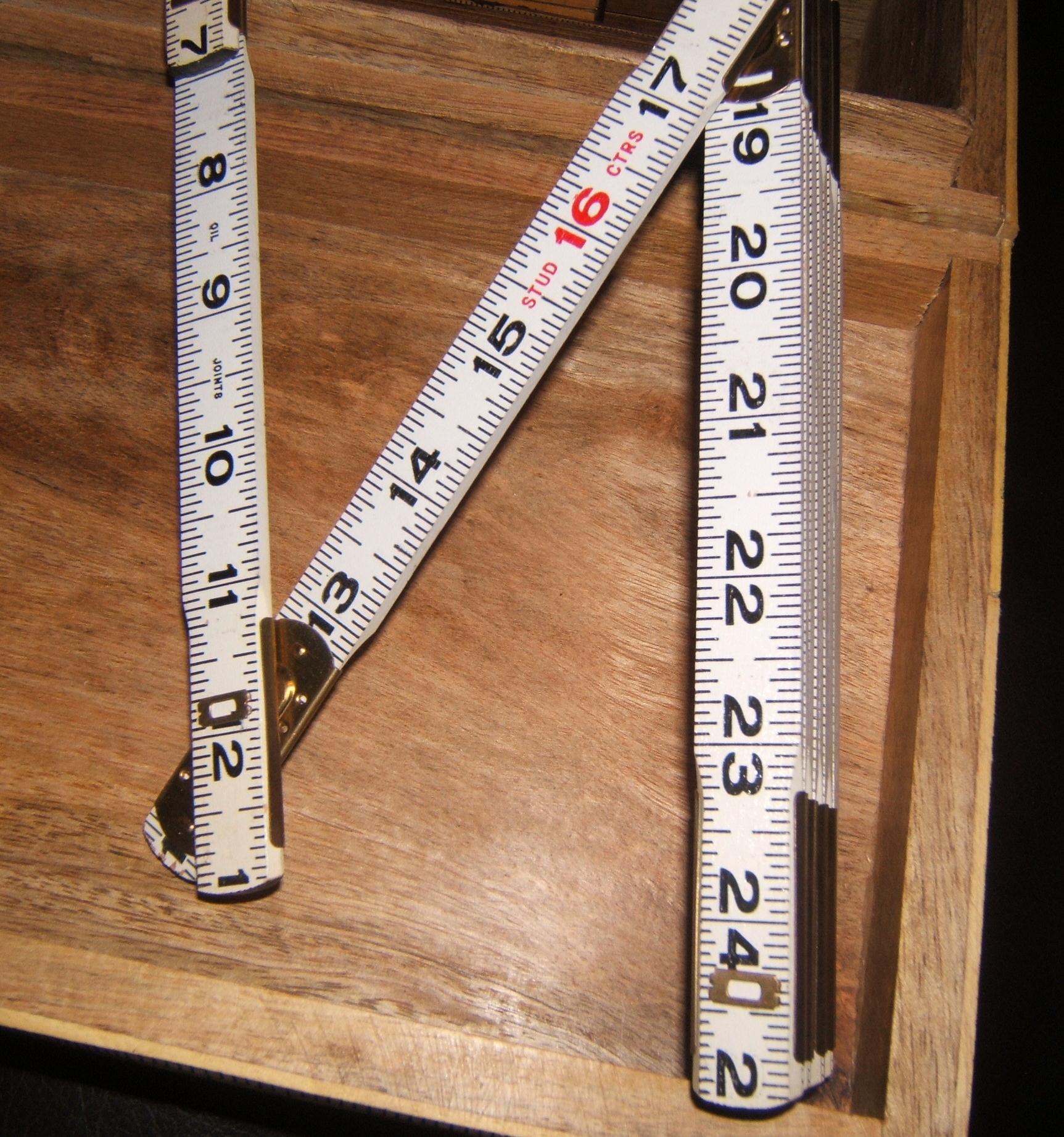
My collection of jointed rulers was given to me by my Dad. He and Mom loved to go to country auctions and they often bought items for me and my sister and brothers. Dad gave me my first jointed ruler for Christmas and then, over the years, added to my collection, one ruler at a time. The rulers were especially meaningful because my Dad was a wonderful carpenter and came from a long line of carpenters:
- my great-great-great grandfather, ‘killed-by-lightning’ William
- my great-great grandfather, ‘shipwrecked’ William (see my post ‘Briar Island Rock #1, #2 and #3′ of December 2, 2011 under the category ‘family history’)
- my great-grandfather, ‘kneeled-on-his-beard-and-couldn’t-rise’ Esau
- my grandfather Robert
- my Dad
- my brothers and sister and me (my husband and I built our own house).
I keep my rulers in a box made of conventional rulers, and I love to take them out and look at them.

Jointed rulers have existed for a long time. They are listed in the 1813 book The Circle of the Mechanical Arts by Thomas Martin (London).

a Plate from Martin, 1813, showing a jointed 'rule' (item # 38)
Jointed rulers are not used very often by carpenters of today since the tape-measure is so much easier to store. However, plumbers still use folding rulers because they can measure twisting pipes.
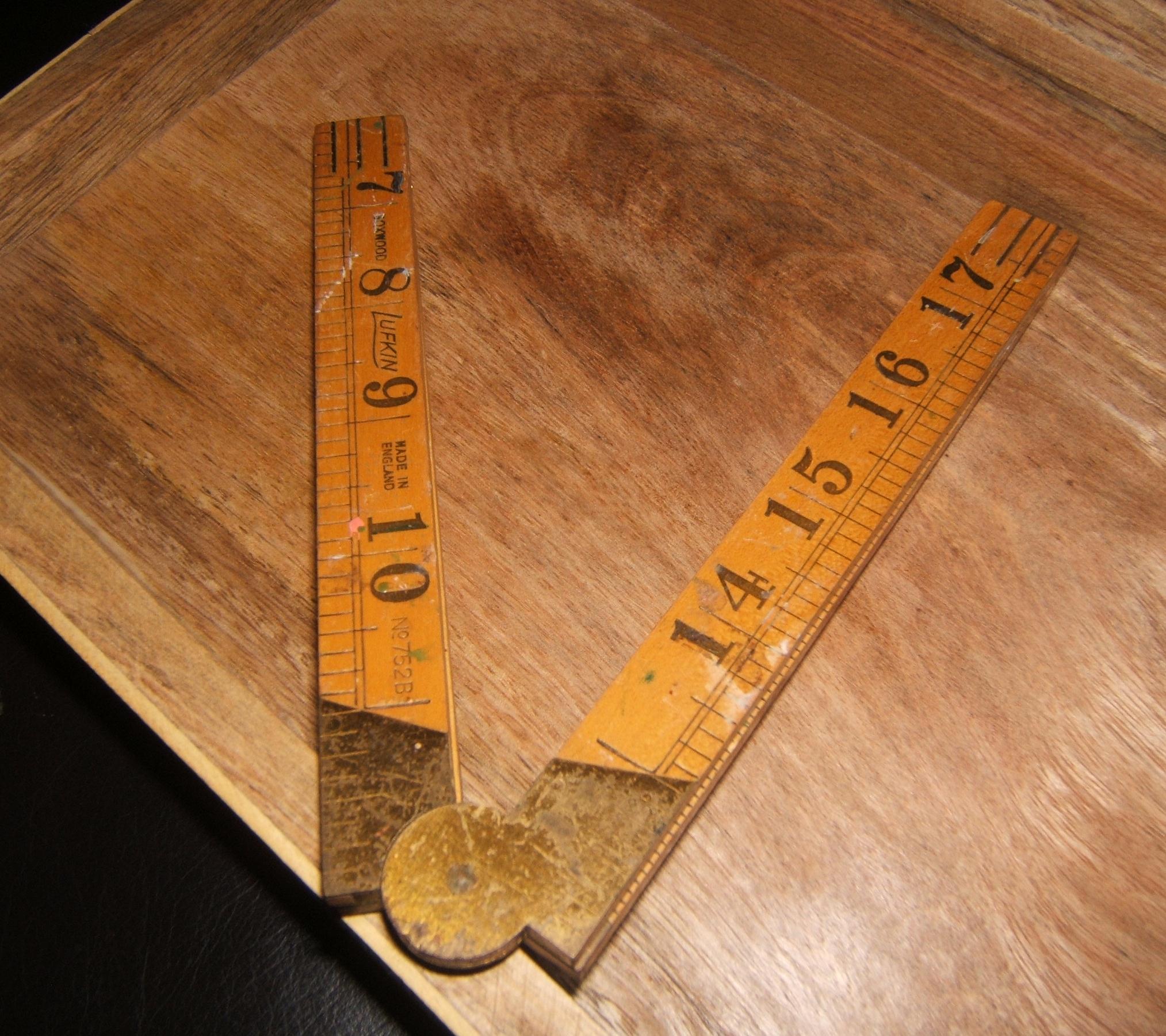
Most of my jointed rulers are made of wood with joints of brass. They can be folded away quite compactly when not in use, and unfolded when they are needed. Unfolded, they have a spidery quality. One of my favorites has a leveling glass built in…
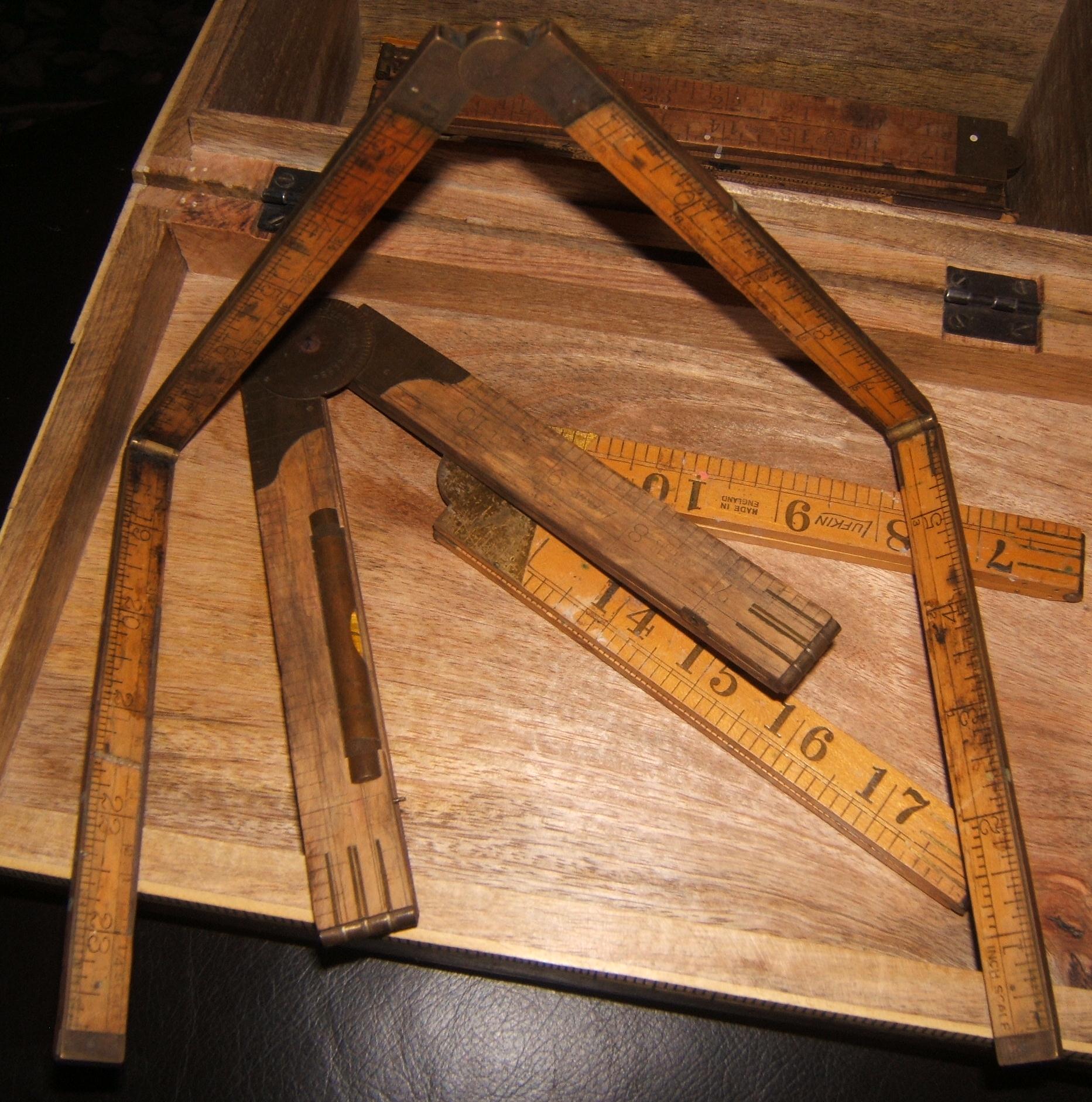
They are precisely made and have the combined beauty of varnished or painted wood, painted numbers, shiny metal and ‘mechanism’.

~
Great Blue Heron and reflection
~
on water, bent legs unite two images
of heron, brass connections
varnished wood
~
jointed rulers unfold, legs
disconnect, images detach
concentric circles swell
~
distance and diameter measured
between droplets
and trailing toes
~
© Jane Tims 2011

Briar Island Rock #4

~
~
jointed ruler
(Wreck of the Trafalgar, 1817)
~
the ship is broken on rocks
and we leave in fog
I hold my brother’s hand
we stumble up the shore
in a yellow room of fog
it stumbles with us
they set the baggage down
together, folded
we wait
~
my step-father
pats my mother’s hand
leaves to talk with the Captain
the ship is lost
I look up at my mother
she watches him go, her lips move
she says we will lie in green pastures
~
I look for grass but only see
black rock and grinning fog
lanterns and men calling
my brother sniffs a little
in my pocket I clutch my father’s jointed ruler
he was a carpenter, would have fixed the hole
the mate says
there’s no going back to her now
we stay where we are
folded in a yellow room
luggage at our feet
~
the walls move
the ruler opens
I see the ship
black hull held high
on dark and pointed rock
against the early morning sky
white waves beyond
the ruler closes
~
pink and yellow mix, and the room
is the color of pumpkin
the ruler opens and I know
the black shore has bristles
I heard the mate call it
Briar Island
~
the rock I stand on tips a bit
I step down
the rock is wet and grey
five sides
a funny-looking stone
fits with other stones
strange puzzle
~
I take my ruler
help it to unfold
I measure the rock
I make it jiggle and my brother smiles
a little smile
the ruler folds, unfolds, the room expands
I see my step-father’s uneven walk
across uneven stones
~
~
Copyright 2011, Jane Tims





 nichepoetryandprose