Posts Tagged ‘Halley’s Comet’
places off-planet #3 – Halley’s Comet 1986
Halley’s Comet, first recorded by astronomers in 240 BCE, has been a regular visitor through the ages, although people did not realise they were seeing the same comet until astronomer Edmund Halley determined this in 1705. Halley’s Comet makes an elliptical orbit of the sun and returns to view approximately every 75 years. It was last seen in 1986. Halley’s Comet is composed of dust, ice water and other frozen gasses, and was described by astronomer Fred Whipple as a ‘dirty snowball’. Its nucleus is 15 km long, 8 km wide and 8 km thick; its tail is as much as 100 million km long!
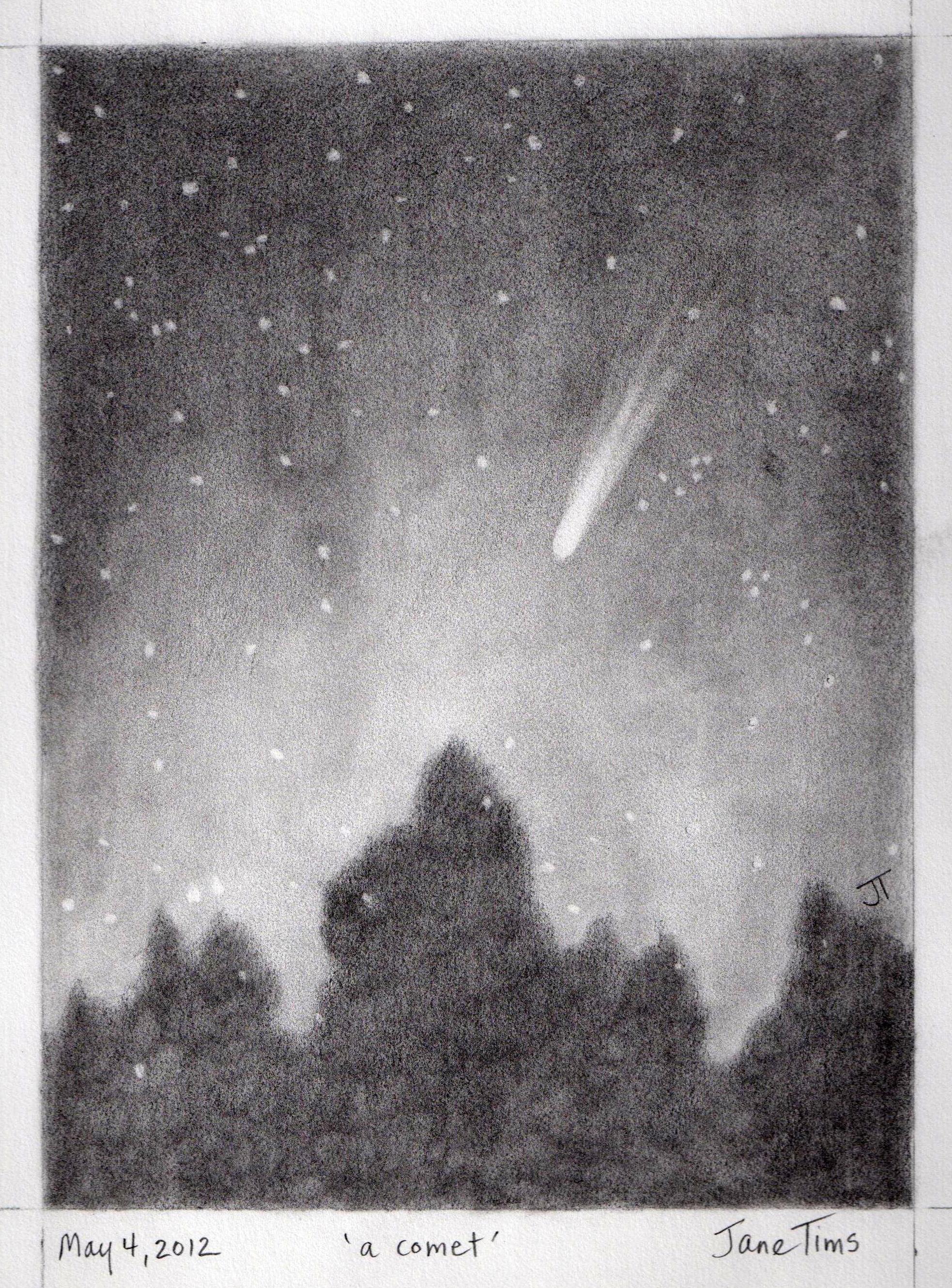
We saw Halley’s Comet as a family, waking in the middle of the night, and driving to a nearby hill overlooking a big field with French Lake and its treeless wetlands in the distance. The night sky was overcast with a thin high-elevation cloud, so our view was not the best. However, to me, it was marvellous… a huge (relative to the size of the stars) ball of fuzzy light. My son can barely remember our watch on the hillside, all swathed in blankets. However, when it returns in 2061 and he is 78 years old, he will be able to say he saw it twice!

Photo from Wikimedia Commons, taken by Kuiper Airborne Observatory
~
~
Halley’s 1987
~
we choose a roadside watching place
beside a farmer’s field
across from the cemetery
few trees
few lights
~
we set the alarm for three
coax one another
into the icy car
in awe for an hour
at the comet fuzzy indistinct
four fingers above the horizon
~
too undefined, too faint
for the dirty snowball
they predicted
I scrape our breath from the window
I see it, says my son, only three
I think
~
he sleeps between us until ten o’clock
his blanket a soft ball
pressed to his nose
~
almost eighty
he waits for the return
~
I saw it when I was only young
I think
~
~
© Jane Tims 1997
places off-planet #2 – three comets
In my life so far, I have seen three major comets – Halley’s Comet in 1986, Hyakutake in 1996, and Hale-Bopp in 1997. There have been comets since then, I know, but I have always been asleep!
A comet is composed of a ‘nucleus’ of rock, dust and frozen gas, and a tail. The tail is formed when the gasses in the nucleus are heated by the sun and create an atmosphere or ‘coma’. The sun’s radiation and the solar wind cause the coma to flow away from the sun as a tail. Since the comet can be moving away from the sun, sometimes this means the comet moves in the direction of its tail!
How many comets have you seen?
~
~
Comet
~
from the Greek
koman
~
to wear long hair
~
© Jane Tims 1997





 nichepoetryandprose