Posts Tagged ‘Dicentra Cucullaria’
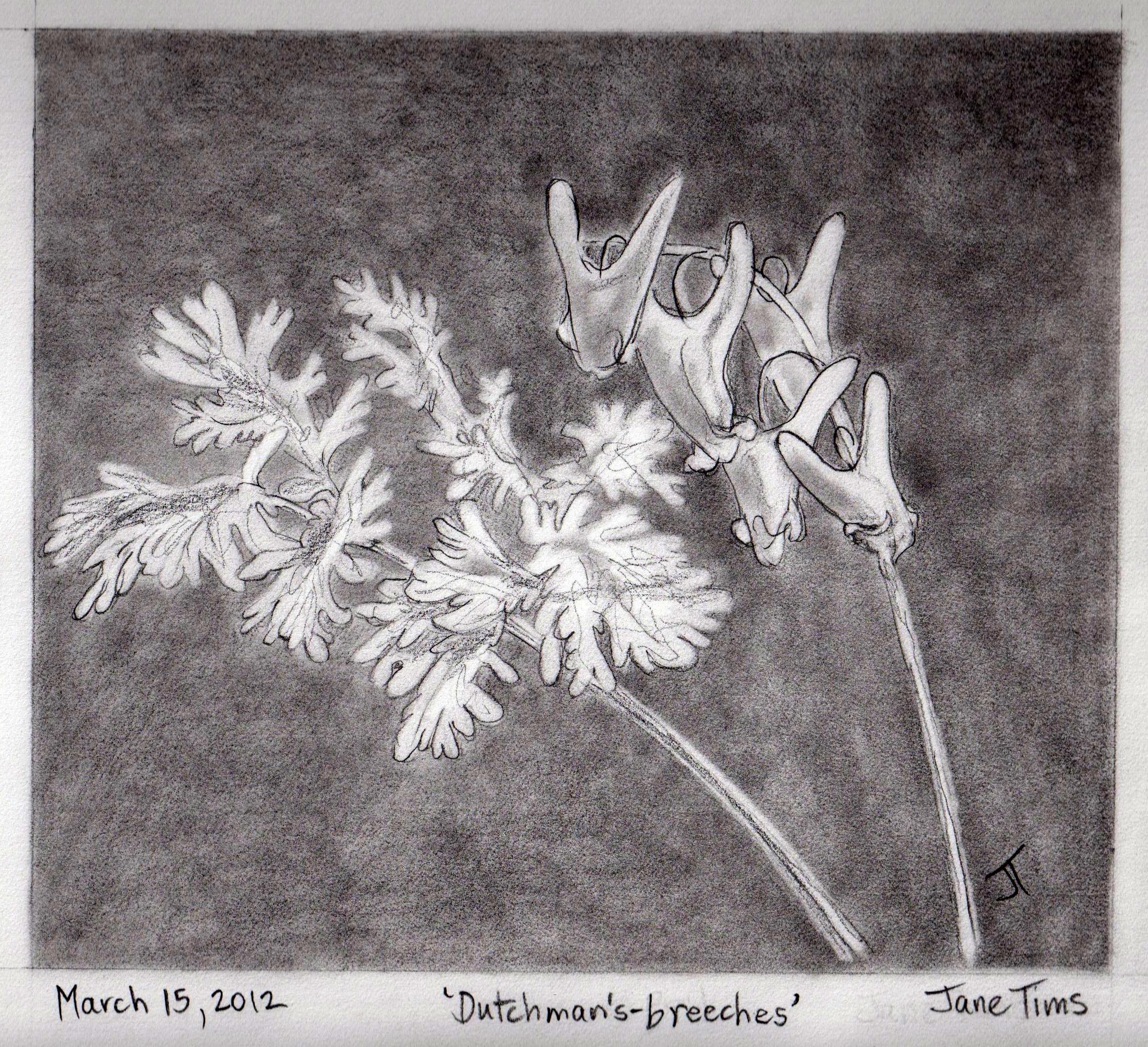
Dutchman’s-breeches (Dicentra Cucullaria (L.) Bernh.)
Our first summer home was located in a rich hardwood of Sugar-Maple (Acer saccharum Marsh.), Beech (Fagus grandifolia Ehrh.) and White Ash (Fraxinus Americana L. ). In these woods, in early spring, as the snow melted, wildflowers found ideal habitat. Many plants take advantage of the few days when the leaves of the overstory trees are still developing, and there is bright light in the understory of the woods.
One of these wildflowers is Dutchman’s-breeches (Dicentra Cucullaria (L.) Bernh.). This charming little plant blooms early in spring, in rich, rocky hardwoods. The white flowers are two-spurred, in groups of four to ten along a stem held just above finely divided, feathery leaves.
The plants is also known as breeches-flower, cullottes de Hollandais, and dicentre à capuchon. The generic name is from the Greek di meaning twice and centron meaning a spur. Cucullaria is the old generic name meaning hoodlike. The plant was named by Johann Jacob Bernhardi.
The flowers of Dutchman’s-breeches are an example of plant adaptation for pollination. The flower has a clever mechanism, in the form of fused flower parts, to ensure only certain insects (such as the bumblebee) can access the nectar and pollen.
In my copy of Roland and Smith (The Flora of Nova Scotia), I recorded my first encounter with this little plant – April 28, 1985, during one of our first visits to our property before we purchased it. We called our cabin Whisperwood, in part because of the subtle breezes in those wildflower-dotted spring woods.
~
~
Dutchman’s Breeches
Dicentra Cucullaria (L.) Bernh.
~
~
Dutchman’s breeches
brighten in sun
woodland washdays
have begun
~
spring-clean trousers
hung in rows
inflated with breath
the May wind blows
~
sprites are playing
tossing their hoods
above the damp
in the spring-fed woods
~
little fairy laundry
trembles on the line
before greening trees
block spring sunshine
~
~
© Jane Tims 1993





 nichepoetryandprose