early schools – old maps, photos and diaries
Last week, my husband and I visited the New Brunswick Museum Archives and had a look at three sources of information on old one room schools in New Brunswick:
- the Walling Map – shows the location of roads, family homes, businesses, churches and schools in 1862 in Kings and St. John Counties
- the photo collection by Marion Johnston Dunphy who photographed 150 schools from 1974 to 1984 – The One Room Schools of New Brunswick and What Became of Them
- the diary of C. Gordon Lawrence, teacher at the Tracy school (Sunbury County, New Brunswick) in 1903. His diaries chronicle his experiences as a school teacher from 1903 to 1962!
~
Thanks to the Walling Map, from now on, when we go for a drive to find old schools in Kings County, we will know exactly where to look. Also, I will know something about the landscape setting for each school – the key component of the poetry I intend to write!
~
With the photos, I was able to check the identity of some of the schools we have already found. A good example is the school building at Mill Road, near Gagetown, Queens County, New Brunswick (below). From the photos in the Marion Johnston Dunphy collection, I was able to verify this as the Lawfield School, Gagetown #1. I signed an agreement not to share the Dunphy photos on the Internet, but I will be able to use them to prompt ideas for my poems.
~
 ~
~
We also looked at C. Gordon Lawrence’s diary from 1903. This contains his day to day experiences as a 17 year old teacher at the Tracy School. He did not detail his observations of the natural world, but there are gems in the diaries for a poet! For example, after a long bout with chicken pox, he was feeling very ill and wrote: ‘… a dose of Pain killer failed to work but a dose of blackberry cordial gave me relief …’.
~
Gordon Lawrence’s diary includes a map of the location of the school. It is faint but shows where the school was located, not far from the North Branch of the Oromocto River. The roads have changed significantly since 1903 – back roads to Harvey and St. Stephen were the main roads in 1903!
~
The three items we looked at are only a sampling of the information available at the Archives. With these preliminary investigations, I can now begin to write my proposal for ‘a manuscript of poems about one room schools in the landscape’. I will be sure to let you know if my proposal is successful!
~
~
Copyright Jane Tims 2016
on my book shelf: ‘Crow Impressions & Other Poems’
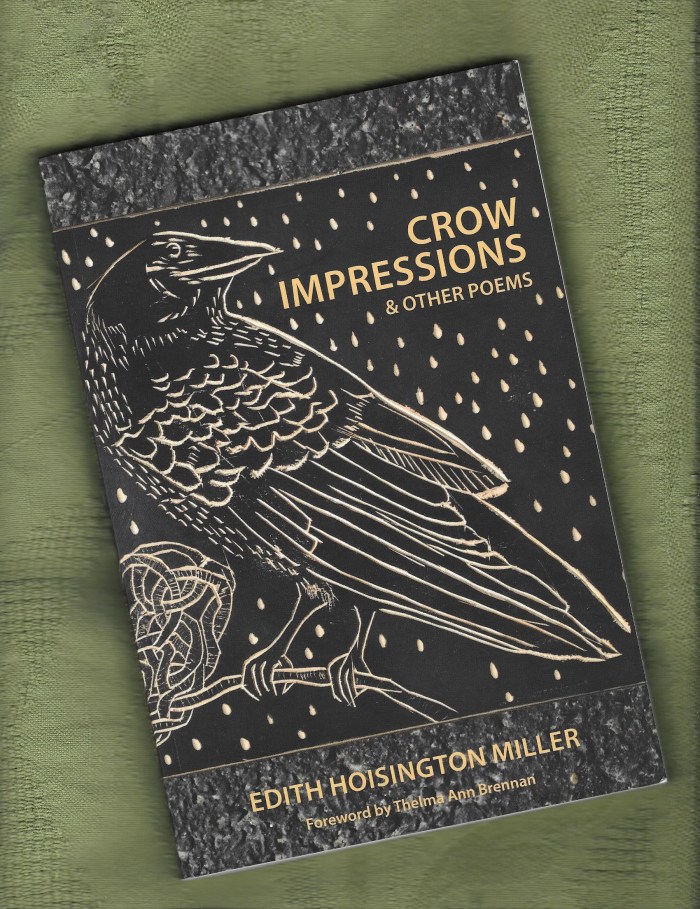
I am now reading Crow Impressions & Other Poems’ by Edith Miller. Crow Impressions is another book from my publisher, Chapel Street Editions in Woodstock, New Brunswick. Edith and I both launched our books at Westminster Books in Fredericton on June 9. Although I gave her book a quick read before the launch, I have now been able to sit down and enjoy a thoughtful read, as this insightful book deserves!
~
~
Edith Hoisington Miller, Crow Impressions and other poems. Chapel Street Editions: Woodstock, 2016.
~
The other evening at a local writing event I sat next to a fellow book-lover who asked me if I’d read Edith’s book. ‘I love poetry about nature,’ she said. ‘The poems in Crow Impressions make you feel like you are there!’
–
Throughout her book, Edith’s first-hand knowledge of her subject matter shines through. Edith has watched not only crows, but herons on the shore, song sparrows in the rose bush, and eaglets in the nest. It has been said that crows recognize individual humans and I am certain they know Edith! I know she reveres this kindred ‘spirit sign’, understanding the crow’s sharing of this world, the intricacies of their language. I love her inclusion of her first poem, written when she was seven – it will be a mystery for you to solve in your own reading, what part of nature she addresses in her poem.
~
As I read, I am able to follow a journey to places Edith has lived and visited — from Long Island Sound to Arizona, from Penobscot Bay to New York City, here to Fredericton in New Brunswick. As I read, I am taken to places I have been but stopped short of fully knowing. I read ‘Tidal Bore’ and experience the wild ride on the Shubenacadie River. The sounds and smells in ‘Air Shaft’ recall my own few days in New York City in the 1970s and show me what it might have been like to live in the Village (truly ‘the dream of a 1950s suburban girl’!). Edith’s poems show she shares my interest in American Hopi culture and her poems show the respect she has for other cultures through her experience in issues of social justice.
~
Crow Impressions is a lovely book, from the feel in a reader’s hands, to the easy-on-the-eyes layout. From the etching on the cover (a woodcut of a crow from a skate board created as a tribute to the memory of her grandson Isaac William Miller) to the final poems of the book. These return to the image of the crow, acknowledging the true nature of the ‘spirit sign’.
–
I recommend a close read of Crow Impressions – it will recall your own journey, make you ponder the symbols in your life for their particular meanings, and give you the joy of a walk on the beach even if you are far from the shore. Edith’s book is available at http://www.chapelstreeteditions.com and at our planned joint reading at Tidewater Books in Sackville this fall.
~
~
Copyright 2016 Jane Tims
playing alleys
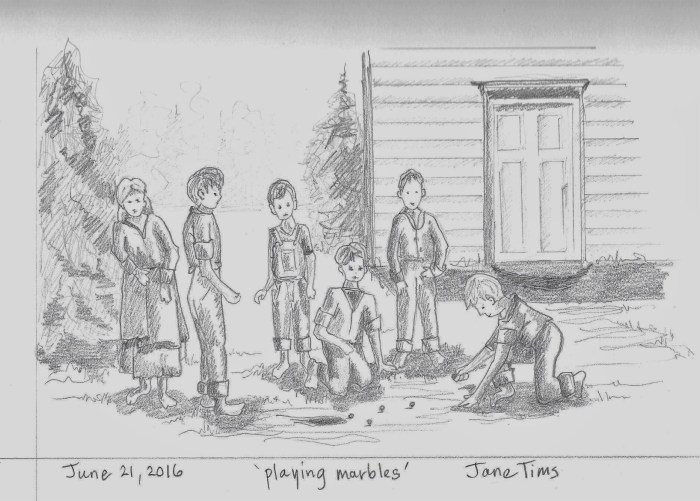
Kids in the school yard have played marbles since the late 1800s, when glass marbles were first produced for the mass market.
~
When my mom talked about marbles, she always referred to them as alleys, no matter what material was used in their construction. According to Wikipedia, alleys were a specific type of marble. Almost every kind of marble has a specific name. When my son played and collected marbles in the 1980s, some of these terms were regularly heard in our home.
aggie – made of agate
alley – a marble made of alabaster
bumblebee – a yellow and black glass marble
cat’s eye – a marble with a eye-like inclusion
crystal – a clear glass marble of various colours
galaxy – opaque marble with coloured dots
oily – an opaque marble with a sheen or oily finish
onionskin – a marble with surface streaks of colour
ox blood – a marble with a streak of dark red
pearl – opaque marble of single colour and a mother of pearl finish
plainsie – a clear glass marble with inclusion of two or more swirled ribbons of colour
swirly – glass marble with a ribbon inclusion of a single colour
tiger – a clear marble with orange and yellow stripes
~
There are lots of other marble types and names.
~
The language of marbles extends to the various moves in the game:
knuckle down – put hand in position to shoot
keepsies – to play for keeps
quitsies – stop playing without consequences
firing – to shoot a marble
~
Such interesting possibilities for the language of a poem!
~
Writing about a game of marbles will include all the senses (I think my poem will be from the point of view of a boy playing marbles):
sound – clinking of dishes in the sink; grinding of marbles together in the marble bag
taste – grit of sand stirred by wind across the playground; grit of raspberry seeds
feel – the cold smooth feel of a marble; a chunk of icicle from the roof in December
smell – stirred dust; girls watching the games, smelling of Ivory soap and well water
sight – bubble rising through the glass of the marble; bubbles with rainbows sliding; dew drops on Lady’s Mantle in the garden
~
I can hardly wait to write a poem about playing marbles in the school yard!
~
~
Copyright 2016 Jane Tims
on my bookshelf: New Brunswick’s Covered Bridges by Helen Coldrick
~
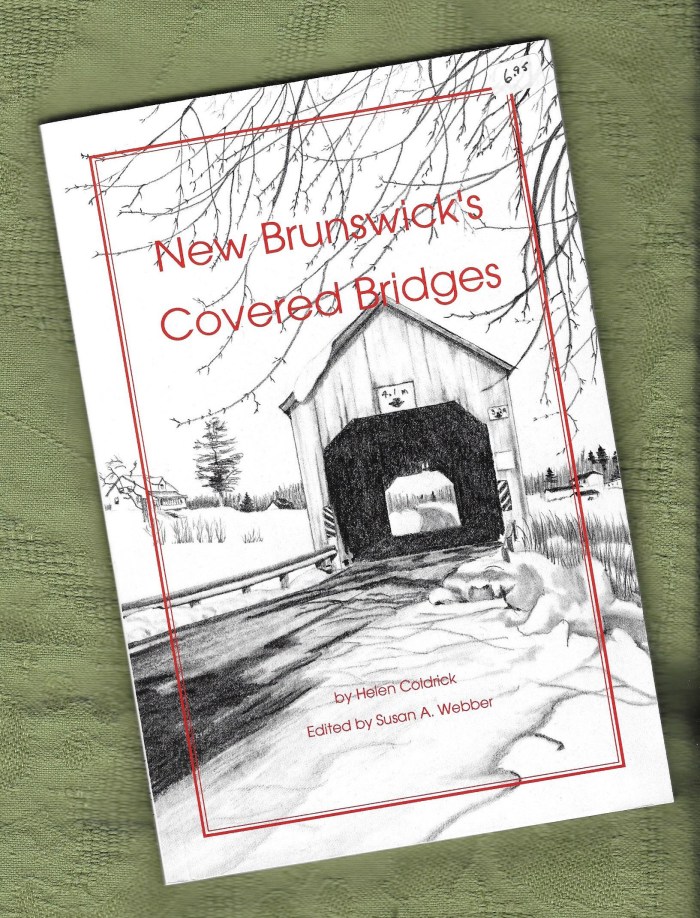
One of the ‘must haves’ in a collection of books about covered bridges in New Brunswick is Helen Coldrick’s soft cover book New Brunswick’s Covered Bridges. It includes drawings and information on the 70 bridges that existed in 1992. Today there are only 60 covered bridges in New Brunswick and Helen’s book is one way of seeing some of what we are missing.
~
Helen Coldrick. New Brunswick’s Covered Bridges. Neptune Publishing Company Limited: Saint John, 1992.
~
~
In her book, Helen includes 30 of her black and white drawings of various covered bridges and construction features. I love these drawings because I can see the artist’s process in the lines: her way of using shadow and white space, and her approach to portraying the reflections in water. The drawings also show the setting of each bridge and in some cases, the dramatic landscape of the river beneath.
~
Drawings in the book include bridges now lost: the Aaron Clarke Bridge (lost to flooding in 2014) and Iroquois River #4 (no longer standing). The book also includes a listing of the covered bridges in New Brunswick in 1992. I think one of the values of the book is its snapshot of the situation in years past. The New Brunswick government keeps a list of today’s covered bridges but finding information on those no longer existing is more challenging. Helen’s book shows us what some of these lost bridges looked like and tells some of their stories.
~
New Brunswick’s Covered Bridges includes a general history of covered bridges in New Brunswick, and a description of covered bridges by county. The book also includes lots of information on bridge construction, including pages on trusses, abutments, bases, sidings, entrances, windows and walkways, and roofs.
~
New Brunswick’s Covered Bridges is available for $7.95 from Nimbus Publishing (www.nimbus.ca). If you are interested in New Brunswick, covered bridges, history or architecture, or if you just like books with lovely drawings, this would be a great addition to your library!
~
~
Copyright Jane Tims 2016
.
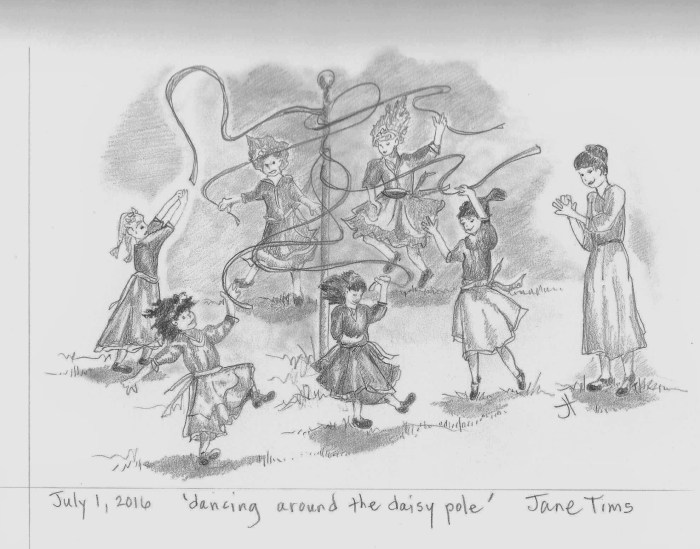
dancing around the daisy pole
Perhaps strange to talk about a Maypole in July but Maypoles have been used for summer celebrations throughout the years. In the old stereoscope photo below, published by a company in Meadville Pennsylvania and St. Louis Missouri, the Maypole is referred to as a Daisy Pole.
~
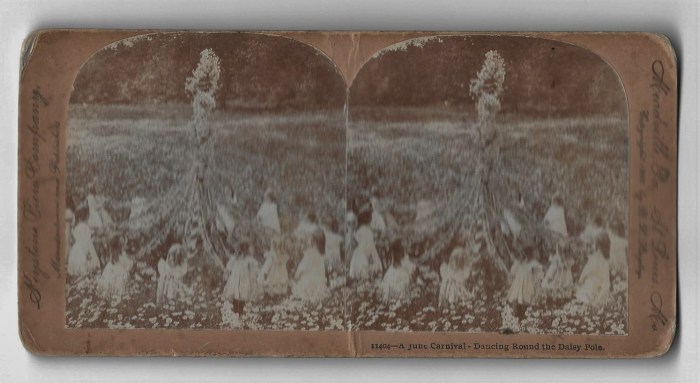
A rather blurry scan of a stereoscopic photo, blurry because it is curved for the viewer. The title of the photo is ‘A June Carnival – Dancing Round the Daisy Pole’ 1900
~
When my Aunt Jane was young, attending a small school in Nova Scotia, field days were held in June. In her book, she recalls participating in a field day:
… I was in grade 1 … we had a “field day”. My dress was made of blue and white crepe paper and, holding on to the end of a white paper streamer, I danced around a May pole. I remember my great embarrassment as a gust of wind took the streamer out of my hand and sent it high in the air to flutter in the breeze …
~

The decorative Maypole we made years ago to celebrate May 1 every year. Through the years, when I needed ribbon, I occasionally snipped a length from the pole, so there are a few short ribbons!
~
~
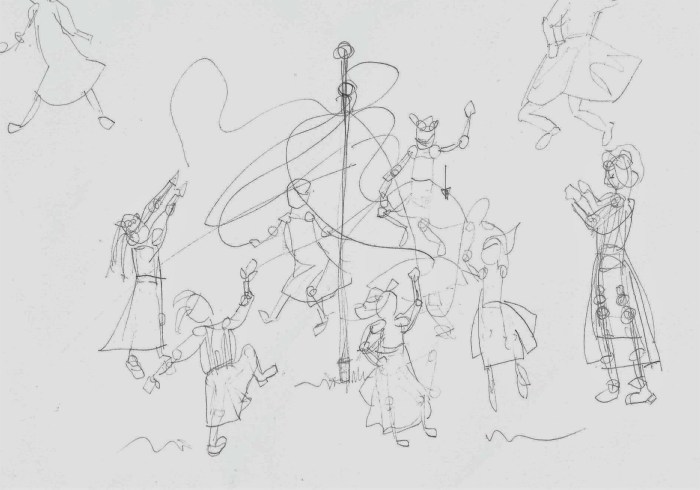
sketch for ‘dancing around the daisy pole’ … in some ways more lively than the final drawing
~
~
Copyright Jane Tims 2016
on my book shelf: ‘Three Wrongs’
As part of my summer reading program I am including books by some of our New Brunswick authors.
~
Chuck Bowie. Three Wrongs – Donovan: Theif for Hire. MuseItUp Publishing: Montreal, 2014.
–
I love mysteries and plots with adventure. Smooth, unflappable, Donovan is a dangerous yet likeable protagonist. His approach to acquiring his ‘souvenirs’ is always original, well planned and flawless. Donovan never leaves his fingerprints behind.
~

~
The characters Donovan encounters in his profession are usually ruthless, willing to pay anything to acquire what they covet. The most interesting of Donovan’s clients is Katie Storm, the spoiled young actor who meets her match in Donovan. Katie hires him to steal a necklace from her rival. Donovan manages to meet his obligations, turn the tables on his immature client and fall in love, but not with Katie! Just how it all unfolds is worth the read.
~
Females characters always interest me and the women in Three Wrongs have strong personalities and very distinct voices. I especially like Madeleine, Donovan’s funky, out-spoken sister. I like his adventure with her during an evening at a ‘take away concert’ – educational if you didn’t know about these before! Their interactions also let readers see Donovan’s background and his believable yet broken family.
~
Three Wrongs takes us through the action of Donovan’s three capers and their consequences. But Three Wrongs is also a story about change and how Donovan realizes change may be the only path to take.
~
I recommend this as a great read and would say I am looking forward to the next in the series, AMACAT, but I must confess: I read that book first!!! Now I am eager to read #3 in the series, Steal It All.
~
~
Copyright Jane Tims 2016
Little Free Library
I have heard about these little free libraries, appearing in cities all over North America. And now we have at least two in Fredericton.
~

‘little free library’ on University Avenue in Fredericton
~
Charming and whimsical …
~

‘little free library’ in Sunshine Gardens in Fredericton
~
A delightful expression of community! I love the stump or stone step so a child can borrow from the little library!
~
The idea is simple … take a book, leave a book. It’s a way to find some great new reading, visit a part of the community you may not know well and promote literacy.
~
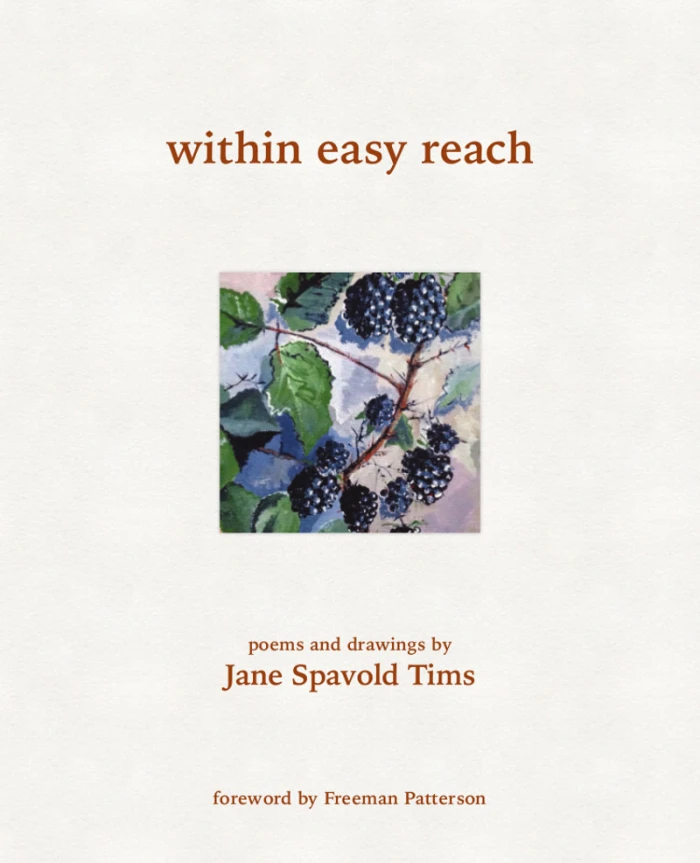
As of this morning, I have left a copy of my poetry book ‘within easy reach’ at two of these tiny libraries, one in Sunshine Gardens and one on University Avenue. If you want to go on a treasure hunt and borrow a book, make sure to take a book with you to trade! Happy reading!
~
~
Copyright 2016 Jane Tims
one room schools – distractions on the way to school
I am thinking about the ways landscape would have influenced the day at a one room school in New Brunswick one hundred years ago. As we drove some of the back roads in the Stanley area this past weekend, I tried to think like a child on the way to school. So many distractions!
~

~
First, the views. Fields green with new corn, yellow with buttercups, winter-white with daisies …
~

~
And daisies to pick, perhaps a bouquet for a favorite teacher …
~
~
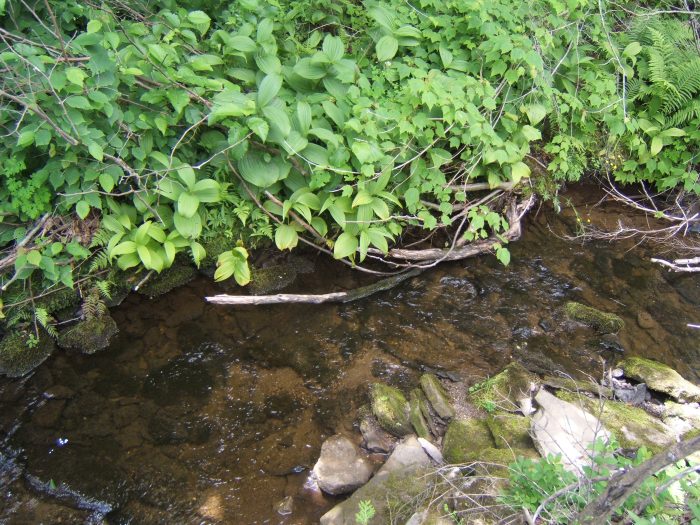
Brooks to cross, and the lure of watching for fingerlings in the clear water …
~

~
And a farmer’s pond, with ducks to watch, fish to feed, frogs to hunt and cat-tails …
~
~
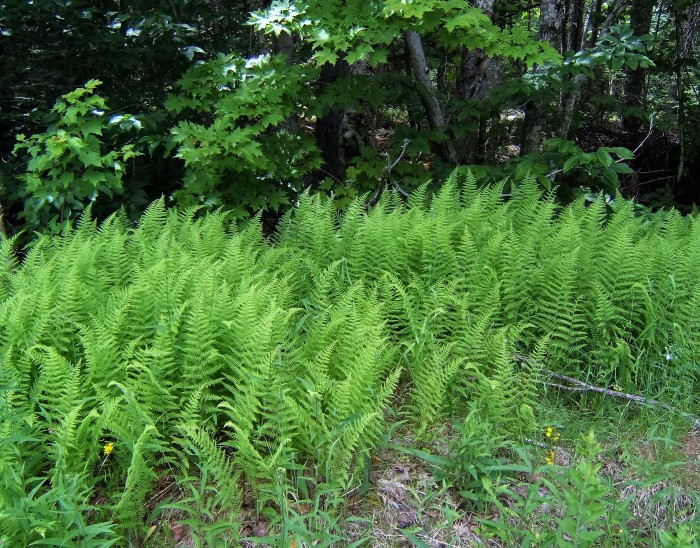
Hillsides of fragrant hay-scented fern to roll in …
~

~
Orchards to play in and ripe fruit to gather …
~
It makes me wonder how anyone ever made it to school.
~
Copyright Jane Tims 2016
on my book shelf – New Brunswick’s Covered Bridges
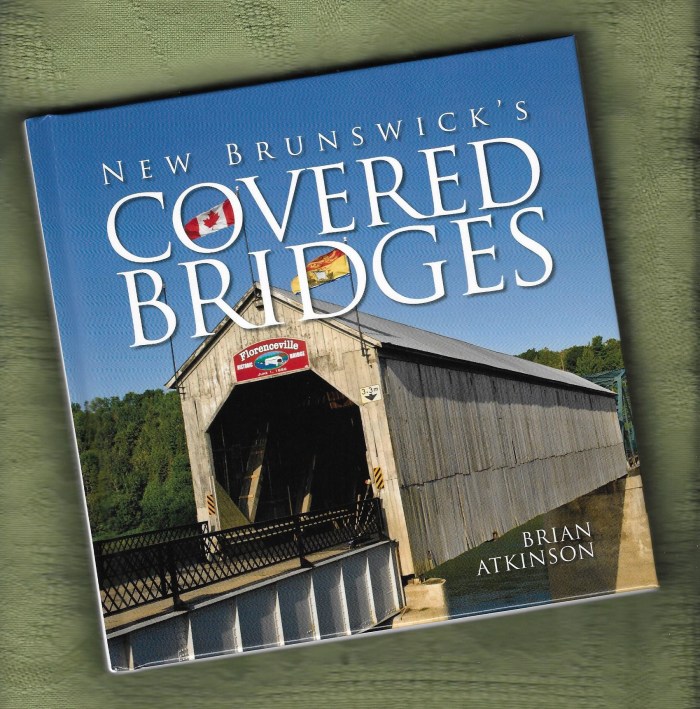
As part of my project ‘in the shelter of the covered bridge’ I have collected books about covered bridges in New Brunswick. One of my favourites is a small book of photos of the 62 covered bridges existing in 2010: Brian Atkinson. New Brunswick’s Covered Bridges. Nimbus Publishing: Halifax. 2010.
~
~
New Brunswick’s Covered Bridges is a compact hardcover, small enough to take along on an adventure spent visiting our covered bridges. The bridges are arranged by County and easily found in an index. Directions to each bridge are provided. Some of the entries include anecdotes about the bridge and all list the year the bridge was built.
–
The best elements of the book are Brian’s photographs. They are clear and set each bridge in its surroundings. Some are taken from unusual angles, either from an upstream or downstream vantage point. One is taken beneath the bridge! Although some offer enticing glimpses through the bridge’s entrance, none show the inside of the bridge.
~
Brian’s book includes an introduction outlining the history of New Brunswick’s covered bridges. He includes information on the construction of the bridges and the origin of the signage advising folks to ‘Walk Your Horse and Save A Fine’!
~
Included in the book is a preface which points out how many of our bridges are in out-of-the-way places … many New Brunswickers have never seen the most quaint and lovely of our bridges. As Brian says of one of the bridges: ‘… as pretty a spot as you can find for letting an afternoon slip by …’.
–
As the book tells us, in 1900 there were 4000 covered bridges in New Brunswick, in 1944, 320 and in 2010, only 62. Today, as a result of flood and fire, only 60 remain. My advice – take Brian’s book and head out for an expedition to make your own discoveries about this wonderful part of our built history.
~
New Brunswick’s Covered Bridges is available through Westminster Books in Fredericton, your own local bookstore, or Nimbus Publishing
https://www.nimbus.ca/?s=New+Brunswick%27s+covered+bridges
~
Copyright Jane Tims 2016
Hermit thrush
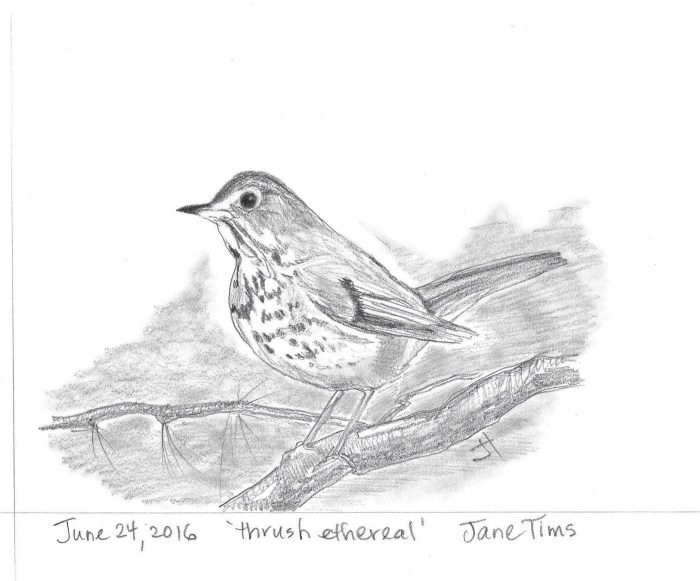
Another surprise in the morning bird chorus — a Hermit thrush. I have been listening for it all spring and at last, this morning, the ethereal notes.
~
~
How to describe the song of the Hermit thrush? T.S. Eliot described it in The Waste Land, in V: What the Thunder Said :
… sound of water over a rock
Where the hermit-thrush sings in the pine trees
Drip drop drip drop drop drop drop …
and
… who is the third who walks always beside you …
and
… In the faint moonlight, the grass is singing
Over the tumbled graves …
~
A technical description of the Hermit thrush song is ‘a beginning note, then several descending musical phrases in a minor key, repeated at different pitches.’
~
The song is clear, flute-like. To me the essential characteristics are the change in pitch at the beginning of the new phrase and the hint of water within. If you watch the Hermit thrush while she is singing, she stands tall, tilts her head back, looks into the distance with her bright black eye, lifts her feathers ever so slightly and opens her beak. Her throat swells a little but otherwise you are left to wonder, where do those notes begin?
~
If her song was another sound, it would be a flute in the forest.
If it was a smell, it would be the sweet scent of mayflowers, as you part the leaves with the back of your hand.
If it was a touch, it would be lifted hairs at the back of your neck.
If it was a taste, it would be syrup drizzled over iced milk.
If it was an image, it would be guttation drops on strawberries.
~
~
What other words describe the song of the Hermit thrush?
clear
precise
covert
alone
sweet
tremolo
pure
hidden
pensive
thoughtful
thicket
froth on a dancing wave
raindrops trembling on the tips of leaves
the step from rung to rung on a ladder
~
If it was a vowel, it would be every vowel
If it was a consonant, it would be ‘c’, ‘l’, ‘r’, or ‘v’
~
~
Hermit thrush
~
Catharus guttatus
~
neither visceral nor guttural, ethereal
tip-toe in tree tops
air pulled into taffy thread
a flute in the forest
froth on a wave
~
rain trembles on leaf tips
guttation drops on strawberry
a lifted curtain of mayflower
~
I saw you there
hidden in the thicket
and I followed
~
climb the ladder and sing
then step to the rung below
heads up, thoughts of the new day
parting of the beak
pulse at the throat
hairs lift
at the nape
of the neck, fingers
warble the keys
between middle and ring
catharsis
~
~
Copyright 2016 Jane Tims





 nichepoetryandprose