Archive for the ‘where plants grow wild’ Category
Coltsfoot (Tussilago Farfara L.)
Although it has been snowing sporadically this month, our recent days of very, very warm weather tell me spring has arrived. As a result, I am watching the roadsides for the first flowers of spring. Even before the snow is out of the woods, it begins to melt along the roadsides as they warm in the lengthening hours of sun. And the cycle of bloom begins again.
Coltsfoot (Tussilago Farfara L.) is one of the first plants seen in early spring. It forms large patches in waste areas, beside brooks and roads, and on damp hillsides. People often mistake Tussilago for Dandelion, but it is quite different. Its yellow flowers are borne on scaly, leafless stems. The large, woolly leaves don’t appear until later in the season. In spite of its early appearance in spring, Tussilago actually has late flowers. The flower buds are formed in autumn at the base of the plant, and pass winter underground, flowering in the first spring sunlight.
Other names for the plant are Son-before-the-Father, which refers to the appearance of flowers before the leaves, and pas-d’âne (literally donkey-steps). The scientific names are from the Latin tussis, meaning a cough, referring to the use of the plant as a remedy for such ailments, and the Latin word for coltsfoot, farfarus. The plant was named by Linnaeus, the Swedish botanist who established the present day system of naming plants.
Although the plant was used by pioneers for its medicinal effects, it is now known that Tussilago contains harmful alkaloids. Tea made from Coltsfoot has caused health problems in infants and pregnant women, so its use as a cough remedy is not recommended. In some States, Coltsfoot is considered a noxious weed.
~
~
Coltsfoot
Tussilago Farfara L.
~
Gold-
splashed beside the road
like prints
of a frisky colt’s feet
~
at first glance-
an early dandelion!
but-
too early
stem scaly
no leaves below the bloom
no perfume.
~
Coltsfoot,
Son-before-the-Father
(flowers before the leaves).
Introduced from
far, far away.
Old wives say
boiled greens
will ease
a cough.
~
Long ago
Tussilago
sprang from where
a burro trod
among the palms
(pas-d’ane)
~
~
Published as: ‘Coltsfoot’, Winter 1993, The Antigonish Review 92:76-77.
Revised
© Jane Tims 1993
~

red berries red
Red Berries Red
Jane Tims
2011
~~
~~
Hawthorn
(Crataegus)
~
between ruby glass
and hard wood floor
a slide of light and three
~
extinguished candles
smoke lifts from smoulder
each mote a particle
~
of spectral light, mosaic
shard, image
reassembled in three
~
dimensions
shepherd, hawthorn
pitiful lamb
~~
~~
Canadian Holly
(Ilex verticillata (L.) Gray)
~
drab November
and lexicon
expires
umber leaves
grey verticals
dull stubble
~
winterberries
astound the wetland
red ink on page
words explode
from exile
~
fever flush and holly
above December snow
icicles vermillion
~~
~~
© Jane Tims, 2011

'red berries' Bunchberry (Cornus canadensis L.)
a place in the marsh
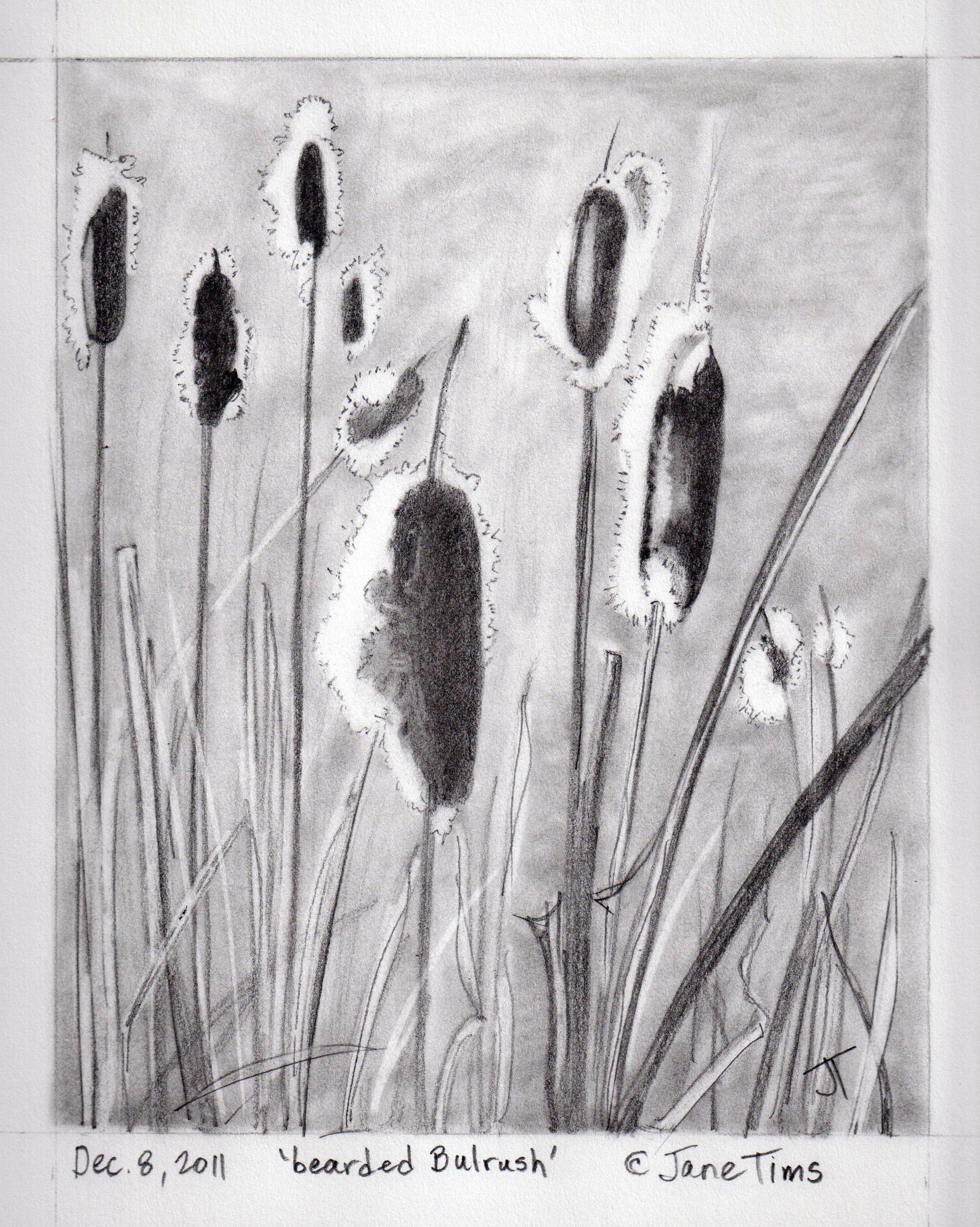
For the last few weeks, as I drive by the ditches and wetlands on my way home from work, I am charmed by the way the bulrushes have burst and made their bountiful seed available to the winds.
The heads of the bulrush (Typha latifolia L., also known as common cat-tail or masette in French) are usually neat and tidy cylinders of dark brown, held high on a sturdy stem. At this time of the year, the seeds emerge in a copious fluff clinging to the brown seed-head like a beard, a lion’s mane or a furry hat.
When I was a child, we always called these plants ‘busby rushes’, presumably after the tall bearskin hats worn by the Queen’s Foot Guards in front of Buckingham Palace. Actually a busby is not the correct name for the bearskin, but is a hat worn by Hungarian hussars, or the Royal Horse Artillary, a ceremonial unit of the British Army.
Our two usual species of Typha are distinguishable by their leaves. Typha latifolia (broad-leaved cat-tail) has flat leaves. Typha angustifolia (narrow-leaved cat-tail) has narrower leaves, convex on the back.
~
bulrush in December
(Typha latifolia L.)
~
4:45 PM rush, the Marshlands
bus expels tired folk to familiar sidewalks
exhausts them in diesel cloud
a bulrush pushing its seed
to the wind in cold December
bearded and wise, fur hats and
ear flaps against the cold
breath expressed as icicles and rime
~
© Jane Tims 2011
Evergreen Woodfern (Dryopteris intermedia Muhl.)
On Sunday, I looked for and found my first November fern! Since we had about 25 cm of snow yesterday, I may have found my only fern of the winter!
The fern I found is an evergreen fern, pressed close to the earth this time of year.

For me, identifying ferns is always a challenge. I use the Peterson Field Guide, ‘A Field Guide to the Ferns and their Related Families’ by Boughton Cobb, 1963. Then I turn to a very helpful website www.ontarioferns.com .
With patience and careful attention to some key features, I can usually figure them out.
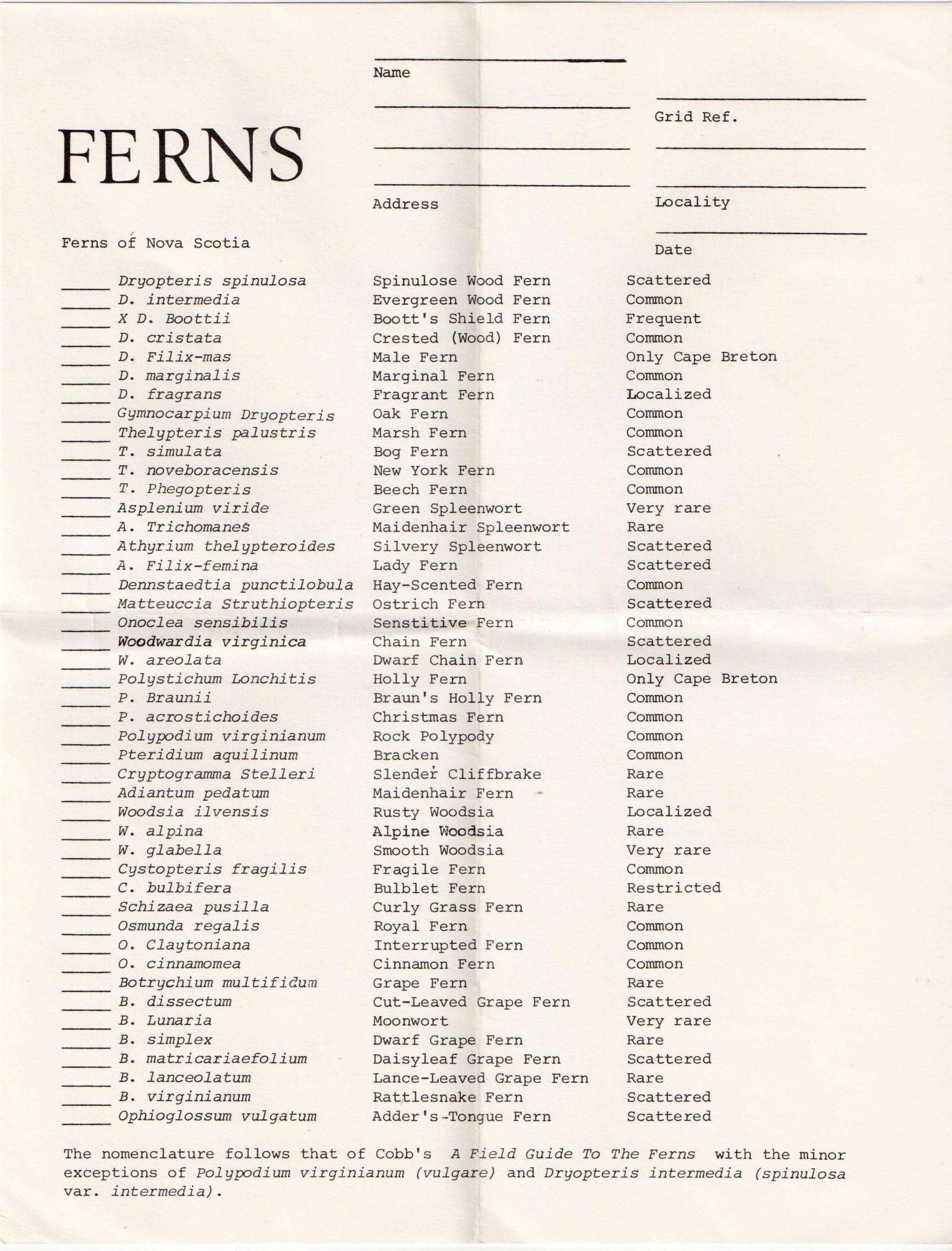
checklist issued by the Nova Scotia Museum for a fern project several years ago; a checklist like this is helpful to double-check your identification
The key features for the fern I found are:
- the roughly triangular shape
- the ‘thrice-cut’ nature of the leaves (cut once into leaflets or pinnae, a second time into subleaflets or pinnules, and a third time into lobes)
- the stalk is greenish and scaly, not hairy
- the lowest pair of inside subleaflets (next to the stem) of the lowest leaflet are slightly shorter than the second subleaflets next to the stem (if you look closely at the photo above, this feature is hard to see due to the camera’s perspective – the best example is the fern at the upper right).
This fern is the Evergreen Woodfern (Dryopteris intermedia), closely related to and difficult to distinguish from the Spinulose Woodfern.
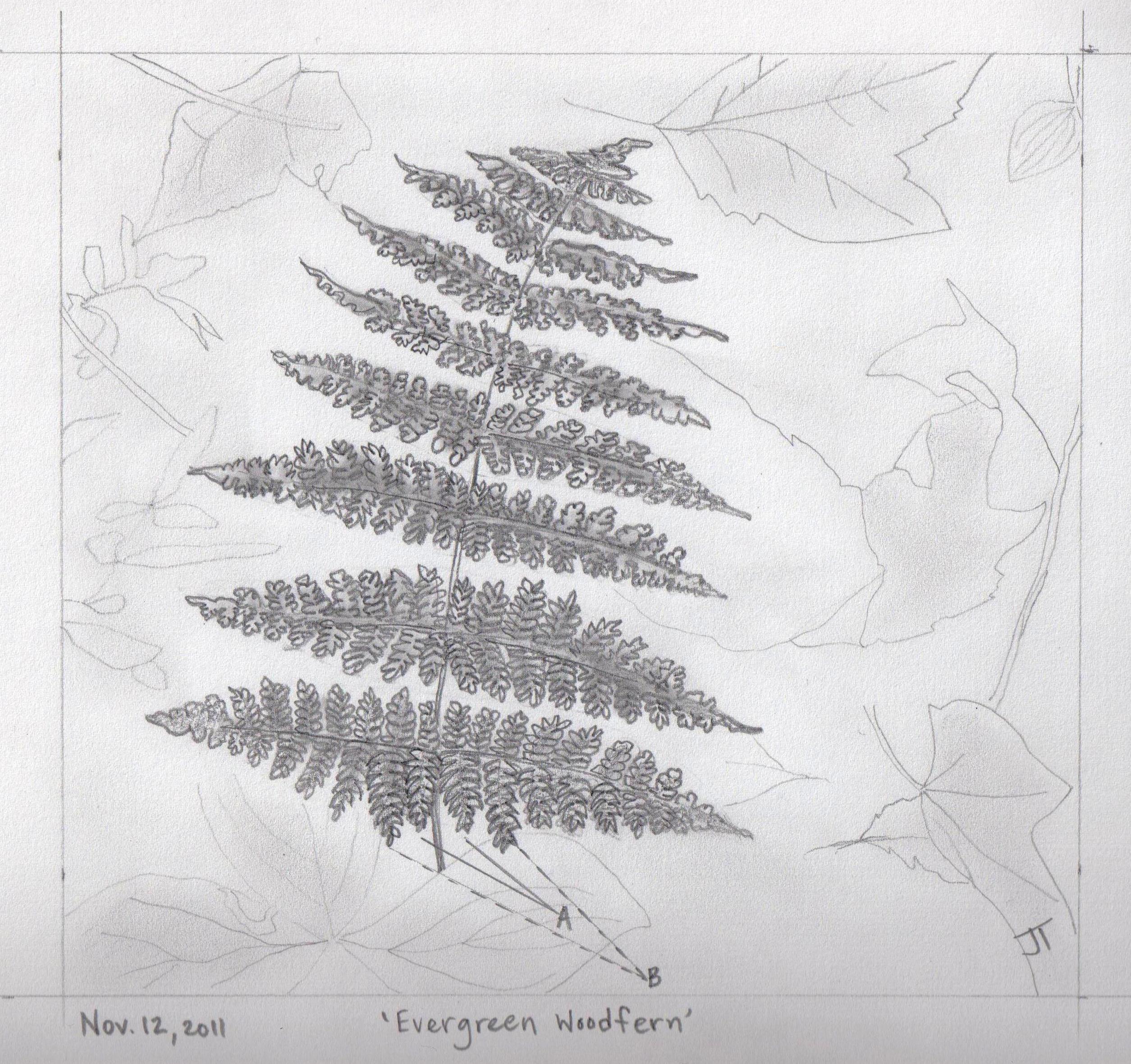
a leaf of the Evergreen Woodfern... the lowest pair of inside sub-leaflets at 'A' are shorter than the next pair at 'B'... this is the feature distinguishing the Evergreen Woodfern from other Woodferns
American Star-flower (Trientalis borealis Raf.)
Crisp November nights are a perfect time for a quick look up at the stars. I’ll be including some posts about our star-gazing, but for now, my thoughts are still turning back to summer. Stars in the sky? There are also stars in the dark summer woods.
The American Star-flower, Trientalis borealis Raf., is a plant with a delicate white, star-shaped flower, found in late spring in woodlands and on peaty slopes. Its scientific name comes from the Latin word for the third part of a foot, a reference to the height of the plant, and the Latin borealis, meaning northern. It is a common little plant, described by Fernald as a “forest pioneer”.
Some will wonder what the ‘Raf.’ refers to, at the end of the scientific name. This is an attribution to the botanist who first named the plant. In many cases, the attribution is ‘L.’, meaning the plant was first named by Carolus Linnaeus (the biologist who first introduced the ‘binomial’ naming system for plants).
‘Raf.’ stands for Constantine Samuel Rafinesque-Schmaltz who first assigned the genus and species names to the plant – Trientalis borealis. He was an eccentric polymath (knowledgeable in many fields and disciplines) who lived from 1783 to 1840. In his lifetime he published 6,700 binomial names for plants.
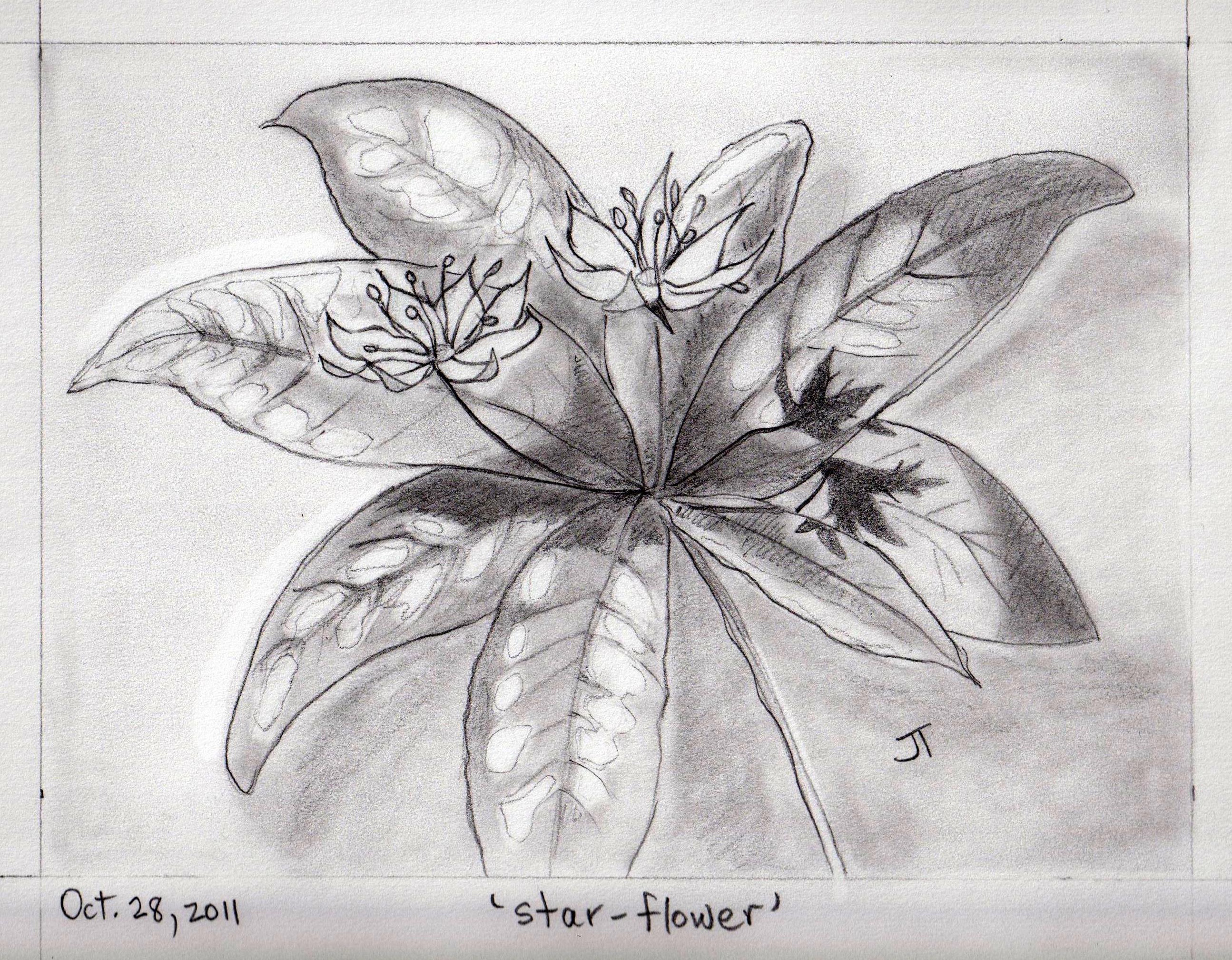
Star-flower
Trientalis borealis Raf.
~
Trientalis
borealis
star-flower
lost from the sky
four inches high
(the Latin name
makes claim)
petals white
boreal light
fallen down
first found
by Constantine
now often seen
it’s little lamp
above the damp
a forest pioneer
final frontier
up above
twinkling of
stamen and star
who you are
I wonder
and wander
down a trail blazed
by a frail flower
one candle power
~
Published as: ‘Star Flower’, Winter 1993, The Antigonish Review 92.
revised
© Jane Tims
Northern White Violet (Viola pallens (Banks) Brainerd.)
Yesterday, we had our first dusting of snow and it persisted on the grass until the evening. It reminded me of some of those low white summer flowers whose petals look like snow when they bloom in masses on the lawn or in a field. In any season, the sight of ‘snow’ can be a charming, welcome sight.
The northern white violet, or small white violet (Viola pallens (Banks) Brainerd.) inhabits the moist ground of meadows, bogs and thickets, and it blooms profusely on our front lawn. Pallens means pale, referring to the color of the flowers. The leaves are somewhat heart-shaped.
The violets are a difficult group, taxonomically. Viola pallens is also known as Viola macloskeyi Lloyd.
Northern White Violet
Viola pallens (Banks) Brainerd.
~
stars in the northern meadow
scattered at the feet
of cattle grazing hay
violet sweet
~
hearts among the grasses
where the ground is wet
flowers pale and nodding
small white violet
~
Published as: ‘Northern White Violet’, April 2005, Refuge 14 (1)
© Jane Tims 2005

Eastern Teaberry (Gautheria procumbens L.)
When the wind is chill and fingers are cold, what better remedy exists than a cup of tea? After years of attending meetings where there is a box of fancy teas to choose from, I now have my own wooden ‘tea box’. I replenish it from time to time with a new blend, but I find the old standbys are my favourites: Red Rose, Earl Grey, and Chamomile.
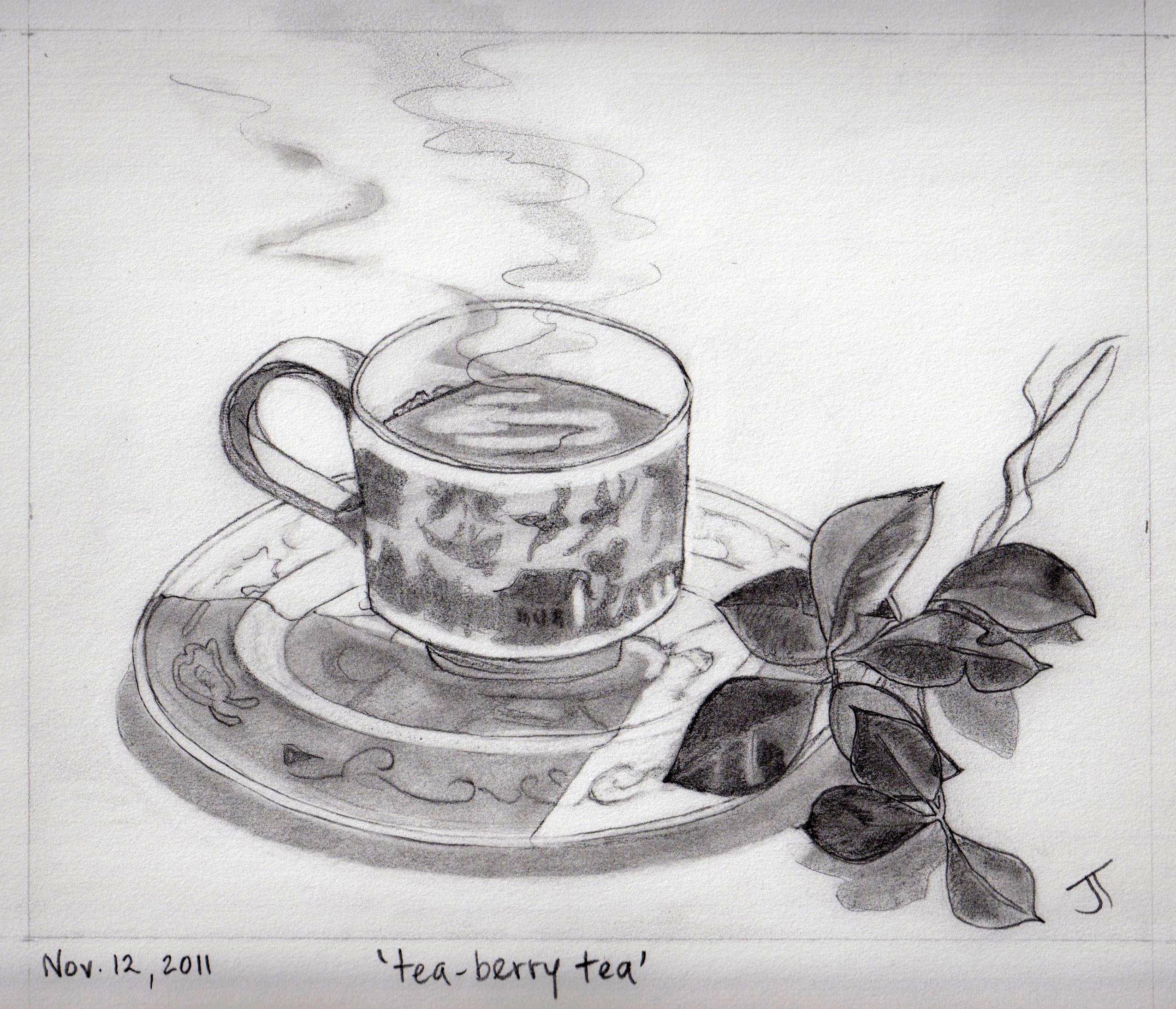
When my son was little, we used to have fun making ‘tea-berry tea’. I still go out occasionally to my patch of Gaultheria procumbens, also known as Eastern Teaberry or American Wintergreen. A few leaves, crushed and steeped in boiling water, make a lovely, fragrant tea with a delicate green color. In French, Eastern teaberry is le petit thé du bois (the little tea of the woods).
The leaves contain oil of wintergreen; the chemical in this oil is methyl salicylate, known for its anti-inflammatory properties and closely related to aspirin. For this reason, use caution and only drink ‘tea-berry tea’ occasionally and if you are not sensitive to aspirin. Methyl salicylate is also found in twigs of yellow birch and it also makes a fragrant tea. Methyl salicylate will build up an electrical charge when dried with sugar and rubbed… you can try this yourself with wintergreen-flavoured hard candies.
Warning: 1. never eat any plant if you are not absolutely certain of the identification; 2. never eat any plant if you have personal sensitivities, including allergies, to certain plants or their derivatives; 3. never eat any plant unless you have checked several sources to verify the edibility of the plant.The leaves of Eastern teaberry are thick and evergreen, so they can be found this time of year. The flowers are white, waxy, nodding, and bell-shaped. The bright red berries are also waxy and sometimes still found in November.
~
Wintergreen
Gaultheria procumbens L.
~
small leaves gathered, crushed
oils weep into water, pale
green tea, pink aroma
sugar and midnight sparks
sweet steam and aspirin make
undelicate my heart
~
~
Warning: 1. never eat any plant if you are not absolutely certain of the identification; 2. never eat any plant if you have personal sensitivities, including allergies, to certain plants or their derivatives; 3. never eat any plant unless you have checked several sources to verify the edibility of the plant.© Jane Tims 2012
© Jane Tims 2011
making friends with the ferns #1
November is an odd time to think about identifying ferns, I admit. But identification of the evergreen ferns is still possible, as they hang on to their identity in the frosty air and even beneath the snow. Also, ferns are so beautiful, it is fun just to look over the field guides and reminisce about the days of summer.

a pressed Long Beech Fern in my copy of Boughton Cobb’s ‘Field Guide to the Ferns’
Ferns belong to the group of vascular plants known as the Pteridophytes. They have stems, roots and leaves but no seeds. Instead, they reproduce by spores and have complicated life cycles.
Ferns grow in many habitats. In our area they are found in moist and shaded woodlands. They are also inhabitants of fields, cliffs, wetlands and cityscapes. I have even seen ferns growing deep within the Howe Caverns of New York State where they have taken advantage of the scant habitat provided by artificial lighting.
The uniform ‘greenness’ of ferns and their highly patterned leaves make them popular as a motif, especially for home decorating and at Christmastime.
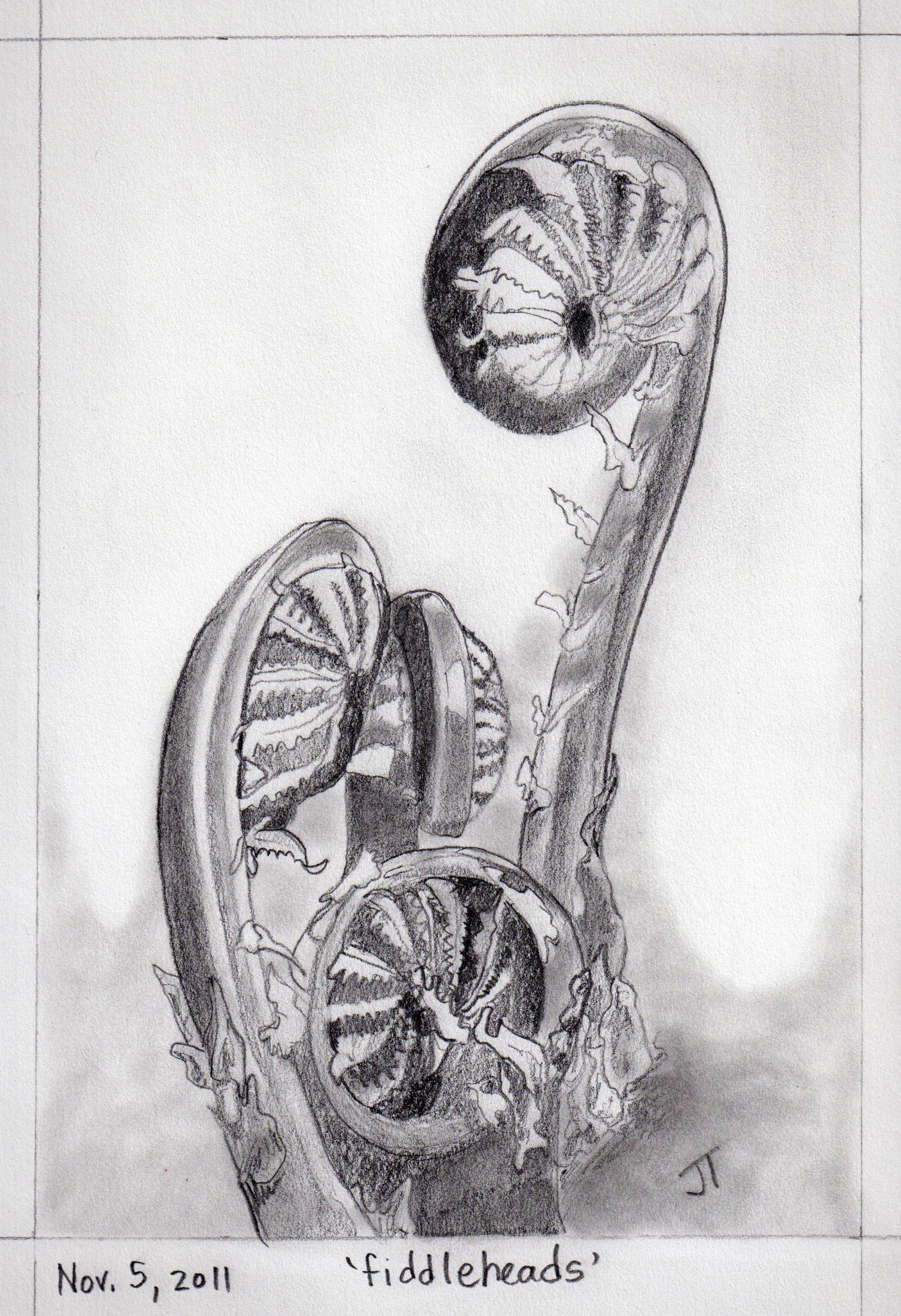
In New Brunswick, fiddleheads, the tightly coiled new leaves of the Ostrich fern (Matteuccia Struthiopteris (L.) Todaro), are collected for food every spring along the banks of rivers and their tributaries.
~
waking from a dream
Ostrich Fern (Matteuccia Struthiopteris(L.) Todaro)
~
bottom-land thicket
naked in spring
a rumpled bed
the throws of hibernation
~
new growth cocooned
in dry leaves, bent skeletons
of last summer’s fern
~
sun surge
an insult
between curtains
~
green fiddlehead
uncoils
head down
fist thrust
between pillows and down
fingers stretched
filigreed shadow
new blocking of sun
~
brown coverlet
kicked
~
new green bedspread
new green canopy
green shade
~
© Jane Tims 2011
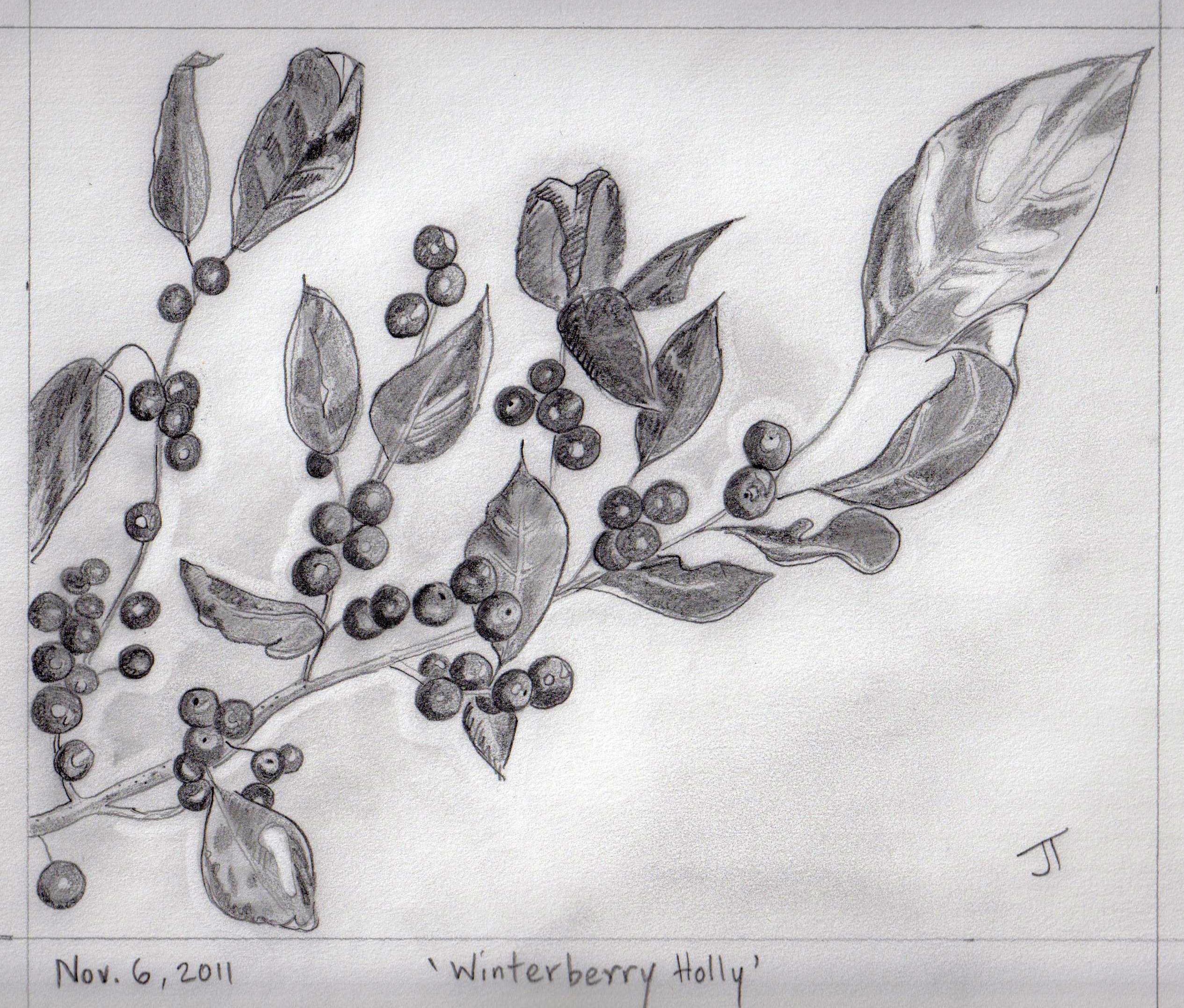
Winterberry Holly (Ilex verticillata (L.) Gray)
In contrast to October, November is a colorless month. The exception – November’s red berries.
They punctuate the roads and ditches – Highbush-cranberry, Staghorn Sumach, American Mountain-ash, Hawthhorn and Rose. Eventually the birds claim every one for food, but through most of early winter, the berries remain to cheer us.

Highbush Cranberry in November
Last November, my husband and I took a walk in the thicket of saplings above the lake. As we came around the edge of a clump of alder, we were surprised to see a sturdy bush of Winterberry Holly. It glowed with orange-red berries, set off by sprays of bronze-coloured leaves, not yet fallen. We are used to seeing Winterberry along the lake, but in the grey and white thicket, the little bush was a gift. We went there again this past Saturday, and there it was, glowing in the morning sun.

our bush of Winterberry Holly
Winterberry Holly (Ilex verticillata (L.) Gray) is also known as Canadian Holly, Swamp Holly, Inkberry, Black Alder and Feverbush. The shrub is usually found in wet areas, including wetlands, damp thickets, moist woods and along waterways. The leaves turn a brassy purple-brown before they fall. The fruit is a small, hard orange-red berry, remaining on the bush until January.

In my poem, the words ‘lexicon’ and ‘exile’ are included as imperfect anagrams for Ilex (ilex).
Canadian Holly
(Ilex verticillata (L.) Gray)
~
drab November
and lexicon
expires
umber leaves
grey verticals
dull stubble
~
winterberries
astound the wetland
red ink on page
and words explode
from exile
~
fever flush and holly
above December snow
icicles vermillion
~
© Jane Tims 2011
yellow rain
In October, we still have at least one more autumn display, the shedding of the tamarack needles. Tamarack is a deciduous tree and loses most of its needles this time of year. We have a number of tamaracks on our property, so the golden needles fall as a constant ‘rain’ during late October and early November.
Tamarack (Larix laracina (DuRoi) K. Koch) is also known as Hackmatack, American or Black Larch and, in French, épinette rouge. Tamarack is a large tree, with a narrow pyramidal canopy and pendulous branches.

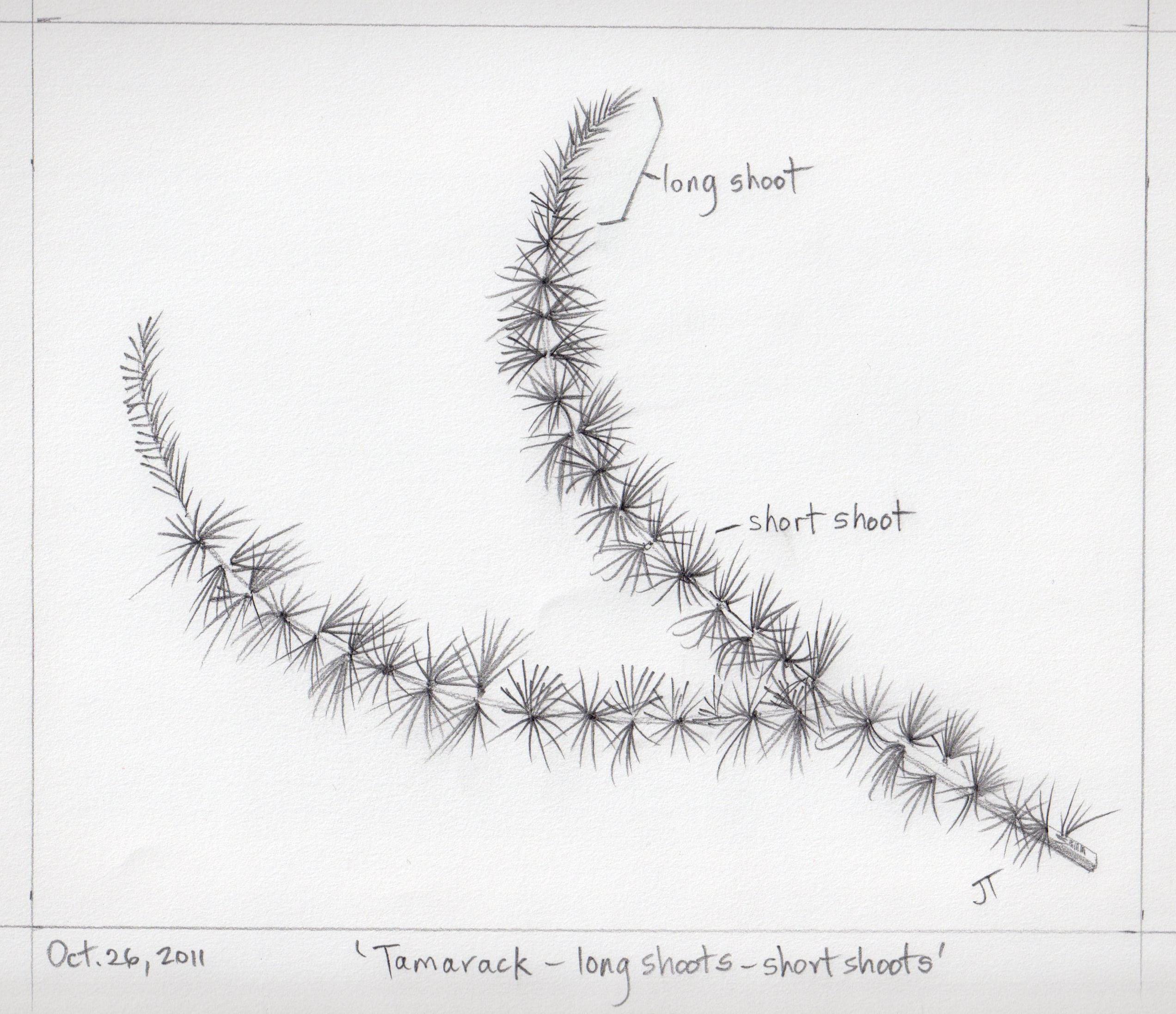
In my head, I can still hear the voice of my undergraduate botany professor, who was interested in the origin of growth forms of plants, saying, “the tamarack has, here, both short shoots and long shoots”. The short shoots emerge from the sides of branches and resemble small bunches or tufts of needles, and the long shoots grow at the ends of each branch and are elongated, with single needles along the length. The needles are small and generally very soft to the touch compared to other conifers.
Today, there is evidence that the ‘amber rain’ has begun, just a few needles on every outside surface. By the end of next week, the windshield of the car will need a swipe of the wipers to clear the yellow needles.
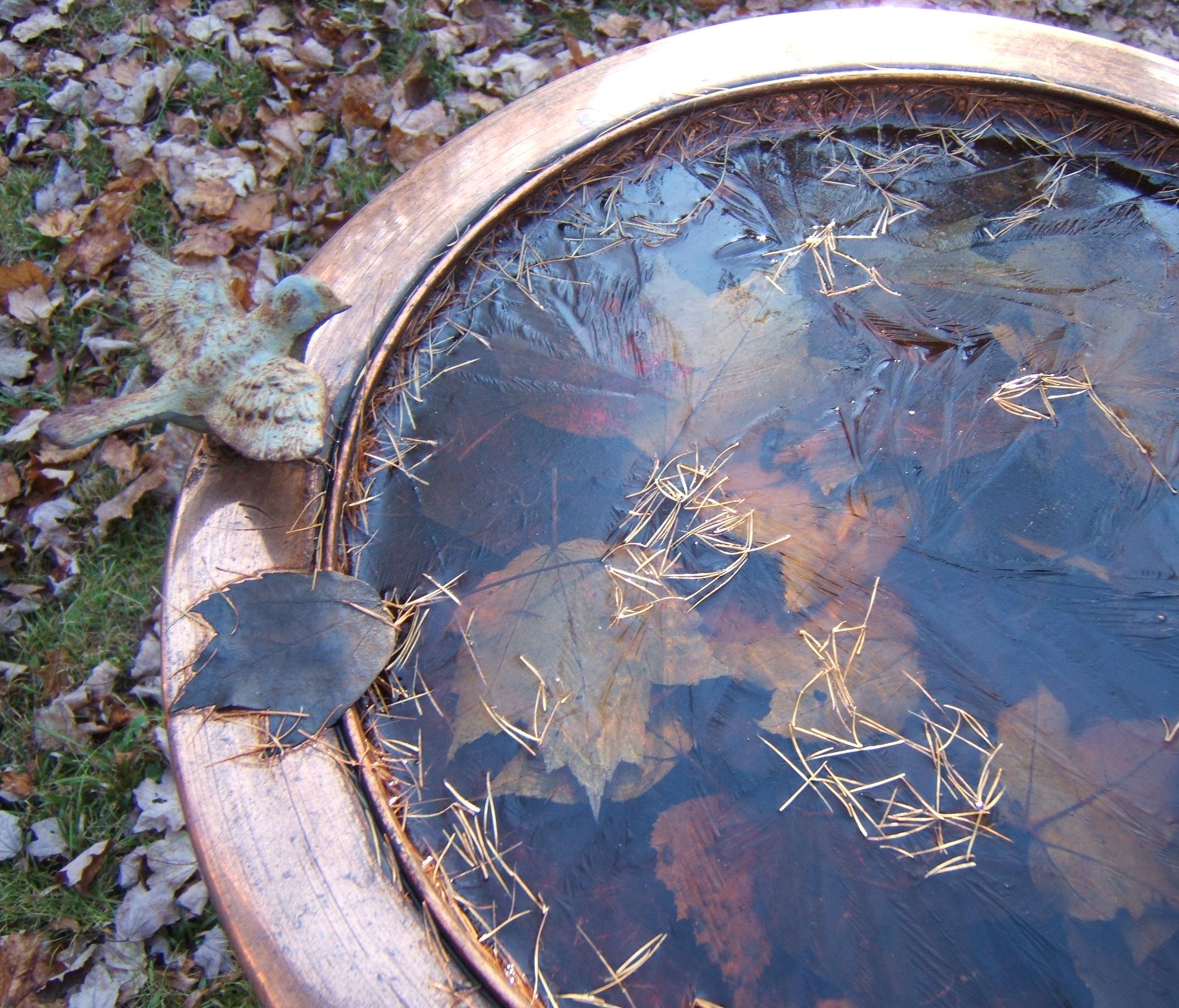
Tamarack needles on the frozen water of the birdbath
Amber Rain
~
autumn fades
bright carpets
swept away
pale ghosts rattle
from beech and oak
limp rags hang
on frosted pumpkin vines
~
but still
a touch of autumn
stands of larch
yellow in the afternoon
~
and now
a gust of wind
begins
the amber rain
~
pelting needles
fill the air
soaking ground
strewing gold
everywhere
~
fairy straw
washed to the edge
of puddle shores
flooding borders
of roads, driven
by wind, a storm
of gold
~
needles patter
gentle chatter
~
where begins
the amber rain?
is it larch
or hackmatack,
juniper
or tamarack?
who sends the amber rain?
~
© Jane Tims 1992




 nichepoetryandprose