Archive for the ‘exploring New Brunswick’ Category
Bald eagle
On a drive along the Saint John River south of Oromocto, we were happy to get great views of two Bald Eagles.
~
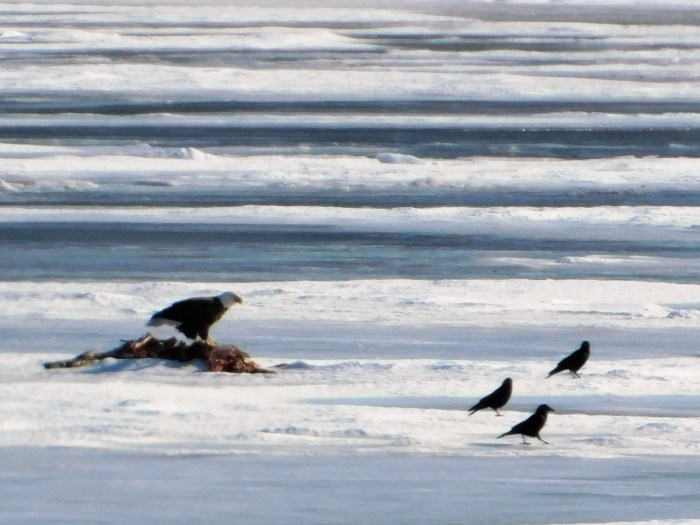
an uneasy gathering on the river ice …
~
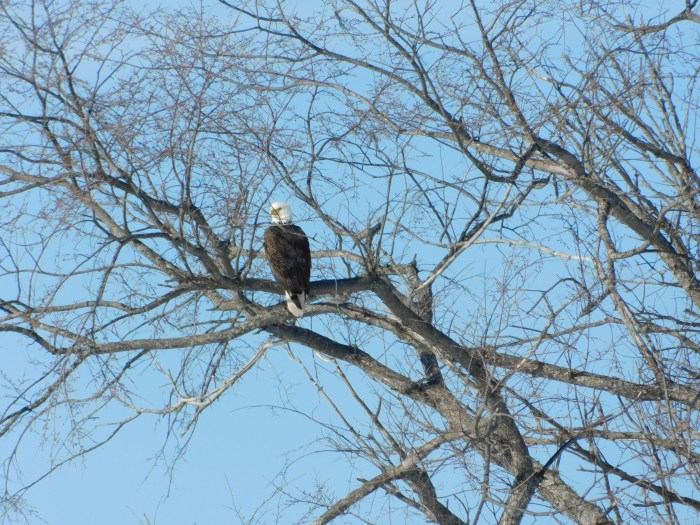
watching for dinner …
~
~
Copyright Jane Tims 2017
spring comes to the Saint John River
We have waited eagerly for spring here in New Brunswick. With late snow storms and temperatures still in the minus degrees Centigrade, my day lilies are just peeking through the grass at the edge of the snow.
~
There is still ice on the river with windrows showing the last snows …
~
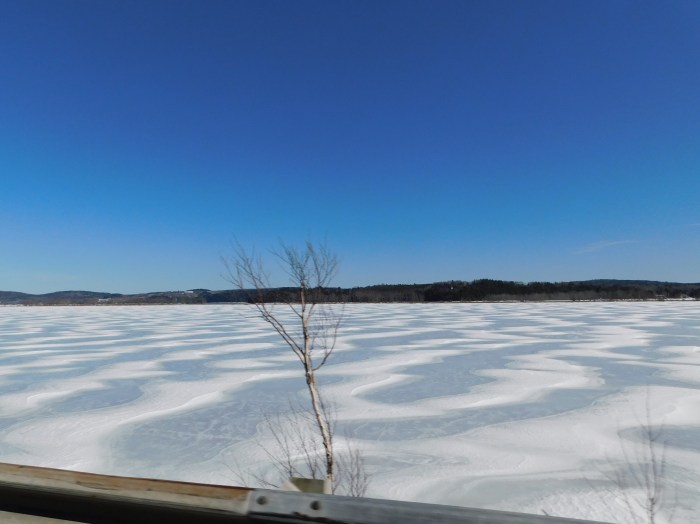
~
but the ice is gradually receding, revealing vast strips of blue water …
~
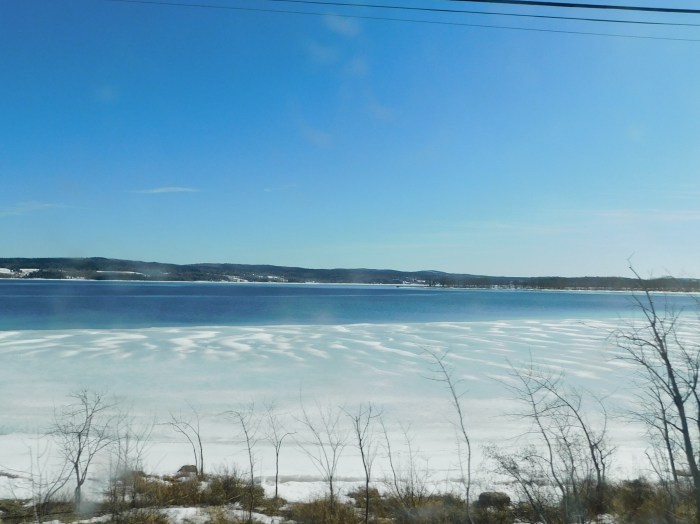 ~
~
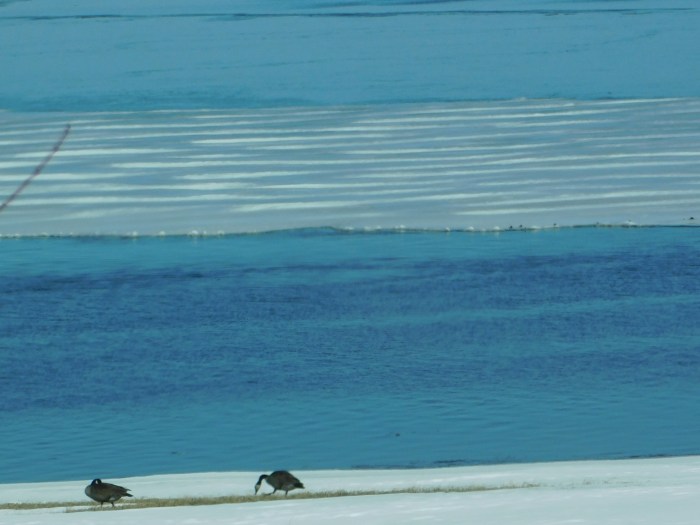
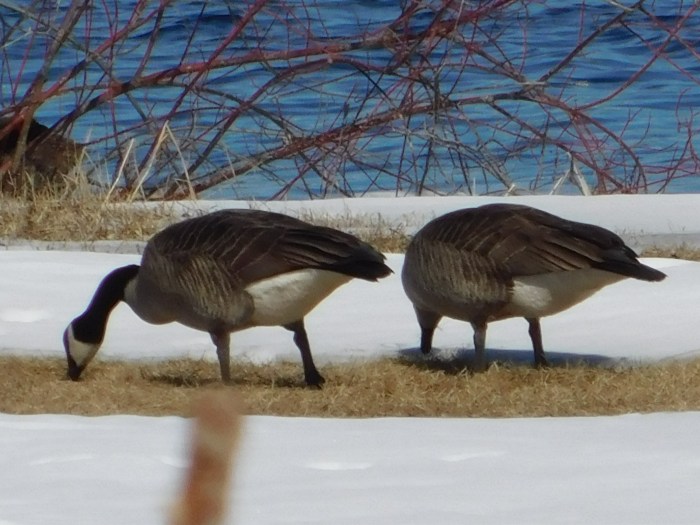
Every year, my husband and I watch for our own harbinger of spring …. the return of the Canada geese to the river. We went for a drive last week to find many examples of geese feeding in the bare fields and along the river edges.
 ~
~
We saw geese in several fields along the way, but our best view was on a side road to one of the river’s many concrete wharves …
~
~
prediction of spring
~
necks of geese
are the steep upward
curve of charts showing:
—— longer , brighter days
——- larger areas of meltwater
——— warmer expressions of sun
~
~
Copyright 2017 Jane Tims
an intelligent world of blue
Yesterday, we went on a drive along the Saint John River from Oromocto to Jemseg. We hoped to see some birds or other wild life. But we didn’t even see a crow!!!!
~
However we did see the world painted in a sweet-toned shade of blue … the ice on the river, the long shadows on the meadows and the sky. I was reminded of Douglas Adams and his tribute to hooloovoo ‘blue’.
~
A Hooloovoo is a super-intelligent shade of the color blue.
― Douglas Adams, The Hitchhiker’s Guide to the Galaxy
~
 ~
~

~
Copyright Jane Tims 2017
mustard electric
More painting going on. Trying to capture some of our dramatic New Brunswick landscape.
~
This summer we drove through the rural countryside near Millville and loved the brilliant yellow mustard fields.
~
This painting is called ‘mustard electric’, 24″ by 20″, acrylic, gallery edges, painted with Hansa yellow, Ultramarine blue, Titanium white. When I had it in the living room, it was impossible to ignore, its blast of yellow lingering in the peripheral vision!
~
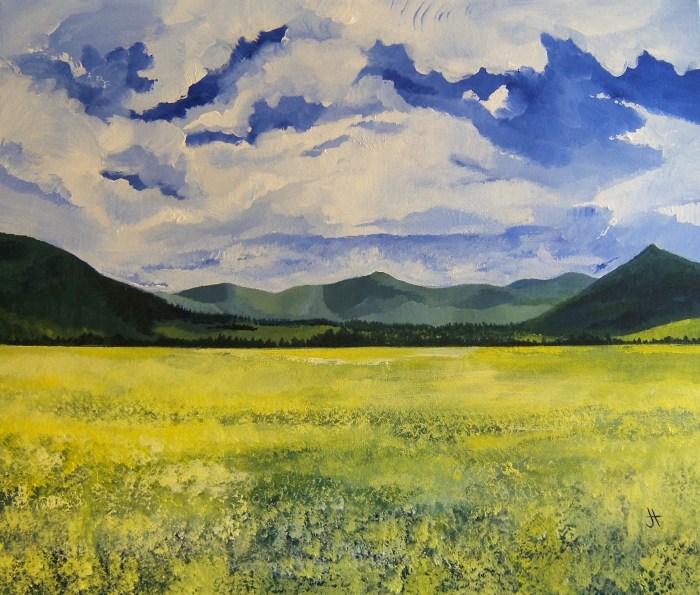
September 10, 2016 ‘mustard electric’ near Millville, N.B. Jane Tims
~
~
Copyright Jane Tims 2016
uphill and down
While doing a search for a particular plant we know grows in the area, my husband and I took a side road through rural Victoria County in New Brunswick. We drove from Route 109 (near the top of the map), south through Upper Kintore and Lower Kintore, to Muniac, a distance of about 23 kilometres.
~

(Map Source: New Brunswick Atlas, First Edition)
~
Kintore was settled in 1873 and named for the town of Kintore near Aberdeen, Scotland. In 1898, Kintore was a railway station and had a post office and a population of 75. (Source: New Brunswick Archives)
~

church and school house in Upper Kintore 2016
~
Interesting to me was the very well-cared-for one room Upper Kintore School, built in 1877.
~
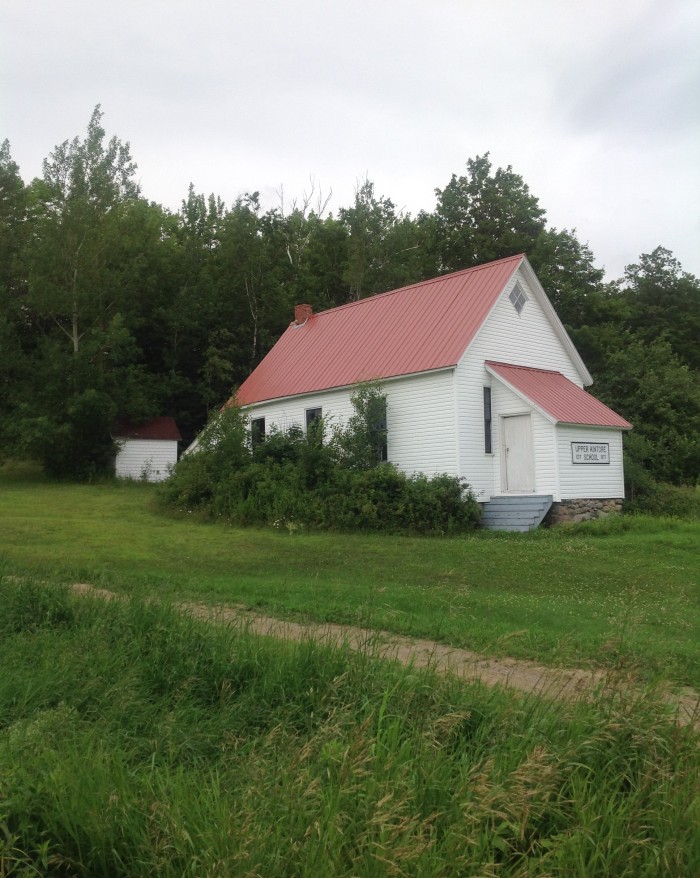
Upper Kintore School built 1877
~
Our drive took us uphill through Upper Kintore, along Big Flat Brook (a tributary of the Tobique River). The road peaked at Lawson Hill and then ran down, through Lower Kintore. Again, the road followed a watercourse, the Muniac Steam (a tributary of the Saint John River). As we drove we talked about the road — the earliest roads took the easy way, along the brooks. The southern part of the road was banked by steep rocky roadcuts.
~
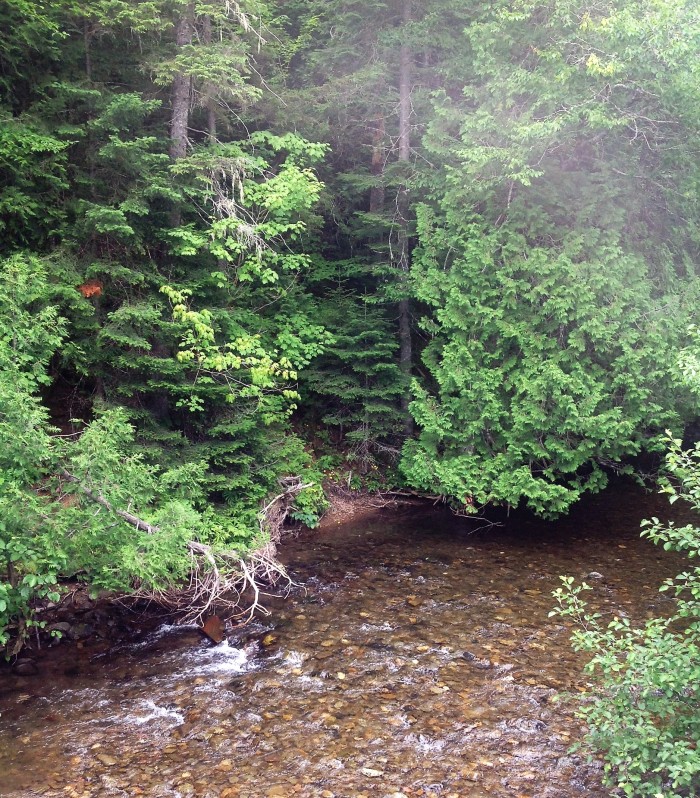
the Muniac Stream near Lower Kintore
~
Since I am interested in the plants children might encounter on their way to school, I was happy that this is the time in New Brunswick when most of our roadside wild flowers are in bloom. We saw Black-eyed Susan (Rudbeckia serotina Nutt.), Red Clover (Trifolium pratense L.), Bedstraw (Galium sp.), Daisy (Chrysanthemum Leucanthemum L.), Bladder-Campion (Silene Cucubalus Wibel) and Meadow Rue (Thalictrum polygamum Muhl.). Quite a bouquet! I have to remain aware that some of these plants have become very weedy and invasive since the early 1900s and may have been hard to find in the 1800s. For example, in the photo below, just above the Black-eyed Susan, you will notice a plant of Wild Parsnip (Pastinaca sativa L.). In New Brunswick, Wild Parsnip is a invasive species, probably introduced by Europeans in the 18th century as a food source.
~
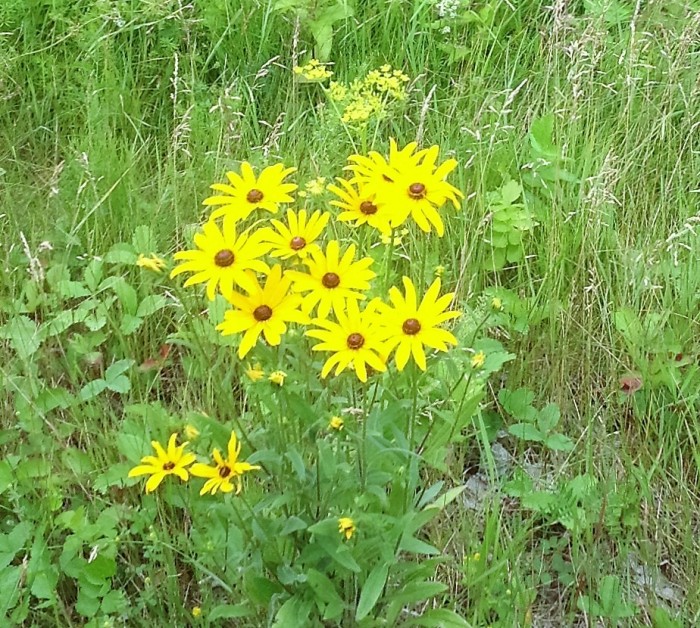
Black-eyed Susan along the road
~
Do you have any favorite rural drives through communities with interesting histories?
~
Copyright Jane Tims 2016
one room schools – distractions on the way to school
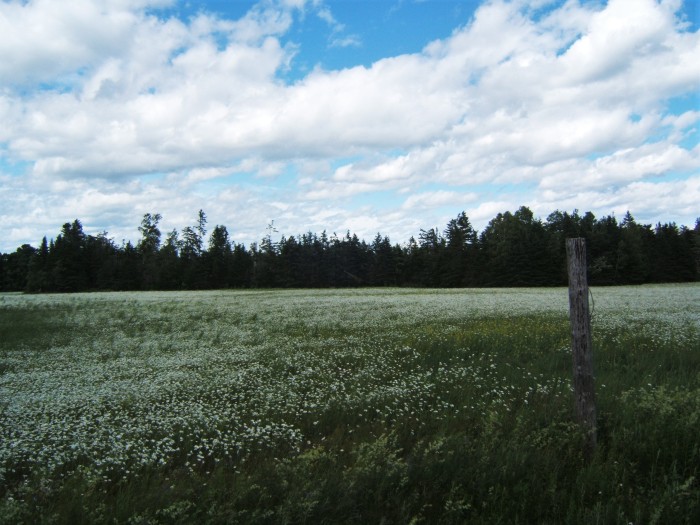
I am thinking about the ways landscape would have influenced the day at a one room school in New Brunswick one hundred years ago. As we drove some of the back roads in the Stanley area this past weekend, I tried to think like a child on the way to school. So many distractions!
~
~
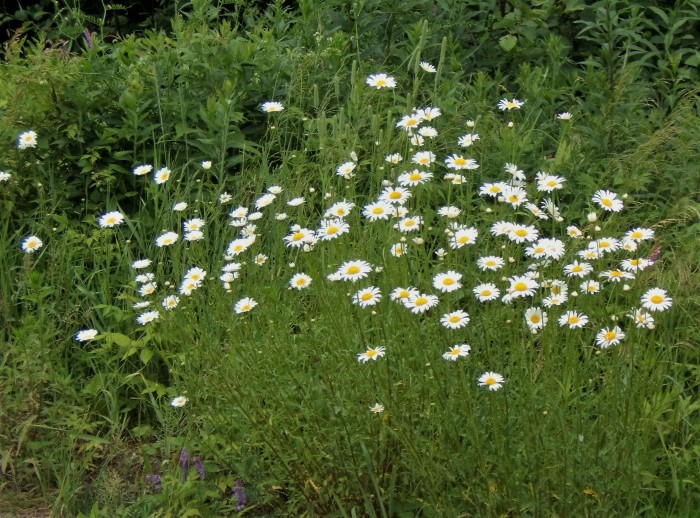
First, the views. Fields green with new corn, yellow with buttercups, winter-white with daisies …
~
~
And daisies to pick, perhaps a bouquet for a favorite teacher …
~
~
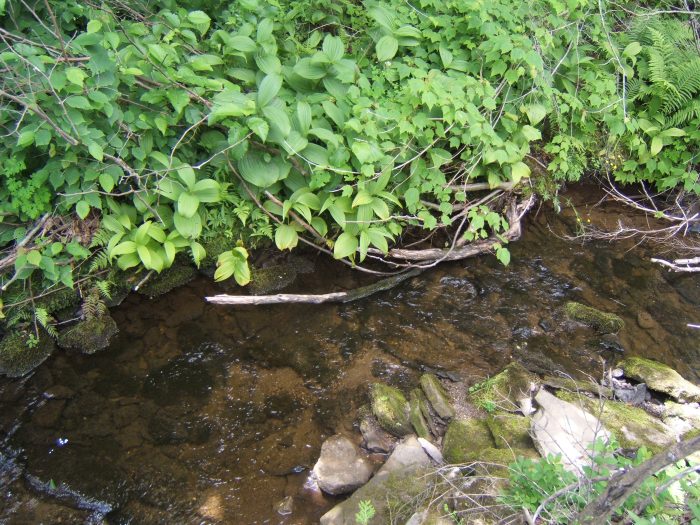
Brooks to cross, and the lure of watching for fingerlings in the clear water …
~
~
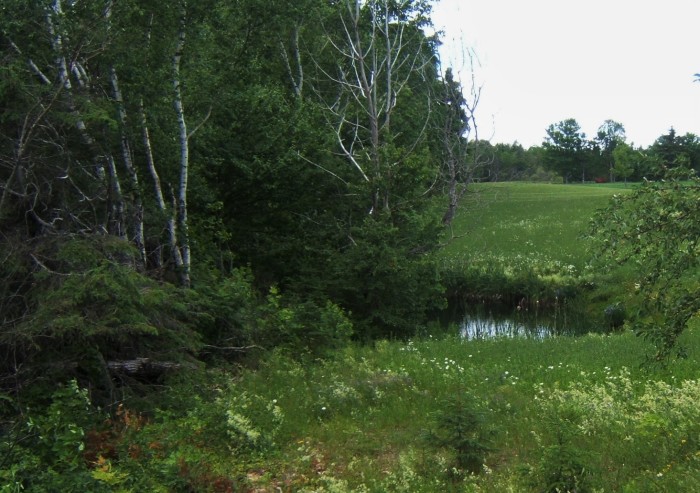
And a farmer’s pond, with ducks to watch, fish to feed, frogs to hunt and cat-tails …
~
~
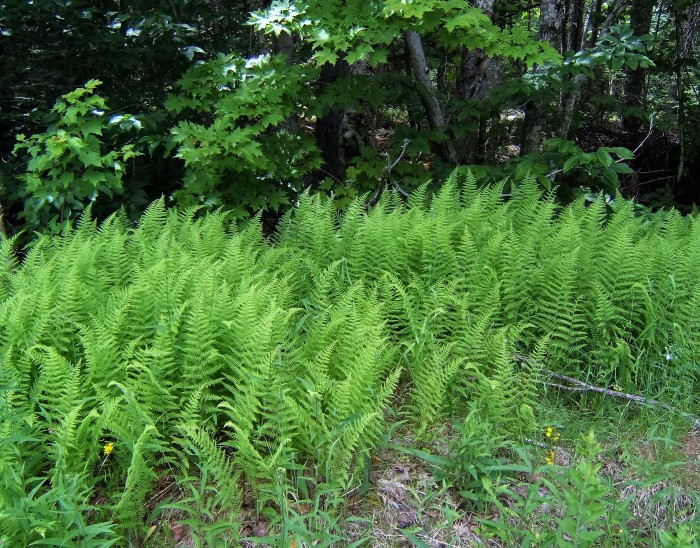
Hillsides of fragrant hay-scented fern to roll in …
~
~
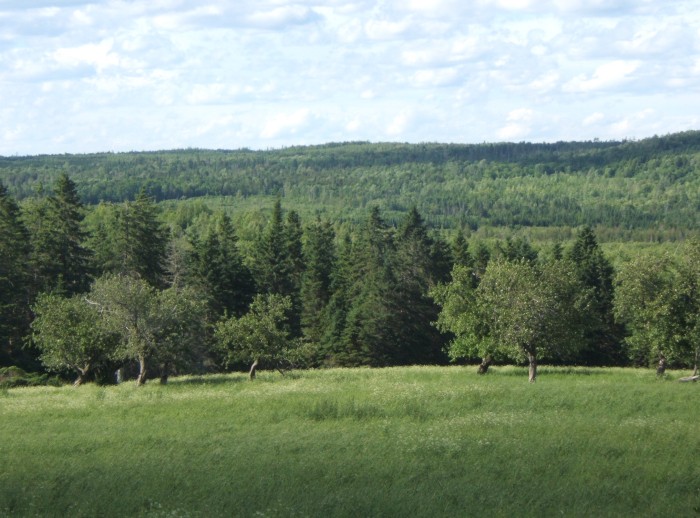
Orchards to play in and ripe fruit to gather …
~
It makes me wonder how anyone ever made it to school.
~
Copyright Jane Tims 2016
one room school houses – hiding in the landscape
Last Friday, we took a drive along the west side of Grand Lake, in the Youngs Cove area of Queens County, New Brunswick. We were searching for old one room school houses. As far as I know, there is no list for these buildings in Queens County, New Brunswick, although a list does exist for nearby Kings County.
~
I had seen one old school in the Whites Cove area, so we began there. This school was operated as a local craft store for a few years but is now a private cottage. The one room school is in good shape, painted bright red. The round plaque in the gable of the roof says 1837. The building had two front doors – one for boys and one for girls.
~
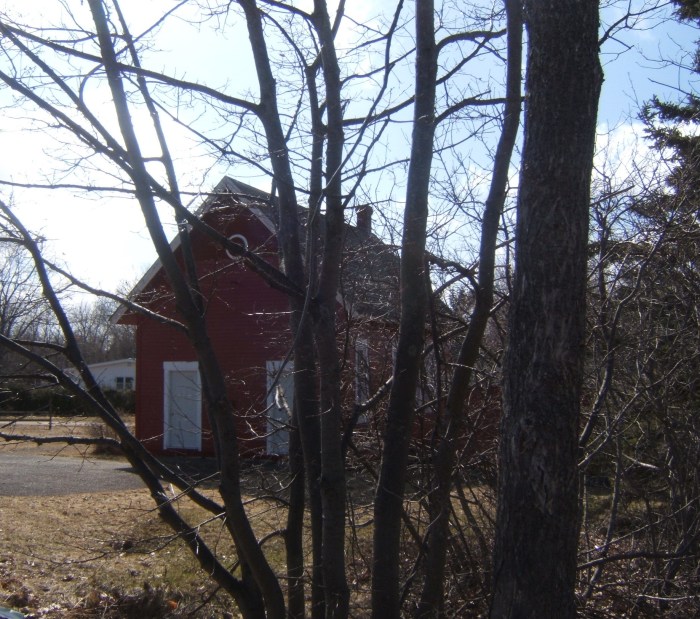
Whites Cove school house
~
We then continued toward Chipman, taking old roads when possible. I know that in the late 1800s and early 1900s, each small community (each Parish) had its own school, so we watched for the tell-tale design of the one room school house – a small, rectangular, one-storey building with a steep-sloped roof and rather high side walls. Each school had two or three tall rectangular windows on each side and one or two front doors. Some New Brunswick schools had a small anteroom or vestibule on the front. The bell-tower common on school houses in the United States was not typical of one room schools in New Brunswick.
~
We followed the road along the shoreline of the peninsulas extending into Grand Lake. In particular, we were watching for the older homes that show what the community may have looked like a hundred years ago.
~
As we came over a hill, we first saw the Rees school house. It had some of the characteristics I describe above. However, I am new to one room school hunting, so I was not really certain this little building had once been a school. And then my husband pointed to the sign on the small road opposite the building – School House Lane. The school house was being used as a cottage and was in poor condition with broken windows and a crumbled brick chimney. But I was happy to see the original stone foundation, a straight roof line, a large flat stone as a threshold, original clapboard on the front of the building, and evidence of the original vestibule.
~

Rees school house
~
Thrilled by our discovery, we continued to the next community and followed a side road. Almost immediately, we saw the Cumberland Bay School, announced by a sign above the door. It was a typical school house design, built on a hill. There was a rock foundation (with some brick) and a straight roof. The building was in good shape with evidence of regular maintenance and use, perhaps as a hall. A cold wind was howling and I felt sorry for the kids who must have come to school in all kinds of bitter weather.
~
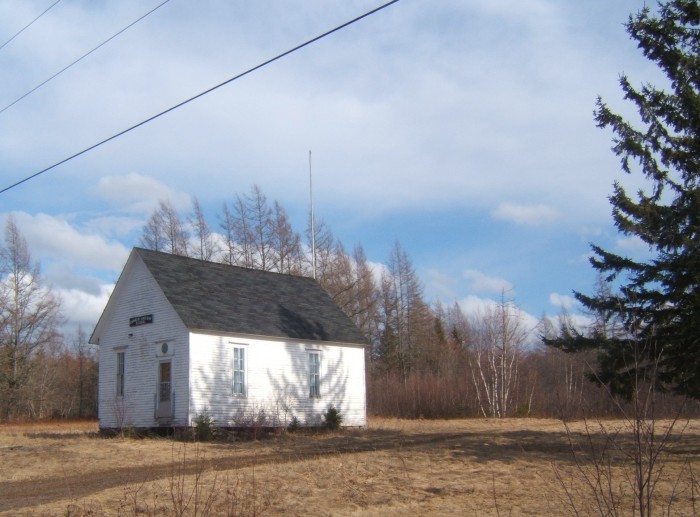
Cumberland Bay school house
~
After seeing three school houses, we felt like pros. We took the next road along the shore, toward Cox Point, and found a school house outside the community of Range. It was set back from the road, used in conjunction with a family cottage. The roof was straight, the side windows were intact and the shingles were in good repair.
~
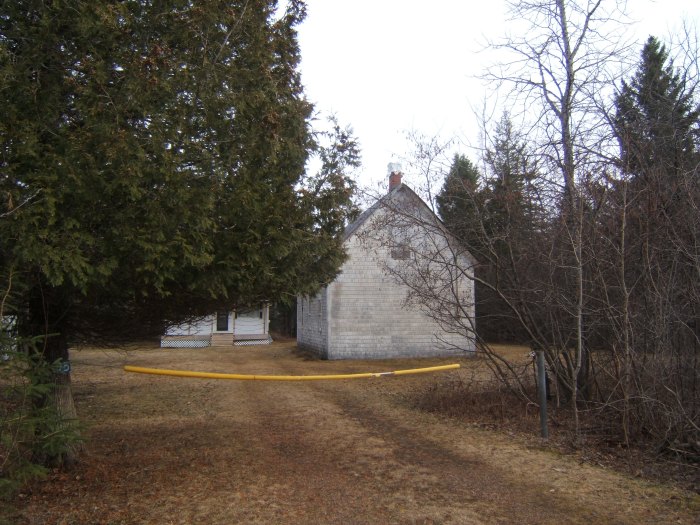
Range school house
~
I was delighted with our drive – we had discovered three school houses we did not know about! I also got a feel for some of the characteristics of these buildings and how they fit into the local landscape.
~

a map showing the old school houses we found … you can see a pattern emerging … I expect there were once school houses in some of the other communities indicated on the map
~
Why am I interested in this topic? My interests in landscape, the environment and history all come into play. I am also beginning to think about my next poetry project and have decided to explore the idea of school houses in the landscape.
~
To do this project, I will think about the setting of the school house in the community and how topography (hills and lakes and rivers), vegetation (fields and forests, orchards and big old swinging-trees) and other built landscape (bridges, churches, stores and farms) would have influenced the students, teachers and members of the community. Visits to old schools, some talk with people who remember attending these old school houses and reading at the Provincial Archives would give me lots of material for my writing.
~
Do you have examples of old one room school houses in your area? Did you attend school in a one room school house? I would love to hear your stories!
~
Copyright 2016 Jane Tims
Next painting for Isaac’s Way art auction …
On January 25, 2016, the 25th Art Auction and Sale at Isaac’s Way Restaurant in Fredericton, New Brunswick will come to an end. Only a few more days to own some reasonably-priced art and help kids-in-need. As of January 4, 2016 this 25th auction has sold 22 paintings and raised $7,600 for art lessons for kids. For a look at the paintings still available, visit http://isaacsway.ca/art/. To have a look at my submission to the 25th Art Auction, see my post for September 18, 2015 https://janetims.com/2015/09/18/art-auction-new-painting/
~
My next submission, for the Isaac’s Way 26th Art Auction and Sale, is a landscape. The piece features a view of the Saint John River, from the Nerepis Marsh at Grand Bay-Westfield towards the Westfield Ferry. It is entitled ‘across the bay’ (24” wide by 20” high, acrylic on canvas, unframed with gallery edges). This auction will run from January 27, 2016 to late May, 2016. The proceeds from the auction will go to sponsor kids-in-need. I am donating 50% of the proceeds from my painting to the charity.
~
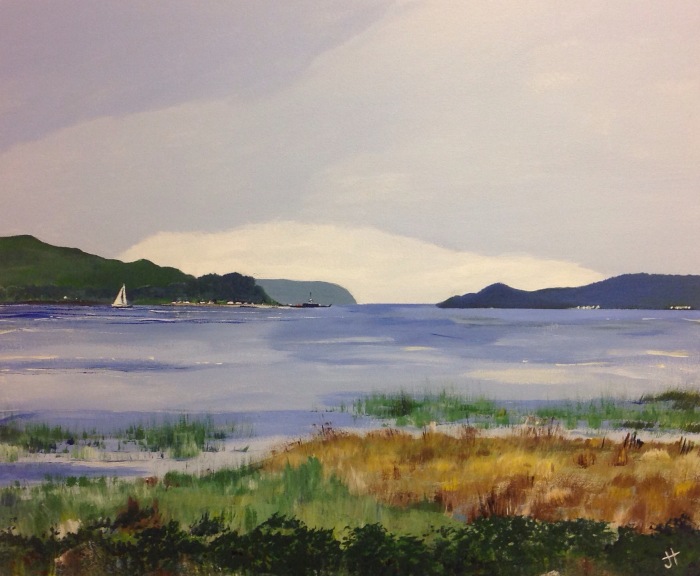
‘across the bay’ Jane Tims
~
Copyright Jane Tims 2016
navigation – guest post by Rob Hughes
I am so pleased to welcome a guest in this post. Rob Hughes is a former colleague and friend, now retired and keeping bees, hobby farming and trekking around the Maritimes. In this post, Rob writes about finding your way in the landscape. Welcome Rob!
~

(photo credit: Rob Hughes)
~
Whiteout
~
In the noise of white the blurring snapped
the normal drive detached
flipped and pulled my brain on bungies
In a spin or floating
zigged
away –
disconnected, inverted, spinning somewhere –
Somewhere, in a nagual line of space.
~
A pinch of view, a scrap
as I groped not knowing –
a bush? Something, please – then
zag.
I see and am unswallowed, spat back out,
land again in what must be reality
Tonality
~
I drive on frightened, woozy from the warp of time and space
The white took over.
~
~
The poem is an attempt to capture the scary vertigo that can happen when driving in a whiteout. We can lose normal visual cues and suddenly, what was familiar becomes a trip into the unknown. While usually only lasting seconds, it can feel like dropping down the proverbial rabbit hole. It’s a powerful lesson in how we are constantly checking where we are in the world, and how quickly our inherent navigation system can go off the rails when the inputs are messed up.
~
These days there are more ways than ever to help find your way around. People still get lost. Map reading might be in danger of becoming a lost art. Let the GPS take care of it. Nice, but you might get disconcerting voice commands to turn here, or there, even when the maneuver is patently impossible. The trouble is that those devices are not thinking. Most of us know of hapless travelers sent into the backcountry mire on a short cut. You could be better off with a map!
~
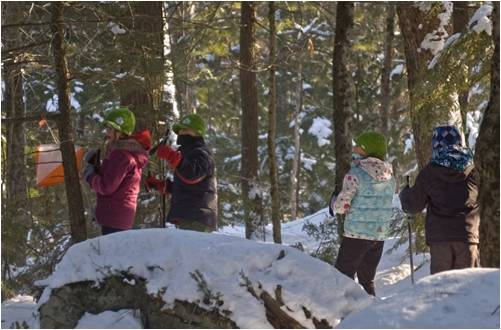
Ski orienteering in Odell Park, Fredericton. (photo credit: Jenny Hughes)
~
For years I have enjoyed turning navigation into adventure, exploration, exercise and fun all at once through the sport of orienteering. There are lots of drills to help with how to visualize terrain, choose the best route, and then memorize it, so you can concentrate on navigating through the real world without having to refer back to your map every twenty seconds. It’s a lot of fun to locate landscape features along a route deep in unfamiliar forest.
~
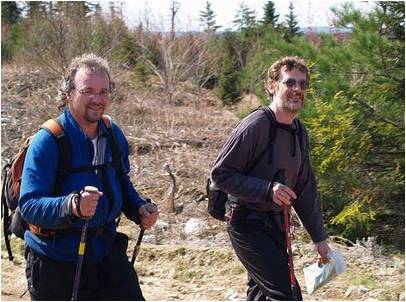
Rob (right) and team-mate Steve finishing the E2C, a 24-h rogaine held annually in Nova Scotia. (photo credit: Halifax Search and Rescue/Orienteering Nova Scotia)
~
After orienteering for some years, there came a sort of craving for more… a kind of classic addiction response, presumably. Enter rogaining. Yes, it really is a word, and the internet is there to prove it. It’s a perfect fix for navigation junkies. I have made some great map and compass buddies in this sport, in which teams of 2-4 spend up to 24 hours seeking control locations in the backcountry, sometimes covering the distance of two marathons in the process. No electronic devices, just map and compass. The sport has a kind of quirky mystique that draws aficionados from all over the globe to the biennial world championships, often held in spectacular settings.
~

The logo of the International Rogaining Federation. It depicts the sport well – day and night, up and down, footsteps…. (credit: International Rogaining Federation)
~
Spring in the Maritimes is marked by an annual pilgrimage to take part in the Eco-Endurance Challenge, held in Nova Scotia in April or early May and organized by Orienteering Nova Scotia and Halifax Search and Rescue. This is often a very difficult and wet rogaine, but popular with hundreds of local map heads. Who knew finding your way could be so addictive?
~
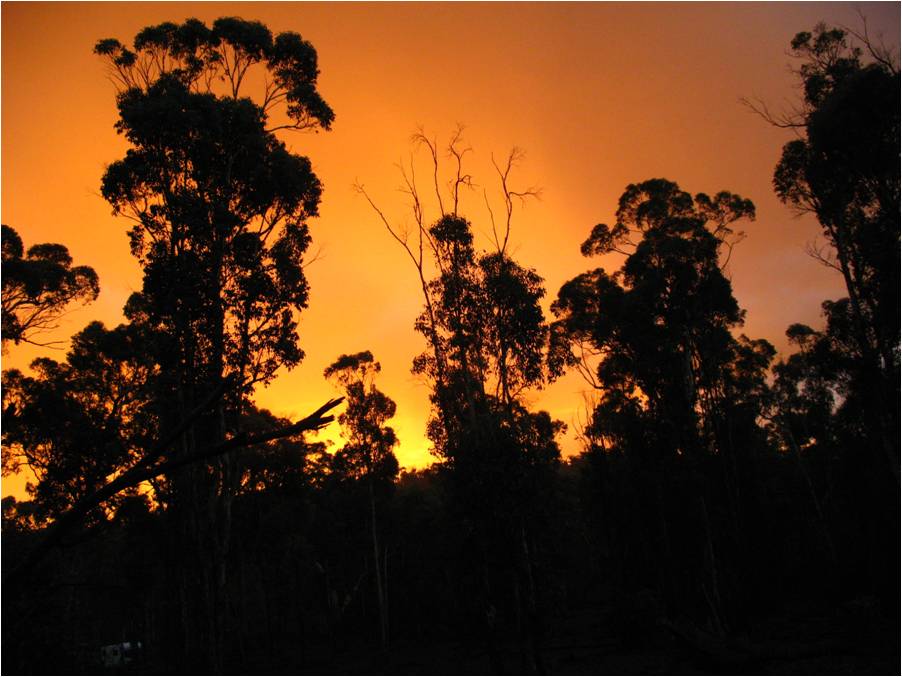
Dawn forest scape at the 2009 Australian Rogaining Championships held at Wandering, Western Australia. A memorable navigation challenge! (photo credit: Rob Hughes)
~
Copyright 2015 Rob Hughes
harvesting yellow … yes, yellow!
After so many lovely browns in my palette of natural dyes, I have despaired of seeing anything but brown when I lift my wool roving from the dye pot. A friend suggested I try Goldenrod (Solidago sp.). Goldenrod, in a variety of species, is plentiful along the roads this time of year. So, this week, on a drive to see our newly opened section of Route 8, we stopped long enough to collect a bag of Goldenrod.
~

Goldenrod along the new highway
~
Collecting Goldenrod is new to me. I am always worried it may cause hay-fever, but I learned during my fact-finding – Goldenrod is rarely responsible for triggering allergies. Its pollen is large and heavy and transported by insects and not the wind. Ragweed is the real culprit, according to my reading.
~

a glory of Solidago
~
I also took a crash course in Goldenrod identification – Goldenrods have always stayed on my ‘refuse to identify’ list. They are actually quite easy to distinguish in our area. There are only 14 common species in New Brunswick and identification points include the size and number of basal leaves, leaf venation, the degree of stem hairiness and the general shape of the inflorescence. It was easy to discover the name of the species I collected – Downy Goldenrod (Solidago puberula Nutt.)
~

a bag of Goldenrod took no time at all to collect
~
The collecting experience? Bright and very aromatic. Smelling Goldenrod is like stuffing your nose in a dandelion.
~
I had lots of material to work with, so preparing the pot of dyestuff was enjoyable too. And the smell as it boiled – very sweet. Most of the plants I’ve used for dyestuff have an unpleasant smell like boiling cabbage.
~

Goldenrod added to the dye pot
~
The result was a yellow dye.
~
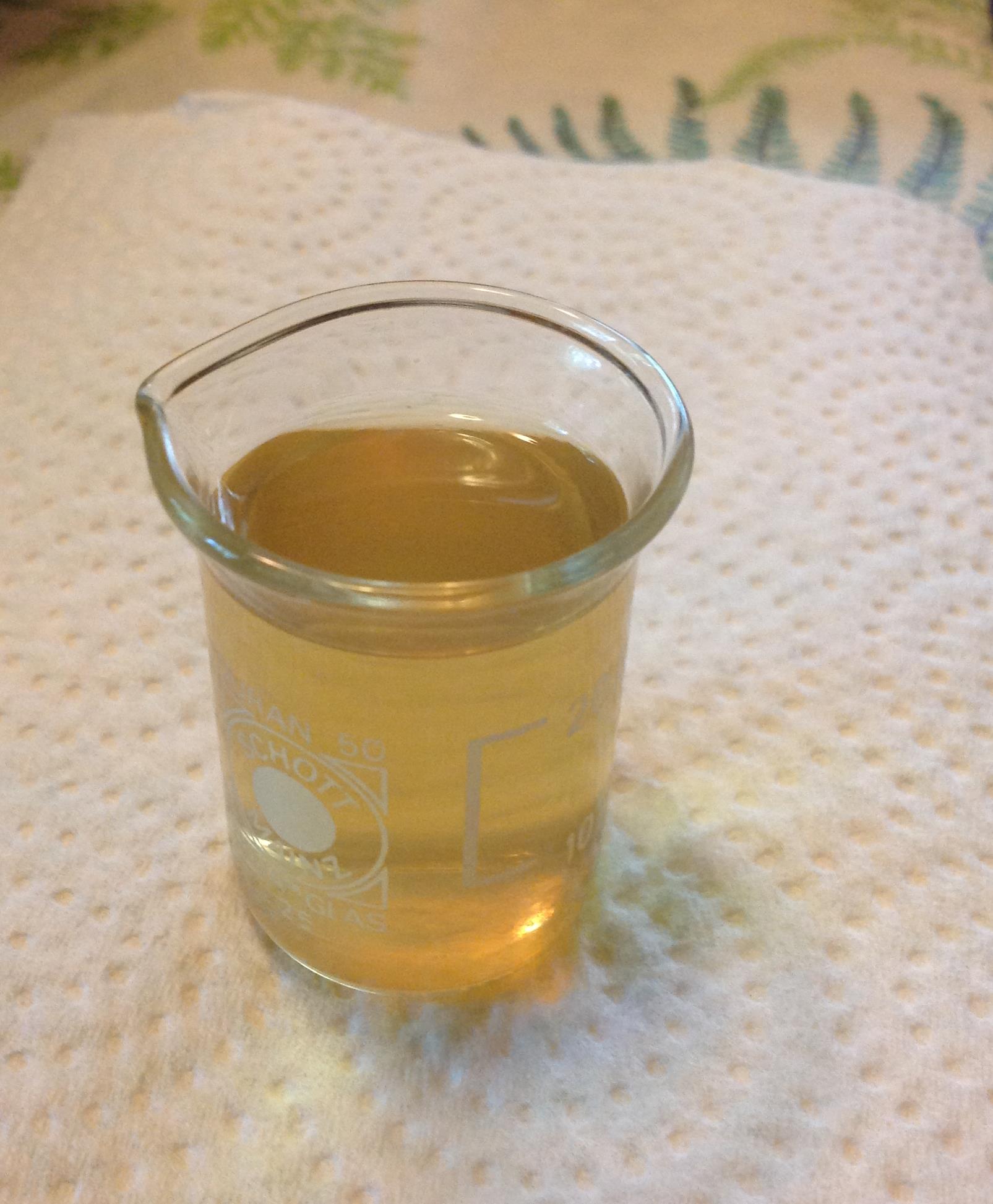
the yellow dye of Solidago
~
But since the colour of the dye seems unrelated to the resulting colour of the wool, my expectations were low. Imagine my joy when the wool emerged from the dye-bath a beautiful lemony yellow!
~

wool roving, treated with alum and simmered for an hour in Goldenrod dye
~
Yellow! Sigh.
~
Copyright 2014 Jane Tims




 nichepoetryandprose