Archive for September 2012
a walk through the covered bridge – Smyth Bridge, South Branch of the Oromocto River
On our August drive along the South Branch of the Oromocto River, we crossed two covered bridges. I love these bridges… they are picturesque and so pleasant to walk through. They are also part of the local history of many communities in New Brunswick. I’ve talked a little about covered bridges before in my Blog – please have a look at https://nichepoetryandprose.wordpress.com/2011/09/05/inside-the-covered-bridge/
One of the bridges we saw on this drive was the Smyth Bridge. It crosses the South Branch of the Oromocto River, near Mill Settlement in Sunbury County (listed as South Oromocto Rover #2 in the April 1992 pamphlet ‘Covered Bridges in New Brunswick’, no author indicated).

Inside the bridge, it is cool and dark. When a car drives through, you hug the side, hoping the driver will see you and slow down. I love the sound of the tires on the timbers making up the floor of the bridge.

Down-river, the shallow water of the river glows in the sun. Most of our local rivers are the color of tea, a consequence of their origins in wetland areas.
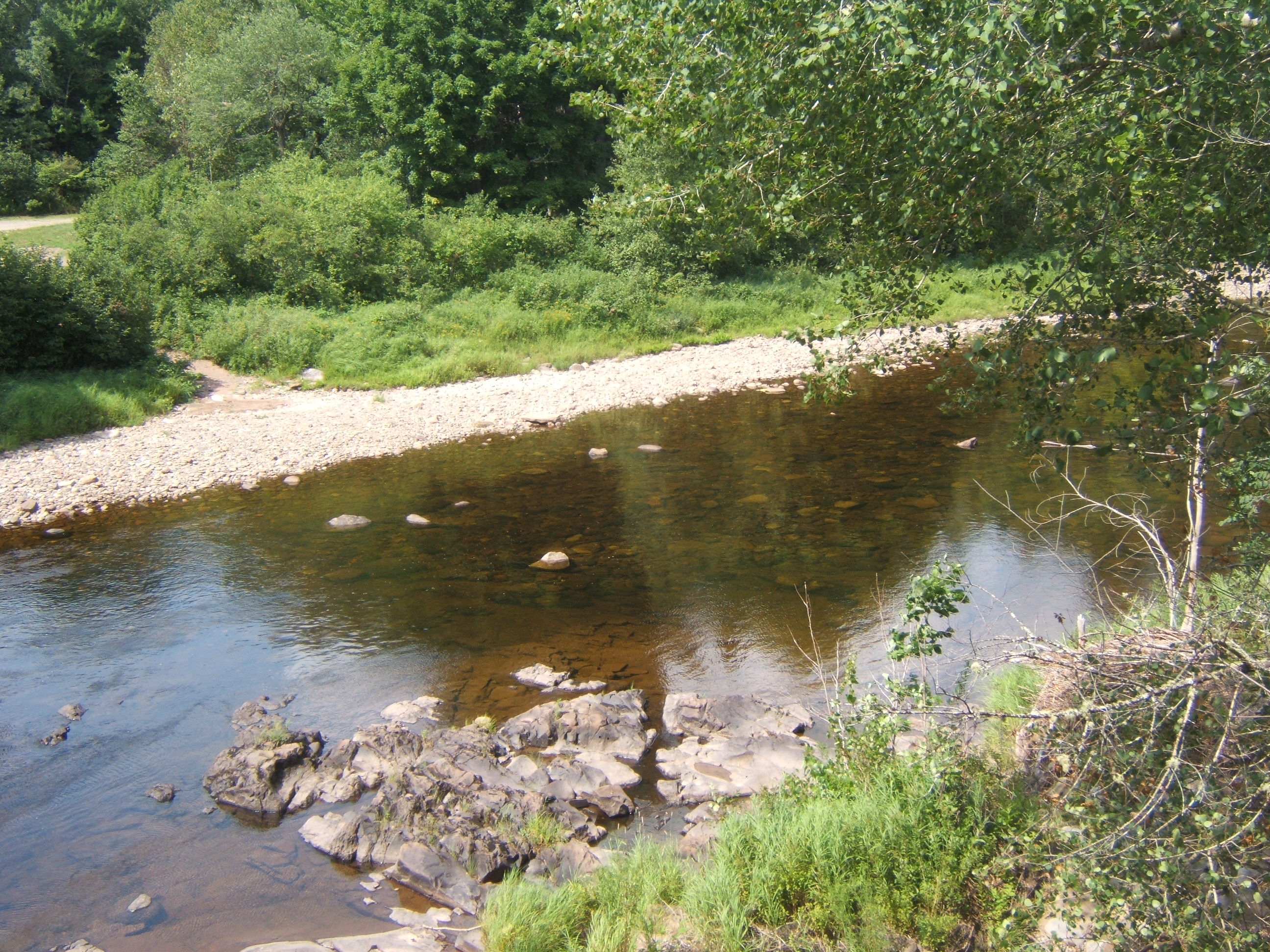
Up-river of the Smyth Bridge is a gravel beach and water for wading and swimming.
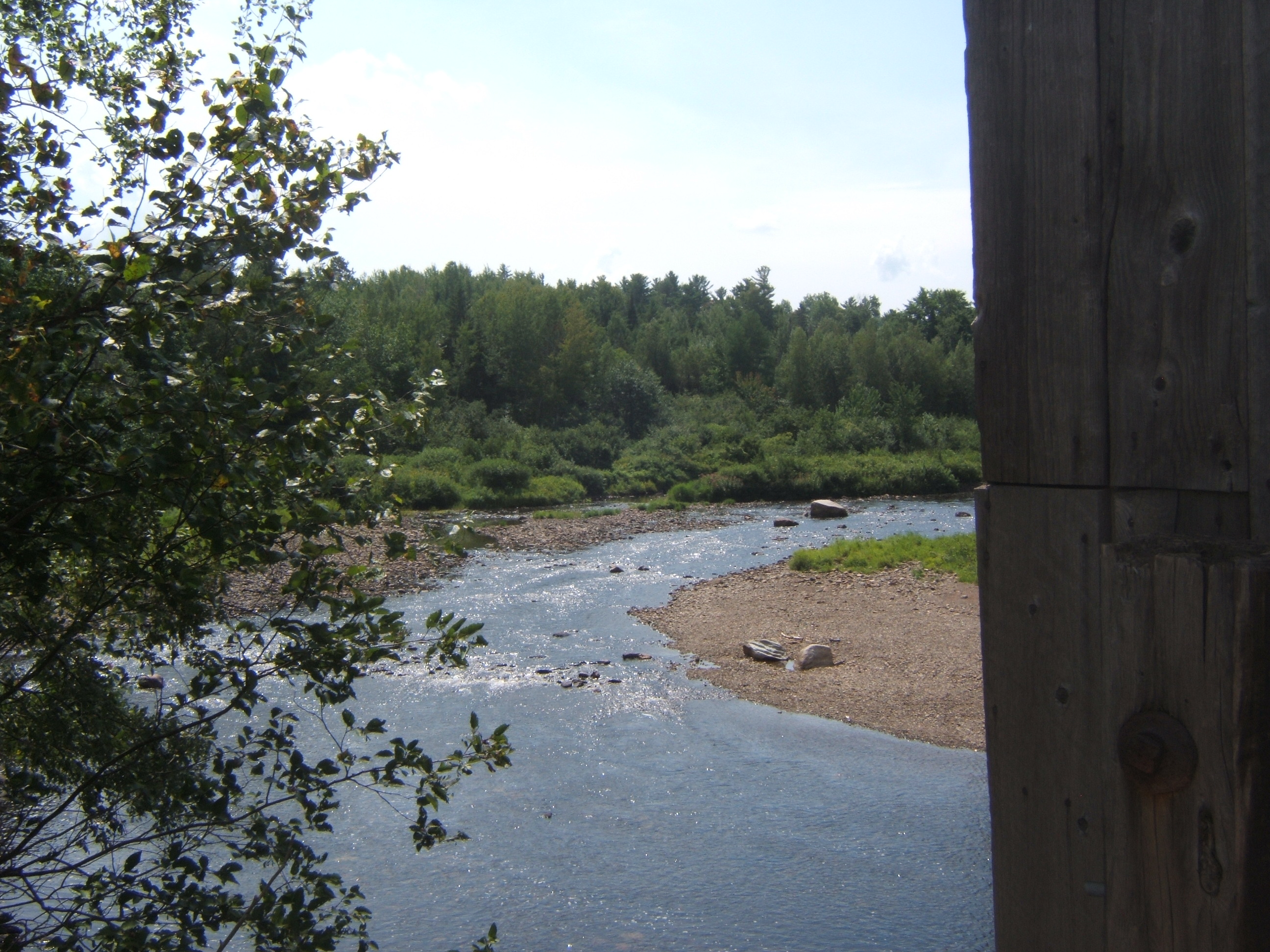
The Smyth Bridge was built in 1912 and has a total length of 139′ 1/2 “, and a span of 136′ 1/2 “. Its roadway width is 14′ 9”. Its Maximum Load is 10 t (6 t for double axle vehicles) and its center clearance height is 3.7 m.
During our Covered Bridge Project for Canada’s 125th anniversary, we visited the Smyth Bridge on April 16, 1992.
In 1992, the oldest dates we could find carved into the bridge were ‘Oct 3, 1915 Sunday’ under the initials ‘R K’ (in pen or pencil) and ‘Feb 1931’ beside the initials ‘LTF’ and ‘LEIK’ to the right of three simple crosses. There was also the totem of a face carved into the south side of the bridge, on the outside corner post. We also found a few other initials, deeply carved: ‘M B’, ‘R H’, ‘C B’, and ‘CED ER May 63’.
Finding these carvings requires patience, a good flashlight and about an hour per bridge, so I didn’t check to see if any of the carvings were still there on our recent visit. Sometimes they are lost when boards are replaced in the bridge during renovations.
I wonder if these people remember leaving their initials in the bridge so long ago?
~
~
‘LEIK’
– initials carved on the boards of the Smyth Covered Bridge, 1931
~
dark
silent
sequestered
~
light leaks between gable
boards, window squares cut high
river water below
sparkles in August sun
~
carved initials announce
the focused presence of
ghosts with knives
~
the clatter of tires
on timbers, as a car
rattles across the bridge
~
~
Copyright Jane Tims 2012
trial and error with mustard seed
On Saturday we took a side trip to see if the mustard is ripe for collecting seeds. We had selected a roadside area in early summer where lots of wild mustard was growing (for more information, see my earlier post about wild mustard –https://nichepoetryandprose.wordpress.com/2012/07/09/a-moment-of-beautiful-mustard-fields-in-bloom/
Although there are still some plants in bloom, the seeds have mostly been set in their long-beaked pods.

I would have been able to show you more, but I nibbled on the green pods the whole way home. They are delicious, crisp and tangy, with a hint of mustard.
There were a few dry seed pods but most need a couple of additional weeks to ripen. Each pod has three to seven well-formed seeds. The seeds take a little work to extract.
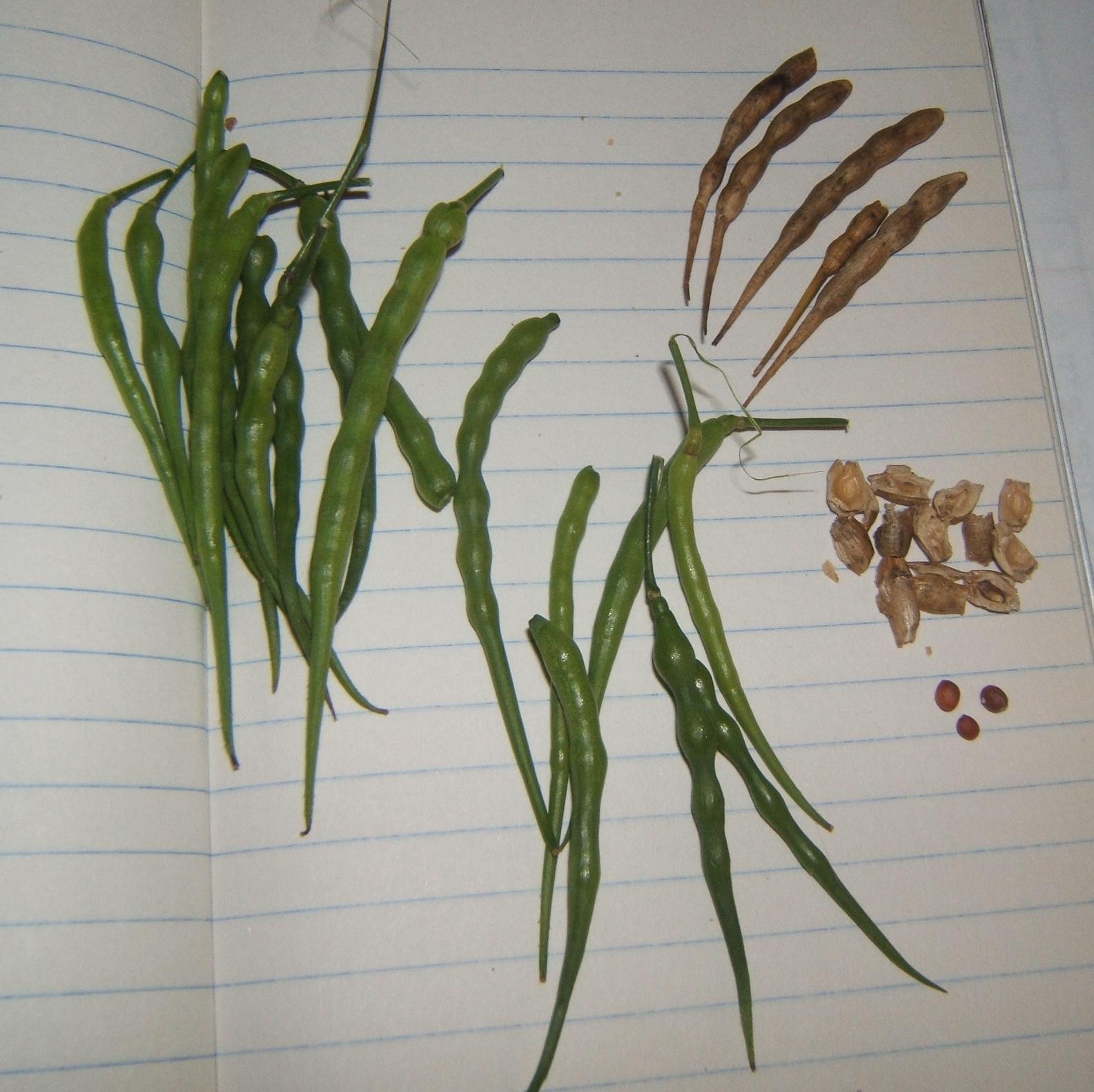
Mustard pods and seeds; green pods, dry brown pods, seed husks and three tiny seeds
I retrieved about 20 ripe mustard seeds from the pods, using a firm tap of the pestle to break the husk. Then I ground the seeds in a half teaspoon of olive oil. To make mustard, all my sources suggest using cold water, but I wanted to see if the seeds would flavour oil.
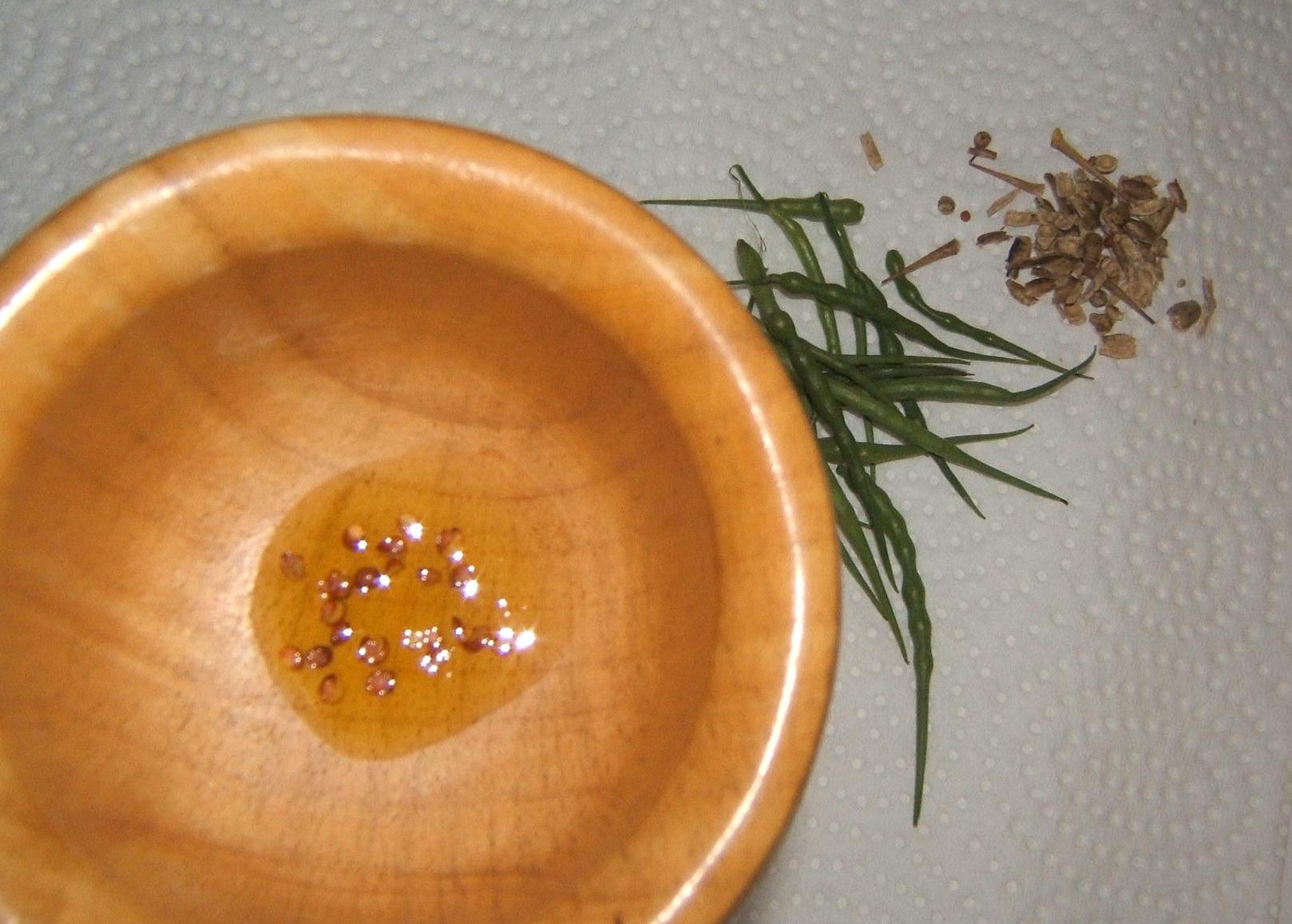
The ingredients almost vanished during the grinding with the pestle, but I got enough ‘mustard’ for a taste.

The verdict: a very mild mustard oil, easily overwhelmed by the salt on the crackers! When the pods ripen, I will pick enough for a few hundred seeds and I will use cold water to extract the flavour, just as the wise ones suggest!!!
~
~
© Jane Tims 2012
~
Warning:
1. never eat any plant if you are not absolutely certain of the identification;
2. never eat any plant if you have personal sensitivities, including allergies, to certain plants or their derivatives;
3. never eat any plant unless you have checked several sources to verify the edibility of the plant.




 nichepoetryandprose