Posts Tagged ‘plants’
snippets of landscape – evidence of old roads
This week, we drove to the south-west corner of the province and spent a little time at the Ganong Nature and Marine Park, at Todd’s Point near St. Stephen. The area is managed by the Quoddy Futures Foundation and is the former property of Eleanor and Whidden Ganong (Whidden Ganong was President of the Ganong Bros. candy factory in St. Stephen). The property is beautiful and good for the soul. We walked through the fields, identified wildflowers, listened to the birdsong, and were returned to a simpler time.
The fields along the path were yellow with Buttercup (Ranunculus sp.) and the largest population of Yellow Rattle (Rhinanthus Crista-galli L.) I have ever seen. The flowers of the Yellow Rattle were bright yellow, but the inflated calyx was tinged with red, giving the field a stippled glow (for more information on Yellow Rattle, see my post for August 3, 2011, ‘along the country road #1’ ).

Yellow Rattle among the field flowers… the fused sepals are tinged and veined with red
The Buttercups were everywhere, but concentrated in certain areas of the field. One area in particular seemed to mark the path of an abandoned road. The Buttercups have found some aspect of the old road to their liking. Perhaps the soil is compacted and they have a competitive ‘edge’ on the other plants. Perhaps the hidden track provides some alteration in the water regime or a place where certain types of seeds concentrate as they are dispersed. Perhaps there are subtle differences in the soil chemistry.
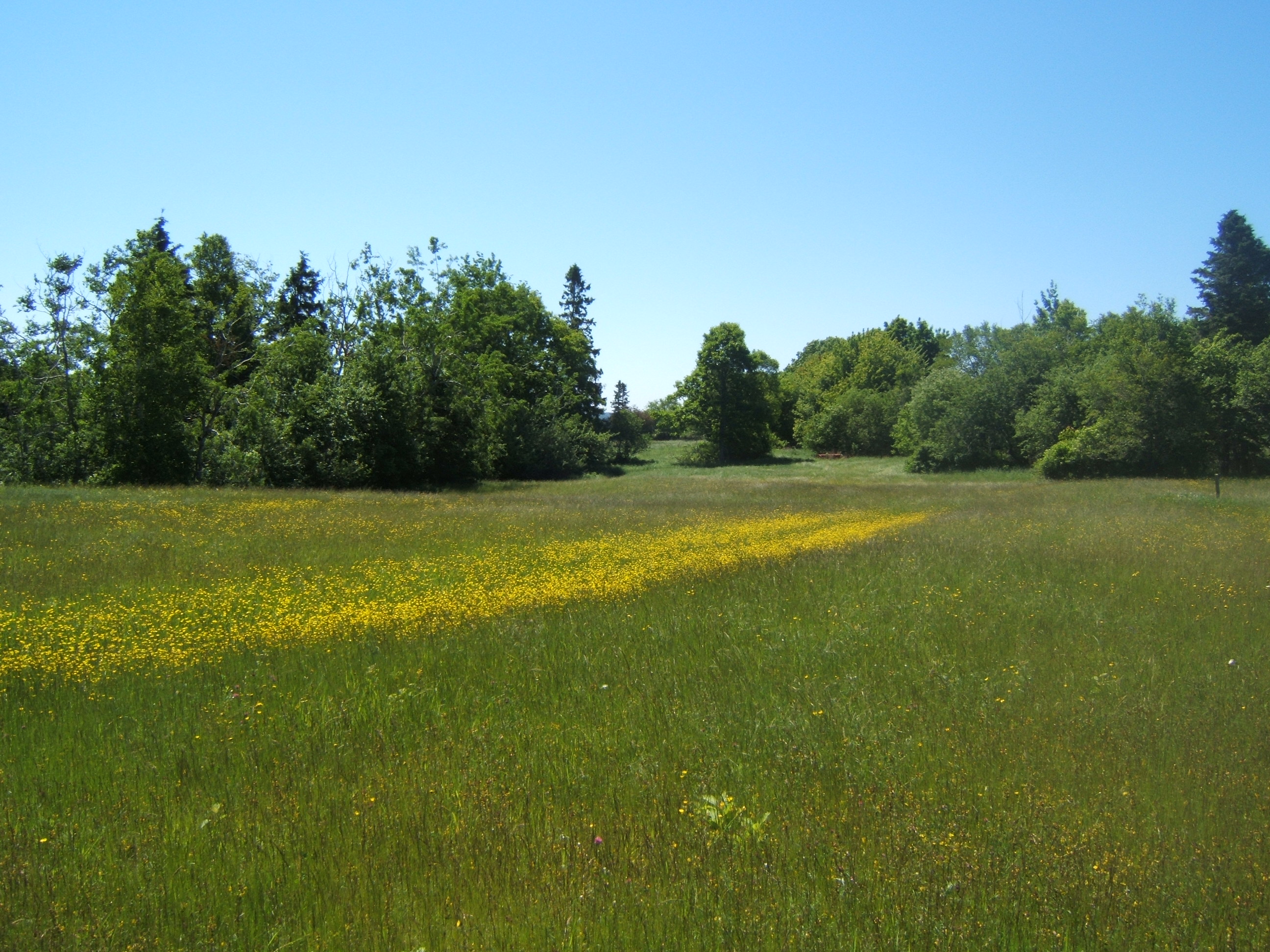
an abandoned track marked in Buttercups… the red tint in the foreground is from the reddish coloration of the Yellow Rattle
Years ago, I visited a property where the roadway to a back field was clearly marked with Bluets (Houstonia caerulea L.). The owner of the property said he thought they grew there because he always took his lime in an open cart back to his fields, and enough had spilled to make the way especially attractive to the Bluets.
Perhaps you will have a look in your landscape for wildflower clues to past activities.
~
~
Invitation to Tea
~
in the afternoon,
I huddle over tea
and watch
the road
~
an old road,
rarely used –
walks scarcely part
the tangle of fern
~
I scan the woods,
I love the look
of ancient trunk
and horizontal green
~
and always,
in the corner of my eye,
the road
~
overgrown –
a narrow course of saplings
intercepts
the sameness
of maturity
~
I watch
expectantly
~
but the road is abandoned –
cart-tracks worn
to rivulets,
culverts buried
by fallen leaves,
rusted oil tins,
depressions in the mould
~
~
© Jane Tims 2012
making friends with the ferns #3
Although the fiddleheads of the Ostrich Fern are edible and a delicacy in New Brunswick, all fiddleheads are not edible. The fiddlehead is the tightly-rolled, earliest emergence of the immature fern leaf. This coil of the leaf resembles the head of a fiddle, hence the name. As time passes, the fiddleheads uncoil and become the mature leaves of the fern.
In the Grey Woods, we have two species of fern with very distinctive fiddleheads.
The fiddleheads of the Sensitive Fern (Onoclea sensibilis L.) are slim and red. They are not edible and are poisonous to horses.

red fiddleheads of the Sensitive Fern are hard to see against the dried leaf layer
The Sensitive Fern grows at the edges of the Grey Woods, along our house foundation and in a large patch on our ‘lawn’.
The common name ‘sensitive’ refers to the fern’s characteristic dying at the first frost. The Sensitive Fern is also called the Bead Fern, a reference to the hard brown spore cases on the fertile spikes. Once the green leaves have died, only the tall brown fertile spikes remain, and these persist until spring. The Sensitive Fern is a once-cut fern (the leaves are cut once into simple leaflets) with wavy margins and sometimes deep indentations in the leaflets. The upper leaflets are ‘winged’ or ‘webbed’ where they join the main axis of the plant.
The fiddleheads of the Cinnamon Fern occur in clumps and are densely covered with coarse white hairs. The fiddleheads can be eaten but are not used as commonly as those of the Ostrich fern.
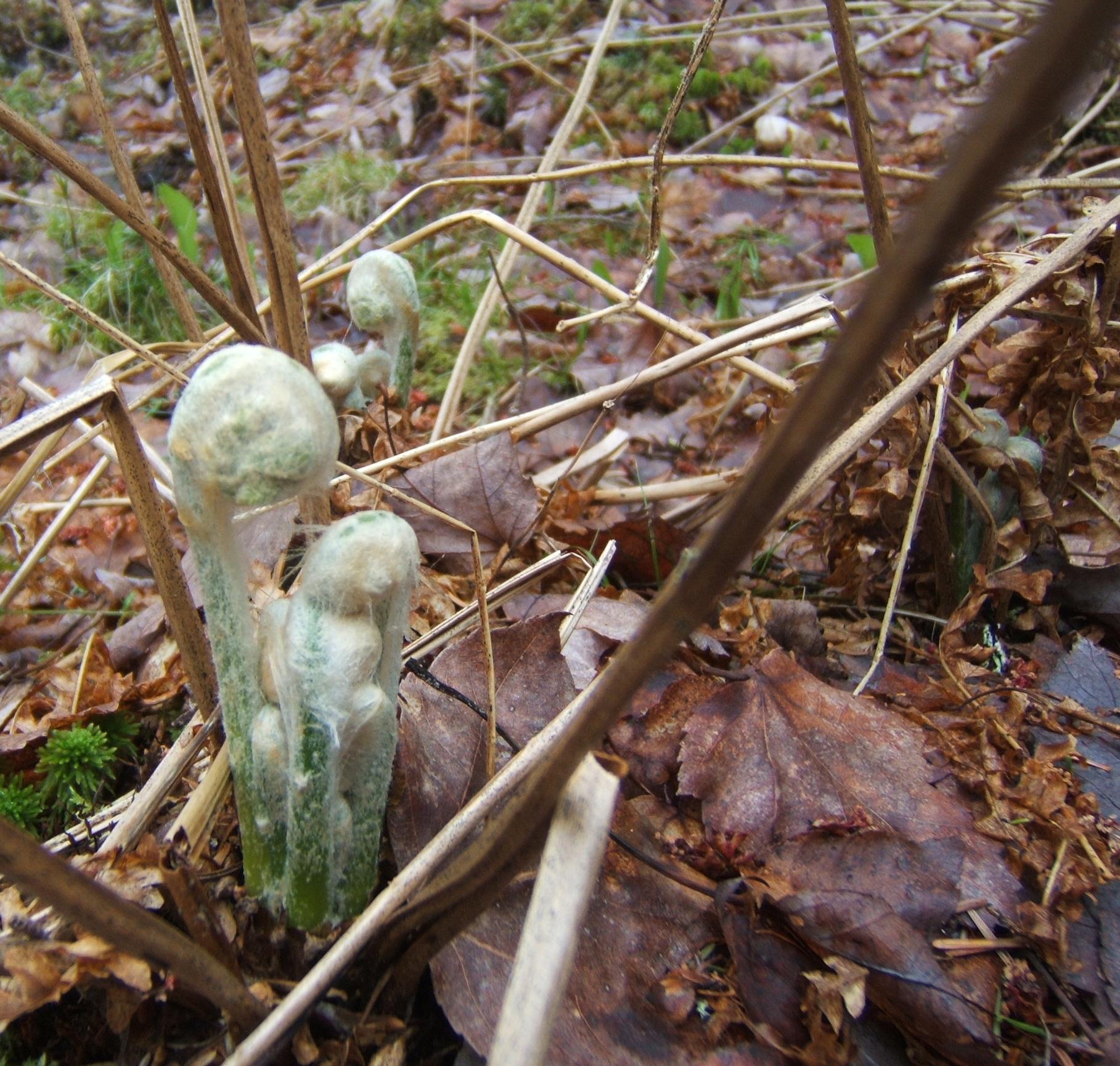
the wooly fiddleheads of the Cinnamon Fern are common in wet woods in New Brunswick
The Cinnamon Fern (Osmunda cinnamomea L.) grows in wet woods and other water-logged areas. In our Grey Woods, it grows in the fern gully (see the ‘map of the grey woods’ under ‘about‘).
Cinnamon Fern is a twice-cut fern (the leaves are cut into leaflets and these, in turn, are cut into sub-leaflets). As the sterile leaves expand, you can see fine cinnamon-colored wooly hair along the stalk, and tufts of cinnamon-colored hairs on the underside and at the base of each leaflet. The plant produces separate fertile spikes that turn cinnamon-brown in color.
~
~
fiddleheads
~
thin music in the May-woods,
trowie tunes from the peerie folk,
a bridge between spring
peepers and the wind,
fiddleheads carved in
Sensitive red and Ostrich green,
the bow strung by spiders,
the riff in the violin trembles
as potential uncoils,
music befuddled in a web
of Cinnamon wool
~
~
© Jane Tims 2012
Warning: 1. never eat any plant if you are not absolutely certain of the identification; 2. never eat any plant if you have personal sensitivities, including allergies, to certain plants or their derivatives; 3. never eat any plant unless you have checked several sources to verify the edibility of the plant.Sweet-fern (Comptonia peregrina (L.) Coult.)
Last weekend, we went on a short hike to the lake to collect some dried Sweet-fern, with the goal of making Sweet-fern sun tea. To make the tea, fresh or dry leaves of Sweet-fern are steeped in a jar in the sun for three hours.
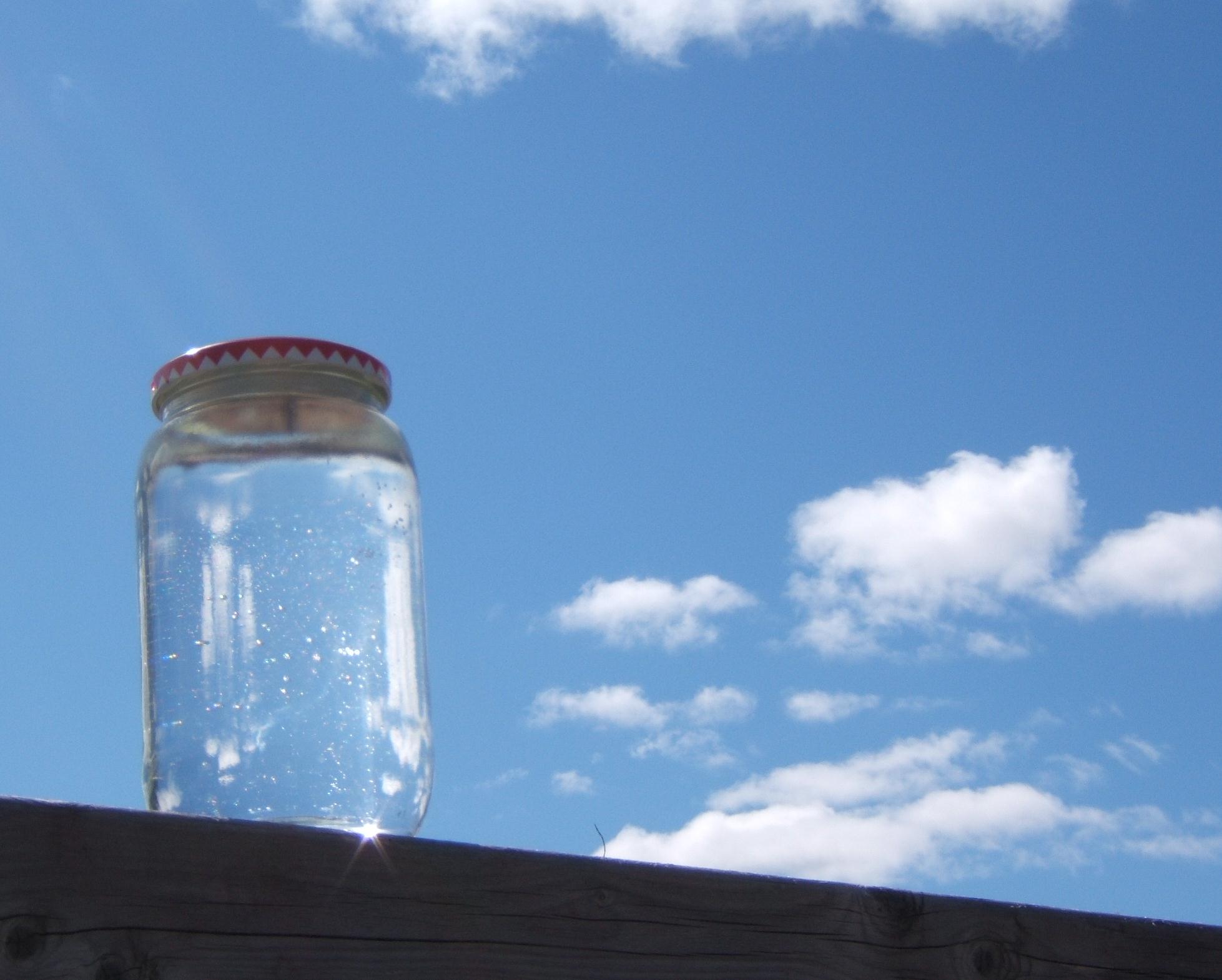
Unfortunately, the wind was too cold to allow the spring sun to warm the jar. So I collected the dry leaves and, on Sunday afternoon, I enjoyed a cup of fragrant Sweet-fern tea, made the usual way, steeped in boiling water.

Later in the spring or summer, I’ll be trying the sun tea method again.
Sweet-fern(Comptonia peregrina (L.) Coult.) is a small rounded shrub with fernlike green leaves found in dry rocky waste areas, clearings or pastures. The leaves are simple and alternate, long, narrow and deeply lobed. The shrub sometimes grows as a weed in blueberry fields.
Sweet-fern is called Comptonie voyageus in French, since peregrina means traveller. The generic name is after Henry Compton, a 17th century Bishop of London who was a patron of botany.
The fruit is a green burr enclosing 1-4 nutlets. These can be harvested in June or July while still tender.
Sweet-fern is a member of the Sweet Gale family. The plant is very fragrant, particularly when crushed, due to glands on the leaves and twigs. The tea made from the leaves is also fragrant. To make the tea, use 1 tsp dried or 2 tsp fresh leaves per cup of water. Remember, to always be absolutely certain of the identification before you try eating or drinking anything in the wild.
~
Directions for Sweet-fern sun tea
8 tsp of fresh chopped leaves
1 quart of clean fresh cold water in a jar
cap and place in sun three hours until water is dark
strain and serve
~
~
Sweet-fern sun tea
Comptonia peregrina (L.) Coult.
~
to quench the thirst of a traveller
and reward a hike too far
~
steep sweet-fern
in the solar flare
~
gives up fragrance to air
and to water in a sun-drenched jar
~
~
Warning: 1. never eat any plant if you are not absolutely certain of the identification; 2. never eat any plant if you have personal sensitivities, including allergies, to certain plants or their derivatives; 3. never eat any plant unless you have checked several sources to verify the edibility of the plant. © Jane Tims 2012accents in red
We are still in the greys and browns of spring.
There are a few wildflowers blooming. The Coltsfoot is spreading carpets of yellow along the roadside. And flowers in the deep hardwoods have begun to display their delicate beauty. But most places are drab and colorless.
I watch for red this time of year. There are a few red berries, still clinging to their branches after winter.
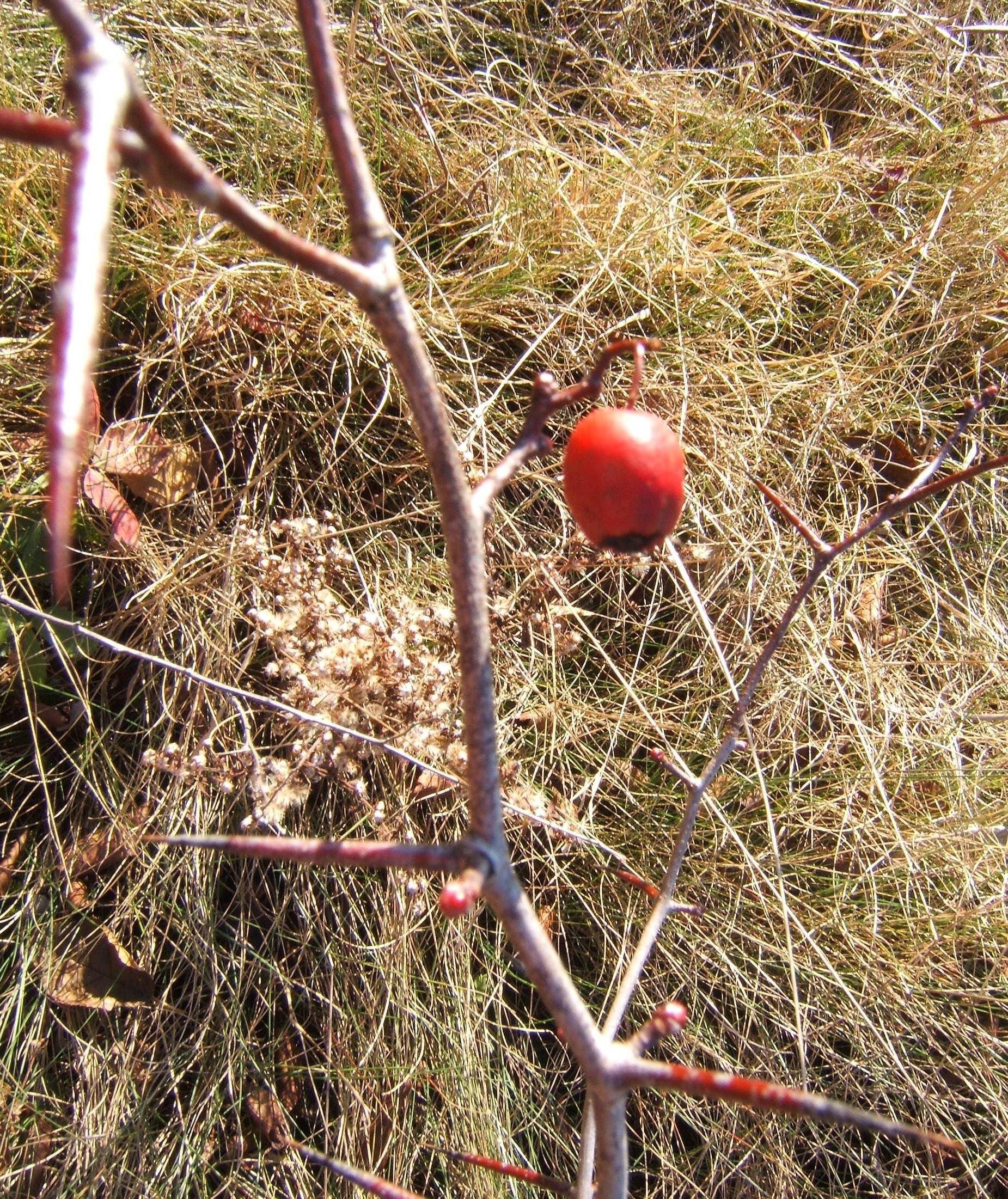

And the stems of Red Osier Dogwood (Cornus stolonifera Michx.) are brilliant in the fields and ditches.

My favorite ‘red’ of spring is the muted red of the blueberry fields.

~
~
fancy
~
the blueberry barren
is faded scarlet
red osier in ditches
rosebush and hawthorn
a single berry, a single haw
Earth in brown
toenails red
~
© Jane Tims 2012




 nichepoetryandprose