Posts Tagged ‘garden escapes’
garden escapes: starting a project
This summer, one of my main occupations will be to work on a collection of poems about garden escapes. Specifically, this means abandoned gardens, plants left behind when homes or communities are abandoned. This work is being supported by a Creations Grant from artsnb.
~
I have a short mantra to refer to these abandoned plants: “die, thrive or escape.” In a way, the project theme can be used as a metaphor for any abandonment. For example, when someone abandons a relationship, the one left behind can languish, or pick up and start over, or just leave, find a place to start over. I will be watching for these metaphors throughout my project.
~
For today, I have to arrange my materials and get started with a plan for my project.
- To start I have my grant application (outlines what I intend to do), a bit of reconnaissance work I did in 2018 to develop some ideas for the project, six blog posts from that time and eight older poems that fit the theme.
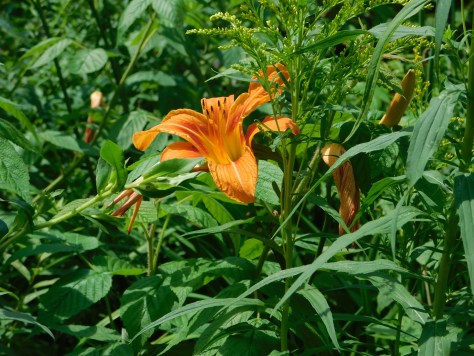
orange day-lilies, found in many of new Brunswick’s ditches, are escapes from older gardens
- To identify abandoned communities, I can refer to information sources and databases developed by others: the Facebook pages Abandoned New Brunswick and New Brunswick Upon Days Faded where interested people post photos and short anecdotes about abandoned houses and buildings; the Provincial Archives of New Brunswick website called Place Names of New Brunswick: Where is Home? New Brunswick Communities Past and Present https://archives.gnb.ca/Exhibits/Communities/Home.aspx?culture=en-CA; additional information on communities will be available in Census Records at https://www.ancestry.ca/; various maps including the New Brunswick Atlas (Second Edition); Google Earth and the associated Street View; maps posted in the Facebook page New Brunswick Upon Days Faded; the Walling Map of 1862 which I have used in other projects, F. Walling, Topographical Map of the Counties of St. John and Kings New Brunswick: From Actual Surveys under the direction of H. F. Walling (Publishers W.E. and A.A. Baker, New York, 1862); and, the Monograph about place-names in New Brunswick, Ganong, William F. A Monograph of the Place-Nomenclature of the Province of New Brunswick. Transactions of the Royal Society of Canada: Second Series 1896-97, Volume II, Section II. 1896.

a sample of the Walling Map for an area in Kings County, New Brunswick. The map shows individual buildings and houses from 1862.
- For anecdotal stories about the gardeners and their gardens, I plan to use the resources of the Provincial Archives of New Brunswick since often diaries and other documents contain amazing bits of information about New Brunswick history. Obtaining anecdotal information about abandoned gardens is tricky during the time of COVID-19 since social distancing means ordinary interviewing is not easy. I will use the websites above to obtain some information and, where possible, talk to people I encounter. I will create a Facebook Page called Abandoned New Brunswick Gardens to obtain some of these stories.
- For plant identification, I have my own skills as a botanist and my trusty guides: Harold R. Hinds, Flora of New Brunswick, Second Edition: A Manual for Identification of the Vascular Plants of New Brunswick, University of New Brunswick, 2000; A. E. Roland and E. C. Smith, The Flora of Nova Scotia, Nova Scotia Museum, 1969; Roger Tory Peterson and Margaret McKenny, A Field Guide to Flowers of Northeastern and North-central North America, 1968; and the website The Plant List: A Working List of all Plant Species (this is to verify plants names since I use older plant guides). http://www.theplantlist.org/
~
My methodology is simple:
- identify possible abandoned homes and communities and create an efficient plan to visit these places
- drive to these locations and look for plant species that may be garden remnants
- photograph the sites and plants
- make notes about the sites, the plants encountered and various sensations encountered (sight, smell, taste, touch and sound)
- do pencil drawings of some plants and locations
- obtain any anecdotal or archived information about the former communities, their gardens and their gardeners
- write the poems using all the information collected
I am going to write mostly free verse but I will also use some poetic forms, for example the ghazal and the pantoum.
~
Sounds like fun!

Viper’s bugloss (Echium vulgare) is an introduced plant in New Brunswick. These are plants found on the New Ireland Road in Albert County, New Brunswick. In 1866, there were 68 families in the community (Source: NB Archives); today all the houses are gone.
~
I will keep you up to date on my adventures and show you some of the plants I find. If you know of any abandoned gardens in New Brunswick, or abandoned communities, please let me know! I will acknowledge you in my book!
~
This work is supported by a Creation Grant from artsnb (the New Brunswick Arts Board)!
~
All my best,
stay safe,
Jane
garden escapes: abandoned gardens and what becomes of them
I am so happy! I have just won a Creations Grant from artsnb (the New Brunswick Arts Board). The project is to write a book-length poetry manuscript on the subject of garden escapes from abandoned New Brunswick houses and communities.
~
The landscape of New Brunswick is changing. As demographics shift towards populated areas, communities are abandoned. When gardens are left behind, some species die out, some thrive and some migrate, finding favorable conditions in adjacent properties.
~

For example, in Fredericksburg, an abandoned community near Stanley, foxglove crowds the ditches; and near Carroll’s Ridge south of Canterbury, no homes remain, but forget-me-nots turn the woods blue. Although local people are aware of these escapes, the stories of the gardens and gardeners are mostly lost.

~
The subject of abandoned flower garden escapes is the matter of poetry. The names of abandoned communities and of plants, common and scientific, provide a lexicon of poetic words. Abandoned and escaped gardens involve all of the senses: sight (pink of the foxglove flowers), sound (calls of birds who find new habitat), smell (scent of flowers), taste (sour stem of an abandoned rhubarb plant) and touch (the thorniness of escaped raspberry).
~
I am looking forward to taking you on my adventures this summer as I search out abandoned houses and communities, look for remnants of the gardens left behind and capture these remnants in poems and images.
~
So, I won’t be staying home as much,
but I am still going to be staying safe!
All my best!
Jane
abandoned spaces: fireweed
Lately, I have been thinking a lot about abandoned rural areas and the remnants of gardens left behind. Although these properties are still owned, the homes that once stood there are gone or left to deteriorate. The gardens, once loved and cared for, are left to survive on their own.
~
When these home-sites are abandoned, the garden plants:
- disappear (most annuals),
- persist (perennials like day-lilies or roses), or
- escape (lupins, mallow or other easily-spreading plants).
Native plants, those liking disturbed or cleared areas, may move into these sites.
~
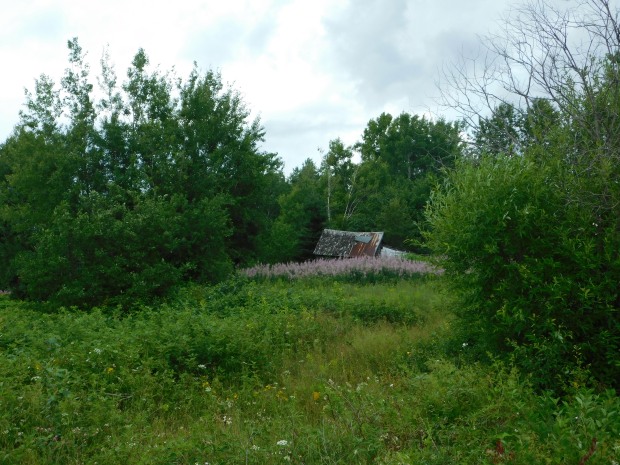
an abandoned site in Williamsburg, New Brunswick where fireweed has colonized
~
As I find abandoned properties, the pink or pale purple flowers of fireweed are often present. Fireweed, an indigenous plant not usually grown in gardens, is often a first indicator a house may once have stood on a plot of land. Often fireweed stands side by side with orange day-lilies and other garden escapes.
~

on this abandoned site in the Williamsburg area, the fireweed stands side-by-side with orange day-lilies (Hemerocallis fulva), rose bushes and other cultivated plants
~
Fireweed (Epilobium angustifolium L.), also known as great willowherb, gets the ‘fire’ in its name since it is one of the first plants to colonize after fire. As a pioneer species, partial to open areas with lots of light, it also moves in to any cleared or disturbed area. After a few years, other plants will move in, out-competing the fireweed. However, the seeds of fireweed stay viable for a long time and may re-colonize the area if it is again disturbed or burned.
~
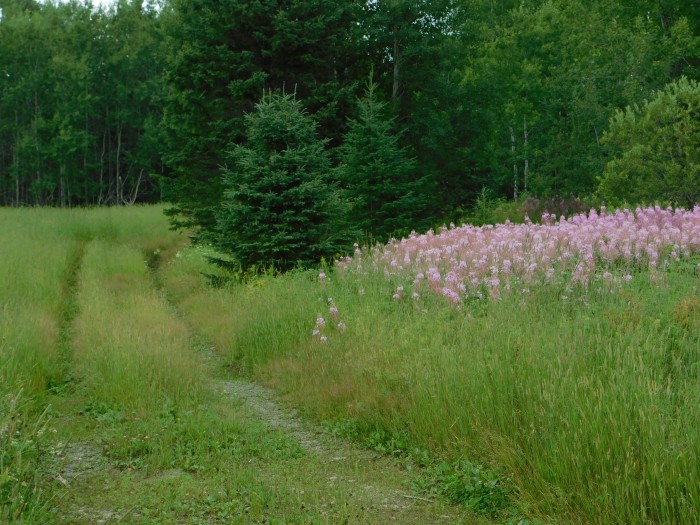
Fireweed is one of many tall pinkish flowers growing in our ditches and wild areas. It is distinguished by its rather loose inflorescence, the flower’s four roundish petals and its seed pods which angle upwards.
~
~
Fireweed spreads by the roots or by seed. In the later part of the season, the seeds are spread by the wind, aided by long silky hairs. Before dispersal the hairy seeds burst out along the seed pods making the plant look unkempt and hairy.
~
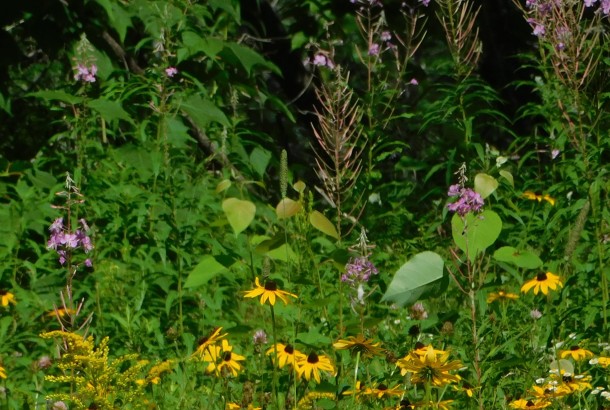
Fireweed (pink) among brown-eyed Susans; the stiff, many-podded plants in the upper right-hand corner are the seedpods of fireweed, finished with their blooming
~
In New Brunswick we are facing a demographic trend of movement from rural communities to cities in the southern part of the province and elsewhere. This means many small communities that thrived a century ago are now abandoned. For example, in 1866 the community of Fredericksburg, New Brunswick was a farming community with 12 families (Source: https://archives.gnb.ca/Exhibits/Communities/Details.aspx?culture=en-CA&community=1367 ). Today only a couple of homes or camps are found in the area but foxglove flowers, that once bloomed in the gardens, thrive in the ditches. For more on the demographics of small New Brunswick communities see:
Lauren Beck and Christina Ionescu. ‘Challenges and Opportunities Faced by Small Communities in New Brunswick: An Introduction’, Journal of New Brunswick Studies Issue 6, No. 1 (2015).
https://journals.lib.unb.ca/index.php/JNBS/article/view/23057
~
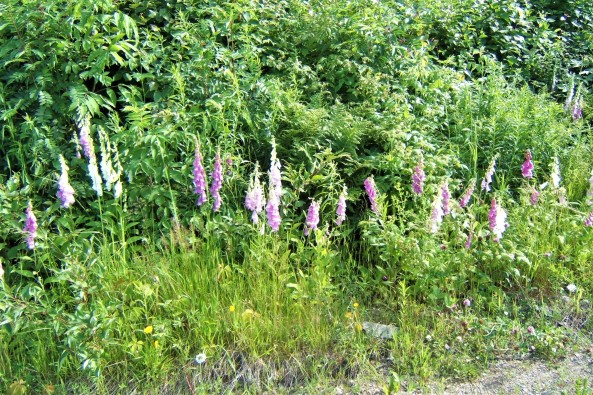
foxglove (Digitalis purpurea) flowers thriving in the ditch in the Fredericksburg area
~
All my best,
Jane




 nichepoetryandprose