Posts Tagged ‘education’
mnemonic: listening to birdsong
Each day, I walk the loop of our drive and stop for a moment at our concrete bench. I sit there and settle, listening to the sounds: a jet passing overhead, cars on the roadway, a neighbour using a saw. Then I start to hear the quiet mutter of the breeze, the rustling of leaves overhead, the occasional song of a bird.
~
~
This morning I heard the ‘caw’ of a crow, the ‘yank, yank’ of a nuthatch, the winnowing of a snipe. When we assign a pattern of words to mimic and remember the sound of a bird call, it is known as a ‘mnemonic.’ Various other sounds are remembered that way: the ‘chug, chug’ of a train, the ‘drip, drip’ of a tap. Bird mnemonics known to almost everyone are the ‘chick-a-dee-dee-dee’ of the chickadee, the ‘who cooks for you?’ of the barred owl, and the ‘conk-la-ree’ of the red-winged blackbird.
~
~
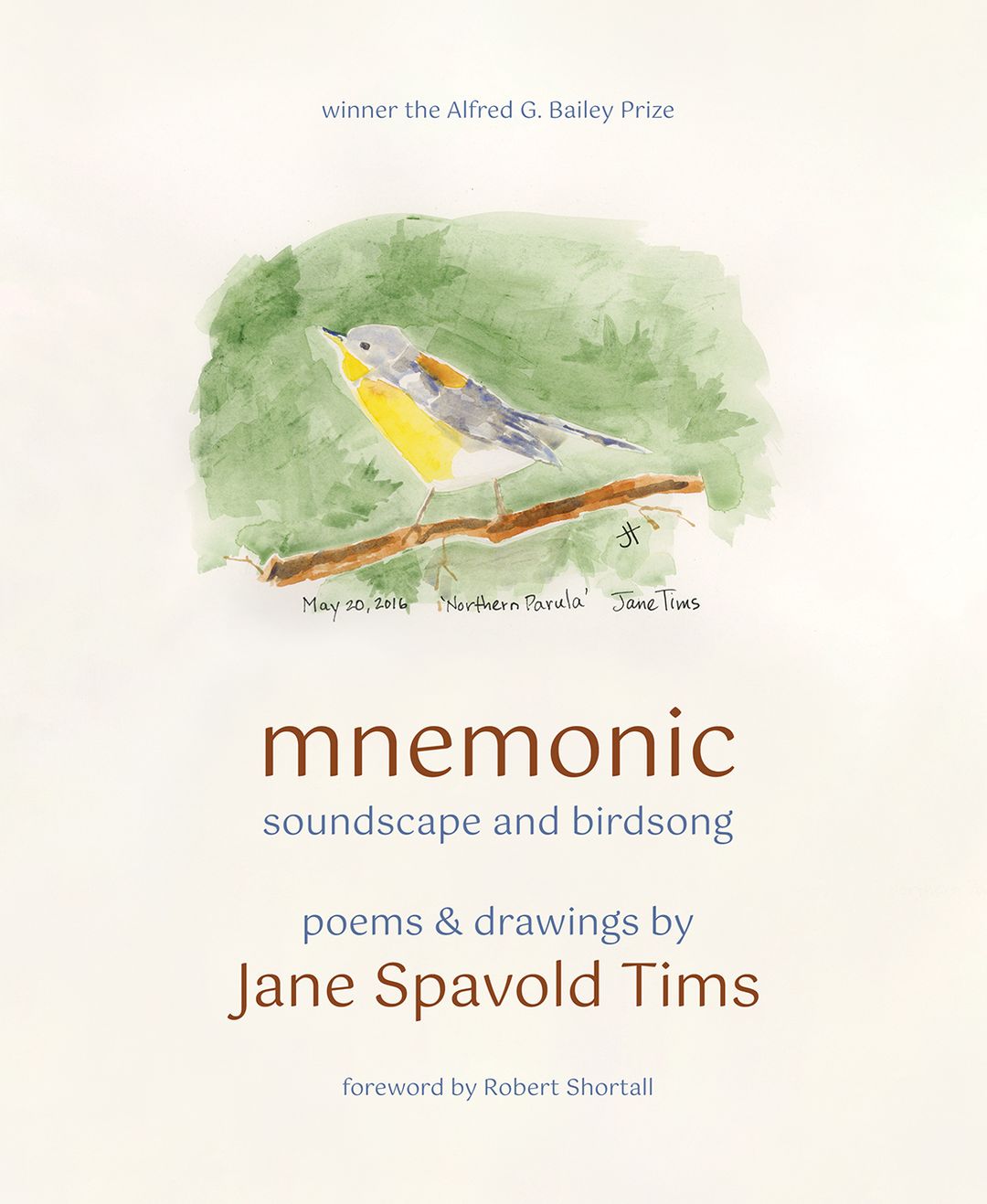
My new poetry book ‘mnemonic: soundscape and birdsong’ focusses on sounds in the woodland and along the shore. Most of the poems celebrate the way bird song can be a metaphor for the events in our lives. For example, the tapping of a pileated woodpecker on the wood of a backstop at the baseball diamond sounds like the connect of bat and ball during the game.
~
~
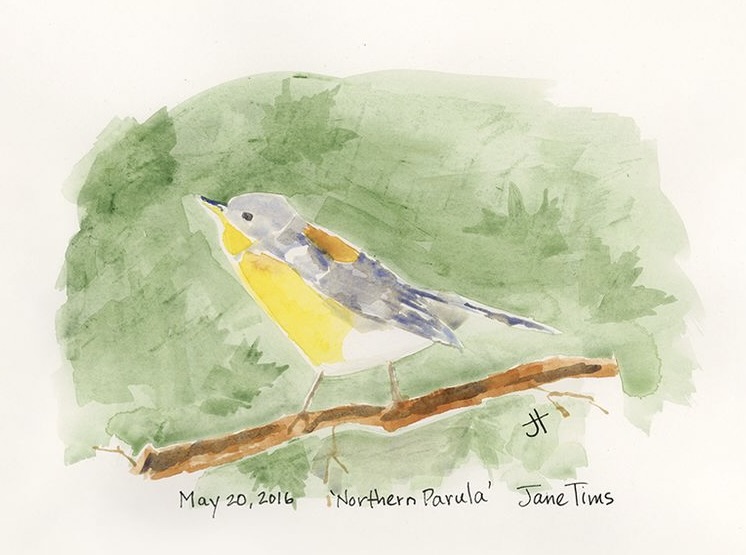
My book ‘mnemonic’ includes my poems and pencil drawings.
~
To obtain a copy of ‘mnemonic,’ take a visit to Dog Eared Books in Oromocto, or Westminster Bookmark in Fredericton. You can also order the book from Chapel Street Editions here, or from Amazon Canada here.
~
I hope you enjoy my poetry and my sketches. You can find a comprehensive list of bird mnemonics at South Bay Birders Unlimited ‘Mnemonic Bird Songs’ here.
~
All my best!
Jane Tims
early schooling in New Brunswick – teachers in 1888
In my family, teaching was a much-revered profession. Both Mom and Dad were teachers, as were my Aunt and Uncle. Mom, and my Aunt and Uncle, taught in one room schools. Mom began teaching in the early 1940s, when she was only 16, just after her graduation from Grade Twelve. At first, she taught with a temporary teaching licence issued during the Second World War. Later she went to Normal School to obtain a permanent licence.
~

a copy of the reader my Dad used in High School in Nova Scotia, about 1933 (High School Reader, 1913)
~
To learn a little about teachers in one room schools in the late 1800s, I have continued to read the Annual Report of the Schools of New Brunswick, 1888 by the Chief Superintendent of Education. In 1888, teachers in New Brunswick were trained in the Provincial Normal School. Of the 1,582 teachers, 1,534 were trained and 48 were untrained. Teachers, depending on qualifications, were in three classes: I, II and III.
~
In 1888 in New Brunswick, there were many more female teachers than male:
| Class | #Male
Teachers |
# Female
Teachers |
| I | 114 | 141 |
| II | 157 | 644 |
| III | 108 | 404 |
~

High School English Composition, 1913
~
The salary of a teacher in 1888 was certainly small compared to today! The average yearly salary for teachers in New Brunswick in 1888 was lower for female than for male teachers:
- male teachers $536.90 (First Class) (average salaries for the three Classes ranged from $231.00 to $536.90)
- female teachers $328.49 (First Class) (average salaries for the three Classes ranged from $187.47 to $328.49)
~
The Superintendent does not mention the inequity in pay for male and female teachers. He focuses on a decrease in pay from 1888 to 1889, criticizing the government for not being more generous to teachers. His worry was that teachers would not stay in the profession if salaries were too low.
… it is an ill-advised economy that seeks to maintain on the scantiest allowance a service which is essential to the preservation of order and the strength and progress of a country.
~
The budget for all schools in the Province in 1888-1889, from provincial, federal and district sources, was $404,145.00 (not including building and property costs).
~

two of the old school books in my collection: Nova Scotia Readers, 1911 (used in Nova Scotia) and The Canadian Readers, 1924 (used in Alberta)
~
Copyright 2016 Jane Tims
Schools of New Brunswick in 1888
I love beginning a new project … love learning, love doing the research, love the dusty old books holding the information.
~
A project about the old schools of New Brunswick won’t be totally new to me. I grew up hearing the stories my Mother told about teaching in one-room schools. In University, I wrote a research paper about school in the 1800s and how schools were situated in the community and in the landscape. And I am always interested in older buildings and how they survive in the built landscape.
~

location of some schools in Upham Parish, Kings County in 1862, showing the effects of linear settlement on school location (map shown is from H.F. Walling, Topographical Map of the Counties of St. John and Kings New Brunswick, 1862)
~
My first step to research this topic was to take a drive in the countryside, to find some old schools (see post for April 26, 2016). My next step is to do some more reading about the school system in the nineteenth century.
~
I began with an old book, not dusty at all, but available on-line at Google Books (https://books.google.ca/books): Annual Report of the Schools of New Brunswick 1888 (Fredericton, 1889) by the Chief Superintendent of Education.
~
In 1888 there were 1,532 schools in New Brunswick. Some of these would have been larger schools, but the majority were one room schools in rural settings. There were 1,587 teachers and 59,636 pupils. Only 50% of these students were ‘daily present’ during the time the school was in session – “…falls far short of what it ought to be …” reports the Superintendent! He suggested that teachers could help a lot if they would “… carefully inquire into the cause of every absence …”
~
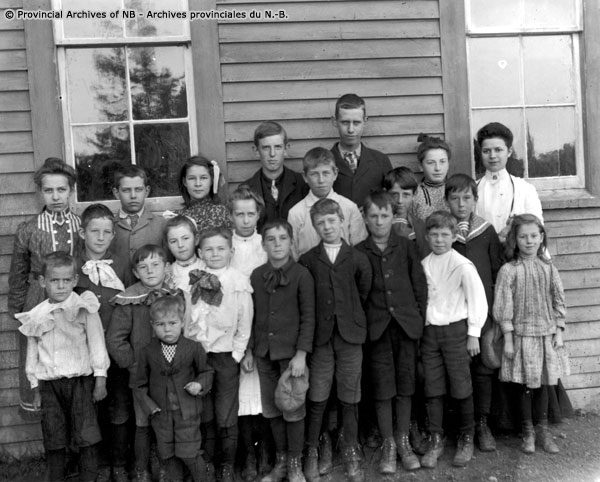
children and teacher at Carter’s Point School on the Kingston Peninsula (Source: Provincial Archives of New Brunswick)
~
The report contains over 1000 pages and lists the classes given most often:
Reading, Spelling, Recitations
Oral Lessons on Morals
Physical Exercise
Health, including Temperance
Composition
Print Script
Writing
Number Standards/ Arithmetic
Geography
Useful Knowledge (for example Plant Life)
~
I love the description of the Health instruction:
pure air, sunlight, good water,
wholesome food, proper clothing, cleanly and temperate habits, avoidance of draughts,
and the sudden checking of perspiration, dry feet, etc.
~
I think I will go check my perspiration and feet …
~

~
Copyright 2016 Jane Tims
one room school houses – hiding in the landscape
Last Friday, we took a drive along the west side of Grand Lake, in the Youngs Cove area of Queens County, New Brunswick. We were searching for old one room school houses. As far as I know, there is no list for these buildings in Queens County, New Brunswick, although a list does exist for nearby Kings County.
~
I had seen one old school in the Whites Cove area, so we began there. This school was operated as a local craft store for a few years but is now a private cottage. The one room school is in good shape, painted bright red. The round plaque in the gable of the roof says 1837. The building had two front doors – one for boys and one for girls.
~

Whites Cove school house
~
We then continued toward Chipman, taking old roads when possible. I know that in the late 1800s and early 1900s, each small community (each Parish) had its own school, so we watched for the tell-tale design of the one room school house – a small, rectangular, one-storey building with a steep-sloped roof and rather high side walls. Each school had two or three tall rectangular windows on each side and one or two front doors. Some New Brunswick schools had a small anteroom or vestibule on the front. The bell-tower common on school houses in the United States was not typical of one room schools in New Brunswick.
~
We followed the road along the shoreline of the peninsulas extending into Grand Lake. In particular, we were watching for the older homes that show what the community may have looked like a hundred years ago.
~
As we came over a hill, we first saw the Rees school house. It had some of the characteristics I describe above. However, I am new to one room school hunting, so I was not really certain this little building had once been a school. And then my husband pointed to the sign on the small road opposite the building – School House Lane. The school house was being used as a cottage and was in poor condition with broken windows and a crumbled brick chimney. But I was happy to see the original stone foundation, a straight roof line, a large flat stone as a threshold, original clapboard on the front of the building, and evidence of the original vestibule.
~

Rees school house
~
Thrilled by our discovery, we continued to the next community and followed a side road. Almost immediately, we saw the Cumberland Bay School, announced by a sign above the door. It was a typical school house design, built on a hill. There was a rock foundation (with some brick) and a straight roof. The building was in good shape with evidence of regular maintenance and use, perhaps as a hall. A cold wind was howling and I felt sorry for the kids who must have come to school in all kinds of bitter weather.
~
Cumberland Bay school house
~
After seeing three school houses, we felt like pros. We took the next road along the shore, toward Cox Point, and found a school house outside the community of Range. It was set back from the road, used in conjunction with a family cottage. The roof was straight, the side windows were intact and the shingles were in good repair.
~

Range school house
~
I was delighted with our drive – we had discovered three school houses we did not know about! I also got a feel for some of the characteristics of these buildings and how they fit into the local landscape.
~

a map showing the old school houses we found … you can see a pattern emerging … I expect there were once school houses in some of the other communities indicated on the map
~
Why am I interested in this topic? My interests in landscape, the environment and history all come into play. I am also beginning to think about my next poetry project and have decided to explore the idea of school houses in the landscape.
~
To do this project, I will think about the setting of the school house in the community and how topography (hills and lakes and rivers), vegetation (fields and forests, orchards and big old swinging-trees) and other built landscape (bridges, churches, stores and farms) would have influenced the students, teachers and members of the community. Visits to old schools, some talk with people who remember attending these old school houses and reading at the Provincial Archives would give me lots of material for my writing.
~
Do you have examples of old one room school houses in your area? Did you attend school in a one room school house? I would love to hear your stories!
~
Copyright 2016 Jane Tims




 nichepoetryandprose