Hermit thrush
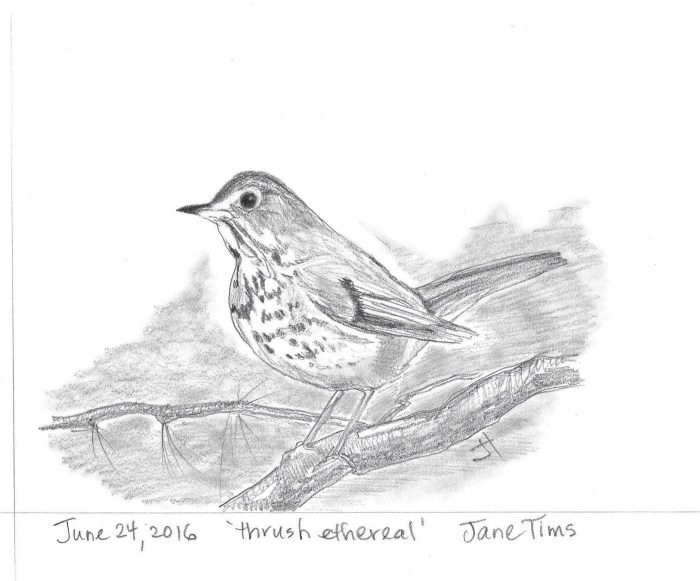
Another surprise in the morning bird chorus — a Hermit thrush. I have been listening for it all spring and at last, this morning, the ethereal notes.
~
~
How to describe the song of the Hermit thrush? T.S. Eliot described it in The Waste Land, in V: What the Thunder Said :
… sound of water over a rock
Where the hermit-thrush sings in the pine trees
Drip drop drip drop drop drop drop …
and
… who is the third who walks always beside you …
and
… In the faint moonlight, the grass is singing
Over the tumbled graves …
~
A technical description of the Hermit thrush song is ‘a beginning note, then several descending musical phrases in a minor key, repeated at different pitches.’
~
The song is clear, flute-like. To me the essential characteristics are the change in pitch at the beginning of the new phrase and the hint of water within. If you watch the Hermit thrush while she is singing, she stands tall, tilts her head back, looks into the distance with her bright black eye, lifts her feathers ever so slightly and opens her beak. Her throat swells a little but otherwise you are left to wonder, where do those notes begin?
~
If her song was another sound, it would be a flute in the forest.
If it was a smell, it would be the sweet scent of mayflowers, as you part the leaves with the back of your hand.
If it was a touch, it would be lifted hairs at the back of your neck.
If it was a taste, it would be syrup drizzled over iced milk.
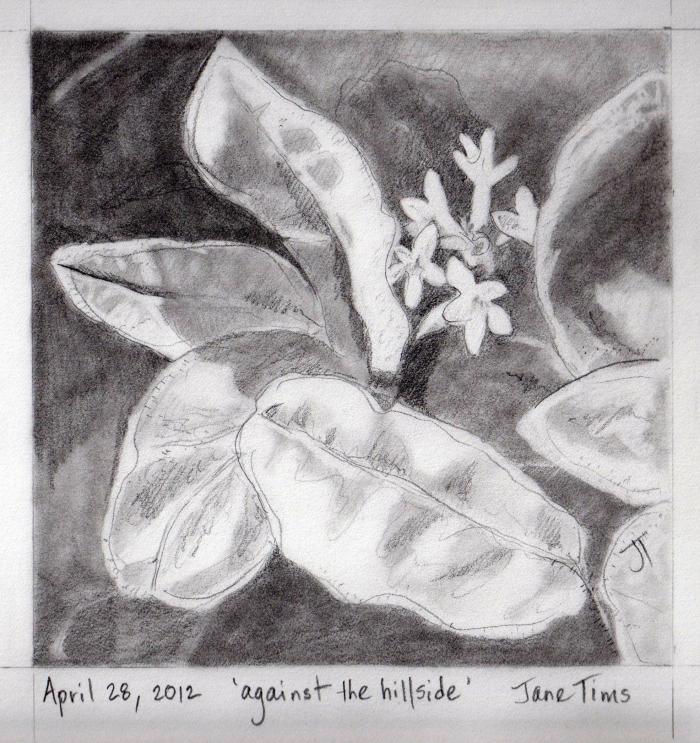
If it was an image, it would be guttation drops on strawberries.
~
~
What other words describe the song of the Hermit thrush?
clear
precise
covert
alone
sweet
tremolo
pure
hidden
pensive
thoughtful
thicket
froth on a dancing wave
raindrops trembling on the tips of leaves
the step from rung to rung on a ladder
~
If it was a vowel, it would be every vowel
If it was a consonant, it would be ‘c’, ‘l’, ‘r’, or ‘v’
~
~
Hermit thrush
~
Catharus guttatus
~
neither visceral nor guttural, ethereal
tip-toe in tree tops
air pulled into taffy thread
a flute in the forest
froth on a wave
~
rain trembles on leaf tips
guttation drops on strawberry
a lifted curtain of mayflower
~
I saw you there
hidden in the thicket
and I followed
~
climb the ladder and sing
then step to the rung below
heads up, thoughts of the new day
parting of the beak
pulse at the throat
hairs lift
at the nape
of the neck, fingers
warble the keys
between middle and ring
catharsis
~
~
Copyright 2016 Jane Tims
time for picking berries (and a good read)
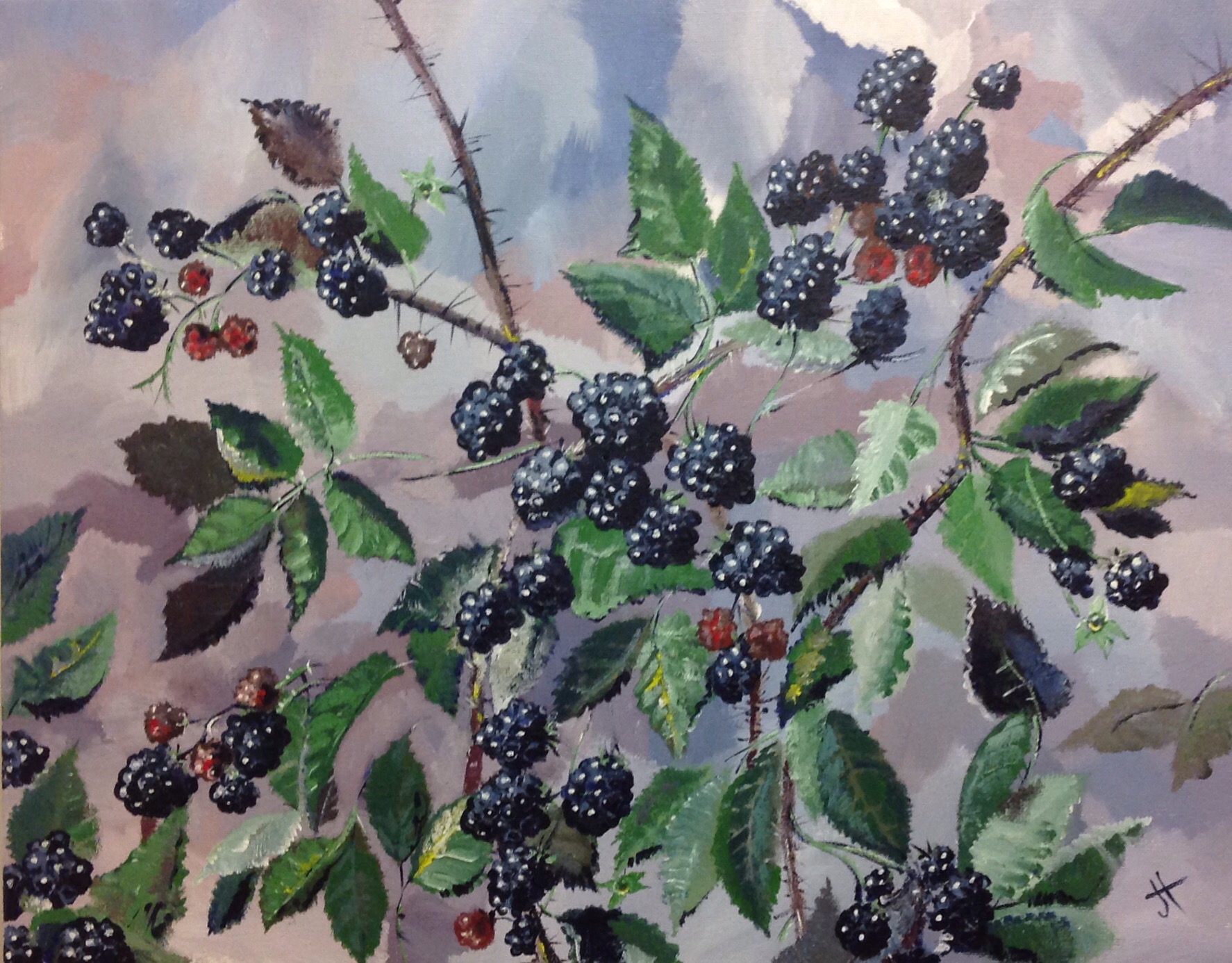
One more day to get a chance to win my painting ‘berries and brambles’ … Just buy my book within easy reach from me or my publisher. www.chapelstreeteditions.com
Mourning dove
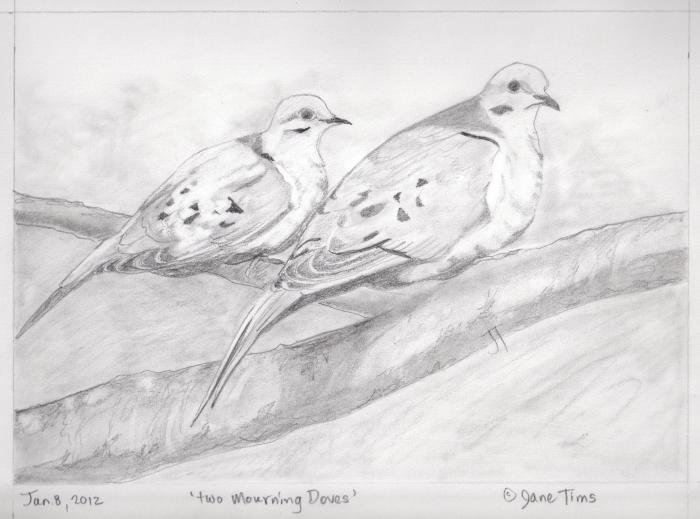
I woke this morning to another new bird in the mix of the morning bird chorus — a Mourning dove. In this area, the Mourning dove is a common bird, seen pecking at seeds beneath feeders or hanging out on the telephone lines. But I haven’t heard one in our grey woods for a while.
~
~
The call of the Mourning dove gives it its name. It begins with a low question and continues in a descending series of coos.
Oh no, no, no, no, no
Dear me, me, me, me, me, me
I decided to try and capture this sound in words.
~
Mourning
Melancholy
Monotonous
Sad
Solemn
Hollow, mellow
A reed, the inside walls of a bottle
An emerald bottle, buried to its neck in the sand
Breath across the mouth of a bottle
A child’s feeble attempt at a whistle
Light and shadow inside a vessel of glass
~
If the call of a mourning dove were a colour it would be amethyst
If the call of a mourning dove were a sound it would be wind blowing down the stairway of a tower
If the call of a mourning dove were a taste it would be chowder, thick and left too long on the fire
If the call of a mourning dove were a touch it would be a wooden shawl, wrapped round and round until it was no longer warm but strangling
If the call of a mourning dove were a song it would be hesitant, riff-driven, repeated over and over
If the call of a mourning dove were a smell it would be the cloying perfume of lilac
~
If it was a vowel, it would be ‘o’ or ‘u’ and sometimes ‘y’
If it was a consonant, it would be ‘m’, ‘n’, ‘r’, or ‘w’
~
Heavy or light
Loud or soft
Tall or short
Sad or happy
Bright or dull
Sharp or dull
Nearby or distant
Solemn or joyous
Spacious or confined
~
So, from all this, a poem. This is the second draft of a poem about the mourning dove which never mentions the bird except in the title.
~
Mourning dove
~
Zenaida macroura
~
wind wakens, descends the stair
notices shadow, gaps in cladding
the hollow of the tower, breath
across the mouth of a bottle
amethyst, buried in sand
~
the reed widened, a solemn song
the riff, the echo, a distant train
expands across the valley
and a child hollows her hand
shapes her lips for a kiss
~
tries to whistle, her breath
a sigh, a puff to cool
the chowder, still simmers
on the fire, thick
and needing stirring
~
potatoes, corn and onions
curdled cream, a woollen shawl wrapped
round and round, warmth tightened
to struggle, viscous as lilac
unable to breathe
~
~
For other posts and poems about the Mourning dove, see https://janetims.com/2012/01/16/keeping-warm/ and https://janetims.com/2015/01/30/for-the-birds/
~
Copyright 2016 Jane Tims
on my book shelf – Triggerfish, a crime novel
‘… he had fifty feet under the hull. The carcass of a rowboat against the shore, cedar, pine and rock rimming the cove, no cottages out here … Switching to the trolling motor, Beck eased around the bend in the cove …’ (Triggerfish).
Around that bend in the cove, Beck meets his share of trouble. I usually think of crime novels as an easy read. Triggerfish challenges that notion. The characters are many and, to me, a bit hard to follow – there doesn’t seem to be a good guy among them. The action is non-stop giving the reader few chances to relax! And what, oh what is going to happen to Eddie???
~

~
Dietrich Kalteis, Triggerfish – a crime novel. ECW Press, Toronto: 2016. Published June 1, 2016.
~
This review is done as a result of my role as Shelf Monkey for ECW Press http://ecwpress.com/pages/shelf-monkey.
~
Not usually in the genre I read, Triggerfish was nevertheless entertaining. The main character, Rene Beckman, ‘Beck’, is an ex-cop, hard-hitting and resourceful. He is trying to stay out of trouble but accidentally views a murder and some ruthless drug runners in action. And the bad guys won’t look the other way.
The action takes place in the Vancouver area and so scenes feel, to me, Canadian, familiar. Description is gritty, but evocative: ‘Crunching on dead leaves, wet ferns slapping against him, he ducked under pine boughs … a dry creek bed. A crest beyond it. Moss, ferns and rock … ‘. Some of the action occurs on Beck’s boat, the thirty-two foot Triggerfish.
The book is the classic example of shortening sentences to move the action along. This, and the frequent inclusion of gerunds to provide an odd combination of past and present tense, mean the book is sometimes hard to read. I’m not certain I ever got used to phrases like: ‘ … Ramon and Eddie walked in from the dining room side, both stopping at the fireplace, Eddie looking like he wanted to turn and run, Ramon nudging him forward…’ Or ‘… He told her, and she said, ”Nice meeting you, Marty Schmidt.” The second shot spoiling his looks.’
The characters are diverse and multi-dimensional: Vicki, environmentalist and play girl; Ashika, skilled and patient terrorist with a sense of humour; and Hattie, mature girl next door. I liked one of the bad guys the best – poor Eddie, trying to outsmart the cruel bosses by stealing their dope, cooperating with Beck.
Ironic humour abounds – from the description of the vegan protest, with protesters wearing body paint diagramming cuts of meat, to Beck’s attempt to rescue a drowning Ashika. Ashika, hearing a rooster crow for the first time, almost blows it off the fence.
It took me a long time to finish this book, partly because of the sentence structure, but mostly because of my lack of familiarity with the genre. In the end the plot was satisfying and no loose ends were left dangling. I just may read it again.
~
~
Copyright 2015 Jane Tims
early schools – the exotic and the common
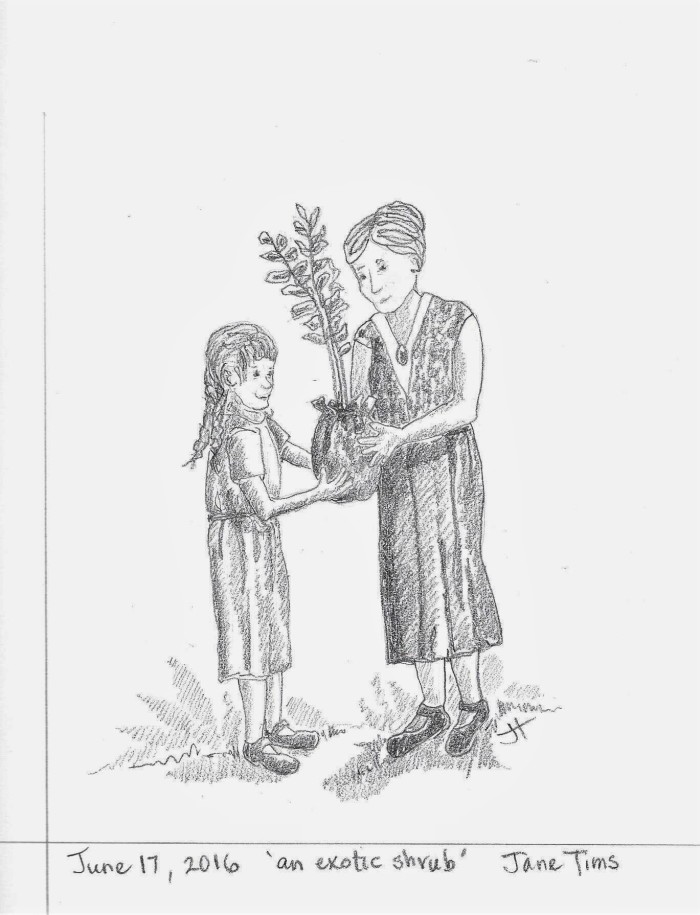
In my Aunt’s book about early schooling in Nova Scotia, she tells an amusing story about field days at school:
… I recall another field day when Dr. DeWolfe, Miss Harris, and Miss Baker came with shrubs to our school. The shrubs were ten cents each. My mother had always longed for a weigela and a snowball and we were delighted that at last she could have her wish, for both these varieties were among Dr. DeWolf’s collection. They were duly planted at my home on the bank of the French River. One turned out to be a high bush cranberry and the other a spiraea, but today we still refer to them as the “snowball” and “weigela” and, I may mention, they have many an offspring throughout our province.
~
I must have seen the high bush cranberry and spiraea many times at my mother’s old home, but I don’t remember them in particular. I do remember the gardens, lush with rose bushes, tiger lilies, and grape vines.
~
~
Copyright 2016 Jane Tims
within easy reach – another chance to win a painting
You will recall that earlier this month I held a draw to win the cover art for my book of poetry within easy reach. Carol Steel, a fellow blogger, was the winner of the painting ! http://carolsteel5050.blogspot.ca/
~
This is to remind you that I am holding a draw to win another painting — ‘berries and brambles’ (18”x 14”, acrylic, gallery edges, unframed). Anyone who has purchased my book from me or my publisher, Chapel Street Editions, has already been entered in the draw. This includes the blog comment folk who entered the earlier draw.
~
 ~
~
There is still time to enter to win the painting! Just purchase my book within easy reach between now and June 30, 2016 from me or my publisher! http://www.chapelstreeteditions.com
~
The draw will be held in mid-July at my book signing and workshop at the 8th Annual Free School at Falls Brook Center in New Brunswick. http://fallsbrookcentre.ca/wp/events2/8th-annual-free-school/
~
Copyright Jane Tims 2016
a place for Zoe
I’ve heard the theory that the Internet is 90% occupied by cats. I have spent a fair share of my time watching feline antics on stairways, kittens tumbling from chairs and cats sneaking up on cameras.
~
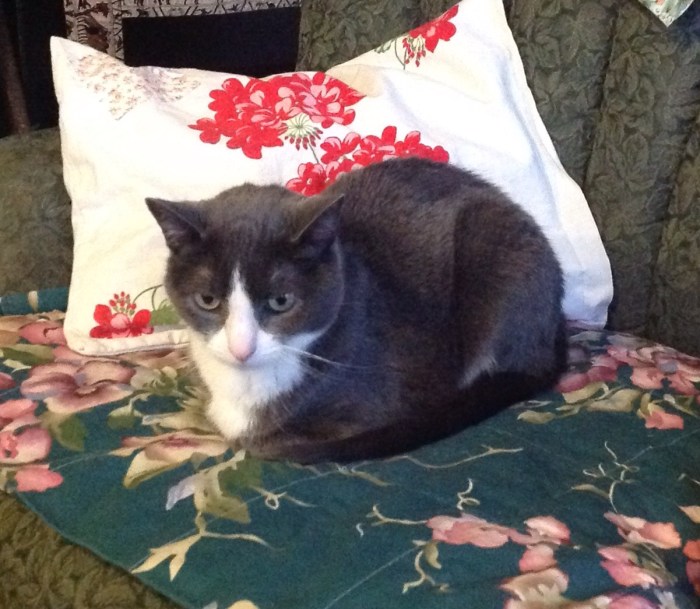
The cat I spend most time with is Zoe. She is a small cat, about eight years old (whoops, my niece says Zoe is twelve)! She tries so hard to communicate and can usually make herself understood via telepathy. She sits and stares at me and I go through the list. Food? No. Water? No. Ice cubes? Yes.
~
~
Zoe checks in with me at intervals through the day. She greets me and listens to the morning bird chorus with me. She runs in front of me to her bowls and waits while I feed her. When I am typing at the computer, she hops up and tries to help. Later, when I watch TV, she snoozes on my lap for a few minutes. She usually appears later to race through the house from corner to corner.
~

~
Nothing special about this particular cat post. But I wish I had Zoe’s nonchalance, her utter calm, her faith that all will be well.
~
Copyright Jane Tims 2016
Arbour Day in New Brunswick – 1888
In a previous post, I wrote about the importance of trees in the school yard and the celebration of Arbour Day in schools in Nova Scotia during the early 1900s. One room schools in New Brunswick also celebrated Arbour Day.
~
The 1888 Annual Report of the Schools of New Brunswick, by the Chief Superintendent of Education, reports on 1888 Arbour Day celebrations in New Brunswick, years before the first official Arbour Day in Ontario, Canada (1906). The purpose of Arbour Day celebrations in the school was:
~
to encourage the improvement and ornamentation of school grounds and thereby of cultivating on the part of pupils habits of neatness and order, and a taste for the beautiful in nature …
~
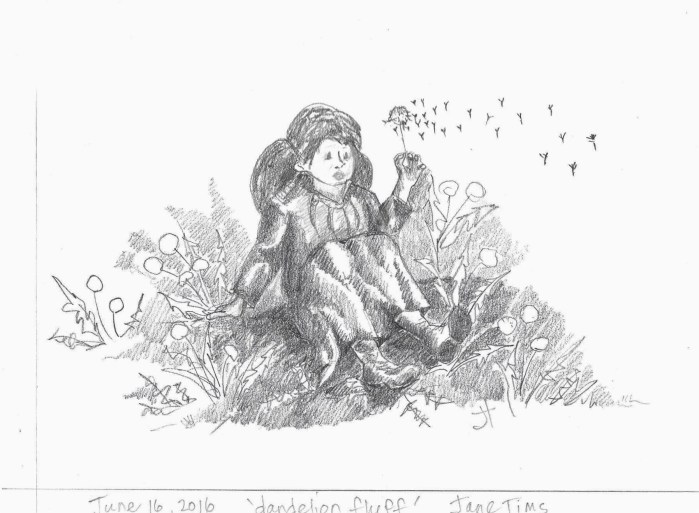
In 1888 New Brunswick schools celebrated Arbour Day on May 18. In the whole province, students planted 6,571 trees, 650 shrubs and 393 flower beds!
~
~
Copyright Jane Tims 2016
early schools – searching for old schools
Last weekend we went on another excursion to try and find some remaining one room schools. We drove from Geary south to Gagetown by way of Westfield, in a loop, going down many side roads. We found six buildings that may have been one room schools. We were in a hurry so we did not stop to ask anyone about their knowledge of the area. That will happen on a future trip when I have a little more information. (Added note: on July 7, 2016, I visited the New Brunswick Museum Archives and was able to verify the information below from the photo collection by Marion Johnston Dunphy who photographed 150 schools from 1974 to 1984 – The One Room Schools of New Brunswick and What Became of Them. Verifications are indicated below in brackets.)
~
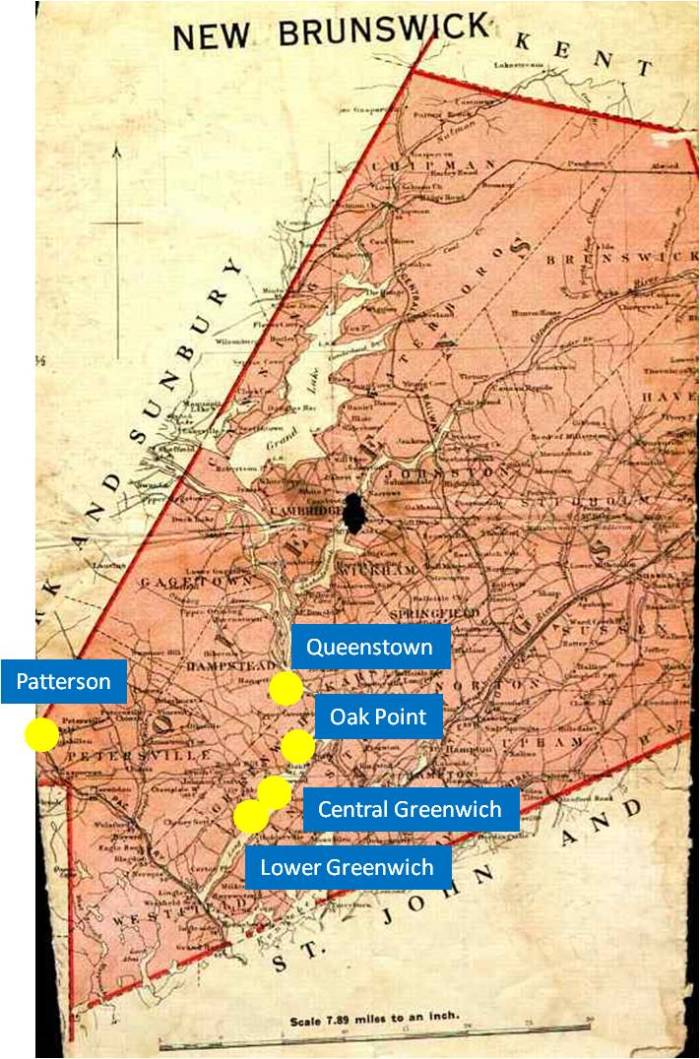
Map showing our drive to find one room school houses … the yellow dots and names in blue show the buildings we considered.
~
The one room school in Patterson is part of an historical settlement created by the community. It is typical of a one room school house in every way. It also has an outhouse. The historical settlement has the school, a church, a store, a house and a barn.
~
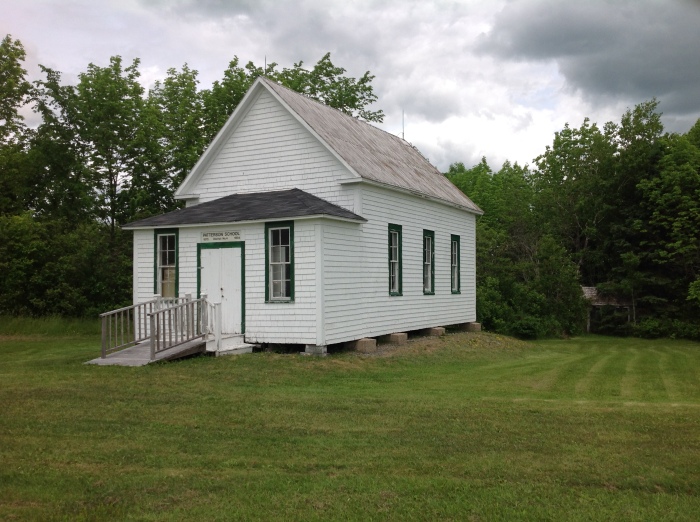
Patterson School at Patterson, Queens and partly Sunbury Counties, New Brunswick
~
This old building in Lower Greenwich is in poor shape, deteriorated since I took the photo below in October of 2014. In spite of the embellishments it has all the characteristics of a one room school. (This building has been verified as Greenwich School from photos at Archives)
~
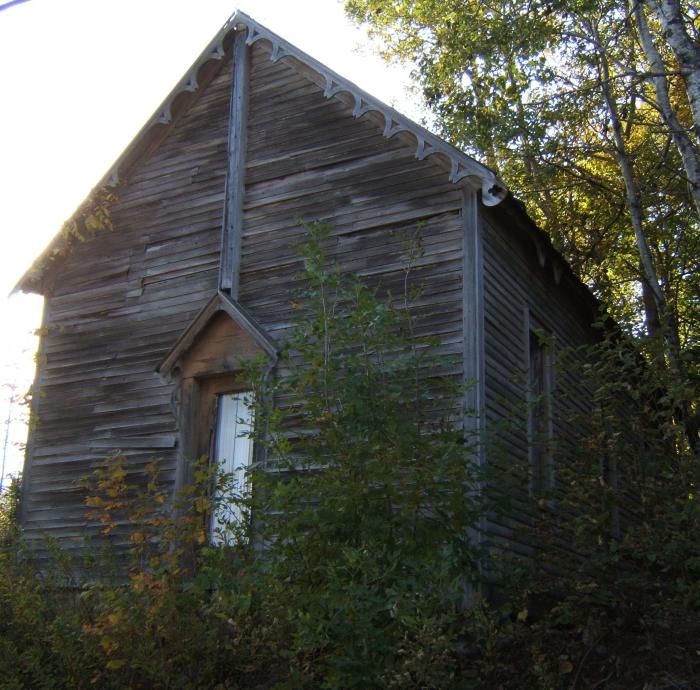
Meeting hall in Lower Greenwich, Kings County, New Brunswick
~
The Central Greenwich Women’s Institute (GEMS Senior Citizens) has an addition with a basement. Although it looks like a school, the middle side window is twice as wide as the other windows.(This building has been verified as Central Greenwich School from photos at Archives)
~
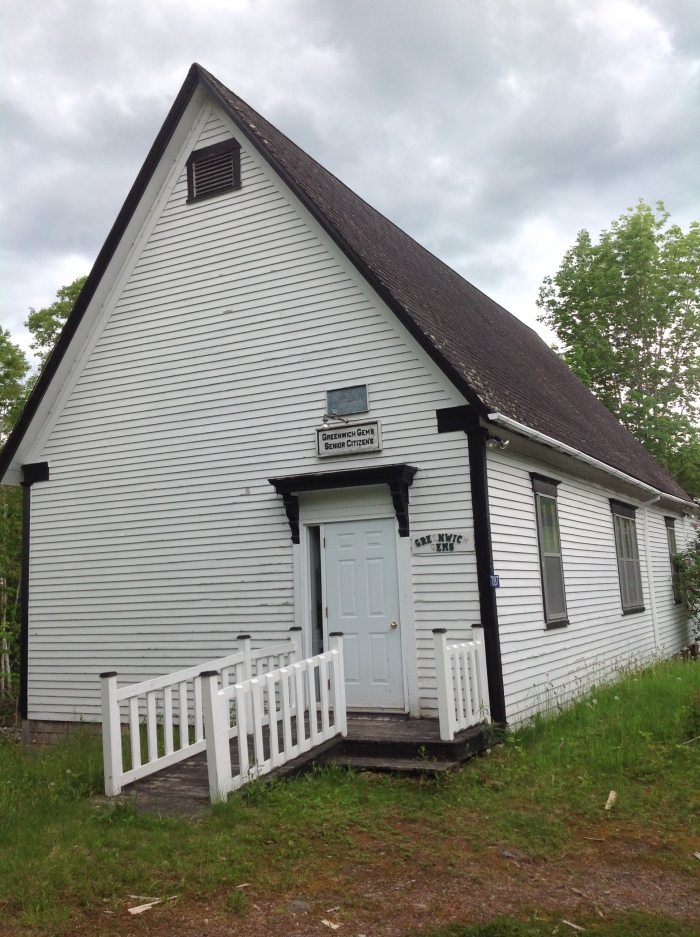
Women’s Institute building in Central Greenwich, Kings County, New Brunswick
~
A little house near Oak Point caught our eye. It was the same size as a one room school, but the windows and doors were all in the wrong places. The locations of these could have been changed to improve access and conform to an internal plan, but it may be just a small house. (This building has been verified as Oak Point School from photos at Archives)
~
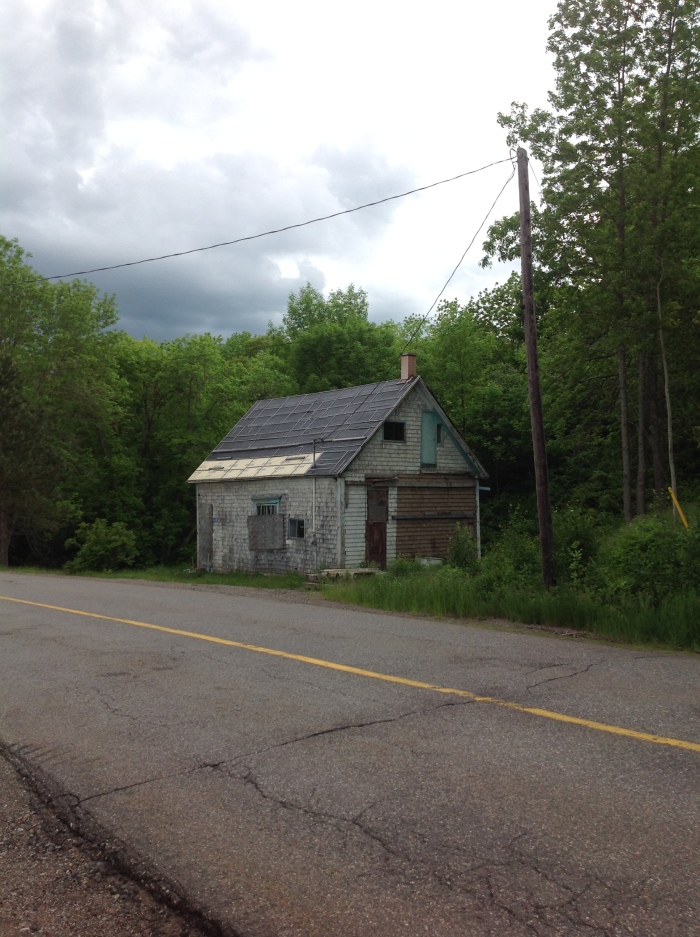
roadside building near Oak Point, Kings County, New Brunswick
~
There were two school-like buildings at Queenstown. The first was a small building used by the Hampstead Local Service District ( a governance unit in un-incorporated areas). This building had only two windows on each side and an added garage. (This building has been verified as Queenstown School, also called Hampstead #2 from photos at Archives)
~
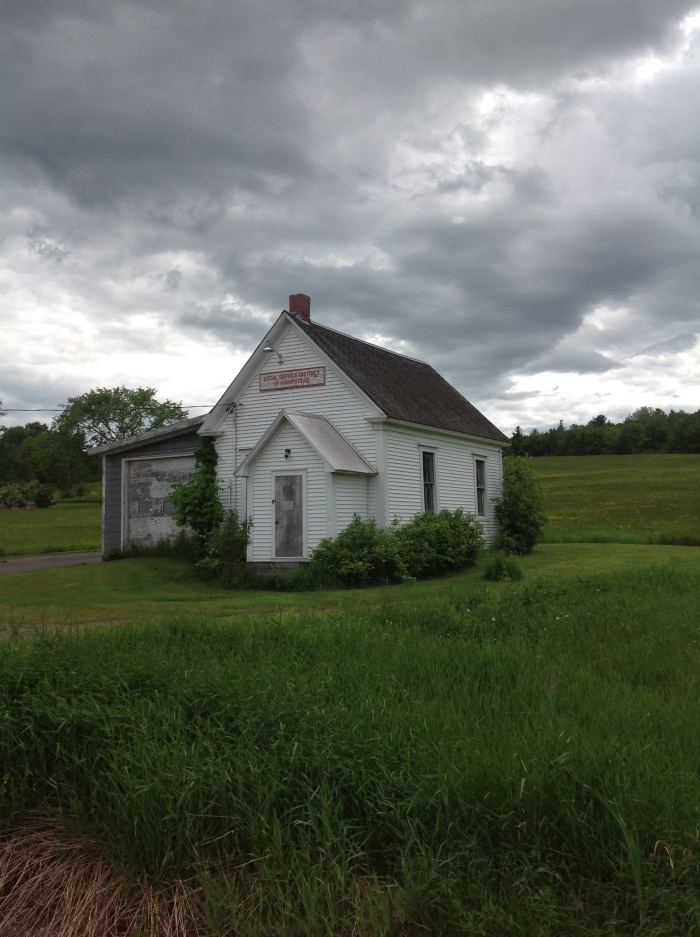
Hampstead Local Service District building, Queenstown, Queens County, New Brunswick
~
The second was just down the road, within sight of the Hampstead LSD building. It was larger than the LSD building, had an addition to the back, a stone basement and a tin roof, and was built on a slope beside a small stream. This building also had the larger middle window seen at the Women’s Institute building in Central Greenwich. I have verified this hall is the relocated Orange Hall from the community of Dunns’ Corner, lost when Base Gagetown was created.
~
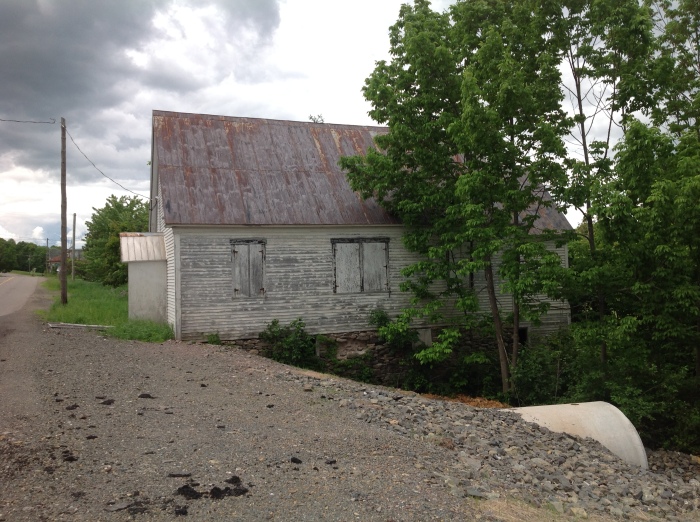
Meeting hall in Queenstown, Queens County, New Brunswick
~
I have three ways of discovering the history of these buildings. One is to talk to local people, to hear their stories. Another is to consult the Walling Map (1862) for the Kings County schools. The other is to have a look at a scrapbook of one room schools, kept at the New Brunswick Museum Archives in Saint John. The scrapbook was made by Marion Johnston Dunphy who photographed 150 schools from 1974 to 1984 (The One Room Schools of New Brunswick and What Became of Them). Her photos may help me identify which of the buildings above were once one room schools. (I looked at this photo collection on July 7, 2016 and verified several of these buildings, as indicated above.)
~
Regarding the Base Gagetown communities, the Base Gagetown Community History Association has an excellent website with photos of schools once located in the communities there http://www.bgcha.ca/communities.html .
~
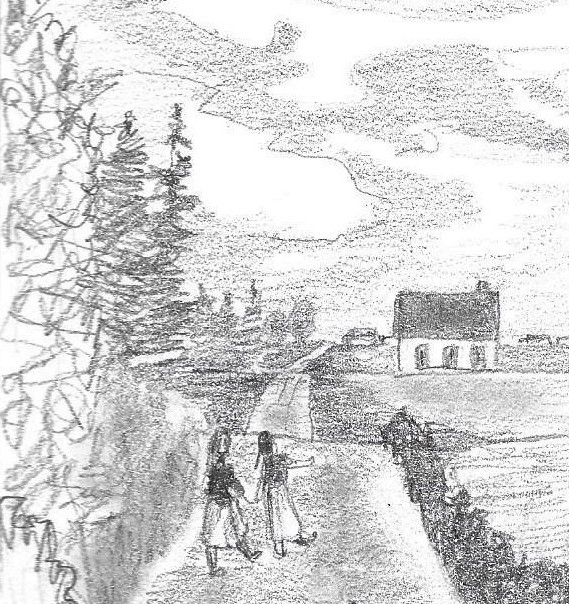
June 5 2016 detail of ‘way to school’ Jane Tims
~
Copyright Jane Tims 2016





within easy reach – what did you think?
with 2 comments
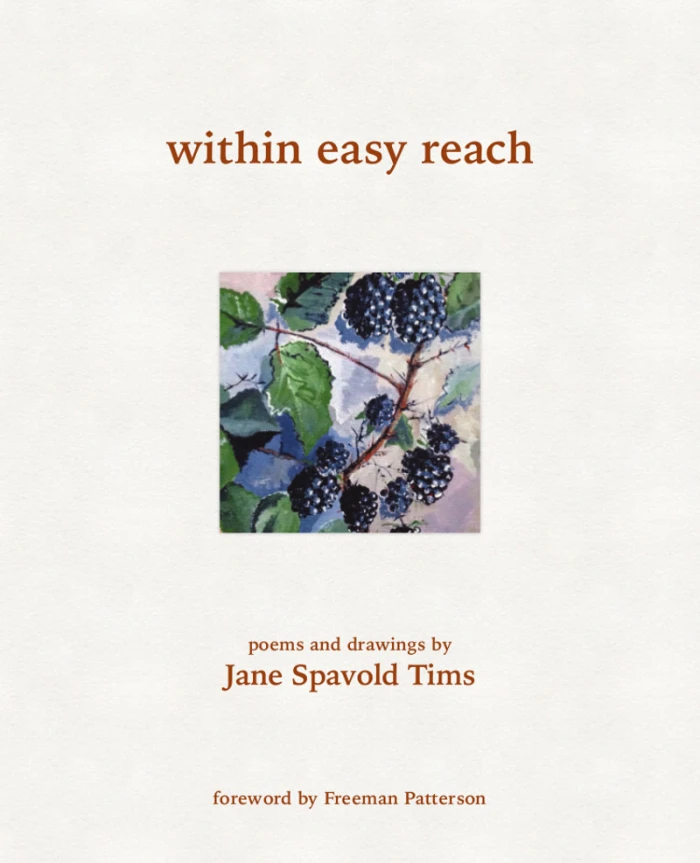
I have had my book ‘within easy reach’ in circulation since early May and I have had an enjoyable time getting it into the hands of readers, including some of you!
~
~
I have had some feedback but I continue to be curious about what you think of my book. I wonder if you’d take the time to give me some comments. Positive or negative … all will help me in my quest to be a better writer.
~
~
If you are willing to go even further than the comments section here, perhaps you’d do a short review of my book on Goodreads or Amazon, or leave a comment on my Twitter account @TimsJane
https://www.goodreads.com/book/show/30105132-within-easy-reach?ac=1&from_search=true
~
You can also take part in my poll:
~
~
Copyright Jane Tims 2016
Share this:
Written by jane tims
June 21, 2016 at 7:43 am
Posted in within easy reach
Tagged with comments, edible plants, feedback, local food, review, within easy reach