Archive for November 2024
creating a cover: identifying a motif
As I prepare to release my new Urban Mysteries Series, I still have some work to do. Because I both write and illustrate my books, I also do my own covers. Selecting a motif or theme for a cover takes some thought.
~
~
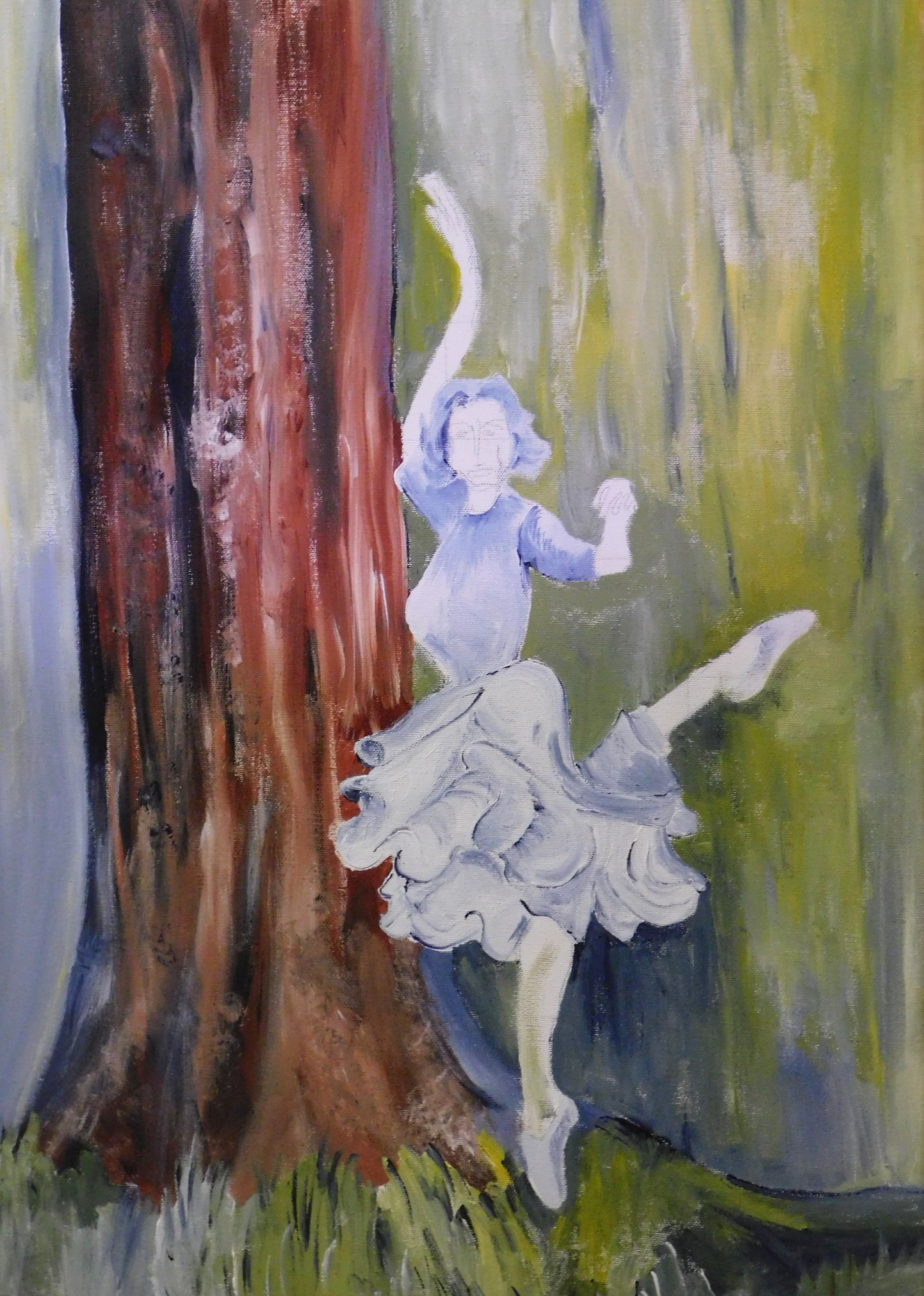
Most of my books focus on a central theme. The fifth book in the Urban Mystery Series (currently titled ‘Dancing with Trees‘) is set in Fredericton and tells the story of an artist who is making an drawn record of the trees in the community. As she draws, she encounters a mysterious woman who appears and dances with some of the trees. The woman is associated with an urban legend of a man and woman who hid a treasure in a local tree and vowed to only retrieve it together.
~
Creating a book cover is a little different from ordinary painting. A cover must:
- represent the themes and symbols in the book;
- entice a reader to know more about the story;
- present a strong focal point;
- leave room for the title, and sub-title and the author’s name;
- consider the style of other books in the series.
~
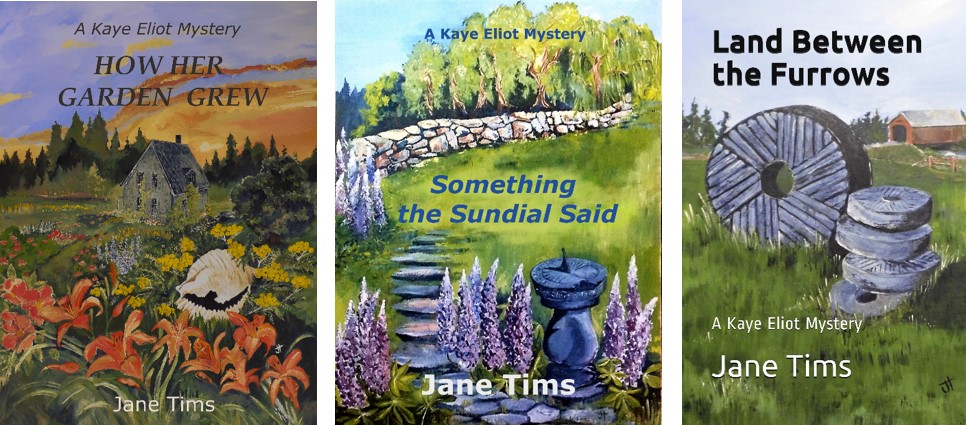
When I chose a theme for the cover of my book, I already have about twenty drawings to illustrate parts of the story. I choose one of the drawings and modify it to represent the story as a whole. The painting can be embellished by including various symbols from the story. In the case of my Kaye Eliot Mystery ‘How Her Garden Grew,’ I include a Grinning Tun, a sea shell that appears in the story, over and over.
~


~
In the Urban Mystery, ‘Dancing with Trees,’ trees and dancers are central motifs. So, for the cover, I chose to paint one of the drawings in the book.
~

~
I work with acrylics and seek to use only a set number of colours in the cover painting. This is partly to allow the font and colour of the lettering to show well on the cover. It also reduces the busy-ness of the image for the reader.
~
~
In a few days, I will be able to reveal the look of the final cover for ‘Dancing with Trees.’
~
All my best,
Jane (a.k.a. Alexandra)
upcoming: my new ‘urban mysteries’
With all my posts about genealogy, you may be wondering if I am doing any creative writing. Oh yes! I am busy on the final touches to a new series: Urban Mysteries.
~
The five mysteries are set in the Maritimes, in cities where I have lived or worked: Halifax, in Nova Scotia, and Fredericton and Saint John, in New Brunswick. They are adventure stories as much as mysteries, although the protagonist in each solves a problem encountered. The main character in each story is a young woman, independent and resourceful.
~
The five books are also Meniscus Peripherals, meaning they occur in the same universe as my Meniscus Science Fiction Series: each of the books mentions an alien abduction but the rest of the abduction story is found in one of the Meniscus Science Fiction books.
~
There will be five books in this first set of the Urban Mysteries Series:
Office Green … in Halifax, a young woman who cares for office plants, crosses the paths of some unsavoury characters;
Hollow Hotel … in Saint John, a climber takes on the outside of an abandoned hospital and must save her two friends after a terrible fall;
Roundabout … in Fredericton, an artist, who is recording life in a new city traffic circle, encounters … well, more unsavoury characters;
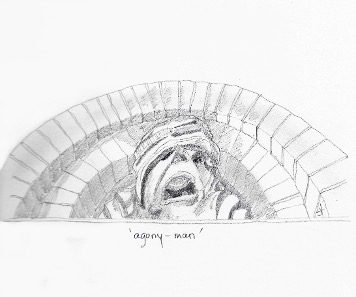
City Grotesque … in Saint John, an artist, working on a mural for tourists, takes part in a contest to find look-alike for sixteen stone carvings on one of the Uptown buildings;
Dancing with Trees … in Fredericton, an artist, drawing some of the city trees, stumbles on a mysterious dancer who is connected to a local urban legend.
~

~
Each of the five Urban Mysteries is less than 20,000 words, so they are properly called ‘novellas.’ All five will be released in December. I’ll keep you up to date!
~
~
All my best,
Jane (a.k.a. Alexandra)
virtual travel: Everton to Beckingham
The next stretch of my virtual cycling program (to visit the villages and towns of my ‘Spavold’ ancestors) took me from Everton in Nottinghamshire, to Clayworth, to Beckingham.
~

~
| Date | From | To | Distance | Time |
| November 4 | Everton | Clayworth | 5 km | 20 minutes |
| November 5 | Clayworth | Gringly on the Hill | 4 km | 18 minutes |
| November 6 | Gringly on the Hill | Beckingham | 6 km | 20 minutes |
~
~
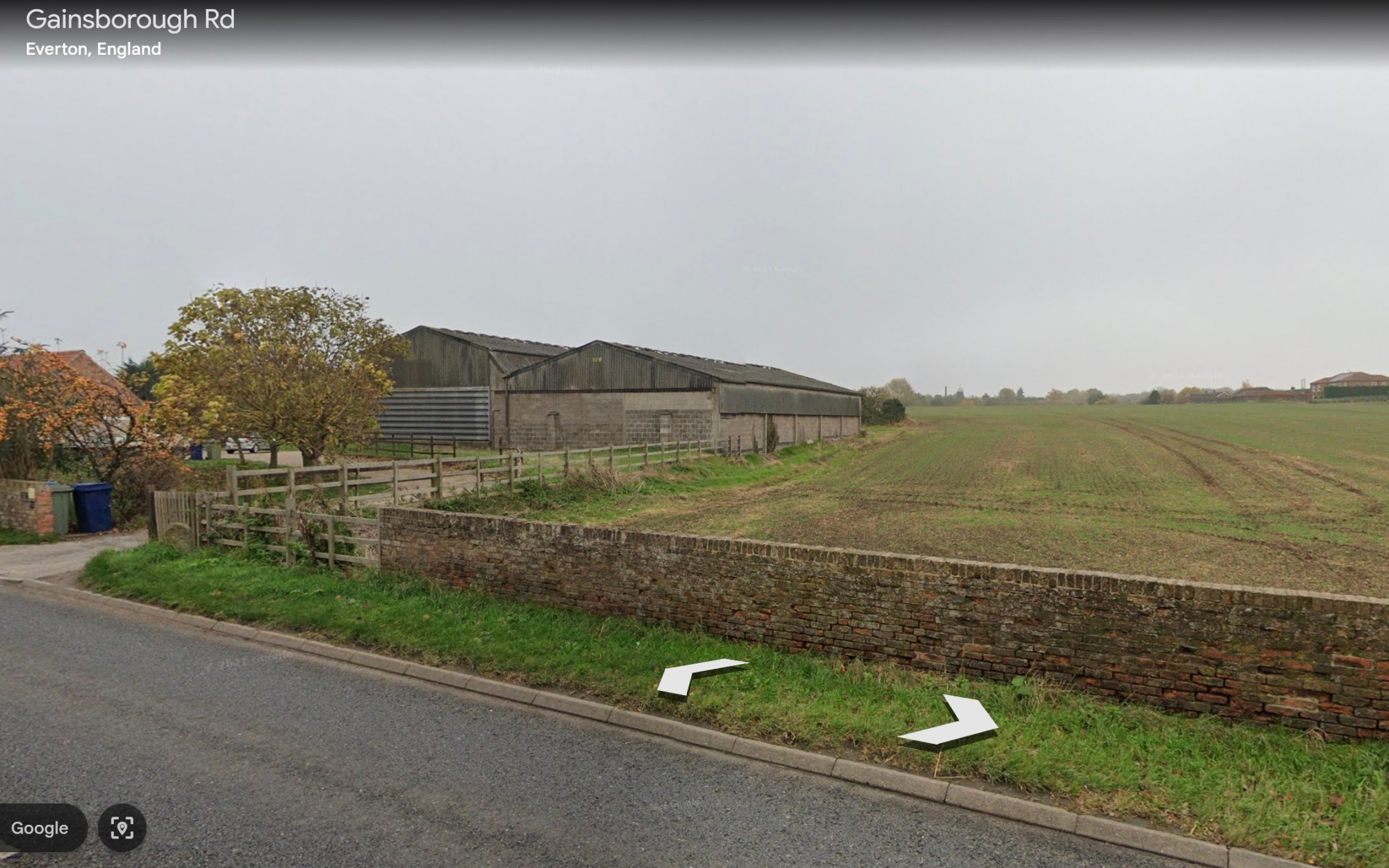
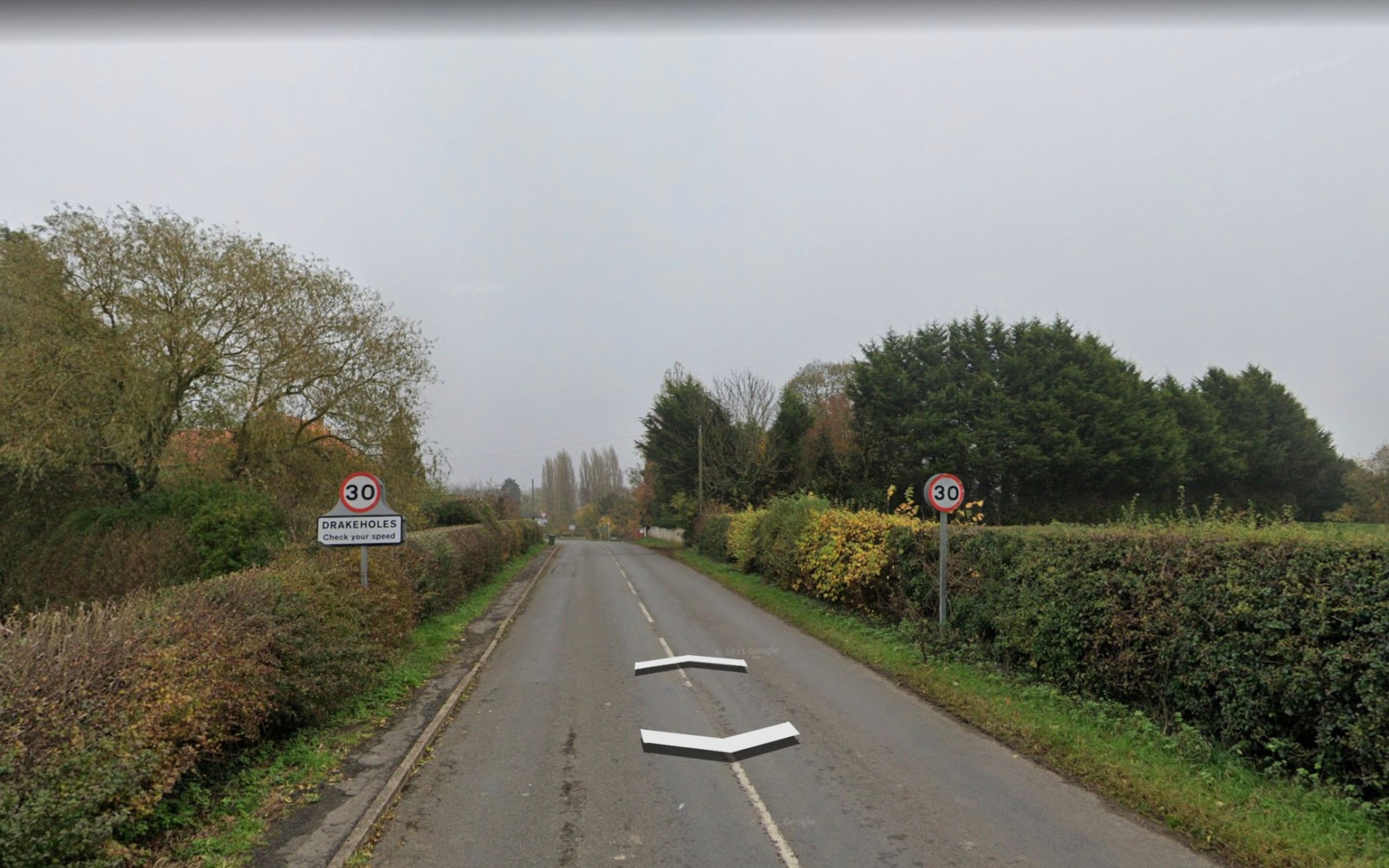
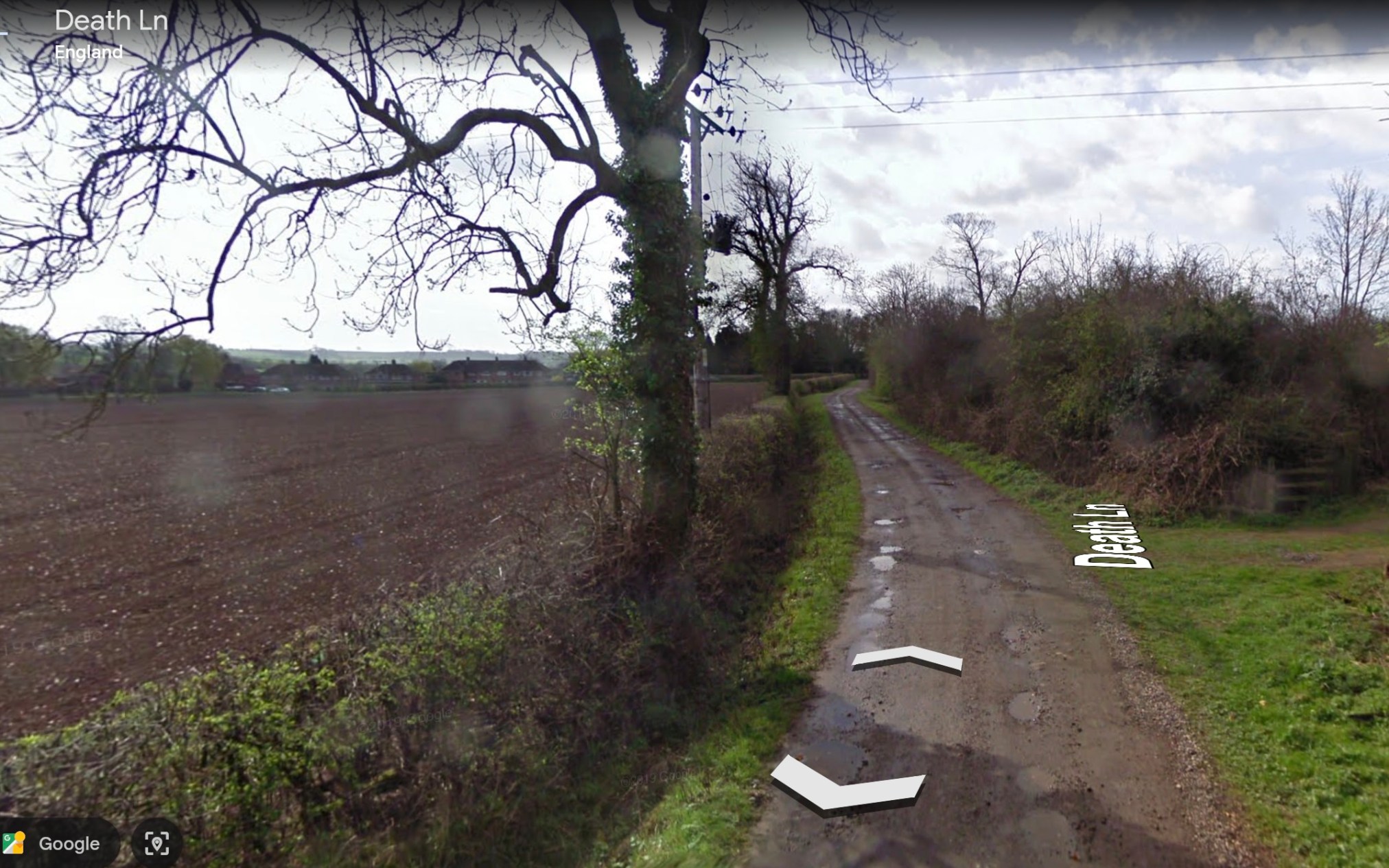
I began at Everton where the land is very flat. The area from there to Clayworth is dominated by fields and farms. The names alongtheu way are interesting… for example Drakeholes???? Death Lane???? The name Clayworth was once thought to represent the soils in the area but now it is thought to refer to a protective area of hills near the village.
~
~
~
The cycle along the road to Gringly on the Hill was flat and also agricultural. Huge fields had been planted along the road.
~

~
Also, there were wild pink roses in bloom along the way.
~

~
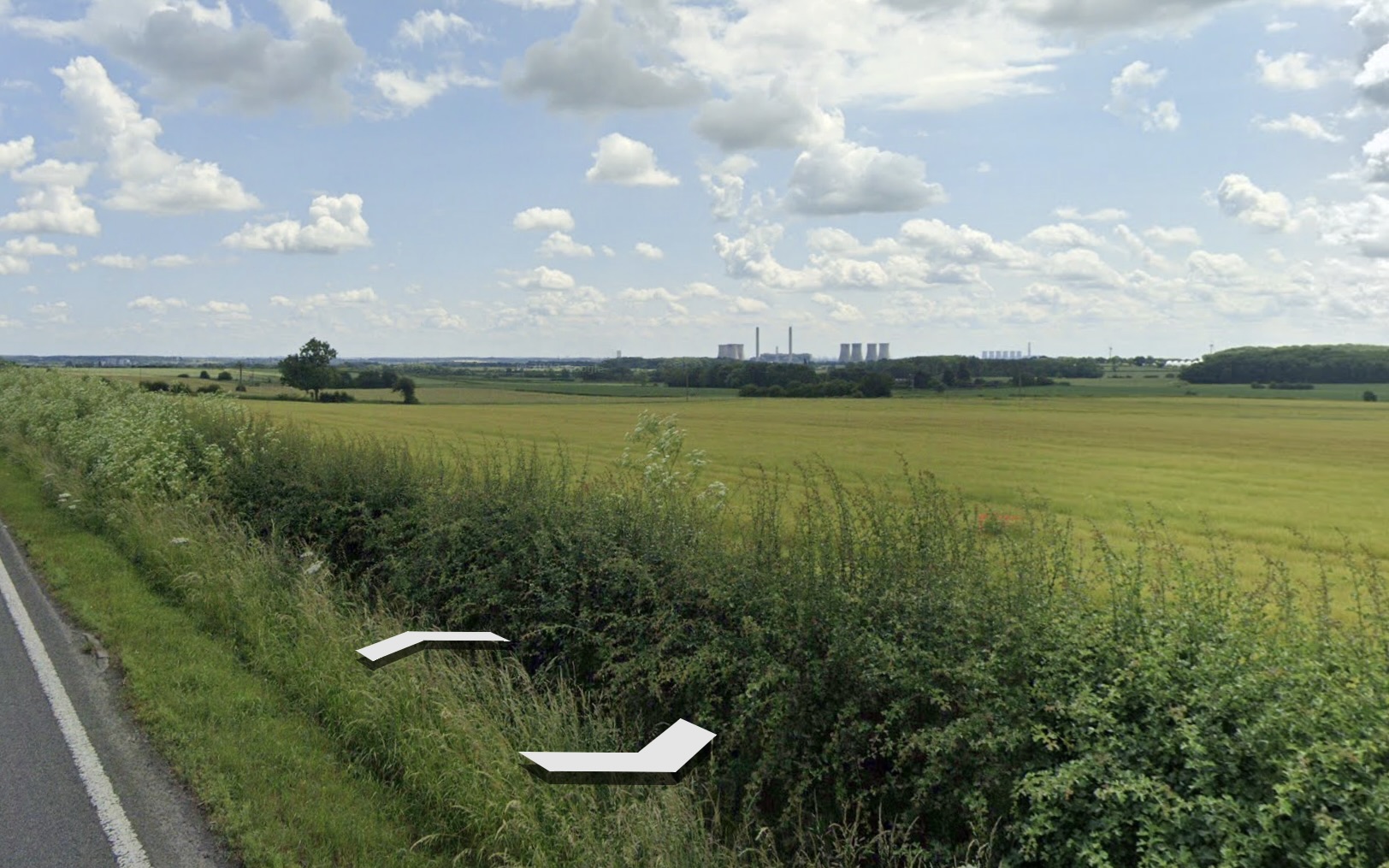
The Double highway from Gringly on the Hill to Beckingham was rather dull, except for a large industrial site on the horizon.
~
~
This turned out to be the power generating station at West Burton.
~

~
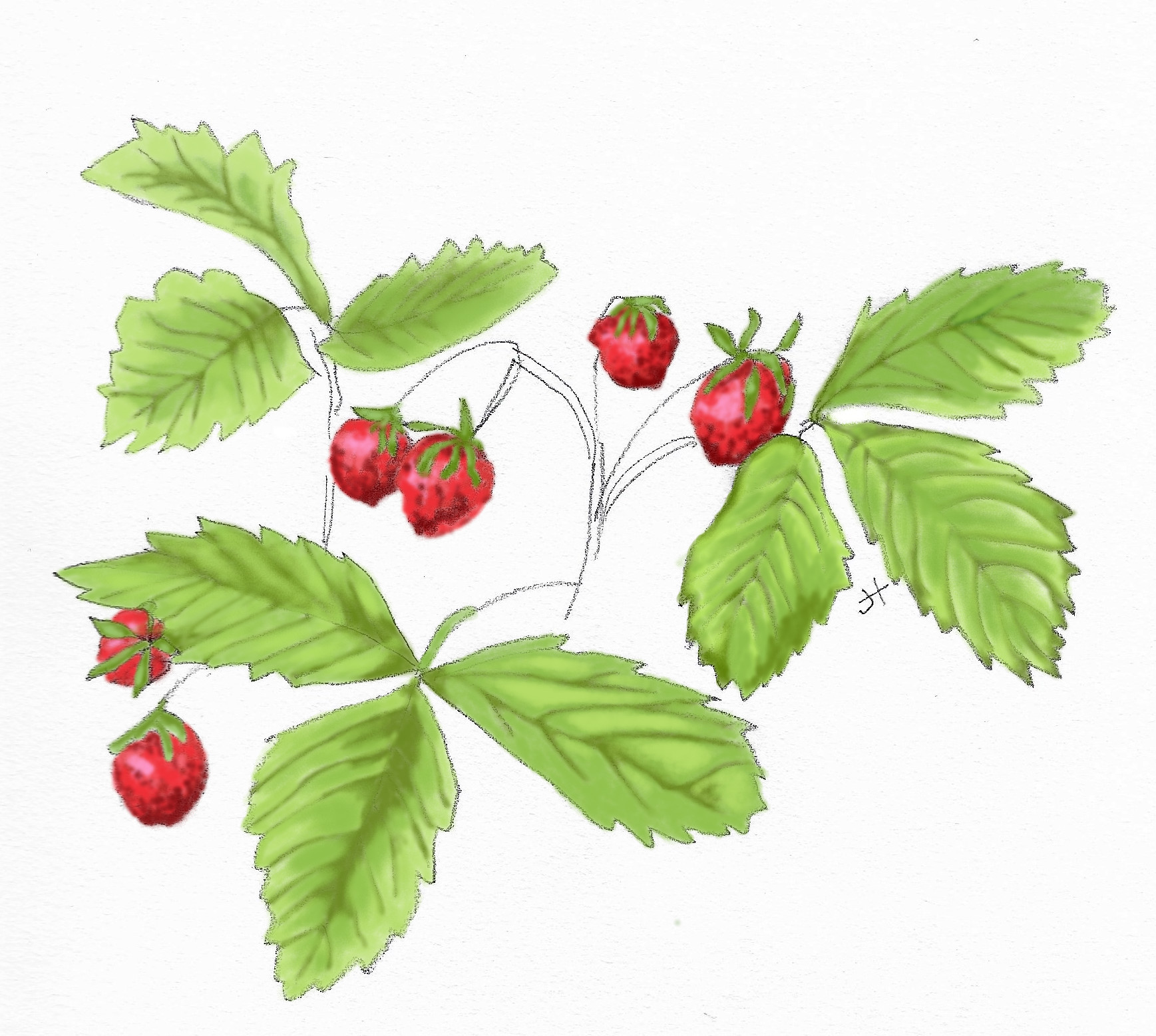
Also, in aerial view, I found a large area near North Wheatley that looked, at first, like a large solar farm. With a little reading, I now think it is more likely to be a view of extensive strawberry polytunnels … the area is known for its strawberry production and the logo for North Wheatley includes the image of a strawberry.
~

~
~
The next leg of my journey will take me to Gainsborough and Walkingerham, Lincolnshire, where three early families with the last name Spaveld/Spaven/Spavalde lived in the 1400s.
~
All my best,
Jane
Winter virtual travel: Starting off
This winter, I want to add some exercise to my days, using my stationary cylcle and Google Earth’s ‘Street View’ to travel to some of the places where my Spavold ancestors lived.
~
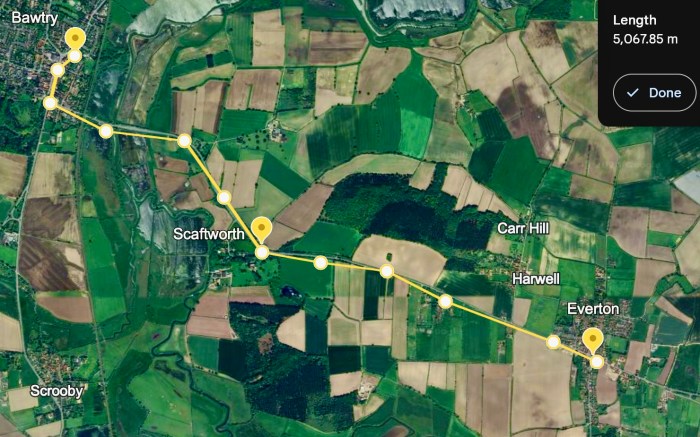
This week I began my virtual travels in Nottinghamshire, travelling from Bawtry to Scunthorpe and then to Everton.
~
~

~
| Date | From | To | distance | time |
| Oct. 28 | Bawtry | Scunthorpe | 2.5 km | 15 min |
| Oct. 29 | Scunthorpe | Everton | 2.5 kn | 20 min |
~
~

~
The highlight of the virtual trip was seeing the Holy Trinity Church in Everton. This is the church where many Spavolds were baptised, married, and buried. They once walked through those doors! They walked the street I followed! The church was built in 1066 and still stands almost 1000 years later!!!! The original settlement was Danish, called Eofortun.
~
The next stretch of my travels will be to Beckingham and then to Gainsborough in Lincolnshire where the earliest Spavold families lived in the 1400s.
~
All my Best,
Jane Tims (a.k.a. Jane Spavold)
Tricks to Improve Accuracy in Your Family Tree
In my recent searches for my Spavold ancestors in England, I have used some very useful tools, all at Ancestry.ca:
- first, the family trees of various genealogist enthusiasts like myself who work slowly to build their family trees; the family tree ‘petbar’ is a very complete ‘Spavold’ family tree and was a great help in building my own tree;
- second, the original documents accessible through the website, including, primarily, records of marriages, baptisms and burials.
~
The quality of information in some Family Trees is variable, depending on how carefully the tree-builders work. Due to the preponderance of similar names in these families, it is very easy to mix up ancestors: for example, men with the name ‘Thomas’ who were born in the same generation and on approximately the same date.
~
To counter this problem, I use the following methods:
- in my draft family tree (not available for public view), for each profile, I use the ‘prefix’ after the person’s full name to easily relocate individuals in the tree. For example, I can use this field to add question marks, possible names of spouses, and notations for examining certain questions, for example, ‘too young,’ ‘possible duplicate,’ and so on. The notations are often visible in the vertical display of the family tree, so you can locate people with respect to one another. These quick notations should be removed before the tree is made public since the field is meant for appellations such as Captain, Jr., Sr., and so on;
- for each profile, I examine the marriage dates and birth dates of children to make certain they are logical. So, a person born in 1625 cannot have children born in 1730 and 1732. And people are not likely to have been married before child-bearing age, although it does happen. Also, children cannot have been born after a mother’s death, or more than a few months after a father dies. Again, there are exceptions, for example, if another possible father is still alive. For each profile, birthdates of children make most sense when they are born one or two years apart. Variations do occur, but should be examined more closely;
- for each profile, I check information on where people lived at different parts of their lives. So, for example, for two confusing Thomases, both born in 1632, one may have been born in Gainsborough in Lincolnshire and lived there all his life, and the other may have lived all his days in Everton in Nottinghamshire. These Thomases likely ‘belong’ to families living in the respective communities or nearby. There are exceptions, of course, for individuals who were widely travelled. Also, the various small communities need to be located with respect to others in the vicinity; for example, communities of Bawtry (Yorkshire), Harworth (Yorkshire), Scaftworth (Nottinghamshire), and Everton (Nottinghamshire) are very close together and family members were mobile between nearby communities;
- consider the alternative spelling of names: ‘Spavold’ is an unfamiliar name and has been listed in the various records as ‘Spaffield,’ ‘Spavin,’ ‘Spavald,’ ‘Spaviald,’ and so on. The most interesting incorrect transcription I encountered was for Willm Epaxato, born in Gainsborough in 1523; I have read the original and I would have transcribed it with ‘Spavold’ (Source: Nottinghamshire, England, Church of England Baptisms, Marriages and Burials, 1538-1775. St Bartholomew Church, at Sutton-Cum-Lound near Retford). The spelling of the family name may provide a clue as to which family our Thomas belongs.
~

~
If you like puzzles, have a look at this marriage record from All Saints Church in Misterton in Nottinghamshire. I reveal the transcription for the third line from the top, written in darker black ink, in a post script at the end of the post:
~

~
Since surnames are specifically male in origin, there is a tendency to ignore women in a family line. However, they are ancestors, important and interesting in their own right. Their records provide additional information on siblings and parents, places lived, and naming traditions. They are also relatives and are represented in the growing DNA data.
~
In spite of my searching, I have yet to find my great-great-great grandfather William Spavold. However, in the various searches of baptism, marriage and burial records, I often find people who do not fit in the family tree or are listed for other areas in England. In my searches to date, I have yet to identify a DNA connection to any owner of the various family trees. This makes me think that my William Spavold will still be found, among the progeny of incomplete profiles or among some of the Spavolds who do not seem to fit in the record.
~
All my best,
Jane Tims (a. k. a. Jane Spavold)
~
Post Script: the names in the Misterton record are transcribed as ‘Robert Spavald’ (born about 1583) and ‘Alice Snell’ (born about 1580). This will give you an appreciation for difficulty historians face when transcribing old records.




 nichepoetryandprose