Posts Tagged ‘Virginia Bliss Bjerkelund’
Bookmarks and Dog Ears-A Mystery
A few posts ago, I introduced you to my new poetry project: ‘Bookmarks and Dog Ears.‘ One of the subjects I want to include (briefly) in my manuscript is the ‘gloss.’ According to Merriam-Webster, a ‘gloss’ is a brief explanation (as in the margin or between the lines of a text) of a difficult or obscure word or expression.
~
A gloss marks a book using pencil or pen marks in the margins and counts in the scope of my writing about ‘bookmarks.’ Some think writing in a book is not a good idea and defaces the book. However, I have found during this project that glosses reveal a lot about the history of a book.
~
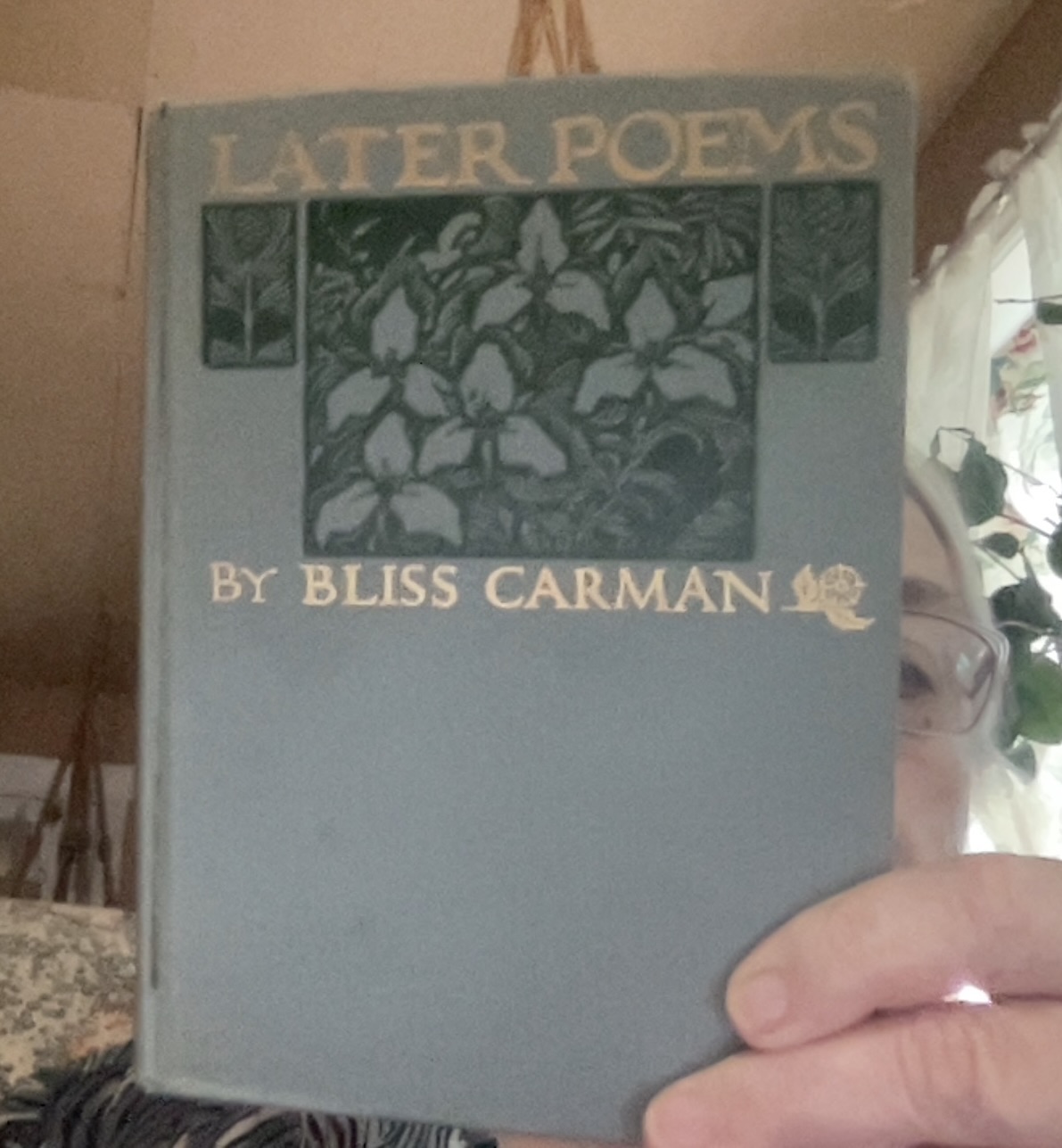
I will use one of my prized possessions to illustrate the power of glosses. This item is a book, a first edition, signed copy of Bliss Carman’s Later Poems, published in Toronto by McLelland & Stewart, 1921. Bliss Carman was a famous poet, born in Fredericton. The book Later Poems includes many poems I love, including ‘Vestigia’ which begins … ‘I searched for God and found him not…’ and goes on to say the poet finds God in many aspects of nature. I bought the book on-line for $80 some years ago. It is a ‘presentation copy’ and includes an inscription by Carman to friend, publisher and author, Irving Way.
~

~
Even better, my copy of Later Poems is glossed with pencil and points out some differences in this 1921 Edition from the 1922 American Edition (Small, Maynard and Company, Boston) and the 1926 Canadian Edition (McLelland & Stewart, Toronto). For example, my 1921 Edition is missing four lines from the end of the poem ‘Easter Eve.’ The lines are present in both 1922 and 1926 Editions. In another example, the glosses point out a duplication of two stanzas in the book: identical stanzas occur in ‘A Christmas Eve Choral’ and ‘The Sending of the Magi.’ The stanzas are entirely missing in the 1922 Edition and are included only in the poem ‘The Sending of the Magi’ in the 1926 Edition.
~

~
At first, I thought perhaps the book was a sort of ‘proof’ copy, and the glosses were Bliss Carman’s. But recently, I found a date in pencil in the same handwriting – 24 July 1932. The glosses were added by another person, not Bliss Carman who died in 1929, or Irving Way who died in 1931. The glosses were also added after the 1926 edition and so could not have been the impetus for changes in either of the other Editions.
~
So, who was the person who wrote in pencil in the book? An heir of Irving Way? An editor considering yet another Edition? Or simply a lover of poetry who did some research between Editions.
~
This is a first draft of part of my poem about the glosses in this book – this part of the poem explains why I love Bliss Carman’s work. One of the reasons – the writing group I meet each month (Wolf Tree Writers) has a member who is a distant cousin of Bliss Carman: Virginia Bliss Bjerkelund, author of Meadowlands- A Chronicle of the Scovil Family (Chapel Street Editions, 2020) and A Nurse for All Seasons (Chapel Street Editions, 2023); for a review of the book Meadowlands, click here.
~
My poem includes quotes from Bliss Carman’s Later Poems.
~
First Edition Glosses
~
1.
as she walked the forest edge
my mother quoted poets
William Cullen Bryant
‘Whither, ‘midst falling dew’
Bliss Carman
‘I took a day to search for God …’
~
at her funeral, knowing
she still ‘dwelt within my heart’
I read ‘Vestigia,’ by Carman
my poet of choice
~
I hear his voice
when purple lilacs ‘stir’
when I hear the wind
‘conversing with the leaves’
~
when I wander
in the meadow
chasing ‘stealthy shadows
of the summer clouds’
~
distant cousin brings his
charm and talent
to our writing group
when it meets each month
~
~
The poem goes on to talk about the other Editions, the glosses and how many hands have held the book before mine.
~
I am loving this Bookmark project. I am learning so many new things and I find the writing of ‘fact-filled’ poetry a bit of a challenge.
~
Enjoy your own reading and discoveries!
~
All my best,
Jane
Book Review: Meadowlands – A Chronicle of the Scovil Family’ by Virginia Bliss Bjerkelund
I have lived in New Brunswick for more than 40 years and love its rural nature and the landscapes dominated by its waterways. In our travels on the weekends, we have spent lots of time in the Oromocto to Cambridge Narrows corridor. For many years we had a cabin in the woods just over the hill from the Narrows. In the last ten years we have had a cabin south of Gagetown. As a result, we have used the Gagetown ferry many, many times. It’s an enjoyable crossing of the Saint John River, like a mini-cruise, with lots to see. I always love disembarking at Foshay Farms. From there, we continue towards Jemseg, watching for turtles in the ponds, osprey on their nests, Canada geese foraging in the fields. One year we watched a glossy ibis in a marshy area along the road, a rare sighting for New Brunswick.
Because of my familiarity with the area, I have looked forward to reading a copy of Virginia’s book Meadowlands, former name of the homestead where the Gagetown ferry lands, the Foshay Farms mentioned above. I also looked forward to the book because Virginia is a member of my writers’ group Wolf Tree Writers. Through the years, Virginia has talked about her Aunt Bessie’s home and workshopped many of the passages in the book.

Meadowlands – A Chronicle of the Scovil Family’ by Virginia Bliss Bjerkelund (Woodstock: Chapel Street Editions, 2020)
An interesting, readable, often humorous, portrayal of life in the early years of the 20th century.
Meadowlands is an enjoyable read, presenting the life of a family after the death of the mother of the five Scovil children. Major characters in the book are Aunt Bessie (Elizabeth Scovil), a professional nurse who knew Florence Nightingale, and Mary Scovil, the youngest daughter in the family and the author’s mother. The book follows the lives of the family, detailing their adventures and travels. The reader is assisted by a map of the area, a family tree and photos of the people in the book.
A remarkable characteristic of the book is its portrayal of women’s lives in the early 1900s. Elizabeth Scovil, a well-known writer in her field and a professional nurse, was an unusual woman, ahead of her time, independent, self-supporting and a source of strength and guidance for her family. Other women’s roles are also presented including the women who taught school, public and private. The division of labour into men’s work and women’s work is a thread running through the book. The lack of control of a woman over her own life, especially in matters of romance, provides some interesting story-lines.
My favorite aspect of Meadowlands is the attention it pays to the transportation of the times. Travels to Saint John and Windsor, and into other parts of Canada and the United States were a regular part of the Scovil year. In particular, the local travels to Gagetown (for school, medical care and various groceries) are interesting for their seasonal nature. In winter, a sled and skates were the preferred way of crossing the river. In summer, a row boat was the norm. The family’s adventures include early innovations in transportation: the first motor cars and the addition of an Evinrude motor to the Scovil boat are memorable.
Meadowlands is an enjoyable book, written in an engaging style with the author’s voice clear and consistent. The reader’s appetite will be inspired throughout by descriptions of the foods eaten and images of sipping cordials on the veranda or turning the crank to make fresh strawberry ice cream.
Meadowlands has had the honor of being short-listed in the New Brunswick Book Awards for the Writers’ Federation of New Brunswick Non-fiction Award!
You can find your copy of Meadowlands at your local bookstore, at the Chapel Street website here, or at Amazon here .
Enjoy your reading!
Jane




 nichepoetryandprose