Posts Tagged ‘Stephen King’
writing a novel – why couldn’t I invent a ‘character generator’?
~
So the poet has decided to write a novel…
~
Title: unknown
Working Title: unknown
Setting: an abandoned church (in part)
Characters: main character a writer (not a very successful writer) who spends a lot of time at some other creative endeavor
Plot: unknown
~
Characters are the stuff of novels. I am sure someone has written a novel without characters, but for me … no character, no action … no character, no growth …
The characters in my novel were not in my head before I started writing. Once I knew a little about my setting, I began to write and the characters began to suggest themselves.
A lot of writers have said this to me. Begin the story, and the characters and plot will start to unfold. Stephen King says (in Chapter 4 of his book On Writing – A Memoir of the Craft, Scribner, 2000): ‘Stories are relics, part of an undiscovered pre-existing world.’ So, with not much more than an idea for the setting, I began to write.
My main character emerged as I started to write about the setting (the old abandoned church). I like to write in the first person, so this character was immediately ‘I’. But, of course, this does not mean my protagonist is ‘me’.
Before I had written three pages, I knew my main character, the ‘I’ in my book, wanted desperately to be a successful writer. But she (still not ‘me’) was also noticing things in the setting that showed she was doing something else with most of her time. Whether she admits this to herself or not in the book, it will be revealed to the reader. Or perhaps a clue is contained within this post…
So, I have my main character. But what about the other characters? Why couldn’t there be a tool for writers called the ‘character generator’, a simple device a writer could use to build the basic characters. Get the characters and the story writes itself, correct???
My ‘character generator’ would look a little like one of those oragami-type fortune-tellers we used to make in school. A number was chosen, fingers flopped back and forth and some ‘secret’ was revealed.

My character generator would be similar, only it would tell the color of the character’s hair, perhaps if he or she was timid or brave, and what sort of work she or he would be good at… a very three-dimensional character… well, it’s a start…
So you think this idea is too ridiculous for words??? Did you know (I discovered this from reading Stephen King’s On Writing ), in the 1920s a writer named Edgar Wallace is credited with creating a Plot Wheel. When a story-teller came to an impasse, all the writer had to do was consult the Plot Wheel to see what should happen next. Once the wheel was spun, the writer could read the result… perhaps one result would be ‘heroine tied to railroad track’ or ‘heroine rescued’… Since then, I suppose many computer-based plot generators are available. I think I will discard my idea of a simple ‘character generator’.

So, now I have a main character who is a writer, but who spends most of her time in some other creative endeavor than writing. Perhaps this is where her real talent lies, or perhaps it is a ‘diversionary activity’. Perhaps she is just using this to avoid facing her fear of never becoming a successful writer.
You see, ‘I’ is not ‘me’.
Copyright Jane Tims 2012

writing a novel – getting started
~
So the poet has decided to write a novel…
~
Title: unknown
Working Title: unknown
Setting: an abandoned church (in part)
Characters: main character a writer (not a very successful writer)
Plot: unknown
~
Before beginning my novel, one of the steps I have taken is to read several books on how to write a novel. This is not because I believe a novel can be written if you just follow some rules. I do want to think about how the novel is constructed and to hear what successful novelists say about their craft.

I have been reading various perspectives on writing the novel and I will talk here about three of these:
1. Stephen King, On Writing – A Memoir of the Craft (Scribner, 2000).
Though I don’t usually seek after the horror genre in books, Stephen King has my admiration for his ability to take you ‘deep into story’. I can’t think of another passage as well done as his description of the running topiary figures in The Shining (Doubleday, 1977), or his chilling account of a father trying to save his son from running into the road in Pet Sematary (Doubleday, 1983). His book On Writing is, itself, highly readable, and contains excellent advice for a writer. I’ll try to pay attention to his cautions about adverbs (she said resolutely) and about using the passive voice (the parishioners abandoned the church, not the church was abandoned by the parishioners). He also says I have to ‘stand in the corner’ if I use the phrase ‘at this point in time’.
~
2. Phyllis Whitney, ‘Guide To Fiction Writing’ (The Writer, Inc. Publishers, Boston, 1982).
Phyllis Whitney’s Thunder Heights (Appleton-Century-Crofts, Inc., 1960) was among the first adult mystery novels I ever read and in my early twenties, I devoured her books. I read her every chance I got, often while everyone thought I was studying. The interesting thing about her Guide to Fiction Writing is how different writing is today. The Guide suggests extensive planning of the novel, working out outline, plot, and characters in labelled sections of a binder. I had to do this for my first book, since it nearly drove me wild trying to remember when such-and-such occurred and whether my character was wearing a pony-tail or not in the chapter before. However, at this point in time [get in the corner, Jane], everything can now be put in a single computer file! And blessings on Word and the ‘Find’ search feature. The advice I have taken from Phyllis Whitney? – do a detailed word sketch about each of your characters. I have done this with my present cast of characters and I believe knowing how the characters will behave in various circumstances helps the story write itself.
~
3. John Braine, ‘Writing a Novel’ (McGraw-Hill, Inc., 1974).
Although I have yet to read a novel by John Braine, I love his no-nonsense approach to giving advice. He says not to write a novel if you are ‘married or permanently entangled’, and suggests a first novel ‘shouldn’t be written much before the age of thirty’. Also, he absolutely advises against making the main character a writer. Bad luck for me, I have decided my main character will be a writer, although not a particularly successful writer. Braine does have advice I plan to take. In particular, he presents the following sentence: ‘he got up, went downstairs, and hailed a taxi’ … he says, ‘test every sentence against it; if any has that same flat, dead quality, rewrite or cut it.’
~
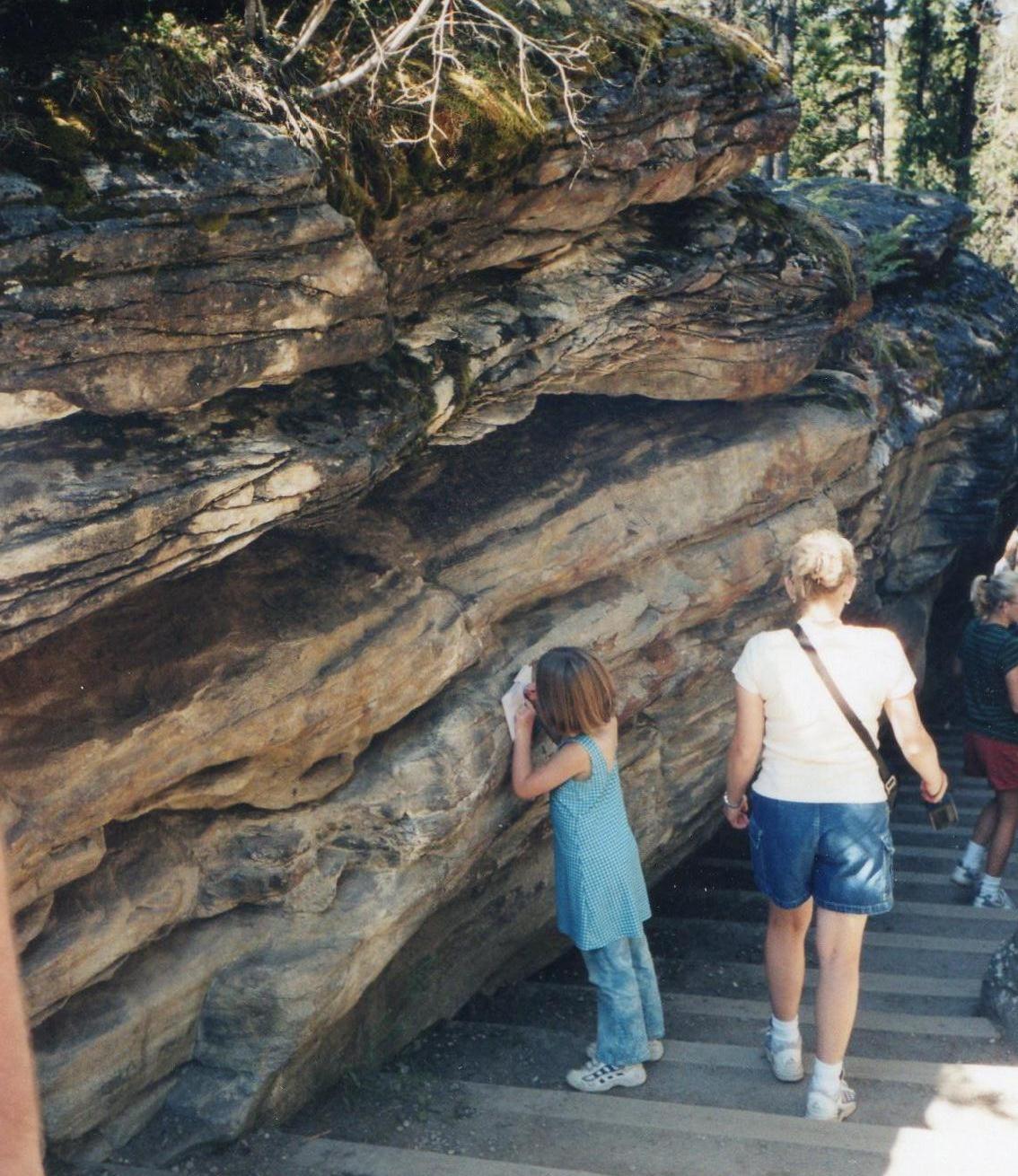
a born writer – a young girl, writing about her experience at the Falls, on any surface she could find – I snapped this photo at Athabasca Falls in Alberta in 2003
And so I am writing my novel with the best advice… and now you know my main character is a writer… but what else will I have her be?
~
Copyright Jane Tims 2012




 nichepoetryandprose