Posts Tagged ‘bookends’
writing a novel – being the reader
At some point during the writing of a novel, the writer must become reader.
~
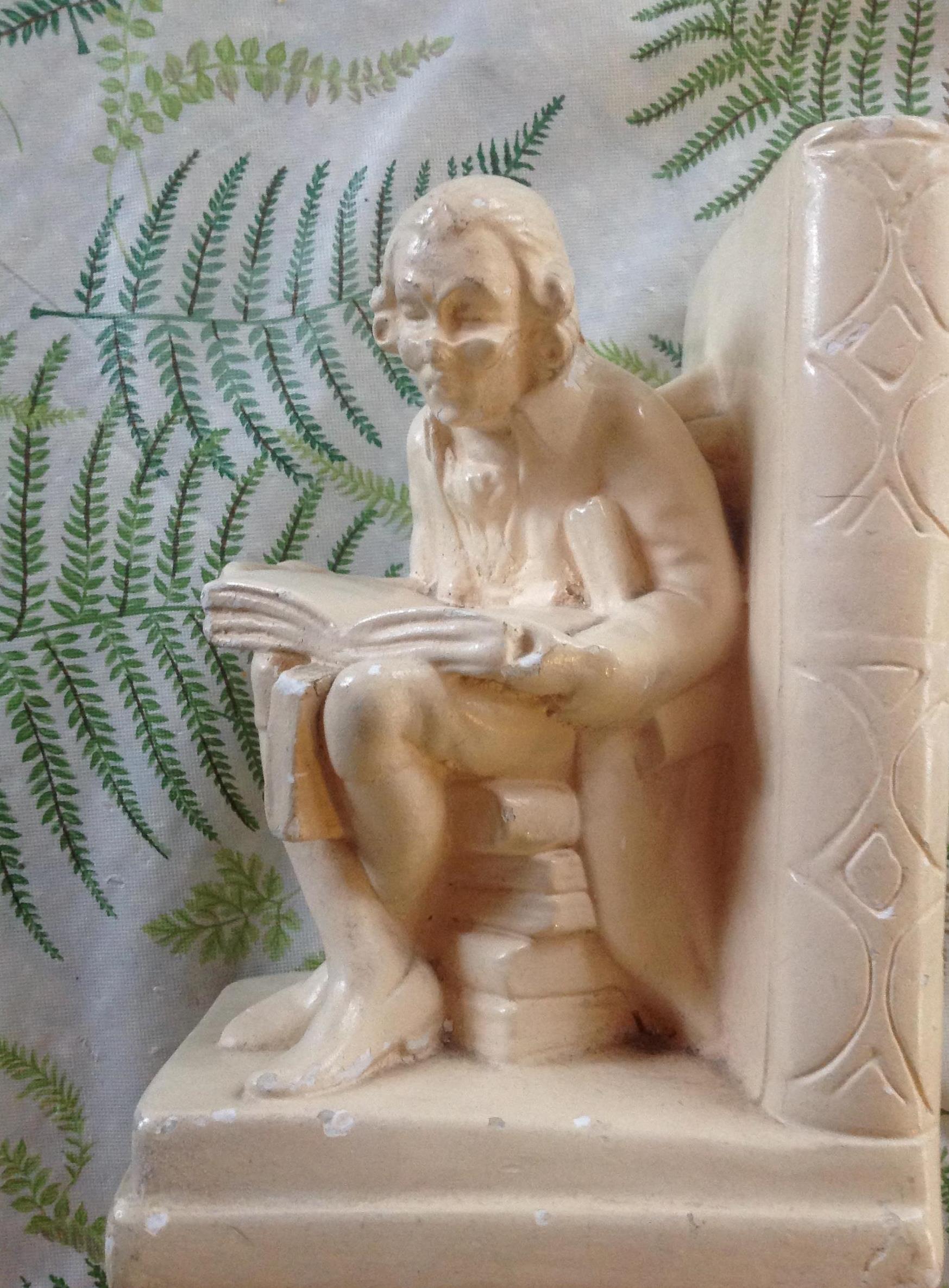
a ‘reader’ in my library – one of a very old set of bookends I call the ‘Two Muses’
~
The writer reads their work, over and over and over. Eventually, the sentences and paragraphs, the story itself, become so familiar, the writer can’t ‘see’ them properly any more.
~
The writer has two disadvantages.
First is familiarity. The writer knows every detail of the story, even details not written down. The writer’s mind fills in the gaps and the poor reader is, perhaps, left wondering. But the reader has experience as well. The writer has to know how much detail to include and how much to leave to the imagination. Sometimes the details the reader fills in make the better story. Have you ever read a book, having a perfect idea of what the protagonist looks like, only to be told, mid-way through the story, he has a twitch in one eye?
Second is love. Writers tend to become enamoured of their characters, their stories and their own writing. A description or sub-plot or character may take root and grow within the novel, even though it has little to do with the larger story. Once written, it is difficult to rip those paragraphs from the whole. Keeping track of word number will help, since it is an objective measure of progress towards a goal. In my novel ‘Crossing at a Walk’ I often write bits that I later remove. Too allay the fear that they will be lost forever, I have a file for a bone-yard – I can always return to this pile in future. I rarely do. ‘Murder your darlings‘ (Arthur Quiller-Couch, 1914).
~

This young lady never reads … she just sits among the potted plants and dreams.
~
The writer must also consider the questions the reader is asking as he or she reads the book. If the book hints at a problem or something that needs resolution, the reader will watch for an answer. For example, if a character mentions she has heard a cousin is coming to visit, the reader will wait for the cousin to arrive. If the cousin never shows up, the result may be a disgruntled reader.
~
I read my book, cover to cover, at every draft. I also think it’s important to read it aloud at some point, once the story is complete. Reading aloud to another person will give the writer some feedback. The act of hearing the word spoken will also suggest problems with rhythm, word choice or continuity. I read aloud to my husband and to the members of the two writing groups where I am a member.
~
In the end, the writer cannot be an objective reader. Every writer must find a test reader, someone who will provide honest feedback on characters, plot and story, as well as editorial advice.
~

I use my Kobo to read drafts of my book …
~
Copyright 2015 Jane Tims




 nichepoetryandprose