Posts Tagged ‘book review’
on my book shelf – Triggerfish, a crime novel
‘… he had fifty feet under the hull. The carcass of a rowboat against the shore, cedar, pine and rock rimming the cove, no cottages out here … Switching to the trolling motor, Beck eased around the bend in the cove …’ (Triggerfish).
Around that bend in the cove, Beck meets his share of trouble. I usually think of crime novels as an easy read. Triggerfish challenges that notion. The characters are many and, to me, a bit hard to follow – there doesn’t seem to be a good guy among them. The action is non-stop giving the reader few chances to relax! And what, oh what is going to happen to Eddie???
~

~
Dietrich Kalteis, Triggerfish – a crime novel. ECW Press, Toronto: 2016. Published June 1, 2016.
~
This review is done as a result of my role as Shelf Monkey for ECW Press http://ecwpress.com/pages/shelf-monkey.
~
Not usually in the genre I read, Triggerfish was nevertheless entertaining. The main character, Rene Beckman, ‘Beck’, is an ex-cop, hard-hitting and resourceful. He is trying to stay out of trouble but accidentally views a murder and some ruthless drug runners in action. And the bad guys won’t look the other way.
The action takes place in the Vancouver area and so scenes feel, to me, Canadian, familiar. Description is gritty, but evocative: ‘Crunching on dead leaves, wet ferns slapping against him, he ducked under pine boughs … a dry creek bed. A crest beyond it. Moss, ferns and rock … ‘. Some of the action occurs on Beck’s boat, the thirty-two foot Triggerfish.
The book is the classic example of shortening sentences to move the action along. This, and the frequent inclusion of gerunds to provide an odd combination of past and present tense, mean the book is sometimes hard to read. I’m not certain I ever got used to phrases like: ‘ … Ramon and Eddie walked in from the dining room side, both stopping at the fireplace, Eddie looking like he wanted to turn and run, Ramon nudging him forward…’ Or ‘… He told her, and she said, ”Nice meeting you, Marty Schmidt.” The second shot spoiling his looks.’
The characters are diverse and multi-dimensional: Vicki, environmentalist and play girl; Ashika, skilled and patient terrorist with a sense of humour; and Hattie, mature girl next door. I liked one of the bad guys the best – poor Eddie, trying to outsmart the cruel bosses by stealing their dope, cooperating with Beck.
Ironic humour abounds – from the description of the vegan protest, with protesters wearing body paint diagramming cuts of meat, to Beck’s attempt to rescue a drowning Ashika. Ashika, hearing a rooster crow for the first time, almost blows it off the fence.
It took me a long time to finish this book, partly because of the sentence structure, but mostly because of my lack of familiarity with the genre. In the end the plot was satisfying and no loose ends were left dangling. I just may read it again.
~
~
Copyright 2015 Jane Tims
Born to Walk – a book review
‘… Marooned at my desk, I swiveled round and round, drowning in digital static …‘ (page XIII).
So many of us can relate in a personal way to Dan Rubenstein’s description of his work life in the field of journalism. When he talks about managing his stress by checking emails every few minutes, I can say, I’ve been there! Dan’s book, Born to Walk, shows us a way to change our lives in a very simple way … just walk!
~
~
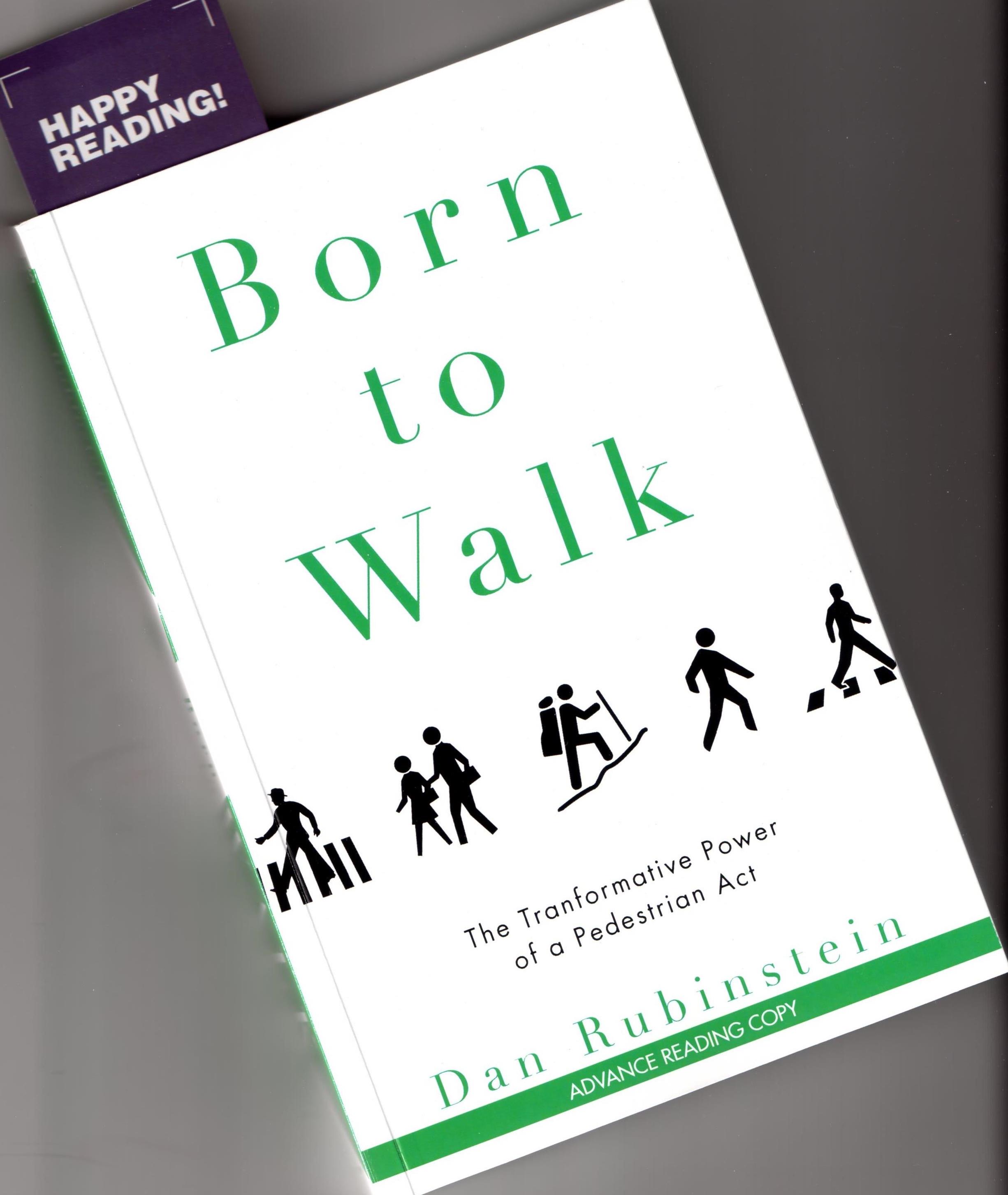
Born to Walk – The Transformative Power of a Pedestrian Act (Dan Rubinstein, 2015, ecw press, Toronto) is a book of non-fiction with a strong narrative component. It could be described as a self-help book of the environmental kind. Born to Walk describes the health benefits of walking, fitting this into the context of what it is to be human in the natural world. This book would be interesting for those who walk already and those who are thinking about taking up or accelerating a walking program. As I was reading, I often wanted to quit reading and start (you guessed it) walking.
~
In a discussion of the benefits and pleasures of walking, Dan considers walking a key life strategy. He tells the tales of people who feel compelled to walk or who walk for a living. Dan’s credentials for writing this book become more obvious as we read – the writer has learned through doing. Over the course of the book, we learn about his interviews with some of the most outstanding walkers in the world – interviews conducted while on foot and on the trail! The walkers he tells us about include a postal ‘delivery agent’ in Ottawa, a police officer walking the beat in Philadelphia, a photographer in New York City, and a medical doctor walking between Native communities in eastern Canada.
~
The book considers, chapter by chapter, specific topics about walking: the effects of walking on the body and mind; how society can benefit from pedestrian ways; the economic and political connections of walking; and the influences of walking on creativity, spirituality and family life.
~
My interest in the book sparked when I read the sub-title – ‘The Transformative Power of a Pedestrian Act’. My struggle with arthritis and the inactivity that accompanies mobility problems, has convinced me that activity and walking should have been a focus of my life, especially in my thirties and forties when I started sitting more than walking. The book points out that isolation and sitting are the new smoking.
~
In opposition to the ‘sitting disease’, Born to Walk explores the benefits walking can deliver. Dan describes the positive effects of being in nature. Sneakers, he says, are as important as medications in dealing with our many health issues. With careful consideration of the sage advice of the walkers of our time, backed up by health statistics and epidemiological studies, Dan explains how walking can improve our sense of ‘personal mastery’ and ‘self-regard’. I was intrigued by his descriptions of the experiences of those who are serious walkers – for example, the ‘green blur’ overtaking those who have been on a difficult trail for days.
~
As a planner, I was most interested in Dan’s insightful ideas about planning for a ‘walkable city’. He describes new approaches to creating urban areas where cars and people can coexist in safety. Some of the ideas he explores include development of road-skinny cities, the benefits of ‘walking meetings’, and the possibility of finding tranquil urban spaces to make up for our lack of being in more natural locations.
~
Reading this book was a pleasure. The narrative lines are engaging, the stories are often funny and Dan’s style is sensitive and not at all condescending. He writes with the conviction and knowledge of one who practices what he advocates. My favourite chapter of the book was definitely ‘Creativity’. As a writer, I have often noticed that the rhythms of walking inspire both the metre and cadence of poetry. Born to Walk describes ‘participatory art walks’ in Brooklyn and the ephemeral art of an ‘X’ walked into a field of daisies. ‘People get ideas when they are out walking’ (page 190).
~
My only problem with the book is related to the way I personally prefer to read. I found the chapters long (eight chapters plus prologue and epilogue for a book of 251 pages with about 300 words per page). I tend to read in chunks and consider it a smooth read if I can take in a full chapter at a sitting.
~
As a person with mobility problems, I applied much of what Dan said to my preferred mode of exercise (the stationary bike). While the stationary bike gives me some of the physical benefits of walking out-of-doors, I realise I am missing out on other benefits. For this reason, I am motivated to walk to the extent of my ability. One truth I read in the book is the idea of embracing and putting up with some pain as long as I am not doing damage to my joints.
~
Born to Walk – The Transformative Power of a Pedestrian Act is a thought-provoking, walk-inspiring book. I am eager to read other books by Dan Rubenstein!
Dan has an interesting blog describing some of his adventures leading to the writing of Born to Walk ( http://borntowalk.org/ ).
~
~
Copyright 2015 Jane Tims




 nichepoetryandprose